
Maleficent (2014)
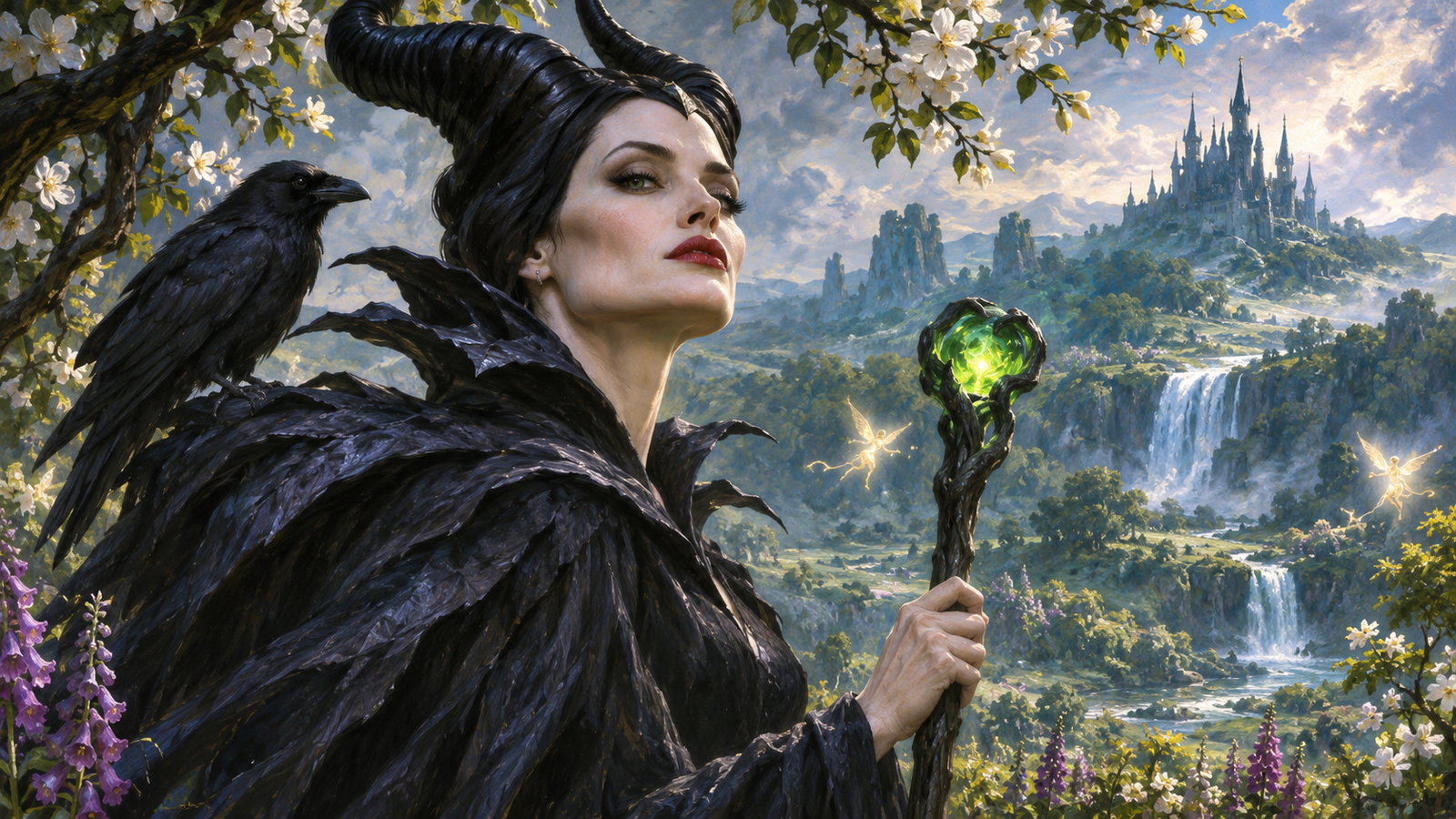
A fairy guardian becomes the terror of a neighbouring kingdom when a broken friendship turns into a curse that neither revenge nor royal authority can easily undo.
Maleficent (2014), directed by Robert Stromberg from Linda Woolverton’s screenplay, retells Disney’s Sleeping Beauty through the eyes of its most memorable antagonist. Angelina Jolie gives the film its commanding presence, while the conflict between a human kingdom and an enchanted wilderness offers a useful model for fantasy stories about betrayal, borders and the consequences of magic.
At a Glance
| Film | Maleficent (2014) |
|---|---|
| Director | Robert Stromberg |
| Screenplay | Linda Woolverton |
| Cast | Angelina Jolie, Elle Fanning, Sharlto Copley, Sam Riley, Imelda Staunton, Juno Temple, Lesley Manville |
| Music | James Newton Howard |
| Runtime | 97 minutes (theatrical) |
| Genre | Fairy-tale fantasy, dark fantasy, adventure |
| Source | Disney’s Sleeping Beauty (1959) and the traditional fairy tale |

Why This Film Matters
The traditional fairy tale asks how a princess can escape an apparently inevitable fate. This version asks why someone would impose that fate in the first place. Its most interesting change is to make the enchantress a participant in a history of political hostility rather than an unexplained source of evil. The human court and the Moors have different ideas of security, ownership and power, and neither realm can resolve their conflict simply by ignoring the other.
The Story — Without Major Spoilers
Maleficent grows up among the strange inhabitants of the Moors and befriends a human boy named Stefan. As ambition and conflict divide their worlds, that friendship becomes a devastating betrayal. Years later, she appears at the celebration of his daughter Aurora’s birth and lays a curse on the child. Watching Aurora grow forces her to confront the difference between punishing an enemy and harming someone who has done nothing to deserve it. The curse becomes a problem for its creator as well as its victim.
Characters and Performances
Jolie combines an imposing silhouette, carefully controlled gestures and moments of vulnerability. Her performance makes Maleficent simultaneously a protector, a dangerous adversary and a person capable of changing. Elle Fanning’s Aurora brings an openness that contrasts with the suspicion of both realms, though the screenplay gives her fewer opportunities to shape the conflict independently. Sharlto Copley’s Stefan increasingly embodies the corrosive effects of ambition and fear. Sam Riley’s Diaval provides a companion who can challenge Maleficent’s choices rather than merely obey them.
The Moors and the Human Kingdom
The enchanted wilderness contains luminous pools, walking tree-like beings, diminutive fairies and large guardians. It is most convincing when these creatures seem to possess their own habits and purposes rather than existing solely to surround the heroine. The neighbouring kingdom’s fortifications and metal weapons contrast with the organic forms of the Moors. This visual opposition makes an otherwise simple border conflict immediately intelligible.
For fantasy campaigns, the strongest idea is that an enchanted land has inhabitants and interests of its own. A ruler may call a forest unclaimed territory while its guardians regard the same ground as home. Agreements about crossings, resources and old injuries can be as consequential as battles.
Behind the Camera
Stromberg’s background in production design and visual effects is evident in the film’s carefully differentiated environments. Anna B. Sheppard’s costume design contributes strongly to Maleficent’s changing appearance, while James Newton Howard’s score supports both the wonder of the Moors and the darker scenes at court. The costumes, prosthetics and physical performance are often more persuasive than the largest computer-generated confrontations.
The Fairy Tale and Its Adaptation
Rather than reproduce the plot and moral structure of the 1959 animated film, the screenplay reinterprets its central curse and the meaning of true love. It places trust, care and responsibility above inherited assumptions about romantic rescue. This is an effective reversal, but its success comes at a cost: a figure once compelling because of her mysterious menace becomes easier to explain and therefore less unpredictable.
Themes and Critical Assessment
The film is strongest when it explores the consequences of an injury without treating that injury as permission to injure others. Its central relationship is not a conventional struggle between good and evil; it is about the possibility of repairing harm after a terrible decision. Jolie’s performance, the enchanted landscape and the shift in Aurora’s role make it memorable. The hurried treatment of the political conflict, broad characterisation of some supporting figures and uneven movement between family comedy and darker drama are its principal weaknesses. As a fairy-tale revision it is more engaging than as a large-scale war fantasy.
Official Trailer
Watch the official Disney UK trailer for Maleficent.
Explore Related Films and Fantasy Lore
Continue with Maleficent: Mistress of Evil (2019), or compare the treatment of a threatened kingdom in Snow White and the Huntsman (2012). For independent campaign material, explore the Fey World, Faerie Courts, fey bestiary and Bestow Curse. These references offer original setting material and game rules, not official adaptations of Disney characters.
Ideas for the Table
- The stolen treaty: a monarch claims that a woodland court broke a generations-old agreement. Both parties possess different versions of the treaty, and the witnesses remember why the disputed clause was added.
- The heir’s impossible birthday: a curse approaches its appointed day. The spellcaster regrets the original bargain but cannot undo it alone. Let the players discover several possible remedies with different costs, rather than demanding one predetermined solution.
- The living border: a hedge grows across roads, separating farms from a market town. Its guardian will negotiate if the adventurers can establish which acts of the human court caused the border to close.
Sources and Credits
- Disney — official film page.
- AFI Catalog — credits and production information.
- BFI — film record.
- Screen International — contemporary criticism.
Film images and characters belong to their respective rights holders. This article is independent criticism with original campaign ideas.
Keep this reference growing
If this page helped with your reading or game, you can support its upkeep or explore the curated books.
Explore the Bookshop — epics, classics and stories behind imagined worlds.