
Hook (1991)
An adult who has forgotten Neverland must recover his past to rescue his children and confront an old adversary.
At a Glance
| Director | Steven Spielberg |
|---|---|
| Screenplay | James V. Hart and Malia Scotch Marmo |
| Source tradition | J. M. Barrie’s Peter Pan stories |
| Principal cast | Robin Williams, Dustin Hoffman, Julia Roberts, Bob Hoskins, Maggie Smith, Charlie Korsmo, Amber Scott, Dante Basco |
| Music | John Williams |
| Runtime | 142 minutes |
| Genre | Fantasy adventure; family drama |
Why This Film Matters
Hook asks what happens when a fairy-tale hero grows older. Neverland becomes a place where memory and the relationships between generations shape the adventure. Its spectacle is most effective when it reveals something about the adult protagonist.
The Story — Without Major Spoilers
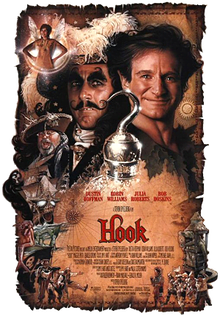
Peter Banning is a busy lawyer who has lost touch with his childhood. When his children disappear, Tinker Bell brings him to Neverland, where Captain Hook awaits his former enemy. Peter’s immediate task is to recover skills and relationships he no longer remembers.
Characters and Performances
Robin Williams plays the adult Peter with a mixture of anxiety and gradual rediscovery. Dustin Hoffman’s theatrical Hook is preoccupied with his rivalry. Julia Roberts plays Tinker Bell, Bob Hoskins plays Smee, and Maggie Smith plays the elderly Wendy. Dante Basco’s Rufio has his own claim to leadership among the Lost Boys.
The World on Screen
The pirate harbour and Lost Boys’ refuge give Neverland distinct communities. Play, food, flight and memory follow the imaginative rules of the setting rather than ordinary geography. The elaborate sets reinforce its character as an enclosed fairy-tale world.
Behind the Camera
Spielberg’s production expands Barrie’s premise into a large-scale family adventure, with practical sets and effects supported by John Williams’s score. Sony’s official film material and the AFI production history provide further context.
Themes and Critical Assessment
The film’s most interesting conflict concerns attention and responsibility, rather than defeating an old opponent. Its lengthy opening and elaborate spectacle can compete with the central story. The performances and visual design nevertheless give the fantasy a memorable atmosphere.
Related Fantasy and Bestiary
The Fey World and Pixie offer independent otherworld encounters. Neverland and Tinker Bell belong to Barrie’s story tradition and its particular adaptations. Compare Peter Pan (2003).
Ideas for the Table
The forgotten promise. An adventurer discovers that an old otherworld agreement survived their forgotten visit.
The changing captain. A band of young explorers has chosen a new leader; a returning former companion must earn trust rather than assume authority.
The borrowed memory. A magical crossing restores a forgotten experience, but its meaning must be pieced together with the help of living witnesses.
Production Deep Dive — Building Neverland
Watch Sony’s official behind-the-scenes documentary, an hour-long collection of production footage. Sony Pictures Museum’s film record places the elaborate sets and performances in their production context. Amblin’s account discusses Spielberg’s longstanding interest in Barrie’s tale and his decision to approach it through an adult Peter’s relationship with his children. The film received five Academy Award nominations, including recognition for its art direction, costumes, visual effects and makeup.
Sources and Further Viewing
AFI Catalog · Sony Pictures — official film page · Sony Pictures — official trailer · Sony — behind-the-scenes documentary.
Film, characters and publicity artwork belong to their respective rights holders. The review and original tabletop ideas are independent commentary. Return to Fantasy Films and Television.
Keep this reference growing
If this page helped with your reading or game, you can support its upkeep or explore the curated books.
Explore the Bookshop — epics, classics and stories behind imagined worlds.