
Harry Potter and the Deathly Hallows – Part 2 (2011)
The search for hidden fragments of an enemy’s power returns to Hogwarts, where former students, teachers and allies must decide what they are willing to defend.
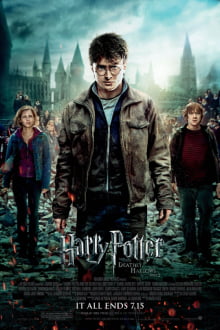
Harry Potter and the Deathly Hallows — Part 2 (2011), directed by David Yates, concludes the film series begun in 2001. Daniel Radcliffe, Rupert Grint and Emma Watson return as Harry, Ron and Hermione, whose search for Horcruxes brings them into the centre of a widening war. The film builds towards the defence of Hogwarts and the resolution of long-running mysteries involving Voldemort, Dumbledore and Severus Snape.
At a Glance
| Film | Harry Potter and the Deathly Hallows — Part 2 (2011) |
|---|---|
| Director | David Yates |
| Screenplay | Steve Kloves, adapted from the conclusion of J. K. Rowling’s 2007 novel |
| Principal cast | Daniel Radcliffe, Rupert Grint, Emma Watson, Ralph Fiennes, Alan Rickman, Maggie Smith, Michael Gambon and Helena Bonham Carter |
| Music | Alexandre Desplat |
| Cinematography | Eduardo Serra |
| Production | Warner Bros. Pictures and Heyday Films |
| Release | July 2011 |
| Theatrical runtime | Approximately 130 minutes |
| Genre | Epic fantasy; supernatural adventure; series finale |
Why This Film Matters
The film gives the long-running series a large-scale conclusion while remaining closely connected to the young people who began at Hogwarts. The school is no longer a distant place of wonder or a temporarily unsafe building; it becomes a community whose teachers and students must decide how to respond to overwhelming danger.
Its most important dramatic question is not who possesses the most powerful magic. Harry has repeatedly learned that people’s motives, loyalties and willingness to sacrifice for others matter more than status or force. The final story brings those ideas together through choices made across years, some of whose reasons have been concealed until now.
The Story — Without Major Spoilers
After the events of Part 1, Harry, Ron and Hermione continue seeking objects that bind Voldemort to the world. Their search brings them to dangerous places where ordinary spells are insufficient, and eventually back towards Hogwarts. The school now stands at the centre of a conflict extending across the magical community.
Former teachers, students and allies gather as Voldemort and his followers prepare to confront the school’s defenders. The trio must continue its private mission amid a much larger battle, discovering that important pieces of the story have been missing from their understanding of the past. The stakes are immediate, but the truth about earlier choices becomes just as important as a final confrontation.
Characters and Performances
Harry Potter (Daniel Radcliffe) is a more restrained protagonist than in the early films, defined by the decisions he makes when he finally understands his task. Ron Weasley (Rupert Grint) and Hermione Granger (Emma Watson) remain essential partners whose loyalty and practical abilities have matured through years of hardship.
Voldemort (Ralph Fiennes) has enormous magical power but a narrow understanding of what motivates other people. Severus Snape (Alan Rickman) is central to revelations that revise the meaning of many earlier events. Minerva McGonagall (Maggie Smith) provides determined leadership at Hogwarts, while Neville Longbottom (Matthew Lewis) demonstrates how someone previously underestimated can become important to a community’s defence.
Bellatrix Lestrange (Helena Bonham Carter) remains one of the most threatening followers of Voldemort. Dumbledore (Michael Gambon) is present through memory and unresolved choices, while Aberforth Dumbledore (Ciarán Hinds) brings another perspective on that family’s past.
Hogwarts Under Siege
Hogwarts is transformed from a school of secret passages and unusual classes into a landscape of barricades, ruined towers, corridors crowded with defenders and open grounds filled with danger. The setting remains recognisable, making its damage more affecting than the destruction of a newly introduced fortress would have been.
A journey through Gringotts demonstrates the peril of entering a place protected by powerful magic and dangerous creatures. At Hogwarts, the defenders’ differing skills become essential. Teachers, students and less celebrated allies all contribute; the film’s strongest scenes recognise that the survival of a community does not rest upon one person alone.
Behind the Camera
David Yates directed the second half of the final adaptation, again working with screenwriter Steve Kloves, composer Alexandre Desplat and cinematographer Eduardo Serra. The two films were produced as closely connected parts of one concluding story, but Part 2 has a different rhythm: it concentrates the search, revelations and confrontation into a shorter, more urgent narrative.
The film combines large-scale visual effects with performances developed over a decade. Familiar faces, places and musical ideas gain meaning because viewers have seen their relationships change over multiple films. The spectacle is extensive, but the best moments use it to frame decisions rather than replace them.
The Novel and the Screen Finale
Rowling’s novel presents the final search and battle as one continuous narrative. Splitting it into two films gives the journey more space in Part 1, allowing Part 2 to focus on the consequences. Some conversations, relationships and explanations from the book are compressed, and the staging of certain confrontations differs substantially.
For example, the last duel takes on a more extended physical and cinematic form than its corresponding scene in the novel. Readers who want the full explanation of several supporting characters’ choices and the aftermath of the battle will find more detail in the written story.
Themes and Critical Assessment
The finale explores loyalty, loss, moral courage and what it means to defend people rather than merely defeat an enemy. Its heroes gain strength through experience and through others who choose to help them, while the chief antagonist’s failure to understand those bonds remains central.
What works: moving performances from the long-running cast, Snape’s complex role, the return to a threatened Hogwarts, large-scale visual effects and the sense of a story reaching its conclusion. What works less well: compressed explanations, some abrupt emotional transitions and action sequences that occasionally overshadow quieter resolutions. Its emotional success depends on the history built across the earlier films.
Related Films and SpiralWorlds
This film concludes the story begun in Harry Potter and the Philosopher’s Stone (2001) and directly follows Deathly Hallows — Part 1 (2010). Fantastic Beasts and Where to Find Them (2016) explores another period in the Wizarding World. SpiralWorlds’ own Bestiary, Magic and NPCs remain distinct from this film continuity.
Ideas for the Table
The school becomes a refuge: an institution prepares to shelter endangered people while a hostile force approaches. Players can arrange evacuation, protect knowledge, organise supplies and negotiate help from independent groups.
The enemy’s hidden weakness: defeating a powerful adversary requires recovering objects linked to past choices. Each object has people who fear or value it, making diplomacy and investigation as important as combat.
After the battle: when danger passes, surviving communities disagree about reconstruction, responsibility and the stories they will tell. Players can participate in that recovery and encounter consequences extending beyond the final fight.
Sources and Credits
- British Council — Deathly Hallows Part 2 (film and production).
- BBFC — Deathly Hallows Part 2 (release and version).
- BFI — Deathly Hallows Part 2 (film record).
Film characters, creatures and promotional artwork remain the property of their respective rights holders. This is independent criticism with original roleplaying material.
Keep this reference growing
If this page helped with your reading or game, you can support its upkeep or explore the curated books.
Explore the Bookshop — epics, classics and stories behind imagined worlds.