
Charybdis, Hunger Beneath the Waves
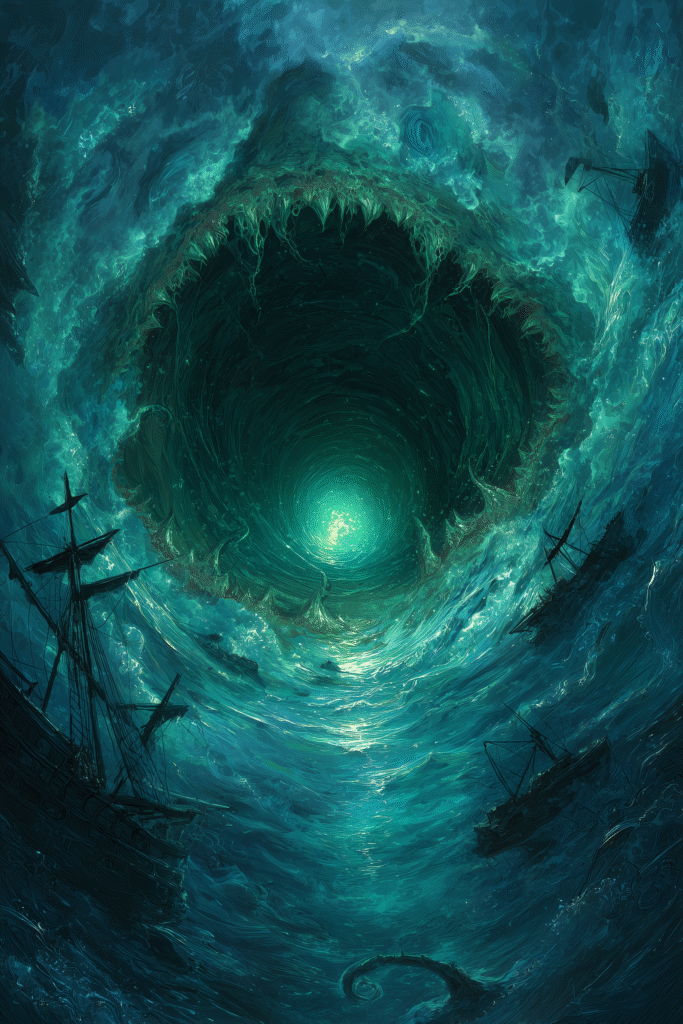
Charybdis is not a race of sea monsters and scarcely resembles an ordinary creature at all. She is the living catastrophe beneath the Strait of Messina: an ancient divine hunger bound beneath the sea, whose inhalation draws ships toward a descending abyss and whose expulsion hurls water, wreckage and foam back toward the sky. Opposite her waits Scylla, so that mariners escaping one horror may be driven directly toward the other.
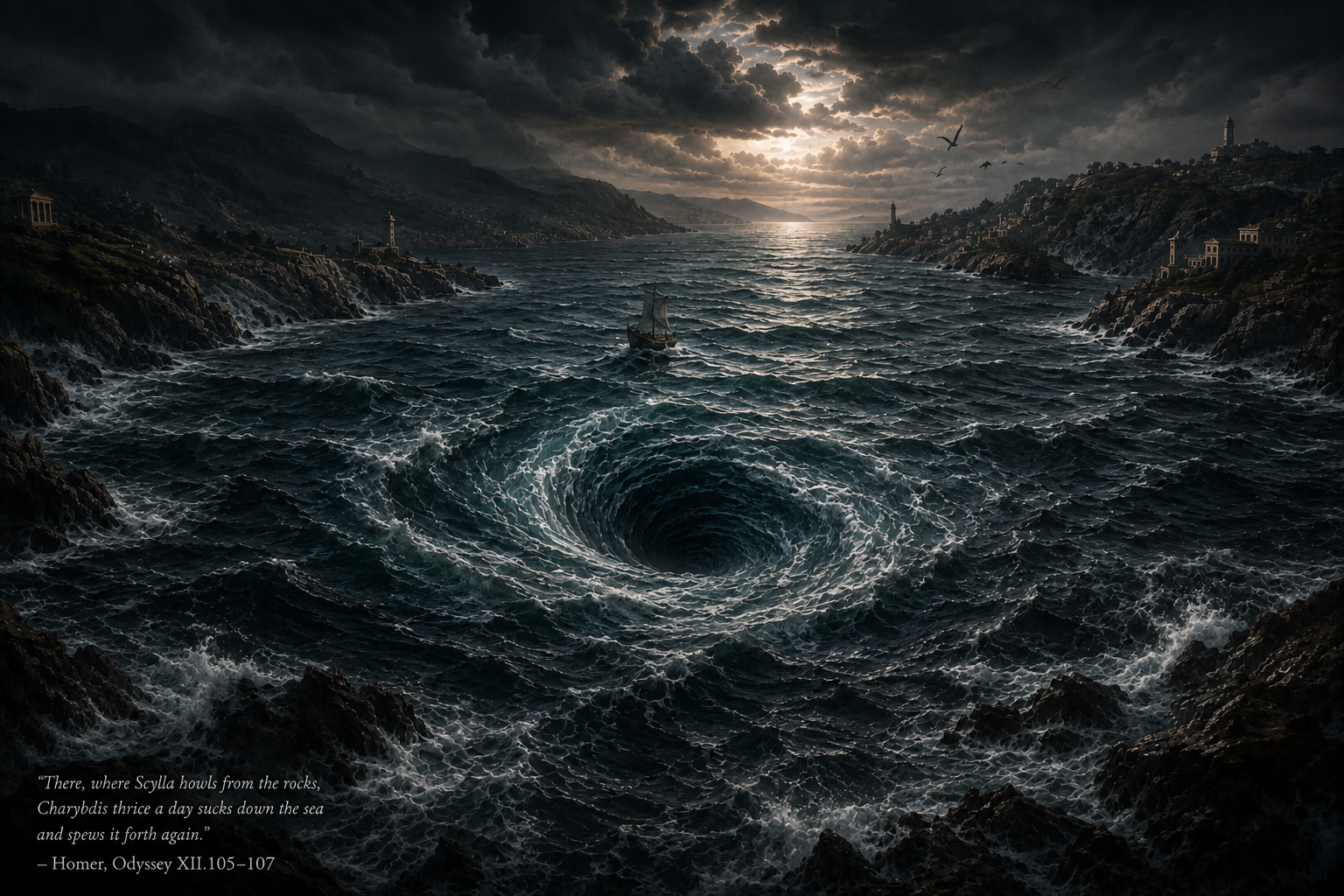
Homer, Odyssey XII: “Thrice a day she belches it forth, and thrice she sucks it down terribly.” Read Book XII at Perseus Digital Library.
Unique-monster rule: defeating Charybdis’s manifested maelstrom does not automatically end Charybdis. Her continued existence is tied to an ancient divine binding. Permanent destruction, release or transformation requires resolving that supernatural cause rather than merely reducing a stat block to 0 hit points.
Game Statistics
These statistics describe the same unique Charybdis in three rulesets. Her mechanics are built around the maelstrom itself: undertow, crushing pressure, the destruction of vessels, the swallowing of the sea and its catastrophic return. She is not intended to function as a stationary kraken trading ordinary tentacle attacks with adventurers.
Armor Class 23 (divine sea-form)
Hit Points 900 (40d20 + 480)
Speed 0 ft. (bound to the strait)
Initiative +8 (18)
Saving Throws Str +22, Con +21, Wis +16, Cha +15
Skills Perception +16
Damage Resistances Acid, Lightning, Thunder
Damage Immunities Cold
Condition Immunities Charmed, Frightened, Grappled, Paralyzed, Poisoned, Prone, Restrained, Stunned
Senses Blindsight 600 ft., Darkvision 120 ft., Passive Perception 26
Languages understands Primordial but rarely communicates
Challenge 30 (155,000 XP; PB +9)
Bound Beneath the Strait. Charybdis has no conventional walking body occupying the battlefield. Her space is the active central vortex. While the ancient binding remains, she can’t willingly leave the Strait of Messina and can’t be pushed, pulled, teleported, banished or transported to another plane.
Living Maelstrom. Water within 300 feet of Charybdis is Difficult Terrain for her enemies. A creature swimming directly away from the central vortex must spend 2 additional feet of movement for every 1 foot moved.
Legendary Resistance (4/Day). If Charybdis fails a saving throw, she can choose to succeed instead.
Magic Resistance. Charybdis has Advantage on saving throws against spells and other magical effects.
Siege Maelstrom. Charybdis deals double damage to ships, docks, seawalls and other objects or structures when an effect specifically says that it damages them.
Threefold Hunger (3/Day). Charybdis begins one complete swallowing and expulsion of the surrounding sea. Once begun, the sequence advances at Initiative count 20 on four successive rounds. Stunning or otherwise disabling Charybdis does not halt a cycle already in progress.
Multiattack. Charybdis uses Crushing Current twice.
Crushing Current. Charybdis creates a 60-foot-long, 20-foot-wide surge originating at a point she can sense within 300 feet. Each creature in the surge must make a DC 30 Strength saving throw. On a failure, a creature takes 45 (10d8) Bludgeoning damage, has the Prone condition, and is pulled up to 40 feet toward Charybdis. On a success, it takes half damage only.
Swallowing Vortex. Each Huge or smaller creature within 30 feet of the central vortex must succeed on a DC 30 Strength saving throw or be engulfed beneath the surface.
While engulfed, a creature has the Blinded and Restrained conditions, has Total Cover against effects originating outside Charybdis, and takes 45 (10d8) Bludgeoning plus 45 (10d8) Cold damage at the start of each of Charybdis’s turns.
An engulfed creature can take an action to make a DC 30 Strength (Athletics) check, escaping into the water within 30 feet on a success. If Charybdis takes 70 or more damage in one turn from creatures engulfed within her, she must succeed on a DC 29 Constitution saving throw or expel every engulfed creature into spaces within 60 feet of the vortex.
Rending Pressure (Recharge 5–6). Water collapses inward in a 120-foot-radius sphere centred on a point Charybdis can sense within 300 feet. Each creature in the area must make a DC 29 Constitution saving throw, taking 72 (16d8) Bludgeoning damage on a failed save or half as much on a successful one.
Legendary Action Uses: 4. Immediately after another creature’s turn, Charybdis can expend one use to take one of the following actions. She regains all expended uses at the start of her turn.
Undertow. One creature Charybdis can sense in water within 300 feet must succeed on a DC 30 Strength saving throw or be pulled up to 40 feet toward the central vortex.
Seething Water. Water erupts in a 20-foot-radius sphere at a point within 300 feet. Each creature there makes a DC 29 Constitution saving throw, taking 27 (6d8) Bludgeoning damage and gaining the Prone condition on a failure. A success halves the damage and prevents the condition.
Wrecking Surge. One unattended object, structure or vessel within 120 feet takes 44 (8d10) Bludgeoning damage.
Crushing Current. Charybdis uses Crushing Current once.
The Maw Beneath the Sea
Mythic Renewal (1/Day). When Charybdis is first reduced to 0 Hit Points, no corpse appears. The visible vortex collapses into a seemingly bottomless depression in the water, every creature engulfed by her is expelled, and Charybdis regains 450 Hit Points.
At Initiative count 20 of the next round, Threefold Hunger immediately enters The Devouring Sea, regardless of whether Charybdis had previously started a cycle.
Wreckage Eruption. During this second phase, immediately after another creature’s turn Charybdis can expend one Legendary Action use to cause ancient wreckage to erupt at a point within 180 feet. Each creature in a 30-foot-radius sphere makes a DC 29 Dexterity saving throw, taking 36 (8d8) Bludgeoning or Piercing damage on a failed save or half as much on a success.
No Bottom. During this second phase, Charybdis can expend one Legendary Action use to force every creature in water within 90 feet to make a DC 30 Strength saving throw. On a failure, a creature is pulled 60 feet toward the vortex.
Charybdis’s divine binding disturbs the sea for approximately 3 miles around the central Strait of Messina. The effects are strongest inside the narrow channel itself and weaken rapidly toward the open Mediterranean. They exist whether or not Charybdis is currently engaged in combat.
Between Scylla and Charybdis. Scylla is not one of Charybdis’s regional effects. The danger comes from the geography of the narrow passage itself. A captain who gives Charybdis a wider berth must steer closer to Scylla’s side of the strait. A route that reduces exposure to one monster therefore increases exposure to the other unless the travellers have found an exceptional way to bypass the passage.
If Charybdis is reduced to 0 Hit Points after Mythic Renewal has already been used, the manifested maelstrom subsides. She leaves no corpse. Unless the ancient divine binding has itself been broken, Charybdis reforms in 1d4 days.
Permanently destroying, releasing or transforming Charybdis requires a divine boon, artifact, ritual, bargain or comparable mythic solution capable of altering the decree that anchors her beneath the Strait of Messina.
When a vessel is required to resist one of Charybdis’s currents, its pilot may make an appropriate ability check using proficiency with water vehicles in place of the vessel’s saving throw. On a failure by 5 or more, exposed creatures aboard the vessel must also succeed on a DC 20 Dexterity saving throw or fall Prone; a creature beside an open rail may instead be swept overboard.
CN Colossal outsider (aquatic, chaotic, native, water)
Init +5; Senses blindsight 300 ft., darkvision 60 ft.; Perception +53
AC 45, touch 11, flat-footed 44 (−8 size, +1 Dex, +34 natural, +8 insight)
hp 738 (36d10+540); fast healing 20
Fort +37, Ref +15, Will +30
DR 20/lawful and cold iron; Immune cold, mind-affecting effects, paralysis, poison; Resist acid 20, electricity 30, fire 30; SR 39
Speed 0 ft. (bound)
Space 30 ft.; Reach 30 ft.
Melee bite +45 (8d6+16/19–20), 2 current slams +42 (4d8+8)
Special Attacks grab, swallow whole, threefold maelstrom, expulsive deluge, current shift, wreck hull
Base Atk +36; CMB +60 (+64 grapple); CMD 71
Feats Ability Focus (threefold maelstrom), Awesome Blow, Critical Focus, Great Fortitude, Greater Vital Strike, Improved Bull Rush, Improved Critical (bite), Improved Initiative, Improved Natural Attack (bite), Improved Vital Strike, Iron Will, Lightning Reflexes, Multiattack, Power Attack, Skill Focus (Perception), Snatch, Vital Strike, Weapon Focus (bite)
Skills Intimidate +45, Knowledge (geography) +41, Knowledge (nature) +41, Knowledge (planes) +41, Perception +53, Sense Motive +47, Survival +47, Swim +55
Languages Aquan; understands speech but rarely answers
Bound to the Strait (Su). Charybdis’s supernatural manifestation is anchored beneath the Strait of Messina. She has a speed of 0 feet and cannot be moved by bull rush, drag, reposition, teleportation or planar travel while the binding remains. She cannot be tripped.
Grab (Ex). Charybdis can use grab with her bite against Huge or smaller creatures. Her CMB for grapple checks made with this ability is +64.
Swallow Whole (Ex). A swallowed creature takes 8d8+16 points of bludgeoning damage and 12d6 points of cold damage each round. The interior has AC 30 and 80 hit points. Cutting free deposits the creature in water adjacent to the active vortex. The interior is flooded; creatures unable to breathe water must hold their breath normally.
Riptide Field (Su). The sea within 300 feet of Charybdis moves persistently toward her. A swimming creature attempting to move directly away must succeed at a DC 30 Swim check or move at only half its normal rate. A creature failing by 5 or more is instead carried 30 feet toward the central vortex.
Threefold Maelstrom (Su) — 3/day. As a full-round action, Charybdis begins one of her great swallowings. All creatures and vessels in water within 600 feet must attempt a DC 36 Reflex save. A swimming creature may attempt a DC 36 Swim check instead, and a vessel’s master may substitute a DC 36 Profession (sailor) check for the vessel’s save.
On a failure, a creature or vessel is dragged 120 feet toward Charybdis. Any Huge or smaller creature drawn to within 30 feet is subject to grab and swallow whole. A vessel drawn within 60 feet takes 20d10 points of bludgeoning damage and may capsize. The save DC is Charisma-based and includes Ability Focus.
Expulsive Deluge (Su). On the round after Threefold Maelstrom, Charybdis may expel the swallowed sea as a standard action. The deluge fills a 600-foot cone. Creatures in the area take 30d10 points of bludgeoning damage and are swept 2d6 × 10 feet away. A DC 36 Reflex save halves the damage and prevents forced movement. Vessels and structures take double damage.
Current Shift (Su). Once per round as a swift action, Charybdis can wrench the water around one creature within 300 feet. The creature must succeed at a DC 34 Reflex save or be moved 30 feet toward or away from the vortex.
Wreck Hull (Ex). Charybdis deals double damage to ships, docks and other waterborne structures. Her attacks and supernatural currents ignore the first 20 points of an object’s hardness.
Curse-Bound Immortality (Su). When reduced to 0 hit points, Charybdis’s manifestation collapses and the surrounding sea temporarily settles. Unless the divine binding has been broken by mythic or divine means, she reforms in 1d4 days. She leaves no corpse.
Charybdis’s supernatural influence extends approximately 3 miles from the central maelstrom, although the strongest effects occur within the narrow waters of the Strait of Messina.
Gathering Current: when the first signs of one of Charybdis’s three daily swallowings begin, Swim checks and Profession (sailor) checks made to hold position or move against the supernatural current take a −2 circumstance penalty. Once the inward pull becomes unmistakably strong, this becomes a −4 circumstance penalty. A character familiar with the Strait of Messina reduces either penalty by 2. These penalties do not stack with Threefold Maelstrom; once that ability begins, use its rules instead.
Reading the Warning: a DC 20 Knowledge (geography), Profession (sailor), or Survival check identifies that a supernatural swallowing is gathering and whether the current is strengthening. A character with practical experience navigating the Strait of Messina gains a +4 circumstance bonus on this check.
Signs of the Maw: fish abandon the channel, floating weed and wreckage turn toward the central waters, anchored vessels pull abnormally at their lines, and the direction of the surface current may cease to agree with wind or ordinary expectations. These signs grow progressively stronger but do not follow a fixed timetable.
Wreckage and the Exposed Bottom: Charybdis periodically returns broken timbers, cargo, anchors, bones and other remains to the surface. At the deepest stage of a full swallowing, black sand, rock and normally submerged wreckage can become briefly accessible.
Scylla’s Side: a vessel deliberately hugging the waters opposite Charybdis reduces the above current penalties by a further 2, to a minimum of 0, but enters the route threatened by Scylla. This is a navigational trade-off, not a magical compulsion.
Limits: these supernatural modifiers disappear beyond approximately 3 miles. They do not interfere with teleportation, planar travel, resurrection or the passage of souls. Temporarily defeating Charybdis suppresses the supernatural influence until she reforms; the natural currents of the Strait remain.
Environment Strait of Messina, Mediterranean Sea
Organization solitary (unique)
Treasure incidental wreckage; Charybdis keeps no deliberate hoard
| Hit Dice | 40d8+680 plus Epic Toughness (890 hp) |
|---|---|
| Initiative | +5 |
| Speed | 0 ft. (bound) |
| Armor Class | 47 (−8 size, +1 Dex, +36 natural, +8 insight), touch 11, flat-footed 46 |
| Base Attack/Grapple | +40/+73 |
| Attack | Bite +50 melee (8d6+17/19–20) |
| Full Attack | Bite +50 melee (8d6+17/19–20) and 2 current slams +47 melee (3d6+8) |
| Space/Reach | 30 ft./30 ft. |
| Special Attacks | Improved grab, swallow whole, whirlpool, expulsive deluge, wreck hull |
| Special Qualities | Bound to the Strait, blindsight 300 ft., darkvision 60 ft., damage reduction 25/lawful and cold iron, fast healing 20, immunity to cold and mind-affecting effects, resistance to fire 30 and electricity 30, spell resistance 39, curse-bound immortality |
| Saves | Fort +45, Ref +27, Will +30 |
| Abilities | Str 44, Dex 12, Con 45, Int 14, Wis 27, Cha 20 |
| Challenge Rating | 28 |
| Treasure | Incidental wreckage; no personal hoard |
| Alignment | Chaotic Neutral |
| Advancement | — |
| Level Adjustment | — |
Skills: Concentration +60, Intimidate +48, Knowledge (geography) +45, Knowledge (nature) +45, Listen +51, Search +45, Sense Motive +51, Spot +51, Survival +51, Swim +60.
Feats: Ability Focus (whirlpool), Awesome Blow, Cleave, Great Cleave, Great Fortitude, Improved Bull Rush, Improved Critical (bite), Improved Initiative, Multiattack, Power Attack, Weapon Focus (bite). Epic Feats: Epic Fortitude, Epic Reflexes, Epic Toughness.
Charybdis is not a mobile melee predator. These statistics describe the supernatural force within the maelstrom when heroes attempt to confront her directly. Her primary weapons are the surrounding sea, crushing pressure, wreckage and the enormous cyclic current.
Bound to the Strait (Su). Charybdis cannot leave the site of her binding through ordinary movement, teleportation, plane shifting or forced movement. She cannot be bull rushed, overrun or tripped while the binding remains intact.
Improved Grab (Ex). To use this ability, Charybdis must hit a Huge or smaller creature with her bite. She can then attempt to start a grapple as a free action without provoking an attack of opportunity.
Swallow Whole (Ex). Charybdis can swallow a grabbed Huge or smaller opponent. A swallowed creature takes 5d8+17 points of bludgeoning damage plus 15d6 points of cold damage each round from crushing, turbulent seawater. A creature can cut its way free by dealing 60 points of damage to the interior (AC 30). The interior is entirely flooded.
Whirlpool (Su) — 3/day. As a full-round action, Charybdis sucks the surrounding sea down toward herself. Every creature and vessel in water within 300 feet must make a DC 49 Reflex save. A swimming creature may attempt a DC 49 Swim check instead.
A failed check draws the target 120 feet toward the centre. A Huge or smaller creature ending this movement within 30 feet is immediately subject to improved grab. A vessel drawn within 60 feet takes 20d10 points of bludgeoning damage. The save DC is Constitution-based and includes Ability Focus.
Expulsive Deluge (Su). On the round immediately following Whirlpool, Charybdis can expel the swallowed sea as a standard action. The effect fills a 500-foot cone and deals 30d10 points of bludgeoning damage. A DC 49 Reflex save halves the damage. Creatures that fail are also swept 2d6 × 10 feet away. Ships and structures take double damage.
Wreck Hull (Ex). Charybdis deals double damage to ships and other waterborne structures and ignores the first 20 points of hardness when damaging them.
Curse-Bound Immortality (Su). Destroying the active manifestation does not permanently slay Charybdis. Unless the divine binding and curse are broken by suitably epic or divine means, the maelstrom reforms in 1d4 days.
Charybdis’s binding affects approximately 3 miles of water around the central Strait of Messina, with the greatest danger concentrated in the actual channel.
Gathering Current: when one of Charybdis’s three daily swallowings begins to gather, Swim and Profession (sailor) checks made to hold position or travel against the supernatural current take a −2 circumstance penalty. When the inward pull becomes strong, the penalty increases to −4. A creature familiar with the Strait of Messina reduces either penalty by 2. Once Charybdis uses Whirlpool, use the Whirlpool rules instead of these regional penalties.
Reading the Warning: a DC 20 Knowledge (geography), Profession (sailor), or Survival check reveals that one of Charybdis’s supernatural cycles is gathering. Characters experienced with the Strait gain a +4 circumstance bonus. Visible signs include fleeing fish, inward-turning debris, abnormal strain on anchors and moorings, and a current that ceases to agree with the expected wind and tide.
Wreckage and Black Sand: old wreckage periodically rises from the depths and circulates through the strait. During the deepest draw-down, portions of the seabed can emerge temporarily, exposing black sand, bare stone and material normally far below the surface.
Scylla’s Side: a ship deliberately steering away from Charybdis reduces the regional current penalty by a further 2, to a minimum of 0, but approaches the waters threatened by Scylla. Escaping one danger therefore increases exposure to the other.
Limits: the supernatural effects weaken rapidly outside the Strait and disappear at approximately 3 miles. They have no special effect on teleportation, plane shifting, resurrection or souls. If Charybdis is temporarily defeated, the supernatural effects cease until she reforms, although the Strait’s ordinary currents and vortices remain dangerous.
Environment: Strait of Messina, Mediterranean Sea.
Organization: Solitary (unique).
The Devouring Sea
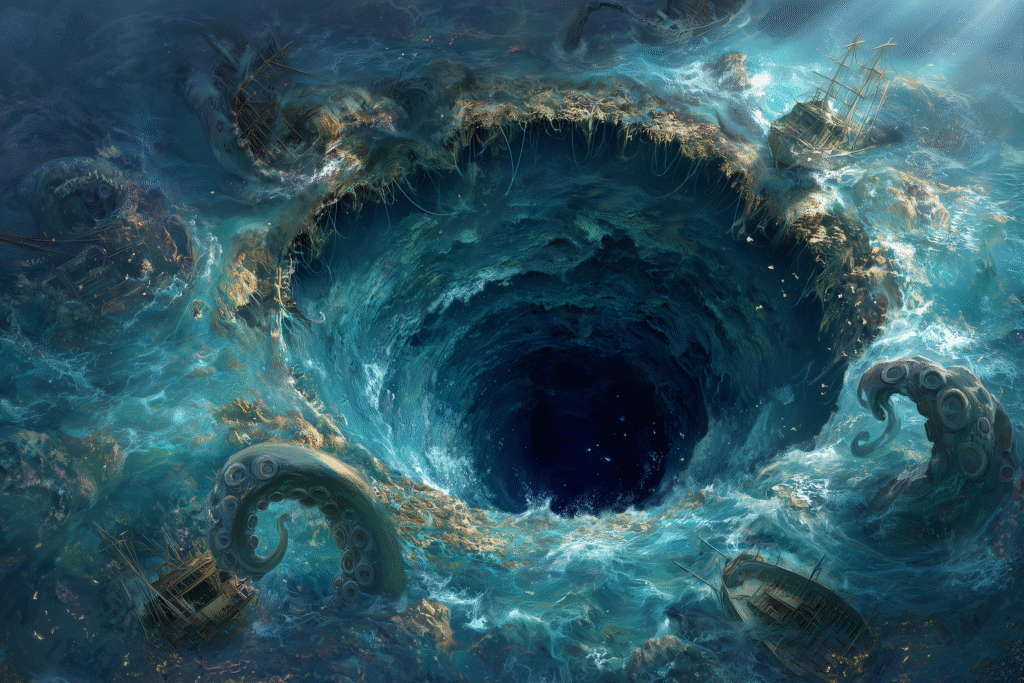
Most sailors never see a monster’s body. They see the sea begin to behave incorrectly. The current turns inward. The surface slopes toward an invisible centre. Foam begins to circle. The circles tighten. Then the water itself starts to fall.
This is the essential ancient image of Charybdis. When she swallows, the sea is dragged downward so violently that the bottom becomes visible: dark earth and black sand beneath a roaring ring of water. When she releases it, the sea boils upward again and spray rises toward the surrounding rocks.
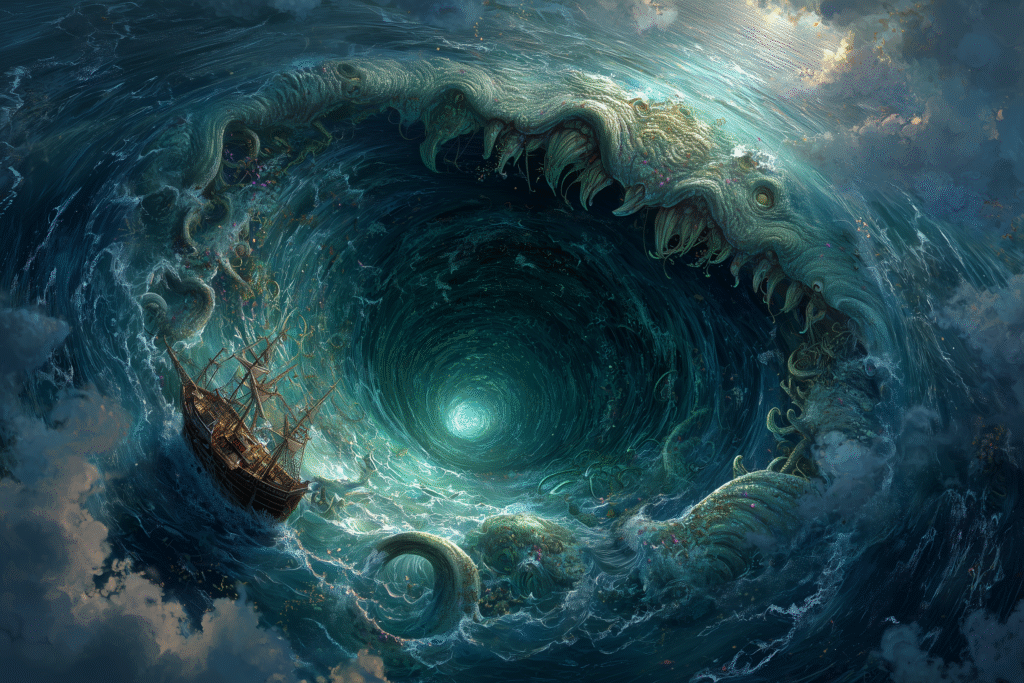
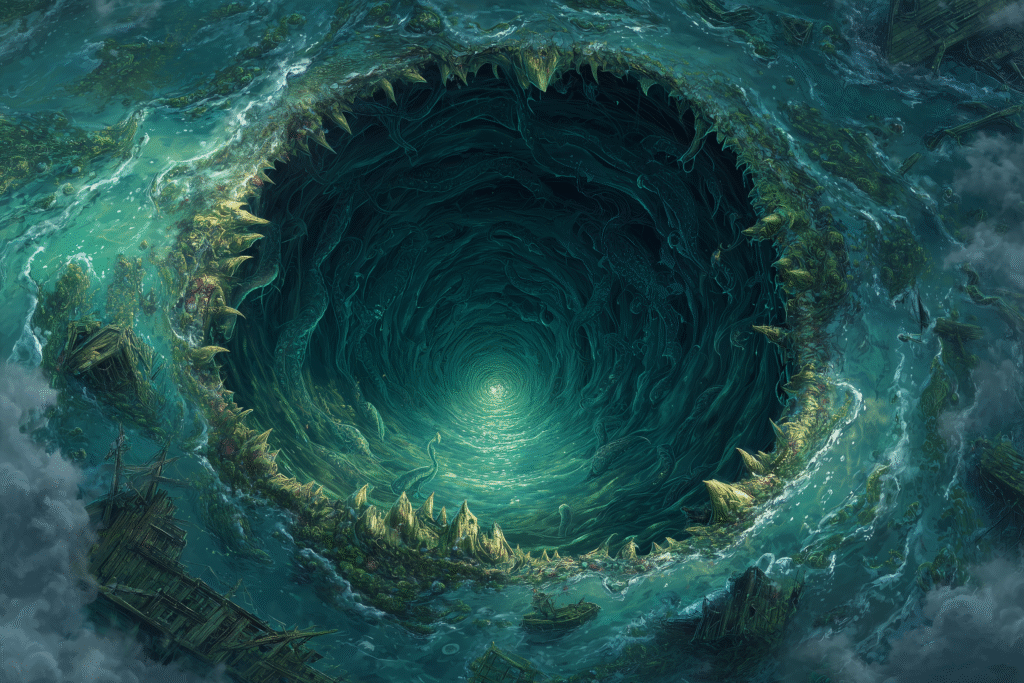
SpiralWorlds treats occasional glimpses of teeth, membrane, eyes or a vast submerged maw as partial manifestations of the being beneath the vortex. They do not make Charybdis a species of giant cephalopod, kraken or marine reptile. Her principal physical expression is the maelstrom.
The Three Daily Swallowings
Three times each day Charybdis draws down the surrounding sea and three times she expels it again. This rhythm is one of her defining characteristics. It should shape encounters with her far more strongly than ordinary melee reach or movement speed.
Before the Descent
The sea may grow deceptively calm. Fish flee. Floating timber slowly changes direction. Experienced pilots recognise these warnings and act before the visible whirlpool reaches full strength.
The Inhalation
The current becomes a vast funnel. Ships lose steerage, swimmers are dragged backward, and normally submerged rock and dark seabed emerge beneath the falling water.
The Expulsion
The swallowed sea returns as a violent ascending torrent carrying foam, timber, cargo, bones and fragments of vessels destroyed in earlier cycles.
Running the encounter: the approach to one of these cycles works well as a clock. Navigation, rescue, preparation, divine aid and the decision to risk the Scylla side of the strait can all matter before conventional combat begins.
Origins and Conflicting Traditions
The surviving ancient traditions do not give Charybdis one completely uniform biography. The oldest literary account establishes the monster and her behaviour but does not provide the full later story of her parentage and punishment.
The Homeric Core
In the Odyssey, Charybdis already dwells beneath the lower rock opposite Scylla. A great fig tree grows above her. Three times daily she swallows the sea and three times she expels it again. Her descending waters expose the dark seabed beneath the strait.
Later Traditions
Ancient scholia preserve conflicting genealogies. One makes her a daughter of Pontos and Gaia; another names Poseidon and Gaia. Other traditions connect her punishment with inundating the land or stealing cattle belonging to Heracles.
SpiralWorlds Canon
SpiralWorlds uses the Poseidon-and-Gaia genealogy. Charybdis’s ancient hunger and destructive command of the sea brought her into conflict with Zeus, who bound her beneath the strait. The punishment did not make her mortal: it fixed her hunger to one place and made the surrounding water the instrument through which that hunger acts.
Scylla and Charybdis
Scylla and Charybdis are more than two monsters inhabiting the same stretch of water. Their proximity creates a single mythic ordeal. A vessel steering away from Charybdis must approach Scylla’s side; a vessel fleeing Scylla risks entering the pull of Charybdis.
This is the heart of being caught between Scylla and Charybdis: avoiding one danger increases exposure to the other.
Encounter principle: a faithful Scylla-and-Charybdis encounter should not normally become two monsters standing beside a ship trading attack rolls with the party. Distance, current, timing, crew losses and the choice of which side of the strait to risk are the encounter.
Odysseus and the Fig Tree
Odysseus approaches the strait after receiving guidance from Circe. He understands that Charybdis threatens the entire ship and so steers nearer to Scylla, accepting a terrible but limited loss rather than risk destruction of the vessel and every soul aboard.
His most remarkable encounter with Charybdis comes later. Cast back toward the strait alone, Odysseus reaches the whirlpool as she swallows the sea. He leaps upward and clings to the great fig tree above her, hanging over the void until Charybdis finally expels the mast and keel on which his survival depends.
The episode provides the clearest model for using Charybdis in play: survival comes from observation, timing and desperate use of the environment, not simply from standing beside the vortex and attacking it.
The Argonauts and the Nereids
The voyage of the Argonauts offers another model for surviving the strait. When the Argo must face Scylla, Charybdis and the neighbouring sea hazards, divine aid intervenes. Thetis and the Nereids guide the vessel through the danger.
In play, this establishes divine favour as a legitimate alternative to brute force. A party that earns assistance from Thetis, Poseidon or another sea power might learn the best moment to attempt the crossing or receive supernatural assistance with the currents. Such intervention should make passage possible rather than make Charybdis harmless.
The voyage also places Charybdis firmly within the broader network of Hellenic heroes and the Hellenic Pantheon.
Charybdis in 1454 CE
Charybdis is still active in 1454 CE. Heroic antiquity has passed, but the divine binding beneath the Strait of Messina has not. Ships continue to use the strait, and mariners continue to contend with a danger older than their kingdoms, charts and ports.
Local fishermen, pilots and captains need not agree on every detail of Charybdis’s genealogy to recognise the signs of her activity. They watch the direction of floating debris, the sudden flight of fish, the strain on anchors and mooring lines, the behaviour of water around familiar rocks and the deceptive slackening that can precede the inward draw.
Foreign captains sometimes dismiss such practices as local superstition. Those who survive a full swallowing seldom make the same mistake twice. Charts and inherited pilotage knowledge can identify the dangerous passage, but neither wind nor ordinary tide alone can perfectly predict a supernatural cycle imposed by an immortal being.
Reports of “another Charybdis” elsewhere describe ordinary whirlpools, magically produced vortices, false identifications or comparisons inspired by her reputation. There is only one Charybdis.
Regional Effects — The Waters Around Charybdis
Charybdis does not need to rise into battle for mariners to know that they have entered her waters. Her binding overlays the already dangerous currents of the Strait of Messina with a supernatural threefold rhythm. The influence is most pronounced in the narrow channel and can be noticed for roughly 3 miles around it before fading into the ordinary Mediterranean.
The Warning Before the Descent
There is no dependable number of minutes between the first warning and the full swallowing. Instead the signs accumulate. Floating weed and foam cease to follow the expected current. Wreckage slowly turns toward the central passage. Fish abandon productive water. A ship lying at anchor begins to pull against its cable in a direction its master does not expect. As the swallowing approaches, these signs become progressively harder to ignore.
A pilot who has spent years on the Strait of Messina can often recognise the developing pattern before a foreign captain understands what is happening. Local knowledge therefore matters enormously, but it does not provide a magical clock for Charybdis.
Natural Current and Supernatural Tide
The Strait possesses dangerous currents of its own. Charybdis does not replace them; she imposes herself upon them. Wind, ordinary tidal movement and the natural set of the water can all remain useful to an experienced mariner, but Charybdis’s supernatural rhythm can strengthen, oppose or overwhelm what the sea ought otherwise to be doing.
In 1454, pilots therefore rely upon experience as much as calculation: the direction of drift, the behaviour of water around rocks, the strain on anchors and mooring lines, the movement of fish and birds, and the testimony of mariners who survived earlier crossings. Existing knowledge of tides and currents remains useful; it simply cannot predict an immortal monster with complete precision.
Wreckage Returned
Charybdis has swallowed ships for centuries. She does not keep a tidy hoard beneath the sea. Instead the repeated draw and reflux scatter what she has taken. Timbers, amphorae, anchors, weapons, cargo, bones and pieces of vessels from different ages can return to the surface, circle for a time, and vanish into the depths again.
This makes the waters around Charybdis an archaeological hazard as well as a monster’s territory. A relic thought lost in antiquity may genuinely reappear among the wreckage—giving adventurers a reason to approach the maelstrom voluntarily.
The Black Bottom
The most terrible stage is also the most revealing. When Charybdis draws the sea furthest downward, normally submerged parts of the bottom can appear beneath the roaring water: black sand, naked rock and wreckage hidden at depths no ordinary swimmer could safely reach. The opportunity lasts only until the sea returns.
Anything still on that exposed ground when Charybdis begins to expel the water must survive the returning weight of the sea.
Things the Sea Gives Back
Not everything Charybdis swallows is destroyed. Cargo, weapons, pieces of ships and other objects can re-emerge during later expulsions. Some return after hours; others may vanish for decades or centuries before appearing again. Such objects need not be magical to be valuable: a lost charter, ancient weapon, sealed reliquary, merchant strongbox or fragment of a famous wreck can be enough to draw treasure-seekers into her waters.
Between Scylla and Charybdis. The choice between the two monsters is geographical, not an enchantment created by Charybdis. The safer line away from her strongest draw carries a vessel toward Scylla. Conversely, a captain seeking distance from Scylla must accept more of Charybdis’s current. The narrow passage makes avoiding both at once the exception rather than the rule.
Limit of the Maelstrom. Charybdis’s supernatural influence fades rapidly beyond approximately 3 miles from the central Strait of Messina. It does not seal the region against teleportation or planar travel, imprison the spirits of the dead, or grant Charybdis dominion over the Mediterranean. If her manifested form is defeated, these supernatural signs fall silent until she reforms; the natural currents of the Strait remain. If the divine binding itself is permanently ended, Charybdis’s regional effects do not return.
Running Charybdis in a Campaign
Pass the Strait
The characters need not defeat Charybdis. Their objective may simply be to bring a vessel, crew or convoy through the passage before the next swallowing reaches full strength.
Rescue the Lost
A damaged ship or important survivor is caught among the rotating wreckage. The party has only one cycle in which to reach them and escape.
Recover an Ancient Wreck
The deepest draw-down briefly exposes places normally hidden beneath dangerous water, creating a narrow opportunity to seize a relic before the sea returns.
Choose Between Monsters
A broken rudder, hostile fleet or supernatural storm forces the vessel toward either Scylla or Charybdis.
Control the Water
Powerful magic such as Control Water can alter a local current or buy precious time, but it does not casually cancel the complete divine cycle of a unique CR 28–30 sea-being.
Permanent defeat should be a story, not merely a damage total. Powerful characters can suppress Charybdis’s manifestation through force. Ending an immortal sea-terror bound by divine decree requires resolving the cause of her persistence.
Mythic Provenance and Sources
Charybdis’s mythology survives through sources written across many centuries. The earliest epic description and later genealogical traditions do not always give the same account, and the distinctions between them remain important.
- Homer, Odyssey, Book XII. The principal source for Charybdis opposite Scylla, the fig tree, the repeated swallowing and expulsion of the sea, the exposed seabed and Odysseus’s survival above the vortex. Read Book XII at Perseus Digital Library.
- Ancient scholia and later mythographic traditions. These preserve variant parentages, including Pontos and Gaia and Poseidon and Gaia, together with stories of Zeus’s punishment. Classical Charybdis passages collected at Theoi.
- Pseudo-Apollodorus, Epitome. The mythographic tradition preserves Odysseus’s later return to Charybdis and the fig-tree episode. Read the relevant passage at Perseus.
- Apollonius Rhodius, Argonautica, Book IV. The Argonautic tradition places Thetis and the Nereids in the divine effort to guide the Argo through the western sea dangers. Read Book IV.
Charybdis in Myth
This focused mythology overview provides a visual introduction to Charybdis and her relationship with Scylla alongside the primary-source material above.
Charybdis: The Gigantic Whirlpool Monster of Greek Mythology — Mythology & Fiction Explained.
Keep this reference growing
If this page helped with your reading or game, you can support its upkeep or explore the curated books.
Explore the Bookshop — epics, classics and stories behind imagined worlds.