
Bestiary · Planar Entity · Native of Limbo
Chaos Beast
A chaos beast is a living failure of permanent form: an ever-changing creature of Limbo whose touch can make flesh forget the shape it is supposed to hold.
Overview
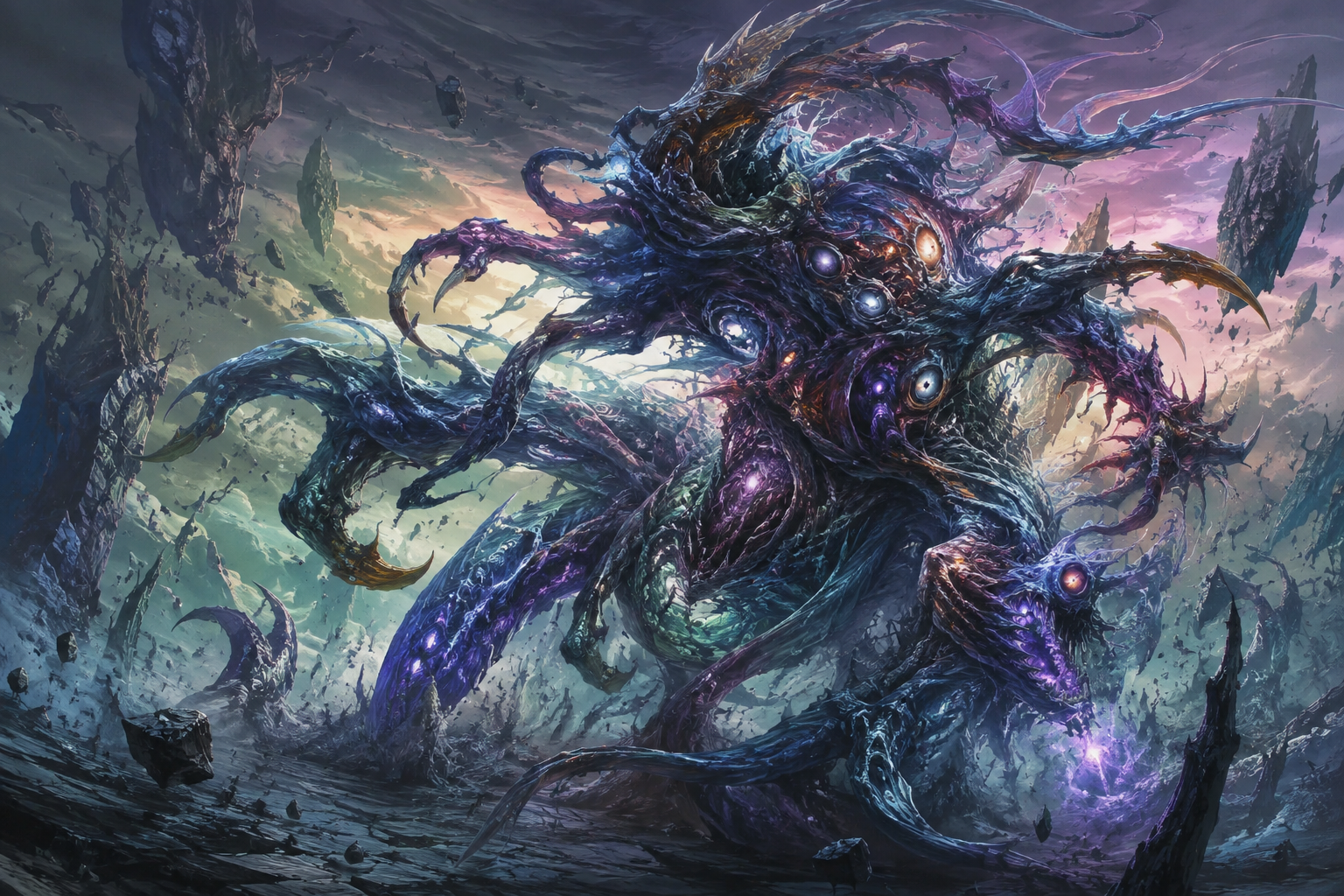
A chaos beast has no dependable anatomy. Eyes open and vanish. Limbs split, merge and reform. Teeth appear where joints should be, while claws soften into tendrils and then harden again into something almost recognisable as hands.
This is not deliberate shapeshifting in the ordinary sense. A chaos beast does not calmly select a useful form from a catalogue of possibilities. Its body simply refuses to accept that one arrangement should remain final.
Although physically dangerous, a chaos beast is remembered less for raw damage than for the unnatural affliction carried in its claws: Corporeal Instability . A victim’s body begins obeying the same principle as the beast itself: form becomes unreliable.
The chaos beast is a native creature of Limbo, not an Abyssal demon. Limbo expresses chaos through instability, possibility and mutable reality. A chaos beast is dangerous because it unravels physical certainty, not because it serves evil.
Game Statistics
The chaos beast remains recognisably the same creature across editions: a chaotic planar predator of roughly CR 7 whose defining threat is bodily instability rather than overwhelming direct damage.
Chaos Beast
Medium Aberration (Planar), Chaotic Neutral
Armor Class 17 (natural armor)
Hit Points 119 (14d8 + 56)
Speed 30 ft.
Saving Throws Dex +5, Con +7, Wis +4
Skills Perception +4, Stealth +5
Senses darkvision 60 ft., passive Perception 14
Languages —
Challenge 7 (2,900 XP)
Proficiency Bonus +3
Traits
Amorphous. The chaos beast can move through a space as narrow as 1 inch wide without squeezing, and it cannot be knocked prone.
Magic Resistance. The chaos beast has advantage on saving throws against spells and other magical effects.
Mutable Anatomy. A critical hit against the chaos beast becomes a normal hit. Its organs and vulnerable points never remain in one arrangement long enough to be reliable.
Resistant to Transformation. If magic would transform, petrify or otherwise impose a different physical form upon the chaos beast, that effect ends on it at the start of the beast’s next turn, when it immediately returns to its own mutable state.
Actions
Multiattack. The chaos beast makes two Formless Claw attacks.
Formless Claw. Melee Weapon Attack: +7 to hit, reach 5 ft., one target. Hit: 15 (2d10 + 4) slashing damage.
Corporeal Instability. Once per turn, when the chaos beast hits a living creature with Formless Claw, the target must succeed on a DC 15 Constitution saving throw or become physically unstable for 1 minute.
While unstable, the target’s body continuously softens, stretches and reforms. Its Speed becomes 10 feet, it cannot properly hold or manipulate objects, it cannot benefit from armor or shields, it has disadvantage on attack rolls, and it cannot cast a spell requiring Somatic or Material components.
At the end of each of its turns, the affected creature repeats the DC 15 Constitution saving throw, ending the effect on a success.
As an action, the affected creature can make a DC 15 Charisma check to force its normal form to reassert itself until the start of its next turn.
Greater restoration, heal, or comparable powerful restorative magic immediately ends Corporeal Instability.
Chaos Beast
CR 7 · CN Medium Outsider (chaotic, extraplanar)
XP 3,200
Init +6
Senses darkvision 60 ft.; Perception +13
Defense
AC 20, touch 13, flat-footed 17 (+2 Dex, +1 dodge, +7 natural)
hp 85 (9d10 + 36)
Fort +9, Ref +8, Will +4
Defensive Abilities amorphous, resistant to transformation; SR 18
Offense
Speed 20 ft.
Melee 4 claws +13 (1d6 + 3 plus corporeal instability)
Statistics
Base Atk +9; CMB +12; CMD 25 (can’t be tripped)
Feats Dodge, Improved Initiative, Mobility, Toughness, Weapon Focus (claw)
Skills Acrobatics +14 (+10 jumping), Climb +15, Escape Artist +14, Perception +13, Stealth +14, Swim +15
Special Abilities
Corporeal Instability (Su). A chaos beast transmits this affliction through its claw attack. A struck living creature must succeed on a DC 17 Fortitude save or lose control of its shape. The save DC is Constitution-based.
On a failed save, the victim gains the amorphous quality. It cannot properly hold or use equipment, rigid worn gear reduces its Dexterity by 4, and its speed becomes 10 feet or one-quarter its normal speed, whichever is less.
The victim cannot cast spells or use magic items while uncontrolled, suffers a –4 penalty on attack rolls, and has a 50% miss chance on attacks.
Each round the victim ends its turn in this uncontrolled state, it takes 1 point of Wisdom drain from the mental shock of losing control of its own body.
As a standard action, the victim can attempt a DC 15 Will save to reassert its normal form for 1 minute.
Three consecutive successful Fortitude saves cure the affliction.
At Wisdom 1, further Wisdom drain stops, but the victim’s instability becomes permanent until removed magically.
Transformative magic can stabilise the victim without actually curing the condition. Relevant effects include alter self, beast shape, polymorph, shapechange, and stoneskin.
Resistant to Transformation (Ex). Effects that polymorph, petrify or otherwise force a chaos beast into another form can alter it momentarily, but at the beginning of its next turn it returns to its mutable body.
Ecology
Environment any; strongly associated with Limbo
Organization solitary or invasion (2–5)
Treasure none
Chaos Beast
Medium Outsider (Chaotic, Extraplanar)
Hit Dice 8d8 + 8 (44 hp)
Initiative +5
Speed 20 ft.
Armor Class 16 (+1 Dex, +5 natural), touch 11, flat-footed 15
Base Attack/Grapple +8/+10
Attack claw +10 melee (1d3 + 2 plus corporeal instability)
Full Attack 2 claws +10 melee (1d3 + 2 plus corporeal instability)
Space/Reach 5 ft./5 ft.
Special Attacks & Qualities
Special Attacks corporeal instability
Special Qualities darkvision 60 ft., immunity to critical hits, immunity to transformation, spell resistance 15
Saves Fort +7, Ref +7, Will +6
Statistics
Skills Climb +13, Escape Artist +12, Hide +12, Jump +9, Listen +11, Search +11, Spot +11, Survival +0 (+2 following tracks), Tumble +14, Use Rope +1 (+3 with bindings)
Feats Dodge, Improved Initiative, Mobility
Environment Plane of Limbo
Organization solitary
Challenge Rating 7
Treasure none
Alignment always chaotic neutral
Advancement 9–12 HD (Medium); 13–24 HD (Large)
Corporeal Instability (Su)
A living creature struck by a chaos beast must succeed on a DC 15 Fortitude save or lose control of its physical form. The save DC is Constitution-based.
An affected creature becomes a flowing, amorphous mass. It cannot hold or use items normally. Bulky clothing and rigid equipment reduce Dexterity by 4, while warped legs and feet reduce speed to 10 feet or one-quarter normal speed, whichever is lower.
The mental shock prevents coherent spellcasting and magic-item use. The victim suffers a –4 penalty on attack rolls and a 50% miss chance while attacking.
Each round spent in the uncontrolled amorphous state drains 1 point of Wisdom.
As a standard action, the victim may attempt a DC 15 Charisma check to force its normal shape to reassert itself. A success stabilises the victim for 1 minute.
If Wisdom reaches 0, the victim completes the transformation and becomes a chaos beast.
Restoration, heal, or greater restoration can remove the affliction. Shapechange and stoneskin can temporarily hold the afflicted creature in a stable body without truly curing the condition.
Immunity to Transformation (Ex)
Magic cannot permanently fix the chaos beast into another body. Polymorphing, petrification and similar transformation effects may alter it briefly, but at the start of its next turn the chaos beast returns to its natural mutable state.
Summoning
In D&D 3.5e, the chaos beast appears on the sixth-level summon monster list and can be called with summon monster VI.
A Body That Has Forgotten Its Shape
A chaos beast has no dependable face, number of limbs or arrangement of organs. At one moment it may resemble a hunched predator surrounded by hooked claws; a heartbeat later those claws have collapsed into tentacles while eyes open across what had been its back.
Teeth emerge, vanish and return somewhere else. Bones may become soft as cartilage, then harden again where no skeleton existed moments before. Parts of the creature can flatten, stretch or fold back into the body without any obvious injury.
For all the spectacle of fangs, pincers and grasping limbs, its physical attacks are less important than the principle carried by those attacks: form is temporary.
Chaos Beasts in Limbo
Chaos beasts are among the most characteristic inhabitants of Limbo. They are especially common near transformation currents, damaged Anchor Realms and regions where local reality is struggling to maintain a consistent physical state.
For travellers accustomed to stable matter, separating creature from environment can become difficult. A rippling wall may prove to be part of a resting chaos beast. A pool can rise into claws. A bridge may acquire eyes and peel itself away from the landscape.
Chaos beasts are not rulers of Limbo, and they are not the compulsory fate of the plane’s petitioners. They belong to its wider ecology as living expressions of a reality where the present shape of a thing is never guaranteed to be its final shape.
Anchor Realms
Stable settlements fear chaos beasts because their presence threatens more than individual lives. An Anchor Realm survives by maintaining a dependable pattern of physical laws and boundaries. A creature capable of spreading bodily instability can turn a manageable planar disturbance into a civic catastrophe.
Transformation Currents
Chaos beasts frequently appear around regions where the substance of Limbo is already changing rapidly. They do not necessarily create these currents. In many cases they are attracted to them, or simply move through conditions that would badly disorient creatures dependent upon reliable matter.
Corporeal Instability
The defining horror of the chaos beast is Corporeal Instability . A creature struck by the beast does not merely bleed; it begins losing its body’s agreement with itself.
Fingers merge, divide or soften. Bones bend where no joint exists. The face migrates. Armor no longer corresponds to the body it was made to protect. Concentration becomes difficult as the nervous system repeatedly redraws its own pathways.
This is why a chaos beast should not be treated as a conventional damage-dealer. Its claws merely open the door. The encounter becomes dangerous when a character must decide whether to continue fighting, try to force their body into temporary stability, protect an afflicted companion or spend precious restorative magic immediately.
Before the first saving throw is rolled, show signs of what the creature can do: warped corpses, mutating wildlife, discarded armor that no longer fitted its wearer, or survivors struggling to keep their limbs in familiar positions. Corporeal Instability works best when the players understand that the claws threaten more than hit points.
Behaviour and Ecology
A chaos beast is alien, but it is not automatically cruel. It does not need manic laughter, sadistic pleasure or a desire to cause suffering to be frightening. Those motives impose a far more conventional psychology than the creature requires.
Its movements may appear restless and difficult to predict. A beast can approach one traveller, recoil seconds later, flow across a wall and abruptly strike another nearby body. Its physical instability continually interferes with the coordination expected of an ordinary predator.
Most encounters involve a solitary beast. In especially unstable territory, several may occupy the same region, producing what Pathfinder tradition calls an invasion. Such a gathering is not necessarily a pack and need not possess hierarchy, coordinated tactics or a leader.
Do Chaos Beasts Feed?
They are not best understood through ordinary hunger. As planar beings, their ecology need not resemble that of Material Plane predators. They may bite, engulf or tear at living creatures, but there is no requirement that these attacks represent a search for meat.
Intelligence
Chaos beasts are not mindless. Their traditional game statistics give them roughly human baseline Intelligence, although they possess no ordinary language. Their intelligence is therefore best expressed through awareness, memory, adaptation and self-preservation rather than conversation or conventional social behaviour.
Beyond Limbo
Although Limbo is their natural home, chaos beasts can reach other planes of existence through conjunctions, unstable portals, failed summonings and magical experiments that loosen the ordinary relationship between matter and form.
A chaos beast encountered far from Limbo should usually mean something. A creature wandering an ordinary forest is less interesting than one emerging from a laboratory where experimental transmutation has begun producing impossible results.
Earth in 1454
On Earth, learned natural philosophers, alchemists and magicians who encounter a chaos beast may regard it as proof that physical form is not an absolute property of matter.
Some scholars might imagine that careful observation of such a creature could transform medicine, alchemy or the theory of transmutation. Any attempt to capture one turns that intellectual ambition into an immediate practical problem.
Running a Chaos Beast
Lead with Instability
The monster’s memorable feature is not raw claw damage. Use Corporeal Instability early enough that the party must respond to it.
Keep It Alien
Do not automatically give the creature sadistic laughter, demonic motives or sophisticated target selection. Its unfamiliarity is stronger than conventional cruelty.
Use the Terrain
In Limbo, let walls, gravity, pathways and distances change during the encounter. The chaos beast should appear at home while everyone else struggles with the plane.
Make the Cure Matter
An afflicted survivor can create an entire secondary problem: reaching a healer, finding stabilising magic or escaping Limbo before the transformation becomes harder to control.
Encounter Seeds
| d6 | Chaos Beast Encounter |
|---|---|
| 1 | A chaos beast emerges from a transformation current where terrain and creature have become almost impossible to distinguish. |
| 2 | An Anchor Realm is beginning to fail, and a chaos beast has appeared inside the district experiencing the worst physical flux. |
| 3 | A transmutation experiment on Earth briefly opens a conjunction with Limbo. The portal closes; the creature that crossed it remains. |
| 4 | A surviving victim has temporarily stabilised their body but knows the transformation will return before suitable restorative magic can be reached. |
| 5 | Several chaos beasts appear around the same Anchor Realm. The obvious assumption is an attack; the more disturbing possibility is that all of them are responding to a much larger instability approaching the settlement. |
| 6 | An inevitable is investigating the planar breach associated with the beast and regards everyone nearby as a possible cause. |
Adventure Hooks
The Failing Anchor
A stable settlement in Limbo begins losing its grip on physical reality. The inhabitants blame a chaos beast beneath the city, but destroying it may reveal that the creature was attracted to the failure rather than responsible for it.
The Summoned Error
A magician intended to call a controllable planar servant. The ritual instead brought a chaos beast to Earth, where it has flowed into the foundations of the laboratory and disappeared.
The Unstable Survivor
A traveller returns from Limbo apparently unharmed. Hours later, their body begins changing. The party must find a cure while determining whether anything else crossed the planar boundary with them.
Invasion
Several chaos beasts appear around the same Anchor Realm. The obvious assumption is that they are acting together; the greater danger may be whatever alteration of Limbo has drawn all of them to the same place.
Video: The Chaos Beast at the Table
Dungeon Dad examines the classic Chaos Beast, its defining mechanics and ways to use it in a modern fantasy RPG encounter.
Watch “This D&D Monster Is Straight Up Mean — Chaos Beast 2.0” — Dungeon Dad.
Sources & Game Content
Planar setting: Limbo — The Unfixed Realm . Chaos beasts inhabit Limbo’s ecology, which is their principal cosmological home.
D&D 3.5e basis: The classic SRD chaos beast establishes the creature as a CR 7 outsider of Limbo whose touch causes bodily instability and, at Wisdom 0, can transform a victim into another chaos beast.
Pathfinder 1e basis: The Pathfinder version preserves the CR 7 core while refining the creature’s amorphous body, four-claw offense and Corporeal Instability. In Pathfinder, Wisdom drain stops at Wisdom 1 and the instability becomes permanent until magically removed rather than transforming the victim into another chaos beast.
5.5e / 2024: The 5.5e statistics above are a SpiralWorlds-compatible conversion centred on the creature’s established CR 7 identity, mutable body and disruptive Corporeal Instability.
Open Game Content notice: System Reference Document material derives from the d20 System Reference Document. Pathfinder material derives from Pathfinder Roleplaying Game Bestiary 2, © 2010 Paizo Publishing, LLC, based on material by Jonathan Tweet, Monte Cook and Skip Williams.
Keep this reference growing
If this page helped with your reading or game, you can support its upkeep or explore the curated books.
Explore the Bookshop — epics, classics and stories behind imagined worlds.