
Unique Mesopotamian Guardian
Humbaba
Guardian of the Cedar Forest · Huwawa · Bearer of the Seven Terrors
Humbaba is the ancient supernatural guardian of the sacred Cedar Forest, an immense lion-faced being whose voice rolls like floodwater and whose presence radiates seven terrible powers. The journeys of Gilgamesh and Enkidu are forever bound to the guardian they confronted among the cedars.
Game Statistics
Humbaba
Traits
| Terror | Effect |
|---|---|
| I · Terror of the Field | The earth within 30 feet of Humbaba heaves violently. It is difficult terrain for his enemies. A creature that starts its turn there must succeed on a DC 22 Dexterity saving throw or fall prone. |
| II · Terror of the River | A supernatural torrent circles Humbaba. An enemy starting its turn within 30 feet must succeed on a DC 22 Strength saving throw or take 18 (4d8) bludgeoning damage and be pushed 20 feet away. |
| III · Terror of the Reed-Beds | Whispering reeds and spectral vegetation obscure Humbaba. The area within 30 feet is lightly obscured to his enemies, and ranged attacks against him from outside the area have disadvantage. |
| IV · Terror of the Lion | Humbaba’s leonine visage becomes unbearable to behold. Each enemy beginning its turn within 30 feet must succeed on a DC 22 Wisdom saving throw or become frightened until the start of its next turn. |
| V · Terror of the Palace | Ancient authority surrounds Humbaba like an unseen wall. He gains +2 AC and cannot be knocked prone or moved against his will. |
| VI · Terror of the Forest | Roots and cedar branches seize at intruders. Each enemy starting its turn within 30 feet must succeed on a DC 22 Strength saving throw or become restrained until the end of that turn. |
| VII · Terror of Nungal | One creature Humbaba can see within 60 feet must succeed on a DC 22 Strength saving throw or become restrained by spectral bonds until the Terror ends. While restrained in this way, the creature cannot teleport. |
Actions
Bonus Actions
Reactions
Legendary Actions
Humbaba can take 3 Legendary Actions, choosing from the options below. Only one option can be used at a time and only at the end of another creature’s turn. Humbaba regains spent Legendary Actions at the start of his turn.
Cedar Forest Lair Actions
When Humbaba fights within the heart of his sacred forest, he can use one of the following lair actions on initiative count 20. He cannot use the same effect on two consecutive rounds.
Humbaba
Defense
Offense
Statistics
Special Abilities
Ecology
Humbaba
Breath Weapon (Su)
60-foot cone of fire, 20d6 damage, Reflex DC 31 half. Once Humbaba uses his breath weapon, he must wait 1d4 rounds before using it again. The save DC is Constitution-based.
Prismatic Aura (Su)
Once per day as a swift action, Humbaba can activate a 30-foot supernatural aura for 7 rounds. At the beginning of each of his turns, determine one of the seven effects of prismatic spray . Creatures beginning their turns within the aura must resolve that round’s effect. The save DC is 26 and is Charisma-based.
Rock Throwing (Ex)
Humbaba can throw immense stones with a range increment of 180 feet. A typical stone deals 2d8+22 points of bludgeoning damage.
Spell-Like Abilities
Caster level 20th. Constant— true seeing ; 3/day— greater shout (DC 23); 1/day— destruction (DC 22), earthquake (DC 23), power word stun .
Guardian of the Cedar Forest
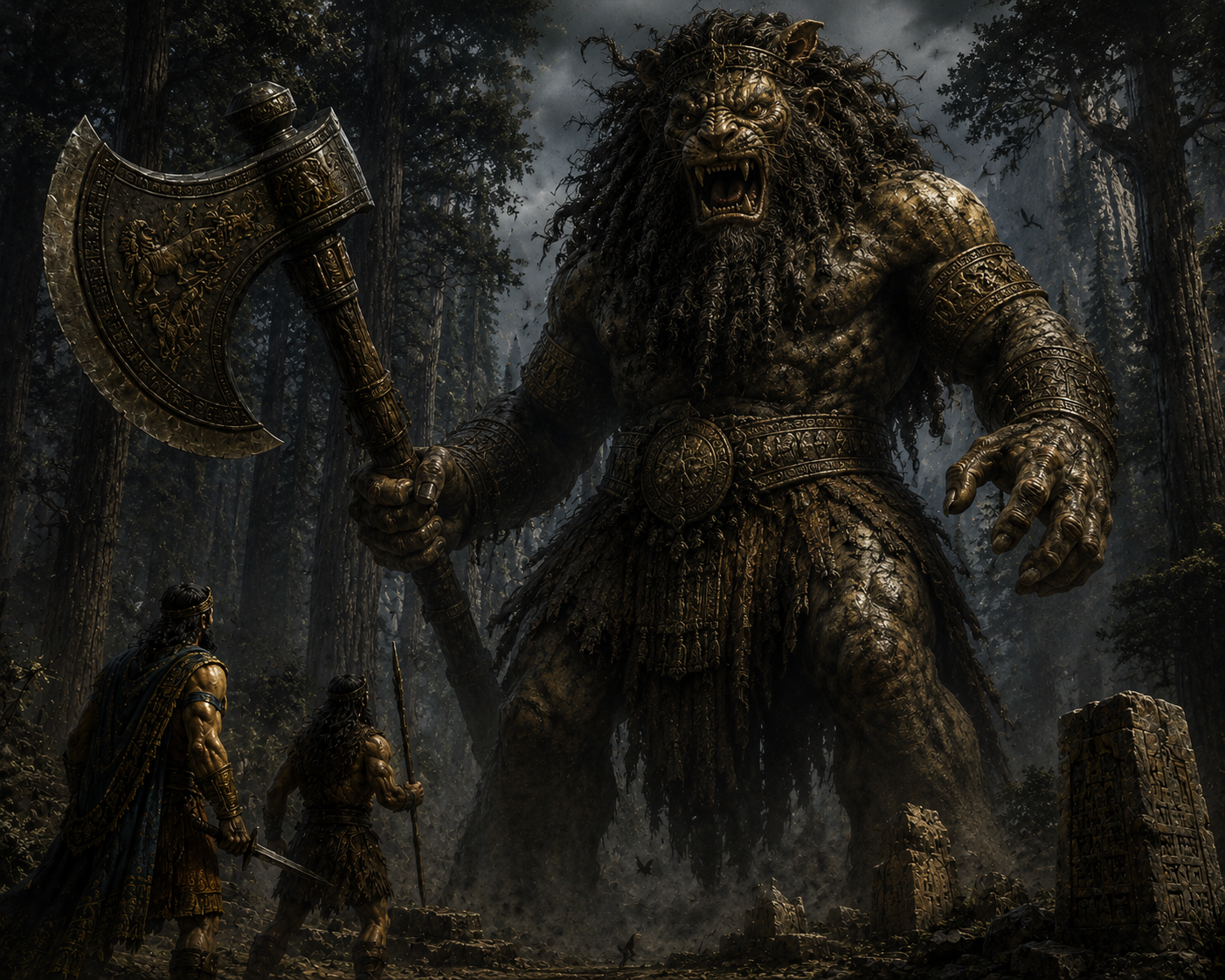
Humbaba towers above ordinary warriors, massively built but proportioned for tremendous speed and reach. His long, powerful legs carry him easily through mountain forests and across broken ground. His face combines leonine ferocity with something older and stranger: heavy brows, deep-set eyes, a broad predatory mouth and great fangs revealed whenever he roars.
Wild cords of dark hair and beard hang around his face like tangled roots. Bronze ornaments, ritual bindings and ancient tokens mark his body, but he needs no forged armour. His hide is supernaturally hard, and the Seven Terrors themselves seem to distort the air around him. When battle is unavoidable, he carries an immense bronze axe whose scale matches the guardian rather than any mortal weapon.
The Seven Terrors
Humbaba’s greatest supernatural power is the sequence of seven terrible auras surrounding him. Their presence makes approaching the guardian almost as dangerous as fighting him.
The ancient traditions describe Gilgamesh gaining access to Humbaba only after the guardian relinquishes these terrors one after another. When the seventh is surrendered, the heroes can finally come close enough to seize him.
After Humbaba’s death, Enlil distributes the surviving auras among the fields, rivers, reed-beds, lions, the palace, forests or hills, and finally Nungal, goddess of prisoners.
The Cedar Forest
The forest Humbaba guards is no ordinary stand of timber. Ancient cedars rise like pillars above shadowed mountain valleys, their crowns disappearing into mist. Narrow paths twist between ravines, old boundary stones and groves that have never known an ordinary woodcutter’s axe.
The Forest Falls Silent
Birds stop calling when Humbaba draws near. Animals disappear into the undergrowth and even the wind through the upper branches seems to cease.
Forbidden Cedars
The oldest trees stand beyond ancient boundary stones. Those who cross carrying axes, fire or tools of destruction announce themselves to the guardian.
Mountain Roads
The approaches wind through successive ridges and steep valleys. Travellers may spend days climbing while still seeing the dark cedar forest far above them.
The Guardian’s Presence
Tracks vanish, routes seem to bend back upon themselves, and the same immense cedar may appear more than once before Humbaba finally reveals himself.
Gilgamesh and Enkidu
Gilgamesh sets out for the cedar mountains seeking renown and their legendary timber. Enkidu , who knows the wilderness and understands Humbaba’s power, warns him repeatedly of the danger ahead.
The expedition receives aid from Utu, and weapons and axes are prepared before the heroes enter the mountains. Deep within the forest, Humbaba releases his terrors and the confrontation becomes a struggle not merely against his enormous body but against the supernatural force surrounding him.
Once the Seven Terrors have been surrendered, Humbaba is captured. He appeals for his life and Gilgamesh begins to show pity, but Enkidu urges his companion to finish what they began. Humbaba is killed and his head is carried before Enlil.
Enlil responds with anger rather than celebration and sends Humbaba’s surviving supernatural auras out into the world.
Divine Powers
Enlil
Enlil is closely connected with Humbaba’s fate. The great god receives Humbaba’s severed head with anger and ultimately redistributes the guardian’s seven auras.
Utu / Shamash
The solar power Utu plays a central role in the journey toward the cedar mountains and aids Gilgamesh’s expedition. Divine winds associated with the struggle against Humbaba can still expose weaknesses in the guardian’s supernatural defences.
Combat & Tactics
Humbaba fights as a territorial guardian rather than a wandering predator. He uses terrain and terror before committing his enormous strength to close combat.
- He forces intruders to cross hostile forest terrain while one of the Seven Terrors is active.
- He uses Look of Death against leaders, spellcasters and creatures rallying frightened companions.
- Voice of the Deluge breaks formations, while Mouth of Fire punishes clustered enemies.
- In melee, Humbaba uses the reach and weight of his colossal bronze axe to prevent smaller enemies surrounding him.
- He uses roots, tremors and the canopy to isolate enemies rather than pursuing fleeing opponents far beyond his territory.
Regional Effects
Where Humbaba’s authority over a sacred cedar wilderness is fully awakened, signs of the guardian appear long before he is seen.
- Within 6 miles, the scent of cedar becomes unnaturally strong whenever travellers move toward the heart of the forest.
- Within 3 miles, ordinary woodland animals fall silent when creatures carrying axes, saws or open flame approach.
- Within 1 mile, tracks left by creatures hostile to the forest begin fading within minutes.
- Sleepers within the inner forest frequently dream of a huge lion-like face staring between cedar branches.
- Whenever a sacred cedar is deliberately felled or burned, Humbaba immediately knows its location while he remains within the same forest.
Humbaba in the Present Age
The ancient guardian has again taken up his watch over surviving sacred cedar groves hidden beyond ordinary roads. Travellers tell of enormous tracks, abandoned logging camps and axes found embedded in tree trunks far above a man’s reach.
Humbaba does not hunt settlements for sport. Trouble begins when rulers, merchants, armies or adventurers cross the old boundaries and attempt to claim what he protects. Once the sacred trees are threatened, retreat may be the only alternative to facing the Seven Terrors.
The Forbidden Expedition
A wealthy patron commissions the recovery of cedar from a remote grove said to have survived since the first cities. The expedition discovers why no timber has left the valley.
The Seven Auras
Ancient objects carrying traces of Humbaba’s scattered terrors begin appearing in distant lands. Someone is gathering them together.
The King’s Axes
A royal logging operation crosses an ancient boundary and begins cutting sacred cedars. Humbaba answers the intrusion personally.
The Forest’s Judgement
The characters discover that the monster they were hired to destroy is defending a sanctuary from the people who sent them.
Humbaba in Myth
Who Is Humbaba?
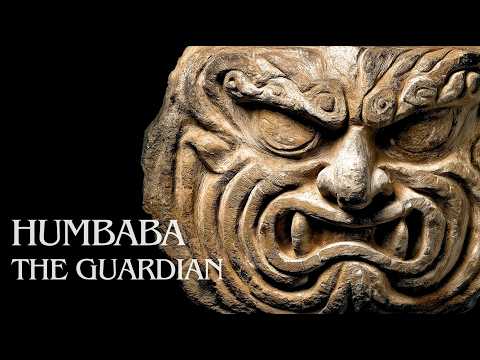
A focused exploration of Humbaba himself: the ancient guardian of the Cedar Forest, his terrifying appearance and his place in Mesopotamian mythology.
Watch Who Is Humbaba?Gilgamesh vs. Humbaba
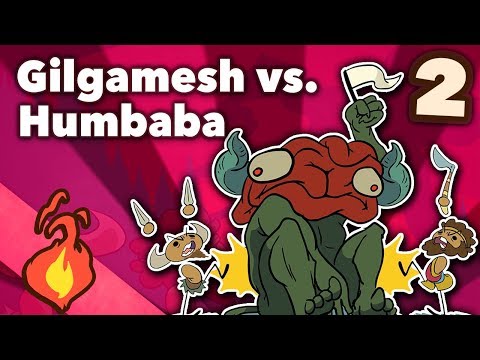
The Cedar Forest episode: Gilgamesh and Enkidu enter Humbaba’s domain and confront its supernatural guardian.
Watch Gilgamesh vs. HumbabaHistorical & Mythological Context
Huwawa in the Sumerian Tradition
The oldest surviving literary traditions call the guardian Huwawa. In the Sumerian tale Gilgamesh and Huwawa, Gilgamesh and Enkidu journey to the distant cedar mountains, where Huwawa guards the forbidden forest.
Huwawa is more than an exceptionally large warrior. His presence radiates supernatural terrors that make approaching him dangerous before battle even begins. The heroes ultimately overcome the guardian, but his death is not treated as an uncomplicated triumph.
Humbaba in the Babylonian Epic
The Cedar Forest story continued into the later Akkadian tradition of the Epic of Gilgamesh. There the guardian is known as Humbaba, and Gilgamesh and Enkidu again undertake the dangerous journey to the sacred forest.
The episode became one of the defining adventures of Gilgamesh: a heroic quest for fame that also demonstrates the danger of violating divine boundaries. Humbaba stands between the heroes and the ancient cedars not as a wandering predator, but as the guardian of a forbidden place.
The Seven Terrors
The Seven Terrors are among the most important features of the older Huwawa tradition. They are supernatural radiances or auras associated with the guardian rather than ordinary weapons or armour.
Their presence explains why reaching Humbaba is itself a challenge. After the guardian is slain, Enlil redistributes the surviving terrors through the world, linking Humbaba’s power to fields, rivers, reed-beds, lions, the palace, the wilderness and Nungal.
Sources
- Gilgamesh and Huwawa, Version A. Electronic Text Corpus of Sumerian Literature, University of Oxford. Translation .
- The Metropolitan Museum of Art. Plaque with face of the demon Humbaba , Old Babylonian, ca. 2000–1600 BCE, Object 55.162.1. Museum record .
- Pathfinder Roleplaying Game Bestiary 3. Archives of Nethys .
Section 15: Copyright Notice
Pathfinder Roleplaying Game Bestiary 3, © 2011, Paizo Publishing, LLC; Authors Jesse Benner, Jason Bulmahn, Adam Daigle, James Jacobs, Michael Kenway, Rob McCreary, Patrick Renie, Chris Sims, F. Wesley Schneider, James L. Sutter, and Russ Taylor, based on material by Jonathan Tweet, Monte Cook, and Skip Williams.
Keep this reference growing
If this page helped with your reading or game, you can support its upkeep or explore the curated books.
Explore the Bookshop — epics, classics and stories behind imagined worlds.