
Skvader — The Winged Hare of Sweden
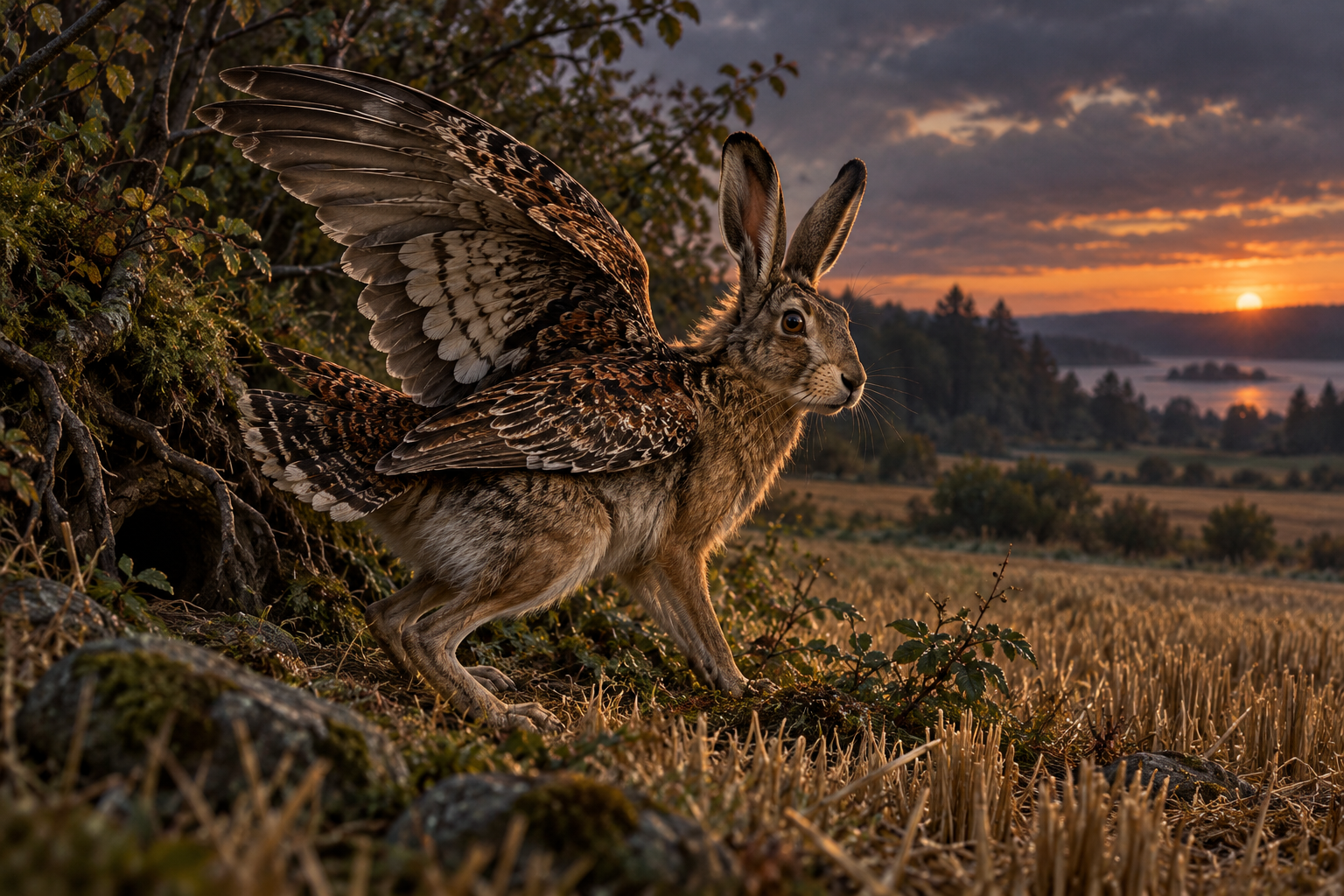
The barley vanished, but no rabbit could have flown over the farmer’s gate. Three small wing-marks scar the mud beyond the field, and in the hedge a narrow burrow is stuffed with green stalks. By sunset the next field will be stripped, unless someone persuades the miller’s men to stop hunting the wrong animals.
A skvader is a small creature with a hare’s head, forequarters and hind legs but the wings, back and tail of a wood grouse. In a campaign it is a nervous grass-feeding magical beast that freezes when threatened, then springs into flight or makes a desperate clinging bite if cornered. A lone skvader is more of a mystery than a monster; several skvaders emptying a farm or answering an alarm cry can become a meaningful local threat.
The real-world skvader began as a Swedish hunter’s tall tale, not a documented medieval animal. Its most famous physical specimen is an assembled taxidermy work dating from 1918. A fantasy-world living skvader therefore uses the folklore as inspiration rather than being presented as a real species discovered in Swedish history.
Skvader: Quick Guide for Players and GMs
At the table: Think of a frightened hare that can fly just long enough to escape a snare. The real danger is chasing it into a family den or ignoring the crop damage until hungry villagers turn on one another.
| Best encounter | A farmer’s impossible pest problem that reveals a quarrel over a miller’s hedge. |
|---|---|
| Players notice | Quiet scuffling, half-eaten shoots, wings unfolding from what looked like a hare. |
| Creature wants | To eat undisturbed, protect its young and return to its burrow. |
| Counterplay | Leave an escape route, fence an exposed field, protect grain stores, or use humane traps rather than cornering a whole family. |
| At a glance | One skvader is weak. Several attached at once cost actions to remove, and a family may draw help with its alarm call. |
Run it in three beats
- Show the puzzle: The field is cropped bare and the tracks end beside unexplained feathers.
- Offer a choice: Guard the crop, follow a harmless specimen, or negotiate with the neighbouring family accused of stealing the grain.
- Give consequences: A peaceful solution saves the harvest and the animal; an unnecessary hunt sends the pack across the village boundary.
Skvader Stat Blocks — Four Editions
Select the edition you are playing. The Pathfinder 1e CR ½ entry is the published creature from Shards of Sin; D&D 2024, D&D 2014 and D&D 3.5e are original conversions, not official published monsters. These rules differ deliberately where editions handle attaching and grappling differently.
Skvader — D&D 2024
Tiny Monstrosity, Unaligned · CR ¼ (50 XP; PB +2) · Original conversion
AC 13; Initiative +3 (13); HP 10 (3d4+3); Speed 40 ft., Fly 30 ft.
| STR | DEX | CON | INT | WIS | CHA |
|---|---|---|---|---|---|
| 6 (−2) | 16 (+3) | 12 (+1) | 4 (−3) | 14 (+2) | 8 (−1) |
Skills Perception +4, Stealth +5; Senses Darkvision 60 ft., Passive Perception 14; Languages —; Habitat Forest, Grassland, Hill; Treasure none.
Traits
Startle Response. The skvader has Advantage on Dexterity (Stealth) checks to hide in long grass or low foliage. It can take the Disengage action as a Bonus Action while not attached to another creature.
Actions
Bite. Melee Attack Roll: +5, reach 5 ft., one creature. Hit: 5 (1d4+3) Piercing damage. If the target is Medium or smaller, the skvader may attach itself to the target. While attached it occupies the target’s space, moves with it and has AC 11; the target is not Grappled and can move normally. At the start of each of the skvader’s subsequent turns while attached, the target takes 2 (1d4) Piercing damage. The target or an ally can use an action to detach it with a successful DC 11 Strength (Athletics) check; the skvader may detach itself as a Bonus Action. A skvader can be attached to only one creature at a time.
Alarm Screech (1/Day). The skvader emits a cry audible to other skvaders within 300 feet in the open. This warns any creatures already nearby but does not summon or create additional monsters.
Running It
One skvader is mainly a nuisance. It seeks long grass, takes one desperate bite if trapped, and flees if the route opens. A pack matters because repeated attachments demand actions from the party; count every creature separately for encounter difficulty.
Original D&D 2024 rules based on fifth-edition conventions; not published by Wizards of the Coast or Paizo.
Skvader — D&D 2014
Tiny monstrosity, unaligned · Challenge ¼ (50 XP) · Original conversion
Armor Class 13; Hit Points 10 (3d4+3); Speed 40 ft., fly 30 ft.
| STR | DEX | CON | INT | WIS | CHA |
|---|---|---|---|---|---|
| 6 (−2) | 16 (+3) | 12 (+1) | 4 (−3) | 14 (+2) | 8 (−1) |
Skills Perception +4, Stealth +5; Senses darkvision 60 ft., passive Perception 14; Languages —.
Traits
Startle Response. The skvader has advantage on Dexterity (Stealth) checks to hide in long grass or low bushes. When not attached to a creature, it can take the Disengage action as a bonus action.
Actions
Bite. Melee Weapon Attack: +5 to hit, reach 5 ft., one creature. Hit: 5 (1d4+3) piercing damage. A skvader that bites a Medium or smaller target may attach to it: it occupies the target’s space and travels with it, but does not impose the grappled condition or reduce its speed. The skvader’s AC is 11 while attached. At the beginning of each of the skvader’s following turns it deals 2 (1d4) piercing damage to the target. The target or another creature can use an action and a successful DC 11 Strength (Athletics) check to remove it. The skvader can detach itself as a bonus action and can attach to only one target at a time.
Alarm Screech (1/Day). A cry audible to other skvaders up to 300 feet away in the open; existing creatures might investigate at the GM’s discretion. No new monsters are created.
Encounter Note
The animal freezes first, sprints or flutters away if threatened, and bites only when chased into a dead end or defending young. The difficulty of a family or flock depends on the number of skvaders, not the listed CR of one.
Original D&D 2014 conversion; not the Pathfinder 1e printed statistics.
Skvader — Pathfinder 1e
CR ½ · XP 200 · N Tiny magical beast · Published in Pathfinder Adventure Path #61: Shards of Sin (2012)
Init +2; Senses darkvision 60 ft., low-light vision; Perception +1.
Defense
AC 14, touch 14, flat-footed 12 (+2 Dex, +2 size); hp 6 (1d10+1); Fort +3, Ref +4, Will +1.
Offense
Speed 40 ft., fly 40 ft. (poor); Melee bite +5 (1d3−1 plus attach); Space 2½ ft.; Reach 0 ft.
Statistics
Str 8, Dex 15, Con 13, Int 4, Wis 13, Cha 6; Base Atk +1; CMB +1; CMD 10 (14 vs. trip); Feats Weapon Finesse; Skills Stealth +14.
Ecology
Environment temperate forest and hills; Organization solitary, pair, family (3–12), or mixed pack (1 wolpertinger and 3–12 skvaders); Treasure none.
Special Abilities
Attach (Ex). When the skvader hits with its bite, it automatically latches onto its target. The skvader is considered grappling, but the victim is not grappled and can still move and act normally. The skvader deals its normal bite damage automatically each round while attached and loses its Dexterity bonus to AC (AC 12). The victim can attack or grapple the attached skvader as normal, or break the attachment with a successful grapple check or Escape Artist check under Pathfinder 1e rules. Do not substitute the fifth-edition attachment mechanic, which has different removal actions.
Familiar Option
Under the printed source, a neutral spellcaster may select a skvader using the Improved Familiar feat at spellcaster level 3 if other prerequisites are met. The skvader is not automatically an eligible familiar in other editions.
Published Pathfinder 1e material from Skvader — d20PFSRD, originally Pathfinder Adventure Path #61: Shards of Sin, © 2012 Paizo Publishing, LLC. The Pathfinder statistics and rule text are Open Game Content under OGL v1.0a with full notice below.
Skvader — D&D 3.5e
Tiny Magical Beast · Original CR ½ campaign conversion
| Size/Type | Tiny Magical Beast |
|---|---|
| Hit Dice | 1d10+1 (6 hp) |
| Initiative | +2 |
| Speed | 40 ft. (8 squares), fly 40 ft. (poor) |
| Armor Class | 14 (+2 size, +2 Dex), touch 14, flat-footed 12 |
| Base Attack/Grapple | +1/−8 |
| Attack | Bite +5 melee (1d3−1, minimum 1, plus attach) |
| Full Attack | Bite +5 melee (1d3−1, minimum 1, plus attach) |
| Space/Reach | 2½ ft./0 ft. |
| Special Attacks | Attach |
| Special Qualities | Darkvision 60 ft., low-light vision |
| Saves | Fort +3, Ref +4, Will +1 |
| Abilities | Str 8, Dex 15, Con 13, Int 4, Wis 13, Cha 6 |
| Skills | Hide +14, Listen +1, Move Silently +2, Spot +1 |
| Feats | Weapon Finesse |
| Environment | Temperate Swedish woodland and grassy hills |
| Organization | Solitary, pair, or family (3–12) |
| Challenge Rating | ½ (original campaign conversion, playtest target) |
| Treasure | None |
| Alignment | Always neutral |
| Advancement | 2–3 HD (Tiny); recalculate CR and skills |
| Level Adjustment | — |
Combat
Attach (Ex). If the skvader bites a Medium or smaller creature, it can immediately move into the target’s space and cling to it without provoking an attack of opportunity or making an opposed grapple check. This is an original specific exception to normal Tiny-creature grapple rules, not a general bonus to its −8 grapple modifier. Each round it remains attached, it deals its normal bite damage automatically (minimum 1). It loses its Dexterity AC bonus while attached (AC 12). A target may use a standard action to remove it with a DC 12 Strength check or a DC 12 Escape Artist check; an adjacent ally may attempt the Strength check as a standard action. A skvader can cling to only one target at a time, and the target is not otherwise immobilised. If it voluntarily detaches it lands in an adjacent space.
Alarm Cry (Ex). A cornered skvader shrieks loudly enough that other skvaders nearby might investigate. This is an audible warning, not a magical summoning effect and does not add free creatures to an encounter.
Using the Skvader. In 3.5e, the skvader has 0-foot natural reach, so a normal Tiny creature would need to enter a foe’s space to attack. Its specific Attach ability provides that approach without provoking an attack of opportunity. Describe it clinging to a traveller’s cloak or boot while the remaining animals dart back into the brush; the target can keep moving while trying to dislodge it.
Original 3.5e conversion using D&D 3.5e SRD magical beast rules under OGL v1.0a; it is not an official 3.5e monster. Its CR and custom Attach mechanic are campaign playtest targets.
What Is Happening Right Now?
The village miller has persuaded a neighbouring reeve to fence off a meadow to keep hares away from the barley. The animals simply fly across it at dusk. Now the miller blames the reeve’s family for stealing seed, and the reeve threatens to seize the mill’s winter grain unless the accusation is withdrawn. A frightened skvader fledgling is trapped beneath the stone culvert that carries water to both farms. A pack of adults is gathering in the reeds, ready to defend it.
The party can investigate the winged tracks and the culvert, rescue the fledgling, or settle the disputed grazing boundary. Burning the nesting scrub protects one harvest but damages the watercourse; moving food or constructing a temporary covered path gives both landowners time to reach an agreement.
Behaviour, Ecology and Counterplay
At rest: A skvader resembles a squat hare until the back feathers shift. It is a herbivore in the fantasy ecosystem, feeding heavily and sometimes destroying tender crops. It favours grassy woodland edges and shallow burrows, usually keeping a route to open ground.
Alarm and defence: A threatened skvader often freezes before bolting. If trapped, it bites and clings to the threat, then shrieks. Other skvaders may rush from nearby hides; the shriek is a natural signal, not a magical summoning rule. Large families are harder encounters simply because more animals participate.
Counterplay: Recognise the feather marks before entering the den; use sacks, nets and covered baskets to shepherd animals out without crushing them; move a fallen tree to reopen an escape route; keep people out of a panicked burrow entrance. Separate a biting skvader using the applicable edition’s action, escape or removal rule.
Society: Fantasy skvaders may travel in family groups and share burrow systems. Earlier Pathfinder text imagines occasional mixed packs with a wolpertinger. Do not equate the fictional family dynamics with the history of the taxidermy hoax.
Encounter: The Barley That Took Wing
Scene: A strip of harvested grain lies flat but the ground is unbroken. A frightened farm dog keeps barking at a thicket on the far side of a newly repaired gate; the gate’s gaps are too narrow for hares to pass. Three skvaders are eating beyond it, and one fledgling is trapped beneath a wooden wheel sunk into the culvert.
Visible clues: Grouse feathers mixed with hare fur, feather arcs among the prints, clipped barley heads and a shrill call when anyone blocks the burrow. Every clue can be found without fighting.
GM choices: The party can free the fledgling, open the field gate, distract the adults with cut grass, or drive the skvaders across another farmer’s land. If players corner them, use the listed skvader statistics and add family members as separate creatures; do not introduce unlimited reinforcements.
GM Encounter Difficulty — Four Editions
For four first-level characters: Start with one curious adult and two animals that flee when given an open escape route. The remaining family is an environmental complication, not automatic combat reinforcements. The trapped fledgling cannot fight. Use three combat-ready adults only if the party deliberately blocks their escape; present warning signs before they attack.
| D&D 2024 | Each Skvader is CR ¼ (50 XP). Four adults total 200 XP, the Low budget for four level-one characters under the 2024 system; however, repeated automatic attachment damage can make that deceptively hazardous. Use two or three if the party is already wounded. |
|---|---|
| D&D 2014 | Four CR ¼ creatures award 200 XP, adjusted to 400 encounter XP after the group-of-four ×2 multiplier. That reaches the Deadly threshold for four level-one characters. Fewer active attackers, opportunities to retreat and noncombat objectives make the scene safer. |
| Pathfinder 1e | One skvader is CR ½; calculate the group encounter CR for the number actually fighting. Its published Attach ability deals automatic damage while clinging, so a fleeing adult need not keep attacking. |
| D&D 3.5e | One original-conversion skvader is provisionally CR ½. Respect its 0-foot reach and custom Attach exception; adding a whole family sharply raises the tactical danger. |
Counterplay that works: Players can release the fledgling, lift the wheel, open the gate, withdraw from the burrow and use an action to pull off an attached skvader. The objective is to save the grain and avoid an escalating dispute, not to kill every animal.
Consequences: Saving the young gains the gratitude of a farmer whose harvest can still be protected with netting. Chasing the pack towards the rival village may trigger the very land dispute the party hoped to prevent.
Adventure Hooks
The Taxidermist’s Last Commission
A collector offers a high reward for a lifelike skvader trophy. The woodcarver knows how to manufacture one from ordinary remains; a living specimen in the woods has just begun to steal vegetables. The party must decide whether to expose the forgery, protect the creature or deliver a convincing substitute.
The Winged Thief
Every night a merchant finds his bright red sealing ribbons dragged from a cart despite locked shutters. A skvader has woven them into the roof of its den, inadvertently revealing the route of a smuggler’s hidden cargo.
The Familiars’ Bargain
A neutral spellcaster seeks an adventurous skvader as a familiar, but its family is nesting in a field scheduled for burning. In Pathfinder 1e the source allows a skvader through Improved Familiar at the appropriate caster level; in other editions familiar eligibility is a GM decision, not an automatic entitlement.
Treasure and Aftermath
The creature carries no treasure. Its nest might hold a coloured string, small copper button, unusual carved token or the missing tally stick of a farm worker. The party’s lasting rewards should be access to the road, a settled neighbourly conflict and perhaps a rescued fledgling—not an implausible cache of coins.
Swedish Folklore and the Skvader’s Origins
The Original Skvader Exhibit
The historical mounted skvader illustrates the Swedish hunting joke. Unlike the living fantasy creature in the hero artwork, this is a constructed taxidermy exhibit, not a documented animal.

The real skvader is a comic Swedish hare-and-grouse hybrid associated with Sundsvall and Medelpad. Hunter Håkan Dahlmark claimed to have shot one in 1874; a birthday painting was produced for him in 1907, and taxidermist Rudolf Granberg assembled the renowned mounted specimen in 1918. It is a creation of humorous storytelling and craftsmanship, not a confirmed animal and not a securely documented medieval legend.
The skvader’s forequarters and rear legs are those of a hare, while its back, wings and tail resemble a female wood grouse. Different modern drawings invent variations, but wings and hare legs are the recognisable shape. The Bavarian wolpertinger and American jackalope are related examples of composite-animal stories with their own regional histories. In a fantasy campaign the living animal can be real without rewriting the origin of the actual Swedish hoax.
For background see the Swedish American Museum’s account of the skvader, the Swedish hunting-history account, and the Wikimedia Commons historical images.
Related Monsters and Adventures
For a more territorial flying hare-creature, visit the Wolpertinger. The Magical Beasts index holds other unusual animals, while the Midgard Bestiary offers northern-region creatures. Follow the World Bestiary for a broader collection.
Skvader FAQs
What is a skvader?
The skvader is a Swedish fictional hybrid that has a hare’s front, hind legs and head, with a female wood grouse’s wings, back and tail. In this fantasy RPG entry it becomes a small, flying, crop-eating magical beast.
Is the skvader a real animal?
No. The best-known museum specimen is a constructed taxidermy exhibit completed in 1918; the earlier claim of a sighting was a hunting tall tale.
Can a skvader fly?
The mythical animal is winged. The fantasy creature on this page has a limited flight speed in all four edition stat blocks, usually using brief wingbeats to flee or cross obstacles.
How does a skvader fight?
It runs or hides first. If trapped, it bites and attaches to its attacker. In Pathfinder 1e the published attach ability functions differently from the independent D&D conversions, so use the rules within the chosen edition tab.
What challenge rating is the skvader?
The original fifth-edition versions are CR ¼; the published Pathfinder 1e creature is CR ½; the original D&D 3.5e creature is provisionally CR ½. A family of several creatures is a higher-risk encounter.
Can a skvader be a familiar?
Pathfinder 1e provides an Improved Familiar option for an eligible neutral spellcaster at level 3. The other edition conversions do not grant familiar eligibility unless the GM allows it.
Sources and Licensing
Pathfinder 1e: The CR ½ rules originate with Skvader — d20PFSRD, drawn from Pathfinder Adventure Path #61: Shards of Sin (© 2012, Paizo Publishing, LLC; author Greg A. Vaughan). The full OGL v1.0a appears below.
5e / 2024 and 2014: Both are original creatures following the relevant D&D 2024 SRD 5.2.1 and SRD 5.1 conventions. They are not official or Paizo-published conversions.
3.5e: Original converted rules using the D&D 3.5e SRD magical beast type under OGL v1.0a. Its Attach exception and CR are campaign rules, not official D&D 3.5e content.
Image: The original photograph is credited to the Medelpad antiquarian association archive / unknown photographer; see Wikimedia Commons File:Skvader.jpg for use and credit details. Reproduction is unchanged; do not assume the photographed specimen was a living animal.
Open Game Content designation: Pathfinder 1e reproduced mechanics and the OGL-derived 3.5e game mechanics are Open Game Content. Original narrative, in-world encounters, folklore commentary, historical analysis, visual design and imagery are not designated OGC. Attribution does not constitute publisher endorsement.
Open Game License v1.0a — complete text and copyright notices
OPEN GAME LICENSE Version 1.0a
The following text is the property of Wizards of the Coast, Inc. and is Copyright 2000 Wizards of the Coast, Inc (“Wizards”). All Rights Reserved.
1. Definitions: (a)”Contributors” means the copyright and/or trademark owners who have contributed Open Game Content; (b)”Derivative Material” means copyrighted material including derivative works and translations (including into other computer languages), potation, modification, correction, addition, extension, upgrade, improvement, compilation, abridgment or other form in which an existing work may be recast, transformed or adapted; (c) “Distribute” means to reproduce, license, rent, lease, sell, broadcast, publicly display, transmit or otherwise distribute; (d)”Open Game Content” means the game mechanic and includes the methods, procedures, processes and routines to the extent such content does not embody the Product Identity and is an enhancement over the prior art and any additional content clearly identified as Open Game Content by the Contributor, and means any work covered by this License, including translations and derivative works under copyright law, but specifically excludes Product Identity. (e) “Product Identity” means product and product line names, logos and identifying marks including trade dress; artifacts; creatures characters; stories, s torylines, plots, thematic elements, dialogue, incidents, language, artwork, symbols, designs, depictions, likenesses, formats, poses, concepts, themes and graphic, photographic and other visual or audio representations; names and descriptions of characters, spells, enchantments, personalities, teams, personas, likenesses and special abilities; places, locations, environments, creatures, equipment, magical or supernatural abilities or effects, logos, symbols, or graphic designs; and any other trademark or registered trademark clearly identified as Product identity by the owner of the Product Identity, and which specifically excludes the Open Game Content; (f) “Trademark” means the logos, names, mark, sign, motto, designs that are used by a Contributor to identify itself or its products or the associated products contributed to the Open Game License by the Contributor (g) “Use”, “Used” or “Using” means to use, Distribute, copy, edit, format, modify, translate and otherwise create Derivative Material of Open Game Content. (h) “You” or “Your” means the licensee in terms of this agreement.
2. The License: This License applies to any Open Game Content that contains a notice indicating that the Open Game Content may only be Used under and in terms of this License. You must affix such a notice to any Open Game Content that you Use. No terms may be added to or subtracted from this License except as described by the License itself. No other terms or conditions may be applied to any Open Game Content distributed using this License.
3. Offer and Acceptance: By Using the Open Game Content You indicate Your acceptance of the terms of this License.
4. Grant and Consideration: In consideration for agreeing to use this License, the Contributors grant You a perpetual, worldwide, royalty-free, non-exclusive license with the exact terms of this License to Use, the Open Game Content.
5. Representation of Authority to Contribute: If You are contributing original material as Open Game Content, You represent that Your Contributions are Your original creation and/or You have sufficient rights to grant the rights conveyed by this License.
6. Notice of License Copyright: You must update the COPYRIGHT NOTICE portion of this License to include the exact text of the COPYRIGHT NOTICE of any Open Game Content You are copying, modifying or distributing, and You must add the title, the copyright date, and the copyright holder’s name to the COPYRIGHT NOTICE of any original Open Game Content you Distribute.
7. Use of Product Identity: You agree not to Use any Product Identity, including as an indication as to compatibility, except as expressly licensed in another, independent Agreement with the owner of each element of that Product Identity. You agree not to indicate compatibility or co-adaptability with any Trademark or Registered Trademark in conjunction with a work containing Open Game Content except as expressly licensed in another, independent Agreement with the owner of such Trademark or Registered Trademark. The use of any Product Identity in Open Game Content does not constitute a challenge to the ownership of that Product Identity. The owner of any Product Identity used in Open Game Content shall retain all rights, title and interest in and to that Product Identity.
8. Identification: If you distribute Open Game Content You must clearly indicate which portions of the work that you are distributing are Open Game Content.
9. Updating the License: Wizards or its designated Agents may publish updated versions of this License. You may use any authorized version of this License to copy, modify and distribute any Open Game Content originally distributed under any version of this License.
10. Copy of this License: You MUST include a copy of this License with every copy of the Open Game Content You Distribute.
11. Use of Contributor Credits: You may not market or advertise the Open Game Content using the name of any Contributor unless You have written permission from the Contributor to do so.
12. Inability to Comply: If it is impossible for You to comply with any of the terms of this License with respect to some or all of the Open Game Content due to statute, judicial order, or governmental regulation then You may not Use any Open Game Material so affected.
13. Termination: This License will terminate automatically if You fail to comply with all terms herein and fail to cure such breach within 30 days of becoming aware of the breach. All sublicenses shall survive the termination of this License.
14. Reformation: If any provision of this License is held to be unenforceable, such provision shall be reformed only to the extent necessary to make it enforceable.
15. COPYRIGHT NOTICE
Open Game License v 1.0a Copyright 2000, Wizards of the Coast, Inc.
System Reference Document, 5.0 Copyright 2016, Wizards of the Coast, Inc.; Authors Mike Mearls, Jeremy Crawford, Chris Perkins, Rodney Thompson, Peter Lee, James Wyatt, Robert J. Schwalb, Bruce R. Cordell, Chris Sims, and Steve Townshend, based on original material by E. Gary Gygax and Dave Arneson.
System Reference Document Copyright 2000-2003, Wizards of the Coast, Inc.; Authors Jonathan Tweet, Monte Cook, Skip Williams, Rich Baker, Andy Collins, David Noonan, Rich Redman, Bruce R. Cordell, John D. Rateliff, Thomas Reid, James Wyatt, based on original material by E. Gary Gygax and Dave Arneson.
Pathfinder Adventure Path #61: Shards of Sin © 2012, Paizo Publishing, LLC; Author: Greg A. Vaughan.
END OF LICENSE
Keep this reference growing
If this page helped with your reading or game, you can support its upkeep or explore the curated books.
Explore the Bookshop — epics, classics and stories behind imagined worlds.