
Unique Hellenic Mythic Being • Guardian of the Dead
Cerberus, Hound of Hades
Three jaws watch the road of death. A serpent coils where a hound’s tail should be. Behind him lies the kingdom of the dead; before him stand the few living souls reckless, blessed, cunning or mighty enough to attempt the passage.
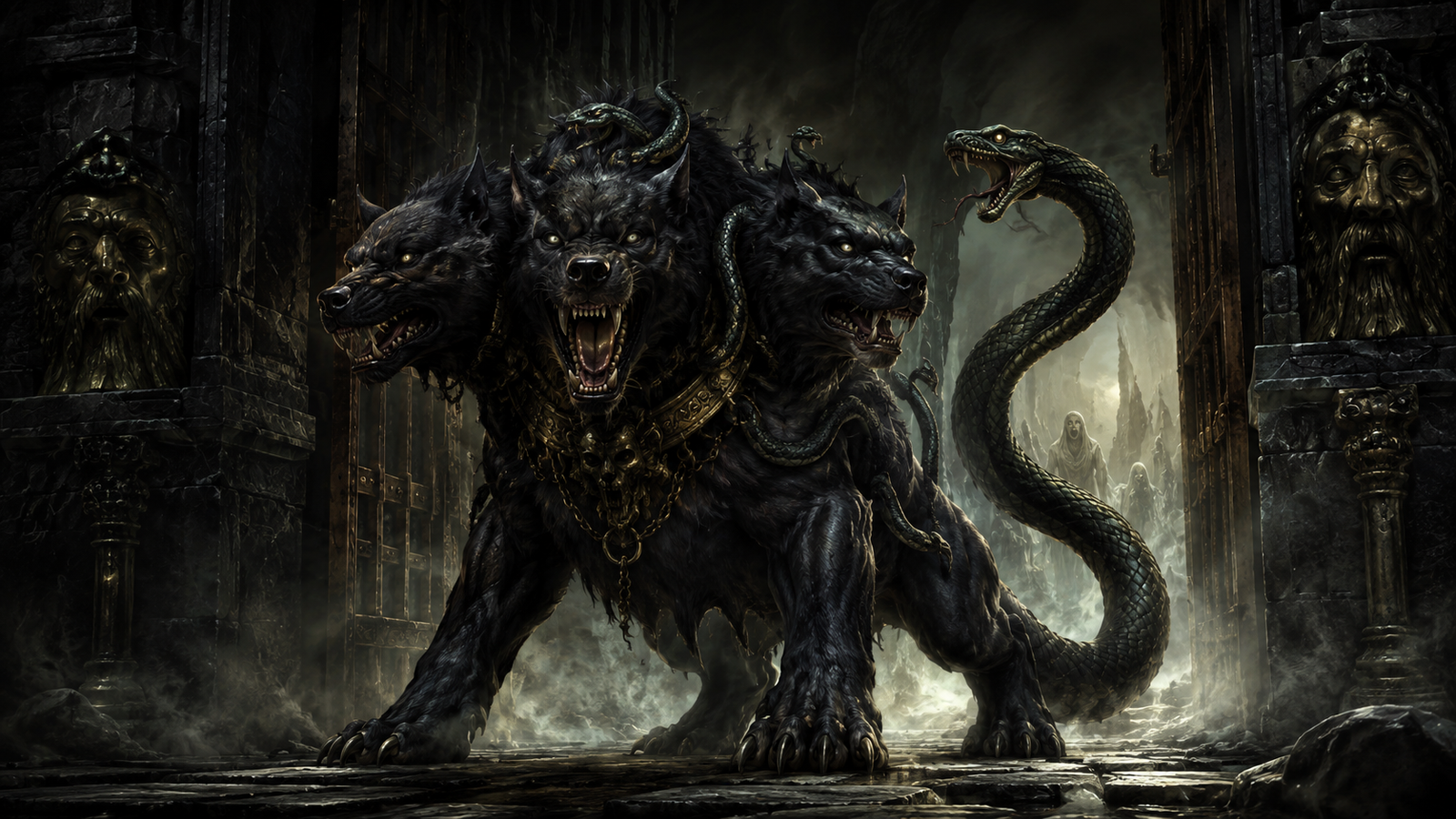
Cerberus is not a breed. He is the singular Hound of Hades, an ancient guardian whose task is more important than slaughter. He watches the boundary between the living and the dead. Those who enter without leave risk his jaws; those who attempt to escape the kingdom of the dead discover why even ghosts fear the sound of three throats barking at once.
Cerberus should not be confused with the lesser cerberi found elsewhere in the planes. Those creatures are fiendish multi-headed sentinels. Cerberus is a unique Hellenic being whose authority derives from his place in the household and realm of Hades.
Game Statistics
Cerberus is a major high-level guardian encounter rather than an ordinary monster wandering a dungeon. His greatest strength is control: he detects souls, watches several directions at once, prevents supernatural escape and punishes creatures that try to cross the threshold he has been ordered to protect.
Cerberus
Armor Class 20 (natural armor)
Hit Points 378 (28d12 + 196)
Speed 60 ft.
| STR | DEX | CON | INT | WIS | CHA |
|---|---|---|---|---|---|
| 30 (+10) | 16 (+3) | 25 (+7) | 10 (+0) | 20 (+5) | 16 (+3) |
Saving Throws Str +17, Dex +10, Con +14, Wis +12, Cha +10
Skills Perception +19, Survival +12
Damage Resistances Necrotic, Poison
Senses truesight 120 ft., passive Perception 29
Languages understands Ancient Greek and the speech of Hellenic divinities but cannot speak
Challenge 21 (33,000 XP; PB +7)
Actions
Reaction
Legendary Actions
Cerberus can take 3 Legendary Actions, choosing from the options below. Only one option can be used at a time and only at the end of another creature’s turn. Cerberus regains all spent Legendary Actions at the start of his turn.
At the Gates of Hades
When Cerberus fights at the supernatural threshold specifically entrusted to him, he can use the following realm actions. On initiative count 20, losing initiative ties, choose one effect. The same effect cannot be used twice in succession.
- Chains of the Gate. Black spectral chains erupt around up to three creatures Cerberus can see within 60 feet. Each target must succeed on a DC 22 Strength saving throw or be Restrained until initiative count 20 on the following round.
- Mist of Acheron. A 30-foot-radius region Cerberus can see within 120 feet fills with cold underworld mist until the next initiative count 20. The area is Heavily Obscured to living creatures. Cerberus sees through it normally.
- The Dead Turn Back. Each Undead or incorporeal spirit of Cerberus’s choice within 90 feet must succeed on a DC 22 Wisdom saving throw or immediately move up to its Speed away from the exit Cerberus guards. This movement does not provoke Opportunity Attacks.
Cerberus
Init +10; Senses darkvision 60 ft., low-light vision, scent, soul scent; Perception +40
Defense
AC 38, touch 14, flat-footed 32 (+6 Dex, +24 natural, –2 size)
hp 348 (24d10+216); fast healing 10
Fort +23, Ref +20, Will +15
DR 15/epic; SR 32
Defensive Abilities threefold vigilance, immortal office
Offense
Speed 60 ft.
Melee 3 bites +34 (4d6+11 plus gate-sealing bite), serpent tail +31 (2d6+5 plus poison)
Space 15 ft.; Reach 10 ft. (20 ft. with serpent tail)
Special Attacks aconite foam, gate-sealing bite, serpent venom
Statistics
| STR | DEX | CON | INT | WIS | CHA |
|---|---|---|---|---|---|
| 32 | 22 | 28 | 10 | 20 | 18 |
Base Atk +24; CMB +37; CMD 53 (57 vs. trip)
Feats Alertness, Combat Reflexes, Improved Critical (bite), Improved Initiative, Improved Iron Will, Improved Natural Attack (bite), Iron Will, Multiattack, Power Attack, Run, Skill Focus (Perception), Weapon Focus (bite)
Skills Perception +40, Survival +29
Languages understands Ancient Greek and the speech of Hellenic divinities but cannot speak
Special Abilities
Combat
Cerberus fights to hold a boundary rather than chase enemies across a battlefield. He positions his bulk between intruders and the road he guards, using his reach and Combat Reflexes to punish movement. He bites spellcasters and planar travellers whenever possible so that Gate-Sealing Bite prevents escape, while his serpent tail pressures creatures attempting to flank him.
If several opponents crowd the gate, Cerberus opens with Aconite Foam and then uses all three heads against whichever creature presents the greatest threat to his charge. Against exceptionally durable opponents, he uses Power Attack to bring his full physical might to bear.
He does not ordinarily pursue a creature that retreats away from the underworld threshold unless ordered to do so.
Cerberus
Hit Dice 30d10+300 (465 hp)
Initiative +6
Speed 60 ft.
Armor Class 40 (–2 size, +2 Dex, +30 natural), touch 10, flat-footed 38
Base Attack/Grapple +30/+53
Attack Bite +44 melee (3d6+15 plus gate-sealing bite)
Full Attack 3 bites +44 melee (3d6+15 plus gate-sealing bite) and serpent tail +41 melee (2d8+7 plus poison)
Space/Reach 15 ft./10 ft. (20 ft. with serpent tail)
Special Attacks aconite foam, gate-sealing bite, serpent venom
Special Qualities darkvision 60 ft., DR 15/epic, fast healing 10, gatekeeper’s dominion, immortal office, low-light vision, scent, soul scent, spell resistance 34, threefold vigilance
Saves Fort +27, Ref +21, Will +14
| STR | DEX | CON | INT | WIS | CHA |
|---|---|---|---|---|---|
| 40 | 15 | 30 | 11 | 14 | 13 |
Skills Listen +29, Search +17, Spot +29, Survival +13
Feats Alertness, Awesome Blow, Combat Reflexes, Improved Bull Rush, Improved Initiative, Iron Will, Lightning Reflexes, Multiattack, Power Attack, Track, Weapon Focus (bite)
Environment The Realm of Hades
Organization Solitary
Treasure None
Alignment Always neutral
Advancement —
Level Adjustment —
Special Abilities
Combat
Cerberus uses his immense body to occupy the route his enemies wish to cross. Combat Reflexes, his long serpent tail and three independent bites make moving around him extremely dangerous. His preferred target is not necessarily the strongest opponent, but whichever creature is closest to escaping his jurisdiction.
He opens a crowded engagement with Aconite Foam, then closes with all three heads. Creatures relying upon teleportation or planar magic quickly discover that the guardian’s jaws are designed to prevent exactly that form of escape.
Appearance
Cerberus is an enormous black hound built on a scale that makes warhorses seem slight. His shoulders rise above a man’s head and three great canine necks spring from a single immensely muscled body. Each head possesses its own attention and temper: one can watch the road behind while another studies a newcomer and the third lowers to scent the trace of death clinging to a soul.
His most recognisable form in SpiralWorlds bears three canine heads, a long serpentine tail ending in a venomous head, and smaller serpentine elements threaded through the heavy mane and along the shoulders. His coat is not aflame. Cerberus belongs to the chthonic darkness of the Hellenic dead, not to the infernal battlefields of Hell.
When angered, pale venomous foam gathers at the corners of all three mouths. His barking does not resemble the sound of an ordinary dog multiplied threefold; it rolls through stone corridors like bronze gates being struck from the other side.
Guardian of the Dead
Cerberus is terrifying, but cruelty is not his defining quality. He has a duty. The living do not possess an unrestricted right to enter the kingdom of the dead, and the dead do not possess an unrestricted right to leave it. Cerberus exists at the point where those two laws become teeth.
A properly received shade has little reason to fear him while travelling deeper into the underworld. The hound’s attention sharpens when a soul turns back toward the world of life, when an intruder crosses without divine permission, or when magic attempts to tear open a road around the gate rather than pass through it.
His obedience is principally owed to Hades, ruler of the underworld, and Persephone, its queen. Their sanction changes the encounter completely. A traveller carrying genuine permission from either deity may pass beneath three watchful muzzles without ever rolling initiative.
Origins and Monstrous Kin
The oldest surviving Greek traditions place Cerberus among the monstrous children of Typhon and Echidna. His wider mythic family includes some of the most famous monsters confronted by the heroes of Greece: the Hydra and the two-headed hound Orthrus belong to the same terrible lineage, while traditions also connect the Chimera to this monstrous generation.
This ancestry explains Cerberus’s mixture of canine and serpentine anatomy. He is not simply a large dog that somehow acquired additional heads. He belongs to the same primordial monster-stock in which species boundaries blur: dog becomes serpent, serpent becomes dragon, and several mouths may express one supernatural identity.
How Cerberus came into the service of Hades is less important than the permanence of the relationship. In the present order of the Hellenic underworld, Cerberus is part of the architecture of death itself. Travellers know the palace, the rivers, the judges and the hound as interconnected features of the same supernatural kingdom.
Cerberus and the Twelfth Labour of Heracles
The most famous breach of Cerberus’s guardianship belongs to Heracles. For his final labour, the hero was commanded to bring the Hound of Hades into the world of the living.
In an influential version of the tradition, Heracles does not simply storm the underworld and steal its guardian. He approaches Hades and receives conditional permission: he may take Cerberus if he can master the beast without relying upon the weapons he carries.
The resulting struggle is therefore one of the great demonstrations of Heraclean strength. Protected by the Nemean lion’s hide, Heracles closes with a monster strong enough to hold the gates of death. Cerberus’s serpent tail strikes and bites at him, but Heracles wrestles the hound into submission and brings him alive before Eurystheus. The achievement is temporary rather than destructive. Cerberus is ultimately returned to his rightful place in Hades.
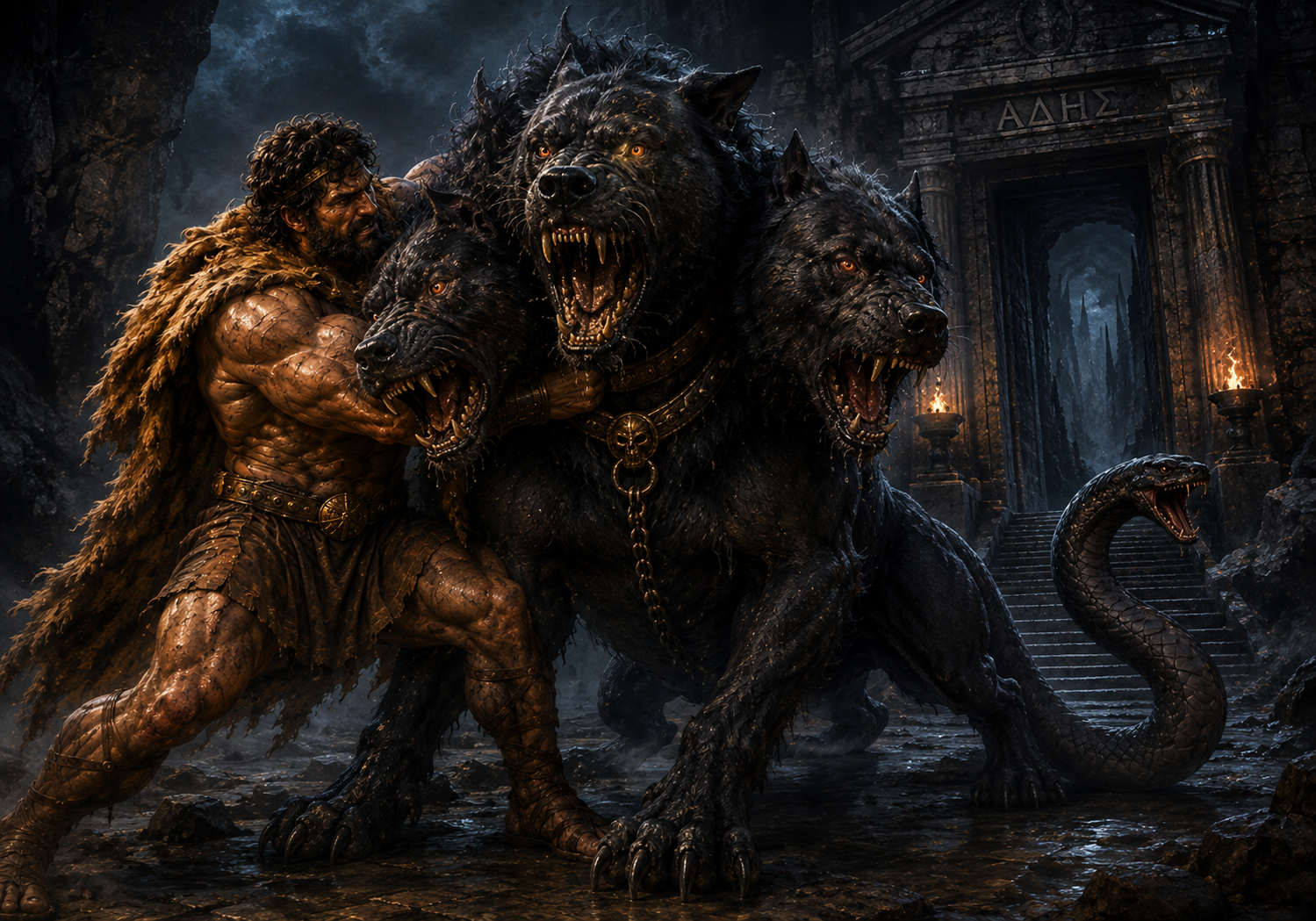
For a campaign, that distinction matters. Recreating the Twelfth Labour does not mean killing the monster. The proper challenge is to descend alive, obtain or circumvent divine permission, face Cerberus under strict conditions, master him without destroying him, bring him to the required destination and then survive the consequences of having removed the guardian of the dead from his gate.
Those Who Passed the Hound
Cerberus is formidable, but myth makes clear that force is not the only language the underworld understands. Different travellers survive him in different ways.
Running a Non-Combat Passage
When a party seeks passage instead of battle, treat Cerberus as a supernatural obstacle with several possible solutions rather than requiring a single predetermined skill. A legitimate token from an underworld power may end the challenge immediately. Music, ritual knowledge, an appropriate offering, deception backed by genuine chthonic lore, or a bargain made elsewhere in the underworld can each create a route through the scene.
Failure should not always begin with Cerberus trying to kill everyone. He may block the road, expose a disguised living creature, destroy a false token, seize an escaped shade, or drive intruders back toward the river. Combat becomes inevitable when the travellers insist upon crossing after the guardian has denied them.
Temperament and Intelligence
Cerberus possesses the instincts of a hound magnified by supernatural age and purpose. He recognises routine, authority, scent and intention with terrifying speed. He does not converse like a philosopher, but neither is he an unintelligent animal waiting for someone to throw food in the opposite direction.
The three heads do not represent three separate creatures. They are three expressions of one awareness. One head may rage while another remains suspicious and the third listens for movement behind the party, but all act toward the same purpose.
Cerberus can learn individuals. A hero who has once tricked the guardian should not expect the same trick to work casually a second time. A shade that has repeatedly attempted escape becomes as familiar to him as a scent worked into an old hunting trail.
Using Cerberus in a Campaign
The Forbidden Descent
The characters must enter Hades while still alive. Reaching the gate is only the beginning; they need a reason Cerberus will accept, a method of bypassing him, or enough power to survive forcing the issue.
The Escaped Soul
A soul has fled the underworld through means that should have been impossible. Cerberus is not the villain of the adventure. His failure is evidence that something has interfered with the laws governing the gate.
The Empty Gate
The heroes reach the threshold and discover Cerberus missing. The absence of the guardian should be more alarming than his presence. Something powerful enough to remove him has opened a road that was never meant to stand unguarded.
A New Labour
A ruler, deity or oracle commands a hero to reproduce the impossible feat of Heracles. The difficulty lies not merely in winning the wrestling match but in completing every stage of the journey without violating the terms imposed by Hades.
The Hound on Earth
Cerberus appears in the mortal world in pursuit of something that should be dead. The characters can fight the terrifying hound, or discover what escaped death so completely that the guardian himself was sent after it.
Three Heads, Three Roads
Each head fixes upon a different member of the party because each carries a different relationship with death: one has been resurrected, one bears a trapped soul, and one is travelling under divine protection.
Encounter Behaviour
- Cerberus protects a line. Place a meaningful gate, bridge, stair, cavern-mouth or other boundary behind him.
- He identifies escape magic early. Characters relying on teleportation should learn quickly that this guardian was created for exactly that problem.
- He watches the entire party. Sneaking behind one distracted head is not enough.
- He can be reasoned around without speaking. Tokens, divine authority, ritual actions and behaviour can communicate permission more effectively than conversation.
- Defeat does not require death. Subdual, distraction, sanctioned passage and temporary incapacitation are all legitimate victories.
Cerberus in the Present Age
Cerberus remains where mortals have feared to find him for millennia: at the boundary of the Realm of Hades. The ancient encounter with Heracles has not turned him into a wandering trophy or a defeated relic. He has resumed his office and continues to watch the traffic of the dead.
His appearance in the mortal world is consequently an omen of exceptional importance. If Cerberus is hunting on Earth, either the underworld sovereigns have sent him, something has escaped their jurisdiction, or the ordinary boundary between life and death has been damaged badly enough to require its greatest guardian.
Historical and Mythological Context
There is no single ancient description of Cerberus that settles every detail. His form changes across centuries of Greek and Roman literature and art. SpiralWorlds uses the familiar three-headed hound with serpent tail as the canonical physical form while preserving the older variations as genuine mythic traditions.
How Many Heads?
One of the earliest surviving literary descriptions, Hesiod’s Theogony, describes the hound of Hades with fifty heads. Other traditions multiply the number differently. Later literature increasingly settles upon three, and the triple-headed form eventually becomes Cerberus’s most recognisable identity.
Ancient visual art is no more mechanically consistent than the poetry. Some surviving representations show fewer canine heads than later literary descriptions. This is best treated as variation in ancient representation rather than evidence for a procession of different creatures all called Cerberus.
Dog and Serpent
The serpent is not a modern embellishment. Ancient descriptions and images combine canid and reptilian features. Apollodorus gives Cerberus three dog heads, a serpent for a tail and additional serpentine growths along his back. The hybrid form connects the hound visually with the wider monstrous family of Echidna and Typhon.
The Foam and Aconite
Roman poetic tradition connects Cerberus’s poisonous froth with aconite. In the story, the hound is dragged into daylight and his foam falls upon the earth, where the deadly plant takes root. SpiralWorlds turns that image into the monster’s Aconite Foam ability without requiring the campaign world to treat every botanical origin myth as literal.
The Honeyed Offering
Virgil’s Aeneid presents a different solution to the guardian. The Sibyl casts Cerberus a honeyed preparation infused with a sleep-inducing substance, and the hound collapses into supernatural slumber while Aeneas passes. The episode provides an excellent precedent for solving an underworld encounter through preparation and ritual knowledge instead of battle.
Heracles’ Victory
The capture of Cerberus is remembered as the final Labour of Heracles. An important feature of the Apollodoran account is the condition imposed by Hades: the hero must master Cerberus without the weapons he carries. This makes the feat an act of extraordinary strength and endurance rather than a monster-slaying episode.
Cerberus in Myth
This focused overview concentrates on Cerberus himself: the guardian of the Greek Underworld, his monstrous form and his place in Hellenic myth.

Cerberus: The Guardian of the Underworld
A focused mythological overview of the Hound of Hades and his role as guardian of the dead.
Historical and Mythological Sources
- Hesiod, Theogony 306–314. Early genealogy and the famous many-headed description of the Hound of Hades. Read at ToposText .
- Apollodorus, Library 2.5.12. Three canine heads, serpent tail and Heracles’s capture of Cerberus under Hades’s condition that the hero master him without his weapons. Read the text .
- Virgil, Aeneid Book VI. The triple-throated guardian and the Sibyl’s honeyed soporific offering. Read Book VI .
- Ovid, Metamorphoses Book VII. Cerberus’s foam and the mythic association with aconite. Read at Scaife Viewer .
- Theoi — Kerberos. Collected ancient literary and artistic references to Cerberus. Cerberus source collection .
Keep this reference growing
If this page helped with your reading or game, you can support its upkeep or explore the curated books.
Explore the Bookshop — epics, classics and stories behind imagined worlds.