
Changeling — Fey Doubles, Stolen Children and Hag-Born Kin
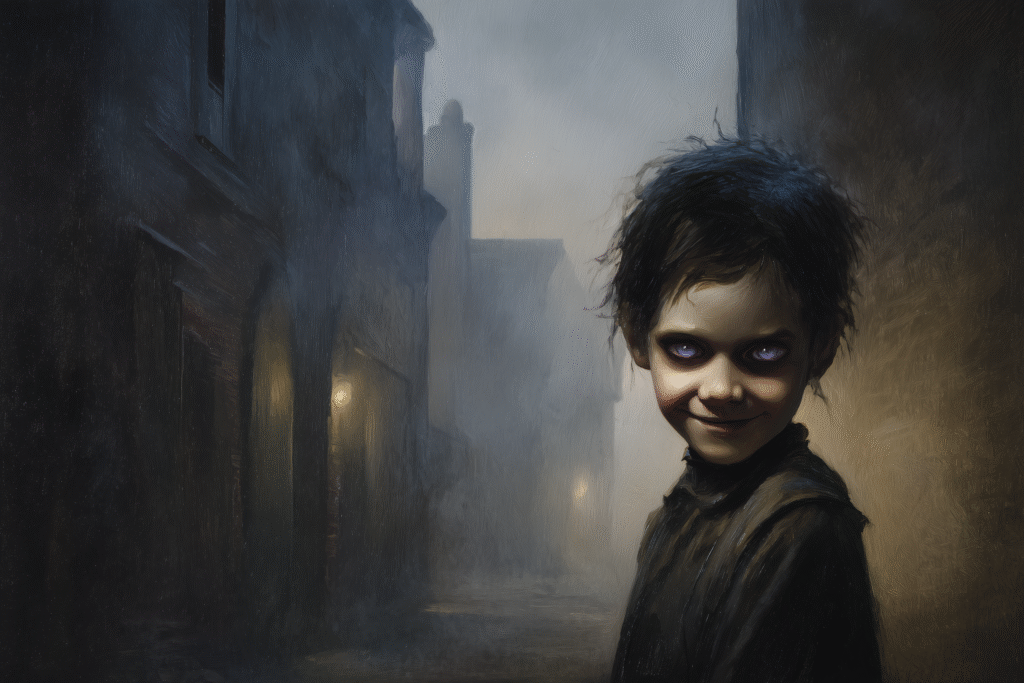
At dawn a mother finds the cradle occupied, but the child within no longer answers to its name. The shutters are bolted and the threshold bears no tracks. A thing from Faerie may have taken the infant’s place; another household might shelter the unrecognised daughter of a hag. The folk call both a changeling, though the two have different origins and different powers.
At a Glance
| Name | Changeling — a name borne by more than one supernatural fate |
|---|---|
| Fey Double | A being from Faerie left in the place of a missing child |
| Hag-Born Child | A mortal daughter of a hag, fostered among other folk |
| Sidhe-Blooded Kin | Children of mixed ancestry, described among the half-fey |
| Temperament | Varies by individual and allegiance; no universal evil nature |
| Signs | Changed habits, an unfamiliar oath, a distant summons or a missing name |
| Encounter | Find the missing child before a court’s bargain is sealed |
| Size and type | Medium Fey (shapechanger); hag-born mortals are a distinct lineage |
| Challenge of the Fey double | D&D 2024 CR 3; D&D 2014 CR 3; Pathfinder 1e CR 3; D&D 3.5e CR 3. Hag-born children are a distinct lineage, not fixed-CR Fey monsters. |
| Habitat | Mortal households near a Fey crossing or under a court bargain |
| Campaign range | Where Fey courts have a documented mortal presence |
Changeling Double — Rules and Statistics
Changeling Double — D&D 2024
Medium Fey (Shapechanger), Neutral
AC 15; Initiative +3 (13)
HP 66 (12d8 + 12); Speed 30 ft.
| Ability | Score | Modifier | Save |
|---|---|---|---|
| STR | 10 | +0 | +0 |
| DEX | 16 | +3 | +5 |
| CON | 12 | +1 | +1 |
| INT | 14 | +2 | +2 |
| WIS | 13 | +1 | +3 |
| CHA | 18 | +4 | +6 |
Skills Deception +8, Insight +3, Perception +3, Stealth +5
Resistances Psychic
Immunities Charmed condition
Senses Darkvision 60 ft., Passive Perception 13
Languages Common, Sylvan
CR 3 (700 XP; PB +2)
Traits
Borrowed Life. The changeling has Advantage on Charisma (Deception) checks to impersonate a creature whose habits it has observed for at least 1 hour. It doesn’t gain that creature’s memories.
True Name. When the changeling hears its genuine Fey name spoken within 30 feet, it can’t take the Change Shape Bonus Action until the end of its next turn. An existing disguise remains in place, and knowing the name does not grant control over the double.
Actions
Multiattack. The changeling makes two Fey Thorn attacks.
Fey Thorn. Melee or Ranged Spell Attack Roll: +6 (Charisma), reach 5 ft. or range 60 ft., one target. Hit: 11 (2d6 + 4) Psychic damage.
Bewitching Word (Recharge 5–6). Wisdom Saving Throw: DC 14, one creature within 30 feet that can hear the changeling. Failure: The target has the Charmed and Incapacitated conditions until the end of the changeling’s next turn. The effect ends early if the target takes damage. Success: The target is immune to this changeling’s Bewitching Word for 24 hours.
Spellcasting. The changeling casts one of the following spells, using Charisma as the spellcasting ability (spell save DC 14), requiring no Material components.
At Will: Disguise Self, Minor Illusion
2/Day: Charm Person
1/Day Each: Invisibility, Suggestion
Bonus Actions
Change Shape. The double takes the appearance and physical stature of a Tiny, Small, or Medium Humanoid it has seen, including a child it has observed, or returns to its true form. Its game statistics remain unchanged except for Size; in a Tiny infant guise, its Speed is 10 feet and it cannot make weapon attacks, although it retains its supernatural spells and voice. It gains no memories, languages or knowledge by copying another person. Equipment does not transform, and the double returns to its true form at death.
Veil Step (Recharge 5–6). The changeling teleports up to 30 feet to an unoccupied space it can see.
Reactions
Unnerving Dodge. Trigger: A creature the changeling can see makes an attack roll against it. Response: The attack roll has Disadvantage.
Changeling Double — D&D 2014
Medium fey (shapechanger), neutral
Armor Class 15 (natural armour)
Hit Points 66 (12d8 + 12)
Speed 30 ft.
| STR | DEX | CON | INT | WIS | CHA |
|---|---|---|---|---|---|
| 10 (+0) | 16 (+3) | 12 (+1) | 14 (+2) | 13 (+1) | 18 (+4) |
Saving Throws Dex +5, Wis +3, Cha +6
Skills Deception +8, Insight +3, Perception +3, Stealth +5
Damage Resistances psychic
Condition Immunities charmed
Senses darkvision 60 ft., passive Perception 13
Languages Common, Sylvan
Challenge 3 (700 XP)
Traits
Borrowed Life. The changeling has advantage on Charisma (Deception) checks to impersonate a creature whose habits it has observed for at least 1 hour. It gains no memories by doing so.
True Name. When the double hears its genuine Fey name spoken by a creature within 30 feet, it cannot use Change Shape until the end of its next turn. Speaking the name does not undo a form it already wears, compel it to obey or reveal where a kidnapped child has been taken.
Innate Spellcasting. The changeling’s spellcasting ability is Charisma (spell save DC 14). It can innately cast the following spells, requiring no material components: at will disguise self, minor illusion; 2/day charm person; 1/day each invisibility, suggestion.
Shapechanger. As a bonus action the double assumes the form and apparent age of a Tiny, Small, or Medium humanoid it has observed, or returns to its true form. Its statistics remain unchanged except for size, and it does not gain the original person’s memories. In an infant-sized Tiny form it has speed 10 feet and cannot make weapon attacks, but can still use its supernatural abilities. Its equipment does not transform; it resumes its own shape when it dies.
Actions
Multiattack. The changeling makes two fey thorn attacks.
Fey Thorn. Melee or Ranged Spell Attack: +6 to hit, reach 5 ft. or range 60 ft., one target. Hit: 11 (2d6 + 4) psychic damage.
Bewitching Word (Recharge 5–6). One creature within 30 feet that can hear the changeling must succeed on a DC 14 Wisdom saving throw or be charmed and incapacitated until the end of the changeling’s next turn. The effect ends if the target takes damage. On a success, the creature is immune to this changeling’s Bewitching Word for 24 hours.
Bonus Actions
Veil Step (Recharge 5–6). The changeling teleports up to 30 feet to an unoccupied space it can see.
Reactions
Unnerving Dodge. When a creature the changeling can see makes an attack roll against it, the changeling imposes disadvantage on that roll.
Changeling Double — Pathfinder 1e
CR 3 (XP 800)
Neutral Medium fey (shapechanger)
Init +7; Senses low-light vision; Perception +10
Defense
AC 16, touch 13, flat-footed 13 (+3 Dex, +3 natural)
hp 33 (6d6 + 12)
Fort +4, Ref +8, Will +8
DR 5/cold iron
Offense
Speed 30 ft.
Melee dagger +6 (1d4–1) or fey touch +6 touch (bewitching touch)
Special Attacks bewitching touch
Spell-Like Abilities (CL 6th; concentration +10): at will—disguise self, ghost sound (DC 14); 3/day—charm person (DC 15), vanish; 1/day—mirror image, suggestion (DC 17)
Statistics
Str 8, Dex 16, Con 14, Int 14, Wis 13, Cha 18
Base Atk +3; CMB +2; CMD 15
Feats Improved Initiative, Iron Will, Weapon Finesse
Skills Bluff +13, Disguise +13, Perception +10, Sense Motive +10, Stealth +12
Languages Common, Sylvan
SQ borrowed life, change shape
Special Abilities
Bewitching Touch (Su). Three times per day, as a standard action, the changeling makes a melee touch attack against a living creature. On a hit, the creature must succeed at a DC 17 Will save or regard the changeling as a familiar, trusted person for 1 minute (mind-affecting charm). The effect ends if the changeling or its allies attack the target. The save DC is Charisma-based.
Borrowed Life (Ex). A changeling gains a +4 racial bonus on Disguise checks to impersonate one specific humanoid whose habits it has observed for at least 1 hour. This bonus is not included in the skill total above.
True Name (Su). If the double hears its true Fey name spoken by a creature within 30 feet, it cannot use Change Shape until the end of its next turn. This does not undo its current disguise or impose obedience.
Change Shape (Su). As a standard action the double assumes the physical appearance of a specific Tiny, Small or Medium humanoid it has carefully observed, including the apparent age of a stolen child. This unique Fey transformation resembles alter self but can also create a Tiny infant guise; it does not grant the original person’s memories or class abilities. Medium statistics are printed above. In Small form, AC 17 (touch 14, flat-footed 14), CMB +1, CMD 14; in Tiny form, AC 18 (touch 15, flat-footed 15), CMB +0, CMD 13. In an infant guise its speed is 10 ft. and it cannot wield its dagger, but it retains spell-like abilities and Bewitching Touch. It resumes its natural form when slain. Its equipment does not transform.
Ecology
Environment any settlement near a Fey crossing
Organization solitary or pair
Treasure standard
Hag-Born Changeling Characters
The hag-born changeling is a separate playable lineage, not this Fey creature. Its standard ancestry traits are: Medium humanoid (changeling); +2 Wisdom, +2 Charisma, −2 Constitution; speed 30 feet; darkvision 60 feet; +1 natural armour; two primary claw attacks (1d4 each); Common and a local language. It also gains one maternal trait: Hulking Changeling (annis hag, +1 melee damage), Green Widow (green hag, +2 Bluff against a creature attracted to her), or Sea Lungs (sea hag, breath held for three times Constitution score in rounds). A mother’s call presents a choice, not an imposed alignment. The Mother’s Gift feat may further strengthen this heritage.
Changeling Double — D&D 3.5e
CR 3
Medium Fey (Shapechanger), Neutral
Hit Dice 6d6+12 (33 hp)
Initiative +7
Speed 30 ft. (6 squares)
Armor Class 16 (+3 Dex, +3 natural), touch 13, flat-footed 13
Base Attack/Grapple +3/+2
Attack dagger +6 melee (1d4–1) or fey touch +6 melee touch
Full Attack dagger +6 melee (1d4–1)
Space/Reach 5 ft./5 ft.
Special Attacks bewitching touch, spell-like abilities
Special Qualities change shape, low-light vision, damage reduction 5/cold iron
Saves Fort +4, Ref +8, Will +8
Abilities Str 8, Dex 16, Con 14, Int 14, Wis 13, Cha 18
Skills Bluff +13, Disguise +13, Hide +12, Knowledge (nature) +11, Listen +10, Move Silently +12, Sense Motive +10, Spot +10 (72 ranks: 9 ranks in each of 8 class skills; (6 + Int modifier 2) × (6 Fey HD + 3))
Feats Improved Initiative, Iron Will, Weapon Finesse
Environment temperate forest or inhabited Fey borderlands
Organization solitary or pair
Challenge Rating 3
Treasure standard
Alignment usually neutral
Advancement by character class
Special Abilities
Bewitching Touch (Su). Three times per day as a standard action, the changeling makes a melee touch attack. A living creature struck must make a DC 17 Will save or treat the changeling as a trusted acquaintance for 1 minute. This is a mind-affecting charm effect. The effect ends if the changeling or an ally attacks the target. The save DC is Charisma-based.
True Name (Su). If the double hears its genuine Fey name spoken within 30 feet, it cannot invoke Change Shape until the end of its next turn. This does not break an existing guise or force the double to obey.
Change Shape (Su). As a standard action the double may take the appearance and apparent age of a Tiny, Small or Medium humanoid it has studied, including a stolen child. This is a specific supernatural variation of alter self that permits a Tiny infant guise, not a general increase to that spell’s size range. It gains no memories or learned abilities from its model. Medium form uses the printed statistics; Small form has AC 17 (touch 14, flat-footed 14), grapple −2; Tiny form has AC 18 (touch 15, flat-footed 15), grapple −6. In infant guise its speed is 10 ft., it cannot wield its dagger and has 0-foot natural reach, though it retains its supernatural touch and spell-like abilities. Its equipment does not change. It resumes its true form when slain.
Spell-Like Abilities. Caster level 6th. At will—disguise self, ghost sound (DC 14); 3/day—charm person (DC 15), invisibility; 1/day—mirror image, suggestion (DC 17). Save DCs are Charisma-based.
Borrowed Life (Ex). The double gains a +4 racial bonus on Disguise checks to impersonate a particular person whose habits it has observed for at least 1 hour. The bonus is not included in the listed skill total; it does not grant the original person’s memories, languages or inherited abilities.
Appearance
A fey replacement may wear the missing child’s face perfectly, faltering only at a familiar song, a name or an oath. A hag-born child may resemble her mortal father’s people but show unusual pallor, mismatched eyes or strange gifts as she matures. Neither appearance is proof of wrongdoing; the test lies in what the creature does, and in the bargain that brought it to the household.
Behaviour
A fey double studies the customs of its adopted household and avoids being named for what it is. Some are spies or thieves of secrets; others have been abandoned by the very court that sent them. Hag-born children are mortal folk with choices of their own, not agents of their mothers by nature.
Habitat
The mystery begins in a cottage, hall, monastery or village where a child has vanished or returned changed. A nearby ford, fairy mound, standing stone or woodland passage may lead to the missing child. Hag-born children commonly grow up among mortals, whether or not they ever learn what called to them from the wild places.
Modus Operandi
The fey double uses mimicry, disguise and charm to preserve its place until its unseen patron calls for it. A hag-born changeling may possess claws and witchcraft, but no curse requires her to deceive her family. For the game master, the first question is whether the apparent child is an impostor, an innocent, or both.
Motivation
The fey double may seek a way home, protection from its former master or a chance to become the child everyone believes it to be. A hag-born changeling may hear her mother’s summons upon reaching maturity; she can resist it and choose her own life. The missing mortal child has an equally urgent claim upon the story.
What Is Happening Right Now?
The midwife of a winter village has hidden a second set of birth records. Seven years ago a child was taken from his cradle and replaced with a creature that wore his face. The replacement now knows the family as its own; the true child waits behind a sealed hill-door, where a year in the mortal world passes as a single night.
A messenger from the Faerie Courts has arrived to collect the double. The villagers are preparing iron chains and a fire, but nobody knows whether breaking the bargain will also condemn the missing child.
Recognising a False Child
There is no single infallible sign. A double may not recognise a lullaby, may speak a true name with visible fear, or may have been taught an impossible version of the family’s past. The most reliable clues concern its behaviour and the oath by which it was sent, not the colour of its eyes. A hag-born daughter is not a fey impostor, and the presence of strange gifts is no licence to accuse her.
Courts, Oaths and Consequences
Some doubles serve as spies or hostages; others are left in a mortal home as payment for an ancestral debt. They may fear the same court that commanded the exchange. A double’s private loyalty may lie with the family that fed it for years, with a patron who threatens its kin, or with the child hidden beyond the hill. These motives determine whether it helps a search, stalls for time or attempts to steal another identity.
The Faerie Pact binding the household may outlast the person who agreed to it. An oath can be examined, challenged or fulfilled; the name of the double is leverage for a conversation, never proof that the court must obey its captors.
The Double at the Cradle
Before an accusation. The double has spent months or years learning the habits of the household. Its advantage lies in a borrowed face and the trust of those who raised it, not in an ability to read another person’s memories. The first troubling signs are an impossible account of an old family event, a forgotten cradle song and a messenger who knows more of the bargain than anyone in the village. None proves that the child is an impostor by itself.
When cornered. A frightened double attempts to charm the person who seems likeliest to harm it, uses illusion or invisibility to break pursuit and slips away towards the old crossing. It fights only if escape is blocked; the Fey Thorn or Bewitching Touch is a last defence, not proof that every double was born malicious. A court-trained spy may be far more ruthless, but a double that has grown attached to its foster family may risk itself to protect them.
Breaking its glamour. Learning and speaking the double’s true Fey name within hearing briefly prevents another change of shape; it neither strips away an existing disguise nor reveals the kidnapped child’s location. Witnesses can compare contradictory accounts and trace the court messenger’s road. Threatening a helpless infant or performing the old cruel fire tests risks harming an innocent mortal child and may destroy the only witness to the exchange.
The bargain. If it knows the bargain, a double can describe who brought it to the cradle and what price was promised. It cannot necessarily cancel its master’s oath, free a child hidden beyond the hill or overrule the court. The safest resolution secures both children and places responsibility upon those who arranged the exchange. If the double escapes, the court will learn that the household is searching; if it is slain, the missing mortal remains missing and the family loses the only creature that shared its daily life.
Rumours and Adventures
The Two Birthmarks. A mother has found the same scar upon a second child born years apart. One belongs to her; the other remembers a winter palace no mortal has visited.
The Debt of Milk. A court servant promises to return every stolen child in the parish if the village gives up one name that was never recorded in its baptismal book.
The Mother’s Call. A young woman descended from a hag seeks refuge from hunters who believe every changeling must turn evil. Her mother’s summons is real, but so is her determination to refuse it.
Kindred and Contrasts
The term changeling is also used for the hag-born children of mortal households. They are distinct from the shapeshifting creature described above. Children of sidhe and mortal ancestry belong instead among the half-fey. The Fey Bestiary describes the wider courts and spirits that may become involved in a stolen-child bargain.
Sources and Licensing
Fey substitutions of infants appear across medieval European traditions. Scottish Gaelic accounts describe a fairy double (tàcharan) sometimes understood as an elderly Fey person occupying a cradle rather than a young fairy child: Historic Environment Scotland, “Scary Fairies! Scotland’s Gaelic Fairy Folklore”. Historical accusations could also endanger sick or disabled children, as Rose A. Sawyer documents in The Medieval Changeling: Health, Childcare, and the Family Unit (2023). The Fey doubles and their CR 3 statistics here are original adaptations of those stories, not an official Pathfinder monster.
The separate hag-born ancestry uses the published Pathfinder Advanced Race Guide changeling lineage, including the mother’s call, inherited traits and player agency. The four-edition double transformations, including the infant guise, are original rules and do not expand the standard alter self spell for other creatures.
Statistics from Pathfinder Roleplaying Game Bestiary 4 © 2013, Paizo Publishing, LLC; Authors: Dennis Baker, Jesse Benner, Savannah Broadway, Ross Byers, Adam Daigle, Tim Hitchcock, Tracy Hurley, James Jacobs, Matt James, Rob McCreary, Jason Nelson, Tom Phillips, Stephen Radney-MacFarland, Sean K Reynolds, F. Wesley Schneider, Tork Shaw, and Russ Taylor.
Ecology from Pathfinder 43: Haunting of Harrowstone. Copyright 2011, Paizo Publishing, LLC, Author: Michael Kortes
Pathfinder Roleplaying Game Advanced Race Guide © 2012, Paizo Publishing, LLC; Authors: Dennis Baker, Jesse Benner, Benjamin Bruck, Jason Bulmahn, Adam Daigle, Jim Groves, Tim Hitchcock, Hal MacLean, Jason Nelson, Stephen Radney-MacFarland, Owen K.C. Stephens, Todd Stewart, and Russ Taylor.
Keep this reference growing
If this page helped with your reading or game, you can support its upkeep or explore the curated books.
Explore the Bookshop — epics, classics and stories behind imagined worlds.