
Roper — Stalagmite Ambusher of the Deep
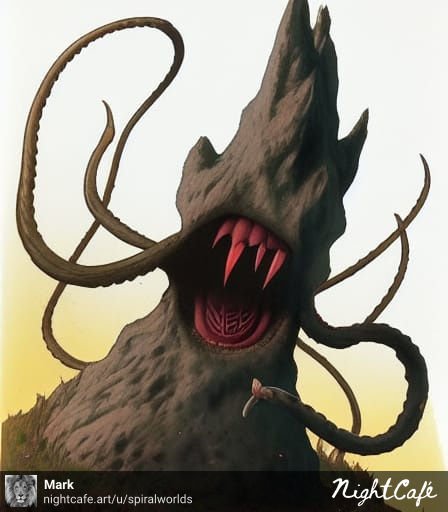
A patient cavern predator that looks like ordinary stone until six long strands seize prey and drag it toward a waiting mouth.
The roper is one of the deep earth’s most effective ambush hunters. Its conical body can match the colour, texture and even apparent temperature of surrounding stone, allowing it to stand motionless among stalagmites or pillars until prey comes within reach. Then its strands shoot outward, latch on and pull victims across the cavern floor toward its jaws.
At a Glance
Run It Tonight
Place the roper where approaching it seems safer than going around: beside the bridge, near the only dry path, or among the stalagmites around a valuable door. The first strand attack should reveal that the “rock” is alive. After that, the whole encounter is about distance: can the party cut the strands or break free before the roper reels someone into bite range?
Rules by Edition
Roper
Large Aberration, Neutral Evil
AC 20; Initiative +5 (15)
HP 93 (11d10 + 33)
Speed 10 ft., Climb 20 ft.
18 (+4)
8 (−1)
17 (+3)
7 (−2)
16 (+3)
6 (−2)
Skills Perception +6, Stealth +5
Senses Darkvision 60 ft.; Passive Perception 16
Languages None
CR 5 (1,800 XP); PB +3
Traits
Spider Climb. The roper can climb difficult surfaces, including ceilings, without making an ability check.
Stone Camouflage. While motionless among natural stone, the roper is extremely difficult to distinguish from an ordinary cave formation. A creature inspecting it closely can identify it with a successful Wisdom (Perception) check opposed by the roper’s Stealth.
Actions
Multiattack. The roper makes two Tentacle attacks, uses Reel, and makes two Bite attacks.
Bite. Melee Attack Roll: +7, reach 5 ft. Hit: 17 (3d8 + 4) Piercing damage.
Tentacle. Melee Attack Roll: +7, reach 60 ft. Hit: The target has the Grappled condition (escape DC 14) from one of six tentacles and has the Poisoned condition until that grapple ends. A tentacle has AC 20 and 10 Hit Points, is immune to Poison and Psychic damage, and regrows at the start of the roper’s next turn if destroyed.
Reel. The roper pulls every creature Grappled by it up to 30 feet straight toward it.
Roper
Large monstrosity, neutral evil
Armor Class 20 (natural armor)
Hit Points 93 (11d10 + 33)
Speed 10 ft., climb 10 ft.
18 (+4)
8 (−1)
17 (+3)
7 (−2)
16 (+3)
6 (−2)
Skills Perception +6, Stealth +5
Senses darkvision 60 ft., passive Perception 16
Languages —
Challenge 5 (1,800 XP)
Traits
False Appearance. While motionless, the roper is indistinguishable from a normal cave formation such as a stalagmite.
Grasping Tendrils. The roper can have up to six tendrils. Each tendril has AC 20, 10 hit points and immunity to poison and psychic damage. Destroying one does not hurt the roper, and a replacement can be extruded on the roper’s next turn.
Spider Climb. The roper can climb difficult surfaces, including ceilings, without an ability check.
Actions
Multiattack. The roper makes four Tendril attacks, uses Reel and makes one Bite attack.
Bite. Melee Weapon Attack: +7 to hit, reach 5 ft., one target. Hit: 22 (4d8 + 4) piercing damage.
Tendril. Melee Weapon Attack: +7 to hit, reach 50 ft., one creature. The target is grappled (escape DC 15), restrained and has disadvantage on Strength checks and Strength saving throws until the grapple ends.
Reel. The roper pulls each creature grappled by it up to 25 feet straight toward it.
Roper CR 12
XP 19,200
CE Large aberration
Init +5; Senses darkvision 60 ft., low-light vision; Perception +24
Defense
AC 27, touch 10, flat-footed 26 (+1 Dex, +17 natural, −1 size)
hp 162 (12d8+108)
Fort +13, Ref +5, Will +13
Immune electricity; Resist cold 10; SR 27
Weaknesses vulnerability to fire
Offense
Speed 10 ft.
Melee bite +20 (4d8+18/19–20)
Ranged 6 strands +10 touch (1d6 Strength)
Space 10 ft.; Reach 10 ft.
Special Attacks pull (strand, 5 feet), strands
Statistics
Str 34, Dex 13, Con 29, Int 13, Wis 16, Cha 12
Base Atk +9; CMB +22; CMD 33 (can’t be tripped)
Feats Improved Critical (bite), Improved Initiative, Iron Will, Skill Focus (Perception, Stealth), Weapon Focus (strand)
Skills Climb +27, Knowledge (dungeoneering) +16, Knowledge (religion) +13, Perception +24, Stealth +18 (+26 in stony or icy areas)
Languages Aklo, Undercommon
Strands (Ex)
The roper can fire up to six sticky strands to a maximum range of 50 feet as ranged touch attacks. A creature hit must succeed on a DC 25 Fortitude save or take 1d6 Strength damage. A strand can be severed with slashing damage and regrows quickly.
Pull (Ex)
A strand can drag its attached target 5 feet closer to the roper each round.
Ecology
Environment any underground
Organization solitary, pair or cluster (3–6)
Treasure standard
Roper
Large Magical Beast
Hit Dice 10d10+30 (85 hp)
Initiative +5
Speed 10 ft. (2 squares)
Armor Class 24 (−1 size, +1 Dex, +14 natural), touch 10, flat-footed 23
Base Attack/Grapple +10/+18
Attack strand +11 ranged touch (drag) or bite +13 melee (2d6+6)
Full Attack 6 strands +11 ranged touch (drag) and bite +13 melee (2d6+6)
Space/Reach 10 ft./10 ft. (50 ft. with strand)
Special Attacks drag, strands, weakness
Special Qualities darkvision 60 ft., electricity immunity, low-light vision, cold resistance 10, spell resistance 30, fire vulnerability
Saves Fort +10, Ref +8, Will +8
Abilities Str 19, Dex 13, Con 17, Int 12, Wis 16, Cha 12
Skills Climb +12, Hide +10 (+18 in stony or icy areas), Listen +13, Spot +13
Feats Alertness, Improved Initiative, Iron Will, Weapon Focus (strand)
Environment underground
Organization solitary, pair or cluster (3–6)
Challenge Rating 12
Treasure no coins; 50% goods (stone only); no items
Alignment usually chaotic evil
Drag (Ex)
A creature hit by a strand is pulled 10 feet closer on each subsequent round unless it escapes with a DC 23 Escape Artist check or DC 19 Strength check. A creature brought within 10 feet can be bitten with a +4 attack bonus in the same round.
Strands (Ex)
The roper can maintain six strands with 50-foot reach. A severed strand deals no damage to the roper and is replaced on its next turn.
Weakness (Ex)
A creature grabbed by a strand must succeed on a DC 18 Fortitude save or take 2d8 Strength damage.
Behaviour
Ropers can wait for astonishing lengths of time. They are not wandering hunters by preference; they choose a productive location, imitate the stone and let prey come to them. Once a victim is attached, the roper reels it in while keeping other enemies at strand range.
The older PF1e tradition makes ropers much more intelligent than their modern fifth-edition counterparts. Those ropers may debate philosophy, religion or mortality with potential prey for hours. Conversation can postpone dinner, but rarely cancels it.
Signs Before Initiative
- One stalagmite sits where falling water should have worn the stone smooth.
- Loose equipment forms a rough circle exactly 50–60 feet from one cave formation.
- Drag marks converge on a single point but no predator tracks leave it.
- A “stone” changes colour subtly between torchlight and darkness.
- Severed fibrous strands harden like wax or cord after being cut.
- In older-edition lairs, survivors describe sudden weakness before they were dragged away.
If Violence Starts
The roper wants as many lines attached as possible before prey reaches melee. In 2014 fifth edition, four tendril attacks let it seize a group quickly; in 2024 the attack count is lower but it makes two bites after reeling. The older CR 12 ropers are significantly more dangerous and sap Strength while they drag victims inward.
Do not have a roper chase unless necessary. Its power comes from forcing the party to cross distance while attached.
Counterplay
Attack the strands. Modern roper tendrils have their own AC and Hit Points, and destroying them frees captured creatures without damaging the roper. In older editions, slashing damage or sunder attempts can achieve the same result.
Long-range attacks also matter. Once the party recognises the “stalagmite” before entering strand range, a large part of the ambush has failed. PF1e and 3.5e characters can additionally exploit the roper’s fire vulnerability.
Roper Variants
Stone Roper. The older page carried a CR 6 third-party fifth-edition variant with tougher stone-like defenses and petrifying venom. It belongs here as a variant, not as an edition tab.
Molting Strangler. A mutable roper that periodically sheds its rocky shell and gains mimic-like shapechanging. Its cast-off shell may persist briefly as a decoy.
Vulkard. A basalt-like roper variant that replaces ordinary fire vulnerability with fire immunity and can feed on heat.
Sigil Crag. A high-level roper marked by crystalline runes that reproduce symbol-like magic learned from powerful spellcasting prey.
Shardstriker. A brutal roper whose jagged strands cut as they pull, trading philosophical curiosity for straightforward violence.
Legacy Related Creature: Piercer
The earlier Roper page also contained a complete Piercer entry. That material is not being discarded, but a piercer is a separate creature rather than part of the roper stat block. A standard legacy piercer resembles a 1-foot stalactite, requires roughly DC 20 Perception to notice, drops when prey passes underneath and allows a DC 15 Reflex save to avoid the fall. The smallest form deals 1d6 piercing damage; 2–4-foot specimens rise to CR 1 and 2d6 damage, while 5–6-foot specimens reach CR 2 and 3d6 damage. Grounded piercers climb only slowly back into position and secrete acid when struck unarmed or by natural attacks.
Using a Roper in an Encounter
The wrong stalagmite. Miners have worked beside the same formation for weeks. It was waiting for the crew to become complacent.
The philosopher’s guest. A scholar has been missing for months but is still alive, kept by a roper that enjoys arguing with them too much to eat them yet.
The six drag marks. A cavern contains six parallel grooves ending at one apparently ordinary pillar.
The ceiling roper. A 2024 roper uses Spider Climb to hunt from above, pulling characters vertically rather than across the floor.
Related Creatures
Compare the roper with the Roperite or other subterranean aberrations such as the Neothelid. Browse the Aberration Bestiary for the wider cluster.
Rules Sources and Licensing
The 5.5e/2024 Roper is from SRD 5.2.1, released under Creative Commons Attribution 4.0 International. The 5e/2014 Roper is from SRD 5.1, also available under CC BY 4.0.
The Pathfinder 1e statistics derive from the open Pathfinder Roleplaying Game Bestiary. The D&D 3.5e Roper is Open Game Content from the Revised d20 System Reference Document. Third-party variant ideas from the former page are retained as concise variants rather than conflated with the standard monster.
Keep this reference growing
If this page helped with your reading or game, you can support its upkeep or explore the curated books.
Explore the Bookshop — epics, classics and stories behind imagined worlds.