
Larval Slime Crawler — Slippery Grappling Scavenger
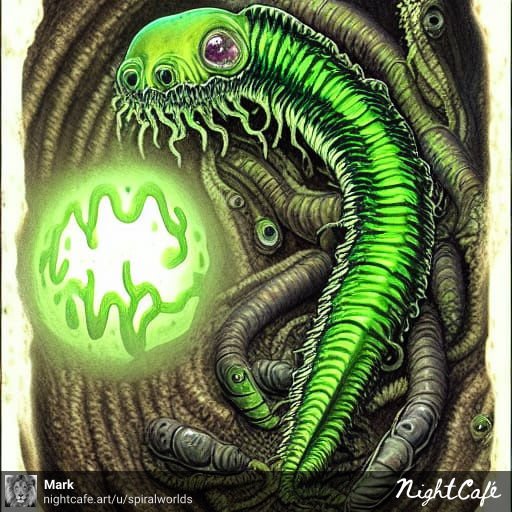
A six-foot larval carrion crawler that leaves treacherous slime behind it and grapples prey with four short tentacles.
The Larval Slime Crawler is the juvenile stage of the Mature Slime Crawler. Its many legs are still little more than buds, and the body remains coated in an oily secretion that helps it slip free from danger. The four tentacles beneath its mouth are strong enough to grab prey but have not yet developed the paralytic venom of adulthood.
At a Glance
Run It Tonight
Make the slime matter before the creature does. A character steps onto a glossy patch, slips, and only then notices the pale segmented crawler clinging to the wall above. Larvae swarm weak or prone targets and use their tentacles to hold prey in place for the nest.
Rules by Edition
Larval Slime Crawler
Medium Aberration, Unaligned
AC 13; Initiative +2 (12)
HP 22 (4d8 + 4)
Speed 20 ft., Climb 15 ft.
12 (+1)
14 (+2)
12 (+1)
1 (−5)
12 (+1)
6 (−2)
Skills Perception +3
Senses Darkvision 60 ft., Scent 30 ft.; Passive Perception 13
Languages —
CR 1 (200 XP); PB +2
Traits
Slippery. The crawler has Advantage on checks and saving throws made to escape a Grapple or restraint.
Slime Trail. The ground in spaces the crawler leaves becomes slippery until the start of its next turn. A creature entering one of those spaces for the first time on a turn must succeed on a DC 11 Dexterity saving throw or have the Prone condition.
Actions
Multiattack. The crawler makes one Tentacles attack and one Bite attack.
Tentacles. Melee Attack Roll: +3, reach 5 ft. Hit: 4 (1d6 + 1) Bludgeoning damage, and a Medium or smaller target is Grappled (escape DC 11).
Bite. Melee Attack Roll: +3, reach 5 ft. Hit: 5 (1d8 + 1) Piercing damage.
Constrict. One creature Grappled by the crawler takes 4 (1d6 + 1) Bludgeoning damage.
Larval Slime Crawler
Medium aberration, unaligned
Armor Class 13 (natural armor)
Hit Points 22 (4d8 + 4)
Speed 20 ft., climb 15 ft.
12 (+1)
14 (+2)
12 (+1)
1 (−5)
12 (+1)
6 (−2)
Skills Perception +3
Senses darkvision 60 ft., passive Perception 13
Languages —
Challenge 1 (200 XP)
Traits
Slippery. The crawler has advantage on ability checks and saving throws made to escape a grapple.
Slime Trail. A creature entering a space crossed by the crawler since its previous turn must succeed on a DC 11 Dexterity saving throw or fall prone.
Actions
Multiattack. The crawler makes one tentacles attack and one bite attack.
Tentacles. Melee Weapon Attack: +3 to hit, reach 5 ft., one target. Hit: 4 (1d6 + 1) bludgeoning damage, and a Medium or smaller target is grappled (escape DC 11).
Bite. Melee Weapon Attack: +3 to hit, reach 5 ft., one target. Hit: 5 (1d8 + 1) piercing damage.
Constrict. A creature grappled by the crawler takes 4 (1d6 + 1) bludgeoning damage.
Larval Slime Crawler CR 1
XP 400
N Medium aberration
Init +2; Senses darkvision 60 ft., scent; Perception +8
Defense
AC 15, touch 12, flat-footed 13 (+2 Dex, +3 natural)
hp 5 (1d8+1)
Fort +1, Ref +2, Will +3
Offense
Speed 20 ft., climb 10 ft.
Melee tentacles +1 (1d3+1 plus grab) and bite +1 (1d4+1)
Special Attacks constrict (1d3+1)
Statistics
Str 12, Dex 14, Con 12, Int 1, Wis 12, Cha 6
Base Atk +0; CMB +1 (+5 grapple); CMD 13 (can’t be tripped)
Feats Skill Focus (Perception)
Skills Climb +9, Escape Artist +8, Perception +8; Racial Modifiers +6 Escape Artist
SQ slippery
Special Abilities
Slippery (Ex). The crawler’s oily coating grants a +6 racial bonus on Escape Artist checks. A creature that steps in its slime trail must succeed on a DC 11 Reflex save or fall prone. The slime remains hazardous for 1d2 hours.
Ecology
Environment any land and underground
Organization solitary, cluster (2–5), swarm (5–10) or nest (10–20)
Treasure none
Larval Slime Crawler
Medium Aberration
Hit Dice 1d8+1 (5 hp)
Initiative +2
Speed 20 ft. (4 squares), climb 10 ft.
Armor Class 15 (+2 Dex, +3 natural), touch 12, flat-footed 13
Base Attack/Grapple +0/+1
Attack tentacle +1 melee (1d3+1 plus improved grab)
Full Attack tentacle +1 melee (1d3+1 plus improved grab) and bite +1 melee (1d4+1)
Special Attacks constrict 1d3+1, improved grab
Special Qualities darkvision 60 ft., scent, slippery
Saves Fort +1, Ref +2, Will +3
Abilities Str 12, Dex 14, Con 12, Int 1, Wis 12, Cha 6
Skills Climb +9, Escape Artist +8, Listen +5, Spot +5
Feats Skill Focus (Spot)
Environment land and underground
Organization solitary, cluster, swarm or nest
Challenge Rating 1
Treasure none
Alignment always neutral
Slippery (Ex)
The crawler gains a +6 racial bonus on Escape Artist checks. Its slime trail forces creatures crossing it to make a DC 11 Reflex save or fall prone; the coating remains hazardous for 1d2 hours.
Behaviour
Larval slime crawlers follow food and shelter rather than defend fixed territory. They gather around carrion, waste and larger adults, squeezing through spaces that mature crawlers cannot use and leaving slick trails everywhere they travel.
A larva prefers to seize and constrict prey rather than bite immediately. Several larvae can therefore turn a narrow tunnel into a dangerous knot of grapples even when each individual is weak.
Signs Before Initiative
- A translucent oily trail crosses walls, floors and low ceilings.
- Bootprints end in a long skid near refuse or carrion.
- Small animals are crushed or suffocated rather than poisoned.
- Several sets of tiny caterpillar-like tracks converge on the same nest.
- Adults are absent, but shed fragments suggest something much larger returns periodically.
If Violence Starts
Larvae try to grab the nearest target and hold on. They do not understand formation or target priority, but a group naturally piles onto anyone who falls prone in the slime. Once prey stops resisting, the larvae begin feeding.
Counterplay
Watch the floor. The slime trail is often more dangerous than the larva’s raw damage because falling prone makes a character much easier to surround. Sand, ash, cloth or other absorbent material can make a path safer at the GM’s discretion.
Larvae are fragile compared with adults. Keeping them at range and preventing grapples usually ends the encounter quickly.
Growth into the Mature Form
The larva’s short legs strengthen as it grows, while the slippery coating diminishes. Its four grasping tentacles lengthen and develop glands that produce paralytic venom. By maturity, the creature is roughly twelve feet long and has shifted from slippery grappler to active paralysing hunter.
That transformation means a nest changes dramatically over time. A neglected larval infestation can become a cluster of Mature Slime Crawlers within months.
Using a Larval Slime Crawler in an Encounter
The slick cellar. A basement floor has become dangerously slippery, and something is eating stored meat from underneath the shelves.
The abandoned nest. Adventurers find larvae but no adults, suggesting the mature crawlers are out hunting and may return.
The sewer spill. A nest is washed into city drains after heavy rain, spreading larvae through several districts.
The wrong quarry. Miners think they have found harmless giant grubs until the first crawler wraps tentacles around a worker’s leg.
Related Life Stage
See the Mature Slime Crawler for the adult paralysing form, or return to the Aberration Bestiary.
Rules Sources and Licensing
The Pathfinder-style larval slime crawler derives from Tome of Horrors Complete, © 2011 Necromancer Games, Inc., published and distributed by Frog God Games. The 5.5e/2024, 5e/2014 and D&D 3.5e blocks are compatibility adaptations created for this entry.
Keep this reference growing
If this page helped with your reading or game, you can support its upkeep or explore the curated books.
Explore the Bookshop — epics, classics and stories behind imagined worlds.