
The Perils of Gwendoline in the Land of the Yik-Yak (1984)
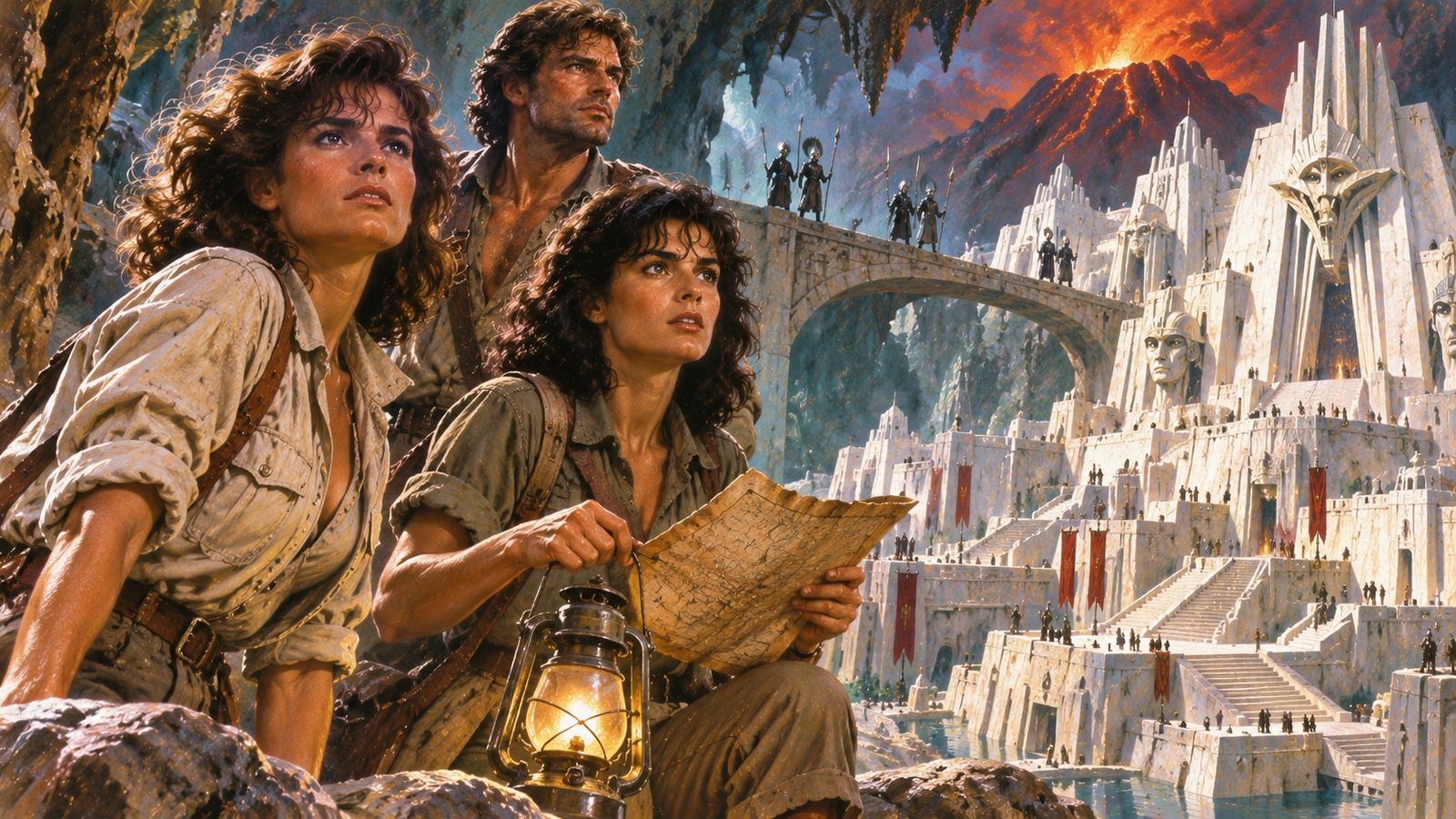
1984 · France · Erotic adventure / fantasy comedy · Director: Just Jaeckin
The Perils of Gwendoline in the Land of the Yik-Yak is an extravagantly designed, often ridiculous pulp adventure in which a search for a rare butterfly leads to a hidden city ruled by a tyrannical queen. Released in France as Gwendoline, it pairs treasure-hunt spectacle with the adult fantasy imagery of its comic-strip source. The production design is more memorable than the storytelling—and that imbalance is central to its cult appeal.
Content note: This is an adult-oriented film containing nudity, fetish imagery, sexual coercion and exploitative ethnic stereotypes. It is not a family adventure.
At a Glance
| Original title | Gwendoline |
|---|---|
| Year and country | 1984; France |
| Director and screenplay | Just Jaeckin |
| Source | John Willie’s comic-strip character and The Adventures of Sweet Gwendoline |
| Principal cast | Tawny Kitaen, Brent Huff, Zabou (Zabou Breitman), Bernadette Lafont and Jean Rougerie |
| Music | Pierre Bachelet |
| Running time | Approximately 106 minutes in the original version; approximately 87 minutes in the shortened US theatrical version |

Why This Film Matters
Gwendoline occupies an eccentric corner of 1980s fantasy cinema. It borrows the quest structure, dangerous wilderness and improbable lost civilisation of adventure serials, then filters them through the erotic imagination of director Just Jaeckin, best known for Emmanuelle. Its underground city, ceremonial spaces and flamboyant costumes have a scale that the script rarely matches.
The film is best approached as a piece of deliberately excessive cult cinema rather than as a straightforward heroic adventure. Its most interesting achievement is the imaginary world it constructs on screen; its weakest element is how little dramatic complexity it gives the people moving through that world.
The Story — Without Major Spoilers
Gwendoline (Tawny Kitaen) arrives in Asia looking for her missing father, whose expedition was devoted to finding an extraordinarily rare butterfly. She is accompanied by her resourceful friend Beth (Zabou). When danger closes in, the pair enlist the help of Willard (Brent Huff), a self-interested adventurer whose knowledge of the region offers their best chance of reaching the remote land of the Yik-Yak.
Their journey shifts from a rough-and-tumble rescue story into something stranger: unexplored territory, abduction, hostile encounters and the discovery of a hidden society with its own brutal hierarchy. Gwendoline’s search for her father soon becomes a struggle to survive a kingdom that treats outsiders as possessions.
Trailer and Further Viewing
Watch a trailer for Gwendoline (1984) on YouTube. This is an external video link rather than an embedded player. For authorised restoration information and differences between releases, visit Severin Films. The film is intended for adults.
Characters and Performances
Tawny Kitaen as Gwendoline: the quest’s determined centre, although the screenplay repeatedly makes her an object of danger and spectacle rather than allowing her to command the action.
Brent Huff as Willard: a roguish escort in the pulp-hero tradition. His swagger suits the film’s knockabout tone, though his character is written more as a familiar archetype than a convincing person.
Zabou as Beth: an energetic companion who helps give the expedition momentum and provides a useful counterweight to the central couple.
Bernadette Lafont as the Queen: the standout supporting presence, playing the ruler of the lost city with the theatrical excess the material invites.
Jean Rougerie as D’Arcy: a figure within the city’s power structure whose divided loyalties become important as the story unfolds.
The World on Screen
Once the expedition reaches the underground city, the film becomes substantially more distinctive. Monumental chambers, regimented attendants, ritualised combat and machinery turn the setting into a feverish fantasy of control. The interiors are not simply backgrounds: their symmetry and severity establish how the Queen’s authority works before the dialogue explains it.
Belgian comics artist François Schuiten contributed to the film’s visual conception; Claude Renard also worked on the costume designs, while Françoise Deleu is credited with production design. That blend of bande dessinée imagination and physical set-building accounts for much of the film’s visual personality. The results can be arresting even when the fights and dialogue are not.
Behind the Camera
Just Jaeckin directed and wrote the screenplay, drawing on John Willie’s Sweet Gwendoline comic strips. The adaptation does not reproduce a single realistic world: it converts an illustrated fantasy of captivity and escape into an adventure spectacle. André Domage handled cinematography, Michèle Boëhm edited the film and Pierre Bachelet composed the score.
For viewers familiar only with the shorter English-language release, the film’s history matters. The original running time is commonly listed at 106 minutes, whereas the US release was cut to about 87 minutes. These are different presentations of the same film, not separate productions.
Themes, Influences and Limitations
The narrative uses familiar adventure machinery: the missing explorer, the rare creature that justifies a journey, the dubious guide, the forbidden territory and the lost city. Its world also turns power into a literal stage set, with uniforms, contests and rituals enforcing a hierarchy in which personal choice is frequently denied.
That premise does not make the film a persuasive statement about women’s power. The camera continually returns to objectifying spectacle, and the story treats coercion as an erotic ingredient. Its depiction of Asian settings and people also draws on stereotypes typical of older exotic-adventure fiction. Those choices deserve to be recognised rather than excused as harmless period colour.
Critical Assessment
What works: the sheer commitment of the set and costume design; Lafont’s flamboyant villainy; and the collision of adventure serial, comics imagery and extravagant studio fantasy. At its best, the film suggests a bizarre illustrated world larger than the plot can contain.
What does not: inconsistent pacing, shallow characterisation, clumsy action and an awkward mixture of slapstick, eroticism and jeopardy. The romance has little room to develop, and much of the apparent danger functions mainly as a pretext for another spectacle.
Verdict: a curious and visually ambitious cult object, most rewarding to viewers interested in eccentric production design, adult exploitation cinema and unusual 1980s fantasy. It is considerably less successful as an adventure story on its own terms.
Ideas for the Table
A lost city is most useful to a Games Master when its inhabitants have conflicting needs, not merely when its gates conceal treasure. Begin with a naturalist who disappears while searching for a rare creature. The expedition’s notes lead to a settlement cut off from the outside world by treacherous terrain, a failing water system and a ruling faction determined to preserve its isolation.
Give the characters several ways to enter: negotiate with scouts, follow an old trade route, rescue a stranded local guide or navigate the dangerous wilderness themselves. Once inside, introduce factions with credible reasons to disagree. One group wants trade, another fears that newcomers will exploit their resources, and a third conceals evidence that the city’s supposed ancient isolation is a recent invention.
The players should be free to help the missing explorer, protect the rare species, expose a secret or leave with new allies. Avoid making the city’s people a faceless enemy, and build its architecture, economy and ecology as an interconnected place that can change through the party’s decisions. Use the setting’s Bestiary for original creatures and the NPC collection for people with motives, limitations and relationships. The film’s coercive spectacle need not be reproduced to make the exploration dangerous and memorable.
Release Versions and Cult Legacy
The shorter American release circulated under the full title The Perils of Gwendoline in the Land of the Yik-Yak; the French title was simply Gwendoline. The difference in length helps explain why summaries and reviews sometimes describe the film differently.
Severin Films later issued a restoration scanned in 4K from the original negative, alongside the alternate US version and contextual extras featuring the filmmakers, performers and designers. The restoration has made the more elaborate version accessible to modern cult-film audiences and helped foreground the craftsmanship behind the film’s notorious imagery.
Explore Related Films and Ideas
For more lost-world adventures and fantasy cinema, explore the Action & Adventure Films archive, Fantasy Films archive, The Lost Continent (1968), The Seventh Curse (1986) or the main Films and Television collection.
Sources and Further Viewing
- The Encyclopedia of Science Fiction — film entry (story outline, running-time comparison and critical context).
- Severin Films — Gwendoline (restoration, alternate version and special features).
- IMDb — full cast and crew (credits reference).
Keep this reference growing
If this page helped with your reading or game, you can support its upkeep or explore the curated books.
Explore the Bookshop — epics, classics and stories behind imagined worlds.