
Clash of the Titans (1981)
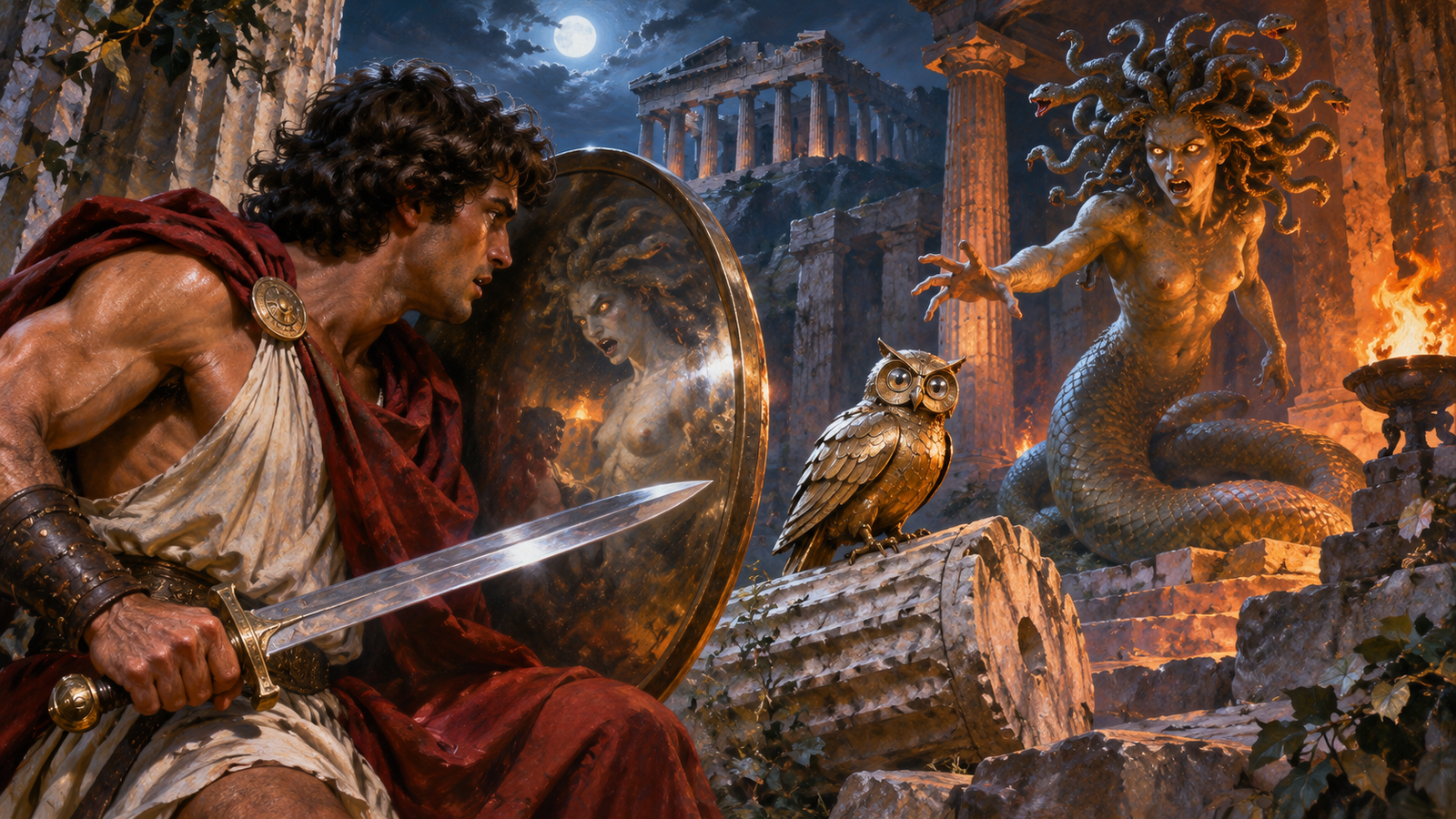
Gods, monsters and a mortal hero whose most dangerous trial may be deciding whom to trust.
Clash of the Titans (1981) is Desmond Davis’s colourful retelling of the Perseus legend, famous above all for Ray Harryhausen’s final feature-film creature effects. Its gods intervene in mortal lives with remarkable casualness, and its enchanted objects are as useful as the judgement of the people who carry them. The film takes substantial liberties with Greek myth, but its parade of distinct challenges remains a model of screen fantasy adventure.
At a Glance
| Film | Clash of the Titans (1981) |
|---|---|
| Director | Desmond Davis |
| Producer | Charles H. Schneer |
| Creature effects | Ray Harryhausen |
| Principal cast | Harry Hamlin, Judi Bowker, Laurence Olivier, Maggie Smith, Burgess Meredith and Claire Bloom |
| Music | Laurence Rosenthal |
| Source | The myth of Perseus and Andromeda, freely adapted |
| Genre | Mythological fantasy; creature adventure |

Why This Film Matters
Harryhausen’s creatures give the quest its changing character. The enormous Kraken conveys the scale of divine punishment; Medusa is a terrifying hunter with her own deadly rhythm; and the mechanical owl Bubo offers a lighter counterpoint to the danger. These are not simply different amounts of damage for Perseus to withstand. Each encounter calls for a different response: watching, searching, moving cautiously or understanding what an enemy can do.
The Story — Without Major Spoilers
Perseus, the son of Zeus, becomes entangled in a dispute involving the gods, the kingdom of Joppa and Princess Andromeda. His journey takes him through a sequence of trials as he seeks a way to save the princess from a dreadful fate. The gods provide gifts and warnings, but their assistance is entangled with pride, grievances and rivalries that Perseus cannot control.
The adventure becomes a race to find what can overcome a power that ordinary weapons cannot. Perseus relies upon courage, companions, artefacts and hard-won knowledge. The film’s main pleasure is seeing each new discovery alter the balance of a seemingly impossible task.
Characters and Performances
Perseus (Harry Hamlin) is an earnest heroic figure who must gradually learn the value of preparation and assistance. Andromeda (Judi Bowker) is more than a distant symbol of the quest: her threatened future gives the spectacle a personal purpose. Zeus (Laurence Olivier) treats mortal destinies as matters of Olympian authority, while Thetis (Maggie Smith) exposes the danger of divine wounded pride. Ammon (Burgess Meredith) provides experience and warmth in a world where the immortals are rarely entirely dependable.
The World on Screen
Temples, islands, marshes and the edge of the underworld form a landscape in which every region has its own supernatural history. The film compresses distances for dramatic effect, but the changes in terrain give the quest a useful variety. Medusa’s lair, in particular, rewards attention to sound, sightlines and the consequences of being seen.
The mixture of miniature animation, full-size sets and live-action performances has a tactile quality that newer digital effects do not automatically provide. The creatures sometimes move with a deliberate stop-motion rhythm, but that physical distinctiveness is part of their identity.
Behind the Camera
Desmond Davis directed, with Charles H. Schneer producing and Ray Harryhausen designing and animating the celebrated creatures. It was Harryhausen’s final feature film, following decades of work that changed the possibilities of fantasy cinema. Laurence Rosenthal’s score contributes grandeur and urgency. The film’s starry Olympian cast gives divine disputes the atmosphere of a family quarrel conducted on a terrifying scale.
Greek Myth and Film Invention
The film is an interpretation, not a reference text for the ancient traditions. The sea monster is called the Kraken, a name associated with northern European sea legends rather than the classical Greek story of Andromeda. Pegasus is associated on screen with Perseus, although the winged horse belongs to different episodes in many ancient accounts. Bubo, the mechanical owl, is a cinematic invention rather than a character from the Perseus myth. The film also reworks the gods’ involvement and the geography of its challenges.
These alterations create memorable cinema, but the distinction matters when drawing on mythology for a living fantasy world. The classical figures can have their own motives and histories independently of Harryhausen’s interpretation.
Themes and Critical Assessment
The film presents heroism as a mixture of courage, good counsel and an ability to use extraordinary gifts wisely. Its episodic structure makes each hazard memorable, though it leaves some characters with little beyond a single role in the quest. The gods are magnificently portrayed but not always emotionally subtle; the adventure is often more exciting than the dialogue between its human leads.
What works: Harryhausen’s astonishing creature performances, a strong sequence of distinct challenges and the contrast between mortal vulnerability and Olympian power. What works less well: abrupt transitions, broad characterisation and a mythology reshaped around the needs of a single heroic narrative. Those limitations do not erase the imagination on display.
Related Films and Mythology
Explore Jason and the Argonauts (1963) for an earlier Harryhausen voyage, and Clash of the Titans (2010) for a different cinematic treatment. The site’s Perseus character entry and Ray Harryhausen profile provide separate paths into legend and screen craft.
Explore in SpiralWorlds
Heroes and gods. The Perseus NPC and Andromeda offer the campaign’s own versions of the legendary couple. Visit Zeus, Athena, Hera, Hephaestus, Poseidon and Thetis for independent divine and Nereid perspectives. Their motives and relationships are not automatically those of the film’s Olympus.
Creatures and wonders. Explore Medusa, Pegasus, the Kraken and the Clockwork Owl for encounters inspired by the movie. Ray Harryhausen’s creatures, especially the film’s Kraken and mechanical owl Bubo, are cinematic inventions and interpretations, not official illustrations of the bestiary. The Hellenic Bestiary supplies more choices.
Ideas for the Table
Build an expedition around a creature that cannot be overcome by simple strength. Put fragments of the answer in different places: a temple oracle, a ruined island shrine, a witness who survived the creature and a magical object claimed by a rival. Give the party several ways to interpret the evidence and consequences for choosing unwisely.
Deities should possess agendas, friendships and grievances that make their apparent aid uncertain. Let the players bargain with a divine patron, offend another or deliberately refuse a gift with hidden conditions. The best result is a campaign that changes according to those choices, rather than a retelling whose ending is already fixed.
Further Viewing and Sources
- British Film Institute — Clash of the Titans (1981) (film record).
- American Film Institute — Clash of the Titans (film history and Ray Harryhausen).
- BFI — Ray Harryhausen’s essential films (effects history).
The film, characters and poster remain the property of their respective rights holders. This criticism and the campaign suggestions are independent editorial material.
Keep this reference growing
If this page helped with your reading or game, you can support its upkeep or explore the curated books.
Explore the Bookshop — epics, classics and stories behind imagined worlds.