
Augustus the Strong — Elector of Saxony and King of Poland
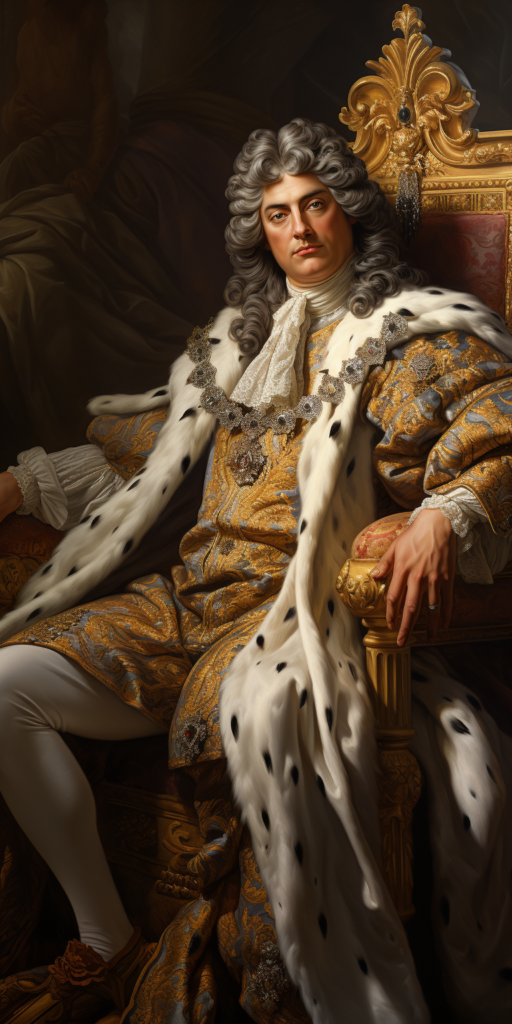
At a Glance
| Identity | Frederick Augustus I of Saxony; known as Augustus the Strong and Augustus II of Poland |
|---|---|
| People | Human; Lawful Neutral |
| House | Wettin, with a Saxon household and Polish royal claim |
| Gift | Exceptional physical strength, cultivated showmanship, military training and political ambition |
| Campaign present | 1454; his claims bring him into conflict with existing imperial rulers rather than giving him unquestioned authority over Saxony or Poland |
| Allies | Household officers, artists, loyal soldiers and patrons who hope to gain by his rise |
| Opposition | Rival Saxon interests, Polish magnates and foreign factions suspicious of his ambitions |
A horseshoe bends in Augustus’s hands before the assembled court. The applause fades when a messenger announces that the prince’s title and the charter supporting it have both been challenged.
What Is Happening Right Now?
Augustus has made a spectacular entry into an imperial city, bending a horseshoe before assembled courtiers and commissioning a procession whose cost has alarmed the treasury. A rival prince insists that Augustus’s claim to a Saxon title lacks proper witnesses. Augustus wants neutral adventurers to retrieve the sealed family contract before the imperial diet opens. If the contract proves false, he may resort to spectacle, threats or a dangerous challenge rather than admit defeat.
He values art, soldiers and ceremony but does not treat every court as his own. His royal and electoral titles matter to his entourage; officials outside that allegiance can—and do—dispute their force. He is not the historical King of Poland ruling unopposed in every territory of the campaign’s 1454 present.
Augustus surrounds himself with accomplished musicians, armourers and builders. Dresden is the centre of his patronage, and every extravagant commission invites a question about whose purse pays for it. He enjoys genuine beauty and workmanship, but he also uses art and spectacle to make uncertain titles look secure. A master artisan may become his favourite in the morning and discover by evening that a rival prince has forbidden the same work.
His weakness is not a shortage of strength but a hunger for recognition. He makes expensive promises before the treasury approves them, confuses affection with loyalty and sometimes demands public victories he cannot afford to lose. Yet a party that defends a craftsman, honours a witnessed bargain or stands firm against intimidation can earn a formidable patron whose influence extends well beyond his personal combat abilities.
Game Statistics
Augustus is a trained and exceptionally strong mortal who commands soldiers and courtiers. His titles, household and patronage are politically powerful but do not grant innate spellcasting, legendary resistance or the powers of a supernatural monster.
Augustus the Strong — D&D 2024
Medium Humanoid (Human), Lawful Neutral
AC 18 (plate armor)
Initiative +1 (11)
HP 90 (12d8+36)
Speed 30 ft.
| Ability | Score | Mod | Save |
|---|---|---|---|
| STR | 20 | +5 | +7 |
| DEX | 12 | +1 | +1 |
| CON | 16 | +3 | +5 |
| INT | 13 | +1 | +1 |
| WIS | 12 | +1 | +1 |
| CHA | 18 | +4 | +4 |
Skills Athletics +7, Intimidation +6, Persuasion +6
Senses Passive Perception 11
Languages German, Polish
CR 3 (700 XP; PB +2).
Traits
Remarkable Strength. Augustus has Advantage on Strength (Athletics) checks to bend or lift unattended metal objects that a human could conceivably move; this doesn’t grant the ability to destroy fortifications with his bare hands.
Actions
Multiattack. Augustus makes two Longsword attacks.
Longsword. Melee Attack Roll: +7, reach 5 ft. Hit: 9 (1d8+5) Slashing damage.
Rally (1/Day). An ally of Augustus within 30 feet who can hear him gains 5 Temporary Hit Points. This is a nonmagical encouragement.
Reactions
Parry. When a creature Augustus can see hits him with a melee attack while he holds a longsword, Augustus adds 2 to his AC against that attack, potentially turning it into a miss.
Augustus the Strong — D&D 2014
Medium humanoid (human), lawful neutral
Armor Class 18 (plate armor)
Hit Points 90 (12d8+36)
Speed 30 ft.
| STR | DEX | CON | INT | WIS | CHA |
|---|---|---|---|---|---|
| 20 (+5) | 12 (+1) | 16 (+3) | 13 (+1) | 12 (+1) | 18 (+4) |
Saving Throws Str +7, Con +5
Skills Athletics +7, Intimidation +6, Persuasion +6
Senses passive Perception 11
Languages German, Polish
Challenge 3 (700 XP).
Traits
Unusual Strength. Augustus has advantage on Strength (Athletics) checks to bend an unattended horseshoe, break a fragile bar or perform another feat of strength within mortal limits.
Actions
Multiattack. Augustus makes two longsword attacks.
Longsword. Melee Weapon Attack: +7 to hit, reach 5 ft., one target. Hit: 9 (1d8+5) slashing damage.
Rally (1/Day). One ally that can hear Augustus within 30 feet gains 5 temporary hit points.
Reactions
Parry. When a creature Augustus can see hits him with a melee attack while he is wielding a longsword, Augustus adds 2 to his AC against the attack, potentially causing it to miss.
Augustus the Strong — Pathfinder 1e
LN Medium humanoid (human), warrior 6
CR 4; XP 1,200; Init +1; Senses Perception +1.
Defense
AC 20, touch 11, flat-footed 19 (full plate); hp 57 (6d10+18 plus Toughness); Fort +8, Ref +3, Will +5.
Offense
Speed 20 ft. in full plate (base 30 ft.); Melee longsword +12/+7 (1d8+5).
Statistics
Str 20, Dex 12, Con 16, Int 13, Wis 12, Cha 18; BAB +6; CMB +11; CMD 22; Skills Intimidate +13, Ride +10; Feats Power Attack, Weapon Focus (longsword), Toughness, Iron Will; Languages German, Polish; Gear full plate, masterwork longsword, signet, sealed documents.
Special Abilities
Remarkable Strength (Ex). Augustus gains a +2 circumstance bonus on Strength checks to bend or break unattended metal objects of a size he could physically lift. This does not apply to combat maneuvers or damage.
Augustus the Strong — D&D 3.5e
Medium Human Warrior 6, Lawful Neutral
CR 5; HD 6d8+18 plus Toughness (48 hp); Init +1; Speed 20 ft. in full plate (base 30 ft.)
Defense
AC 19, touch 11, flat-footed 18
Offense
BAB/Grapple +6/+11; Attack longsword +12 melee (1d8+5); Full Attack longsword +12/+7 melee (1d8+5); Space/Reach 5 ft./5 ft.
Saving Throws
Saves Fort +8, Ref +3, Will +5
Statistics
Abilities Str 20, Dex 12, Con 16, Int 13, Wis 12, Cha 18; Skills Intimidate +13, Ride +10; Feats Power Attack, Weapon Focus (longsword), Toughness, Iron Will; Languages German, Polish; Possessions full plate, longsword, signet, documents, court dress.
Special Qualities
Remarkable Strength (Ex). Augustus gains a +2 circumstance bonus on Strength checks made to bend or break unattended mundane metal objects that a well-built human could plausibly move. This bonus applies only to objects, not attacks or combat maneuvers.
Power Beyond the Stat Block
Augustus can hire a court, fund musicians, recruit officers and bribe informants, but these resources are not automatically present in every encounter. His charisma and wealth create adventures even when he is defeated in a duel; rival claimants may challenge a forged inheritance, a missing treasure inventory or the legal foundation of his claim to the Polish crown.
Augustus at the Imperial Banquet
Augustus sits beneath Saxon banners in a borrowed imperial hall. He bends a horseshoe for the room, then asks a rival claimant to demonstrate a subtler strength: persuading three independent witnesses to sign the same charter. He rewards a bold challenge but keeps a close eye on the public response. The crown may be disputed, but he is already building a court as though it were his.
Personality, Relationships and Resources
Manner and voice. He is broad-shouldered, physically confident and dressed to outshine the host. He laughs easily until someone questions his honour. Compliment craftsmanship, military courage or music and he grows generous; accuse him without proof and he demands a contest before witnesses. His Lawful Neutral habits favour publicly witnessed bargains and the rights of his household, but his vanity can push those around him into dangerous obligations.
Allies. Saxon officers and courtiers, armourers, musicians, architects and financiers who hope to benefit from his patronage. Rivals. Other Wettin claimants, imperial electors and Polish nobles who refuse to accept his asserted titles without lawfully established consent; Swedish and Ottoman interests may oppose his ambitions. He respects an adversary who keeps a promise more than a flatterer who breaks one.
Household and affection. Christiane Eberhardine of Brandenburg-Bayreuth is his wife in the historical record, while Aurora von Königsmarck is associated with his court and personal life. Their involvement here should preserve those relationships rather than inventing duplicate spouses or conflating his household with that of an earlier elector. His public religious allegiance and its political cost are matters that his allies may contest openly.
Augustus can finance a festival, hire guards, obtain plate armour, commission a sculptor or award an expedition charter when his treasurer has funds. His reputed strength lets him perform extraordinary but mortal feats. The soldiers, influence and treasury are resources available through his court, not creatures or powers automatically produced by his stat block. A claimant seeking recognition must eventually deal with Emperor Frederick III and rivals among the imperial princes, including the Wittelsbach interests represented by Albert IV of Bavaria.
Dangers, Rumours and Adventure Hooks
- The horse-shoe challenge. A rival claims Augustus cheated a strength contest with alchemical metal. Discover who supplied the props before a duel turns into a riot.
- The disputed inheritance. An old Saxon contract has appeared with two different seals. Augustus promises protection to whoever brings the authentic original.
- A Polish claimant. An envoy challenges the title written on Augustus’s banner. The party must escort witnesses through roads held by hostile soldiers.
- The unpaid builders. A magnificent new pavilion stands on land whose owners have received no compensation. The builders threaten to leave unless a lawful settlement is reached.
- The prince’s wager. Augustus has promised a warhorse and safe-conduct to an unknown challenger. A courtier fears the winner is an assassin using the contest to approach the ruler.
Consequences and Journeys
A party that uncovers a forgery may gain an ally with guards, gold and access to princely courts. If they endorse a false claim, local rulers may refuse their letters, imprison their contacts or raise troops to defend disputed tolls. A public victory gives Augustus prestige; a fair defeat may win his respect if his witnesses agree upon it. Travel through the Empire’s rival lands requires safe-conduct from the authorities who actually control each road, not merely a flattering letter from Augustus.
Historical Foundation and Sources
In recorded history Frederick Augustus I of the House of Wettin (1670–1733) became Elector of Saxony in 1694 and King Augustus II of Poland in 1697. His imposing physique, courtly display and cultural patronage inspired the name Augustus the Strong. In the campaign’s 1454 present he may appear alongside earlier princes, but his titles face active claims and negotiations; his historical succession has not automatically happened throughout the region.
Historical references: Getty Museum — Augustus II, Royal Castle in Warsaw collection. Explore other people of the Empire and the surrounding imperial territories for the claimants, soldiers and courtiers who could challenge him.
Rules Licensing
These are original unofficial campaign NPC profiles. Pathfinder and D&D 3.5e rules derived from Open Game Content are designated Open Game Content; original setting prose and artwork are excluded.
This work includes material from the System Reference Document 5.2.1 (“SRD 5.2.1”) by Wizards of the Coast LLC, available at https://www.dndbeyond.com/srd. The SRD 5.2.1 is licensed under the Creative Commons Attribution 4.0 International License.
This work includes material from the System Reference Document 5.1 (“SRD 5.1”) by Wizards of the Coast LLC, available at https://www.dndbeyond.com/srd. The SRD 5.1 is licensed under the Creative Commons Attribution 4.0 International License.
Open Game License v1.0a & applicable Section 15 notices
OPEN GAME LICENSE Version 1.0a
The following text is the property of Wizards of the Coast, Inc. and is Copyright 2000 Wizards of the Coast, Inc (“Wizards”). All Rights Reserved.
1. Definitions: (a) “Contributors” means the copyright and/or trademark owners who have contributed Open Game Content; (b) “Derivative Material” means copyrighted material including derivative works and translations (including into other computer languages), potation, modification, correction, addition, extension, upgrade, improvement, compilation, abridgment or other form in which an existing work may be recast, transformed or adapted; (c) “Distribute” means to reproduce, license, rent, lease, sell, broadcast, publicly display, transmit or otherwise distribute; (d) “Open Game Content” means the game mechanic and includes the methods, procedures, processes and routines to the extent such content does not embody the Product Identity and is an enhancement over the prior art and any additional content clearly identified as Open Game Content by the Contributor, and means any work covered by this License, including translations and derivative works under copyright law, but specifically excludes Product Identity; (e) “Product Identity” means product and product line names, logos and identifying marks including trade dress; artifacts; creatures characters; stories, storylines, plots, thematic elements, dialogue, incidents, language, artwork, symbols, designs, depictions, likenesses, formats, poses, concepts, themes and graphic, photographic and other visual or audio representations; names and descriptions of characters, spells, enchantments, personalities, teams, personas, likenesses and special abilities; places, locations, environments, creatures, equipment, magical or supernatural abilities or effects, logos, symbols, or graphic designs; and any other trademark or registered trademark clearly identified as Product identity by the owner of the Product Identity, and which specifically excludes the Open Game Content; (f) “Trademark” means the logos, names, mark, sign, motto, designs that are used by a Contributor to identify itself or its products or the associated products contributed to the Open Game License by the Contributor; (g) “Use”, “Used” or “Using” means to use, Distribute, copy, edit, format, modify, translate and otherwise create Derivative Material of Open Game Content; (h) “You” or “Your” means the licensee in terms of this agreement.
2. The License: This License applies to any Open Game Content that contains a notice indicating that the Open Game Content may only be Used under and in terms of this License. You must affix such a notice to any Open Game Content that you Use. No terms may be added to or subtracted from this License except as described by the License itself. No other terms or conditions may be applied to any Open Game Content distributed using this License.
3. Offer and Acceptance: By Using the Open Game Content You indicate Your acceptance of the terms of this License.
4. Grant and Consideration: In consideration for agreeing to use this License, the Contributors grant You a perpetual, worldwide, royalty-free, non-exclusive license with the exact terms of this License to Use, the Open Game Content.
5. Representation of Authority to Contribute: If You are contributing original material as Open Game Content, You represent that Your Contributions are Your original creation and/or You have sufficient rights to grant the rights conveyed by this License.
6. Notice of License Copyright: You must update the COPYRIGHT NOTICE portion of this License to include the exact text of the COPYRIGHT NOTICE of any Open Game Content You are copying, modifying or distributing, and You must add the title, the copyright date, and the copyright holder’s name to the COPYRIGHT NOTICE of any original Open Game Content you Distribute.
7. Use of Product Identity: You agree not to Use any Product Identity, including as an indication as to compatibility, except as expressly licensed in another, independent Agreement with the owner of each element of that Product Identity. You agree not to indicate compatibility or co-adaptability with any Trademark or Registered Trademark in conjunction with a work containing Open Game Content except as expressly licensed in another, independent Agreement with the owner of such Trademark or Registered Trademark. The use of any Product Identity in Open Game Content does not constitute a challenge to the ownership of that Product Identity. The owner of any Product Identity used in Open Game Content shall retain all rights, title and interest in and to that Product Identity.
8. Identification: If you distribute Open Game Content You must clearly indicate which portions of the work that you are distributing are Open Game Content.
9. Updating the License: Wizards or its designated Agents may publish updated versions of this License. You may use any authorized version of this License to copy, modify and distribute any Open Game Content originally distributed under any version of this License.
10. Copy of this License: You MUST include a copy of this License with every copy of the Open Game Content You Distribute.
11. Use of Contributor Credits: You may not market or advertise the Open Game Content using the name of any Contributor unless You have written permission from the Contributor to do so.
12. Inability to Comply: If it is impossible for You to comply with any of the terms of this License with respect to some or all of the Open Game Content due to statute, judicial order, or governmental regulation then You may not Use any Open Game Material so affected.
13. Termination: This License will terminate automatically if You fail to comply with all terms herein and fail to cure such breach within 30 days of becoming aware of the breach. All sublicenses shall survive the termination of this License.
14. Reformation: If any provision of this License is held to be unenforceable, such provision shall be reformed only to the extent necessary to make it enforceable.
15. COPYRIGHT NOTICE
Open Game License v 1.0a Copyright 2000, Wizards of the Coast, Inc.
System Reference Document. Copyright 2000, Wizards of the Coast, Inc.; Authors Jonathan Tweet, Monte Cook, Skip Williams, based on material by E. Gary Gygax and Dave Arneson.
Pathfinder Roleplaying Game Reference Document. © 2011, Paizo Publishing, LLC; Author: Paizo Publishing, LLC.
Pathfinder Roleplaying Game Core Rulebook. © 2009, Paizo Publishing, LLC; Author: Jason Bulmahn, based on material by Jonathan Tweet, Monte Cook, and Skip Williams.
Pathfinder Roleplaying Game Bestiary. © 2009, Paizo Publishing, LLC; Author: Jason Bulmahn, based on material by Jonathan Tweet, Monte Cook, and Skip Williams.
Augustus the Strong — original NPC adaptation, copyright © 2026 SpiralWorlds.
Keep this reference growing
If this page helped with your reading or game, you can support its upkeep or explore the curated books.
Explore the Bookshop — epics, classics and stories behind imagined worlds.