
Samodiva
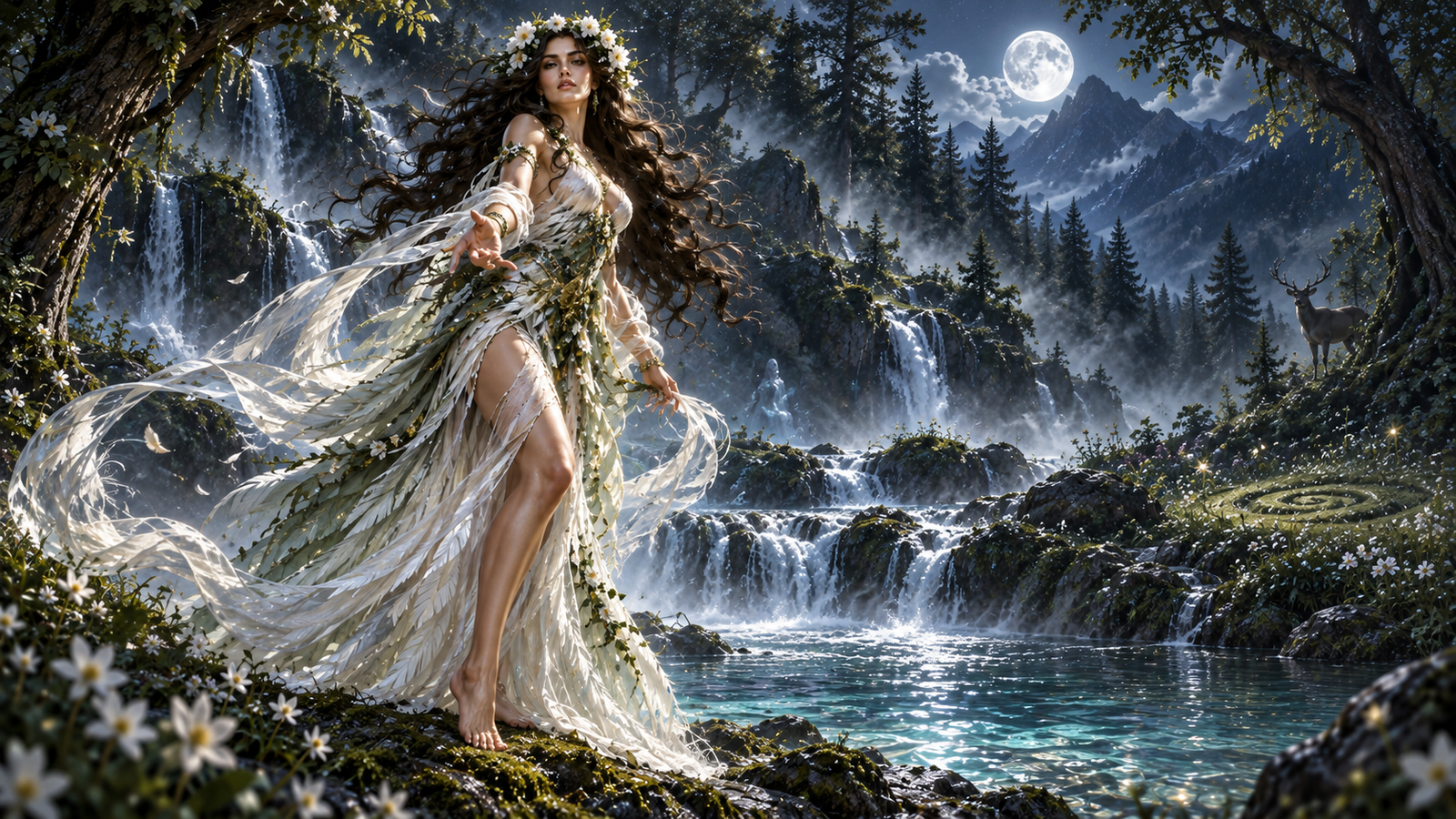
Samodiva — Bulgarian mountain and forest spirits of sacred springs, white feathered garments, healing herbs and dances that can steal a mortal’s strength before dawn.
The grass around the spring has been pressed into a perfect circle. White cloth moves between the trees although the air is still, and somewhere beyond the dark water a woman is singing without words.
Then one of your companions steps into the circle.
She stands barefoot beside the spring: beautiful, pale beneath the moonlight, wrapped in a flowing white garment edged with feathers. Wild herbs flower where her feet pass. A deer watches from beneath the trees. She smiles as though she has been expecting you.
And the music changes.
A samodiva is a powerful supernatural woman of the Bulgarian mountains, forests and waters. She can heal sickness, bless fields, reveal forgotten paths and bring relief to a drought. She can also enchant travellers, punish those who violate her ground and compel mortals to dance until their bodies fail them.
Samodivi are not automatically enemies. Respect shown at the correct moment may earn supernatural aid. Arrogance, theft or violence may turn an apparently peaceful encounter into a struggle against a creature for whom the entire glade has become a weapon.
Samodiva at a Glance
| Creature | Medium Fey |
|---|---|
| Challenge | CR 14 |
| Temperament | Independent, passionate and dangerous when insulted |
| Terrain | Mountain forests, springs, lakes, caves, meadows and secluded woodland |
| Known For | Compelling dance, supernatural beauty, healing herbs, weather magic and feathered garments |
| Most Important Warning | Do not enter an occupied dancing ground merely because you have been invited |
SpiralWorlds treats the Samodiva as Fey for game purposes. Within the world, however, she is a distinct regional supernatural being rather than simply an elf, nymph, dryad or generic fairy.
Samodiva Game Statistics
Samodiva — D&D 5.5e / 2024
Medium Fey, typically Chaotic Neutral
AC 18
Initiative +6 (16)
HP 210 (28d8 + 84)
Speed 40 ft., Fly 60 ft. while wearing her Feathered Veil
| Ability | STR | DEX | CON | INT | WIS | CHA |
|---|---|---|---|---|---|---|
| Score | 12 | 22 | 17 | 16 | 18 | 22 |
| Mod | +1 | +6 | +3 | +3 | +4 | +6 |
| Save | +1 | +11 | +8 | +3 | +9 | +11 |
Skills Medicine +9, Nature +8, Perception +9, Performance +16, Persuasion +11, Stealth +11
Immunities Charmed
Senses Darkvision 60 ft.; Passive Perception 19
Languages a local Bulgarian or neighbouring South Slavic vernacular, Sylvan
CR 14 (XP 11,500; PB +5)
Traits
Magic Resistance. The samodiva has Advantage on saving throws against spells and other magical effects.
Feathered Veil. The samodiva’s flowing feathered garment carries part of her supernatural freedom. While she wears it, she has her Fly Speed, can use Veil Lash and can use Whirling Escape.
An unwilling conscious samodiva cannot have the veil removed merely by making an attack against it. If she is rendered Unconscious, willingly gives it up, or is otherwise separated from it through the circumstances of the adventure, her Fly Speed becomes 0 and she cannot use Veil Lash or Whirling Escape until the garment is recovered.
The veil is not automatically a permanent magic item usable by another creature. Its greatest importance is as a supernatural bond between the samodiva and her freedom.
Sacred Ground. While the samodiva is within 60 feet of a natural spring, mountain pool or dancing ground she has claimed, she regains 10 Hit Points at the start of each of her turns if she has at least 1 Hit Point.
A campaign using cold iron as a specific fey weakness can suppress this healing until the start of her following turn when she takes damage from a cold-iron weapon.
Actions
Multiattack. The samodiva makes three Veil Lash attacks.
Veil Lash. Melee Attack Roll: +11, reach 10 ft. Hit: 28 (2d8 + 6 Slashing plus 3d8 Psychic) damage.
Spellcasting. The samodiva casts one of the following spells, requiring no Material components and using Charisma as the spellcasting ability (spell save DC 19, +11 to hit with spell attacks):
- At Will: Druidcraft, Minor Illusion
- 3/Day Each: Charm Person, Entangle, Suggestion
- 1/Day Each: Control Weather, Heal, Plant Growth
Dance Until Dawn (Recharge 5–6). The samodiva begins a supernatural dance. Up to three creatures of her choice in a 30-foot Emanation must make a DC 19 Wisdom saving throw. A creature is affected only if it can both see and hear the samodiva.
Failure: The creature has the Charmed and Incapacitated conditions for 1 minute. Its Speed is 0 as it dances in place or circles helplessly within its space.
At the end of each of its turns, the creature repeats the save. On a failed repeat save, it takes 13 (3d8) Psychic damage and gains 1 level of Exhaustion. On a successful save, the effect ends on that creature.
If a creature affected by the dance takes damage from a creature other than the samodiva, it can immediately repeat the saving throw, ending the effect on itself on a success.
The effect immediately ends on an affected creature if it is more than 30 feet from the samodiva or can no longer see or hear her. The effect ends on all affected creatures if the samodiva has the Incapacitated condition or dies.
A creature that succeeds on its initial saving throw is immune to that samodiva’s Dance Until Dawn for 24 hours.
Bonus Actions
Whirling Step. The samodiva moves up to half her Speed without provoking Opportunity Attacks.
Reactions
Whirling Escape. Immediately after an attack misses the samodiva, she moves up to 20 feet without provoking Opportunity Attacks. She must be wearing her Feathered Veil to use this reaction.
Encounter Note
Dance Until Dawn is deliberately dangerous, but it has visible counterplay. A creature must both see and hear the samodiva to remain caught by the dance, allies can damage an affected companion to grant another save, and removing or incapacitating the samodiva ends the threat entirely.
Samodiva — Pathfinder 1e
CR 14 XP 38,400
CN Medium fey
Init +11; Senses darkvision 60 ft., low-light vision; Perception +30
Defense
AC 29, touch 18, flat-footed 21 (+7 Dex, +1 dodge, +11 natural)
hp 189 (18d6+126)
Fort +13, Ref +18, Will +16
DR 10/cold iron; SR 25
Defensive Abilities sacred ground renewal
Offense
Speed 40 ft., fly 60 ft. (good) while wearing feathered veil
Melee 3 veil lashes +16 (2d8+6 plus 2d6 force)
Space 5 ft.; Reach 5 ft. (10 ft. with veil lash)
Special Attacks beguiling gaze, dance until dawn
Spell-Like Abilities (CL 14th; concentration +20)
- At will — dancing lights, detect magic
- 3/day — charm person (DC 17), entangle (DC 17), suggestion (DC 19)
- 1/day — control weather, heal, plant growth
Statistics
Str 14, Dex 24, Con 24, Int 18, Wis 20, Cha 22
Base Atk +9; CMB +11; CMD 29
Feats Alertness, Combat Casting, Dodge, Flyby Attack, Improved Initiative, Mobility, Skill Focus (Perform [dance]), Spring Attack, Weapon Finesse
Skills Acrobatics +28, Diplomacy +27, Fly +32, Heal +22, Knowledge (nature) +21, Perception +30, Perform (dance) +33, Perform (sing) +19, Sense Motive +30, Stealth +28, Survival +24
Languages a local Bulgarian or neighbouring South Slavic vernacular, Sylvan
SQ feathered veil, sacred ground renewal
Ecology
Environment temperate mountain forests, uplands, springs, lakes, caves and secluded meadows
Organization solitary, pair, or dance (3, 5 or 7)
Treasure standard; see Feathered Veil
Special Abilities
Beguiling Gaze (Su). A samodiva can attempt to charm a creature within 30 feet that meets her gaze. The target must succeed on a DC 25 Will save or be affected as though by charm monster for 1 hour.
A creature that successfully saves is immune to that samodiva’s Beguiling Gaze for 24 hours. This is a mind-affecting charm effect. The save DC is Charisma-based.
Dance Until Dawn (Su). Once per day as a full-round action, a samodiva begins a supernatural dance that can continue for up to 1 minute.
Each living creature of her choice within 30 feet that can both see and hear her must succeed on a DC 25 Will save or become compelled to dance.
An affected creature is staggered, takes a –4 penalty to Armor Class and Reflex saves, cannot make attacks of opportunity, and can move no farther than a single 5-foot step on its turn.
At the end of each of its turns it may attempt another Will save. Each failed repeat save deals 1 point of Constitution damage and causes the creature to become fatigued. A creature already fatigued becomes exhausted instead.
Whenever an affected creature takes damage from a creature other than the samodiva, it immediately receives another saving throw to end the effect.
The effect immediately ends on an affected creature if it is more than 30 feet from the samodiva or can no longer see or hear her. The effect ends on all affected creatures if the samodiva becomes helpless or dies.
A creature that succeeds on its initial save is immune to that samodiva’s Dance Until Dawn for 24 hours. This is a sonic, visual, mind-affecting compulsion effect. The save DC is Charisma-based.
Feathered Veil (Su). A samodiva’s supernatural feathered garment grants her a fly speed of 60 feet with good maneuverability and allows her to make veil lash attacks.
The veil can normally be removed only from a willing, helpless or unconscious samodiva. If separated from it, she loses her fly speed and veil lash attacks until she recovers it.
A separated veil does not automatically function as a permanent magic item for another creature.
Sacred Ground Renewal (Su). A samodiva gains fast healing 5 while within 60 feet of a natural spring, mountain pool or dancing ground she has claimed.
Damage dealt by a cold iron weapon suppresses this fast healing until the beginning of the samodiva’s next turn.
Veil Lash (Su). While wearing her feathered veil, a samodiva can animate strips of the garment as supernatural natural weapons. She makes veil lash attacks using Dexterity instead of Strength and adds her Charisma modifier to damage. A veil lash has a reach of 10 feet and deals an additional 2d6 points of force damage.
Samodiva — D&D 3.5e
Medium Fey
Hit Dice 18d6+126 (189 hp)
Initiative +11
Speed 40 ft. (8 squares), fly 60 ft. (good) while wearing feathered veil
Armor Class 29 (+7 Dex, +1 dodge, +11 natural), touch 18, flat-footed 21
Base Attack/Grapple +9/+11
Attack veil lash +16 melee (2d8+6 plus 2d6 force)
Full Attack 3 veil lashes +16 melee (2d8+6 plus 2d6 force)
Space/Reach 5 ft./5 ft. (10 ft. with veil lash)
Special Attacks beguiling gaze, dance until dawn, spell-like abilities
Special Qualities damage reduction 10/cold iron, darkvision 60 ft., feathered veil, low-light vision, sacred ground renewal, spell resistance 25
Saves Fort +13, Ref +18, Will +16
Abilities Str 14, Dex 24, Con 24, Int 18, Wis 20, Cha 22
Skills Diplomacy +29, Hide +28, Listen +28, Move Silently +28, Perform (dance) +30, Perform (sing) +27, Sense Motive +26, Spot +28
Feats Dodge, Flyby Attack, Improved Initiative, Mobility, Skill Focus (Perform [dance]), Spring Attack, Weapon Finesse
Environment temperate mountain forests, uplands, springs, lakes, caves and secluded meadows
Organization solitary, pair, or dance (3, 5 or 7)
Challenge Rating 14
Treasure standard; see Feathered Veil
Alignment usually chaotic neutral
Advancement 19–27 HD (Medium)
Level Adjustment —
Languages a local Bulgarian or neighbouring South Slavic vernacular, Sylvan
Combat
A samodiva prefers to control the encounter rather than simply exchange attacks. She uses enchantment against isolated intruders, Entangle to divide groups and Dance Until Dawn when several enemies have entered her ground.
Once violence is unavoidable, the supernatural strips of her feathered garment whirl around her like living ribbons. She fights while constantly moving, using Spring Attack and Flyby Attack to prevent opponents from surrounding her.
A samodiva defending a sacred spring is substantially harder to kill than one caught far from her own ground.
Beguiling Gaze (Su). Charm monster, 30 feet, duration 1 hour, Will DC 25 negates. A creature that succeeds on the saving throw is immune to that samodiva’s gaze for 24 hours. This is a mind-affecting charm effect. The save DC is Charisma-based.
Dance Until Dawn (Su). Once per day as a full-round action, a samodiva begins a supernatural dance lasting for up to 1 minute.
Every living creature of her choice within 30 feet that can both see and hear her must succeed on a DC 25 Will save or become compelled to dance.
An affected creature is staggered, takes a –4 penalty to Armor Class and Reflex saves, cannot make attacks of opportunity, and may move no farther than a single 5-foot step during its turn.
At the end of each of its turns it can attempt another Will save. Each failed repeat save deals 1 point of Constitution damage and makes the creature fatigued. A creature already fatigued becomes exhausted.
Whenever an affected creature takes damage from a creature other than the samodiva, it immediately receives another saving throw to end the effect.
The effect immediately ends on an affected creature if it is more than 30 feet from the samodiva or can no longer see or hear her. The effect ends on all affected creatures if the samodiva becomes helpless or dies.
A creature that succeeds on its initial saving throw is immune to that samodiva’s Dance Until Dawn for 24 hours. This is a sonic, visual, mind-affecting compulsion effect. The save DC is Charisma-based.
Feathered Veil (Su). A samodiva’s magical feathered garment gives her a fly speed of 60 feet with good maneuverability and allows her to make veil lash attacks.
The garment can normally be removed only from a willing, helpless or unconscious samodiva. Without it she loses her fly speed and veil lash attacks until she recovers it.
The recovered garment does not automatically become a permanent magic item usable by another creature.
Sacred Ground Renewal (Su). A samodiva has fast healing 5 while within 60 feet of a natural spring, mountain pool or dancing ground she has claimed. Damage from a cold iron weapon suppresses this ability until the beginning of her next turn.
Spell-Like Abilities. Caster level 14th. At will—dancing lights, detect magic; 3/day—charm person (DC 17), entangle (DC 17), suggestion (DC 19); 1/day—control weather, heal, plant growth.
Veil Lash (Su). A samodiva attacks with the animated edges of her feathered garment. She uses Dexterity rather than Strength on veil lash attack rolls and adds her Charisma modifier to damage. Each veil lash has a reach of 10 feet and deals an additional 2d6 points of force damage.
Combat
A samodiva is most dangerous when the characters enter a place she already controls.
She does not normally stand in the centre of a road waiting for adventurers to roll initiative. Her encounters begin earlier: an inexplicably cold spring, flattened grass, deer that refuse to enter a clearing, distant singing, abandoned tools beside a pool or a local warning that nobody should cross a particular meadow after sunset.
If strangers appear merely lost or ignorant, the samodiva may reveal herself and speak to them. She is capable of bargaining, curiosity, humour and genuine generosity.
If threatened, she first disrupts the party. Entangling vegetation closes escape routes. Enchantment turns certainty into hesitation. Dance Until Dawn removes dangerous opponents without immediately killing them.
Only once the encounter becomes openly violent does she turn the feathered garment itself into a weapon.
A samodiva is intelligent enough to retreat. She does not normally sacrifice herself over a random insult. A threatened sacred spring, stolen veil, murdered animal, violated dancing ground or imprisoned sister may change that calculation completely.
The Dance Until Dawn
The defining danger of the samodiva is not a claw, sword or fire spell. It is the dance.
A mortal who enters the rhythm stops behaving like someone in a fight. Feet begin moving by themselves. The body turns when the music turns. Friends shout warnings that suddenly seem very far away.
The first moments can even be beautiful.
Then exhaustion begins.
A prolonged dance may leave survivors unable to walk, feverish for days or permanently terrified of music heard in the wilderness. A samodiva who wishes to punish rather than kill may deliberately release victims before the dance becomes fatal.
This distinction matters. Samodivi are dangerous supernatural persons, not machines programmed to murder every traveller they encounter.
The Feathered Garment
The white feathered garment is central to the SpiralWorlds Samodiva.
Some accounts describe a gown, some a veil, some wings or feathered clothing. SpiralWorlds treats these as regional descriptions of the same underlying supernatural bond: the garment represents the samodiva’s freedom to pass through wild country and, in game terms, supports her supernatural flight and veil attacks.
Stealing one is possible, but rarely sensible.
A mortal who acquires the garment may prevent its owner from leaving by air, but has not turned the samodiva into an obedient servant. She remains intelligent, powerful and very interested in getting it back.
A household that has hidden such a veil for twenty years has not solved a fairy tale. It has spent twenty years creating one.
Healing Herbs and Wild Medicine
Samodivi know plants that ordinary physicians overlook.
A spring keeper may know where a particular root grows only during thunderstorms. Another may collect flowers before sunrise from a slope no mortal can climb safely. A third may refuse coin entirely but cure a dying child because the child’s mother once left clean water beside a wounded deer.
Their healing is therefore useful in play even when nobody intends to fight them.
A samodiva can become the only available cure for a supernatural fever, poison, battlefield infection or wasting curse. Reaching her is one problem. Persuading her to help may be the adventure.
Water, Rain and Drought
Samodivi are strongly associated with wild water and the health of the land.
Springs, mountain pools, wells, forest streams and secluded lakes make natural places for them to appear. Their magic can also influence vegetation and weather, giving them a direct relationship with harvests, grazing land and drought.
This does not make every failed harvest the work of a samodiva.
It does mean that a valley suffering without rain may seek one out, blame one, imprison one, bargain with one—or discover that the real cause of the drought is that someone has already offended her.
Ecology
Samodivi are supernatural beings rather than an ordinary biological population. They are encountered where wilderness, water and old custom overlap.
Favoured places include remote mountain forests, wooded slopes, springs beneath ancient trees, clear lakes, caves near water and meadows separated from travelled roads.
A claimed dancing ground often changes subtly over time. Grass grows differently inside the circle. Medicinal plants appear in unlikely abundance. Dew forms when surrounding ground is dry. Animals avoid the centre after sunset but drink safely from the edges during daylight.
Deer are particularly comfortable around some samodivi, although the relationship should not be confused with the mounted hunting culture of the Vila.
Samodivi eat and drink when they choose, but survival does not bind them in quite the way it binds mortals. A spring abandoned for years may still have a guardian waiting beneath the trees when travellers return.
Society
Samodivi have no universal queen, single court or empire.
Many are solitary. Others maintain small circles linked by territory, friendship, obligation or shared dancing grounds. Such groups may meet irregularly and then disperse for months.
The absence of a central government should not be mistaken for isolation. A samodiva who has lived beside the same mountain for generations may know neighbouring spirits, shepherd families, herbalists, hunters, monsters and hidden roads better than any mortal ruler does.
Personal obligations matter. A gift may be remembered for decades. So may an insult.
The same samodiva who once cursed a poacher may later save his granddaughter because the girl approached her respectfully and asked for help rather than assuming it.
Samodiva in SpiralWorlds
Samodivi are encountered most strongly in the Bulgarian and eastern South Slavic regions of the Balkans.
The mountain ranges associated with their traditions include the Rhodopes, Rila, Pirin and the Balkan Mountains, but individual samodivi may be found wherever old forests, springs, caves and mountain waters remain beyond easy control of settlements.
In the default SpiralWorlds present, travellers moving through the region need not believe every village story. They only need one of them to be true.
Shepherds may leave particular springs untouched after sunset. Herbalists know that some clearings are safe only before moonrise. Mercenaries laugh at these restrictions until the first sentry walks silently away from camp because he has heard music nobody else can hear.
Local rulers face a practical problem. A samodiva may be too dangerous to remove, too useful to antagonise and too independent to command.
The result is usually accommodation rather than sovereignty: boundaries, customs, gifts, warnings and an understanding that certain wild places do not belong entirely to human law.
Samodiva and Vila
Vila, samovila and samodiva traditions overlap extensively across South Slavic folklore. SpiralWorlds nevertheless keeps Vila and Samodiva as related supernatural traditions rather than a single identical creature with several names.
The distinction is deliberately useful at the table.
Vila are presented most strongly as western and South Slavic mountain spirits: riders, archers, shapeshifters, storm-bringers and supernatural sworn sisters whose relationships with mortal heroes can last for generations.
Samodivi are presented more strongly through the Bulgarian and eastern traditions: sacred springs, medicinal knowledge, white feathered garments, overwhelming fascination, dangerous night dances and the ability to bless or punish the fertility and health of the land.
Neither definition claims that historical folklore observed a neat zoological boundary. The distinction exists so the two creatures remain culturally connected without becoming redundant game entries.
Samodiva and Rusalka
A traveller who knows only that beautiful supernatural women dance beside water can easily confuse a samodiva with a Rusalka.
That mistake can be fatal.
A SpiralWorlds rusalka is an undead or death-bound water being associated with drowning, restless death and dangerous attraction. A samodiva is a living supernatural power of wilderness, water, herbs and dance.
Both may sing. Both may fascinate mortals. Both may appear near water.
They are not the same creature.
Cold Iron
Traditional fairy lore varies widely on iron, and the historical Samodiva material is richer than a single universal monster weakness.
SpiralWorlds nevertheless retains cold iron in the Pathfinder 1e and D&D 3.5e stat blocks because it provides familiar fey counterplay and is consistent with the site’s broader Fey Senses material.
The feathered garment remains the more important Samodiva-specific vulnerability.
Samodiva Variants
Spring Keeper
A Spring Keeper rarely leaves a particular water source. Increase the importance of Sacred Ground Renewal and make the spring itself the centre of the adventure. Such a samodiva is more likely to heal strangers who honour her water and more dangerous toward anyone who fouls it.
Night Dancer
A Night Dancer emphasises fascination, music and Dance Until Dawn. She may deliberately establish dancing grounds beside roads or abandoned settlements and test travellers according to rules that are obvious only after someone breaks them.
Herb-Wise Samodiva
This samodiva is known primarily as a supernatural healer. She may know cures unavailable anywhere else, recognise magical diseases immediately or demand rare services rather than money.
Drought-Bringer
A Drought-Bringer is associated with withheld rain, dry wells and failing vegetation. Sometimes she is responsible. Sometimes she is merely the only creature powerful enough to repair damage caused by someone else.
Veil-Bound Samodiva
A mortal has stolen or hidden her feathered garment. She may be trapped in a household, village, fortress or valley while quietly arranging its recovery.
The samodiva is not automatically friendly toward whoever decides to “rescue” her. What matters is what the characters actually do.
Optional Legacy Firebird Samodiva
Campaigns that wish to preserve the most distinctive element of the older SpiralWorlds interpretation can make firebird transformation a rare individual power rather than a defining trait of the species.
Such a samodiva might possess a unique fiery veil, have survived contact with an elemental power or belong to an exceptional lineage. She should be treated as a variant encounter and not as the folklore baseline.
Signs of a Samodiva
| d8 | Sign |
|---|---|
| 1 | Grass beside a spring has been flattened into a flawless circle although nobody nearby admits visiting it. |
| 2 | White feathers hang from branches despite no bird nesting in the area. |
| 3 | A deer drinks beside the road and refuses to flee until the characters turn toward a particular path. |
| 4 | Medicinal plants grow thickly around one pool while the surrounding hillside is almost barren. |
| 5 | A traveller is found alive but exhausted, his boots torn through from dancing. |
| 6 | Music can be heard beyond the trees, but its direction changes whenever anyone tries to follow it. |
| 7 | A spring remains icy cold during the hottest part of summer. |
| 8 | Villagers walk an inconvenient mile around a meadow rather than crossing it after sunset. |
Rumours About Samodivi
| d6 | Rumour |
|---|---|
| 1 | “If you steal her white veil she can never leave you.” The first half may be true. The second is dangerously optimistic. |
| 2 | “A samodiva can cure anything if you bring her the correct herb.” She may know cures ordinary healers do not, but payment is rarely that simple. |
| 3 | “Never step into a circle beside a spring after moonrise.” Sensible advice even when no samodiva is present. |
| 4 | “They murder every man who sees them dance.” False. They are quite capable of killing witnesses, but behaviour depends on the individual and the circumstances. |
| 5 | “A deer will lead you away from a samodiva’s ground.” Sometimes. It may also be leading you directly to her. |
| 6 | “If the valley has no rain, somebody has offended one.” Not always—but frequently enough that locals investigate the possibility. |
Adventure Hooks
The Dancing Men
Three woodcutters return from the mountains barefoot, feverish and unable to remember the previous night. A fourth never came home. The missing man’s footprints end inside a ring beside an untouched spring.
The White Veil in the Chest
A merchant family has prospered for twenty-seven years while keeping a feathered garment locked beneath its house. The woman who once wore it has finally discovered where they moved.
No Rain Beyond the Ridge
Every storm reaching a fertile valley divides before crossing the mountains. Villagers blame a samodiva. She claims somebody poisoned her spring and refuses to restore the rain until the culprit is found.
The Physician Who Cannot Cure Her
A noble’s daughter is dying from a supernatural fever. Physicians, alchemists and court magicians have failed. An old herbalist insists that a samodiva in the mountains knows the cure—but the noble’s grandfather once sent hunters to drive that same spirit away.
The Seventh Dancer
Six samodivi gather at a moonlit meadow but refuse to begin their dance. Their seventh sister has vanished. The circle suspects mortals have imprisoned her, and villages across the region are already suffering strange failures of wells and crops.
The Spring Beneath the Fortress
A new fortification diverts a mountain spring into a cistern. Soldiers begin waking outside the walls with bleeding feet and no memory of leaving their beds. The commander wants a monster killed. The samodiva wants her water returned.
Treasure and Rewards
Samodivi have little reason to accumulate heaps of coin simply because adventurers expect treasure.
They may possess jewellery, embroidered cloth, silver ornaments, old coins received as offerings, rare herbs, carved vessels, beautiful knives or objects lost by travellers over many generations.
Their more valuable rewards are often things that cannot be bought:
- healing from an otherwise incurable affliction;
- knowledge of a hidden spring or mountain path;
- identification of a rare medicinal plant;
- a warning about another supernatural creature;
- temporary protection while travelling through claimed wilderness;
- the enrichment of fields or orchards through Plant Growth;
- or intervention in dangerous weather through Control Weather.
A samodiva’s feathered garment should not be treated as routine loot. Taking it is more likely to create a recurring supernatural enemy than a convenient flight item.
Running a Samodiva Encounter
The best Samodiva encounters begin before initiative.
Give the players evidence that something owns or watches the place. Let them choose whether to respect the warnings. Make conversation possible. Then make the consequences of their choices visible.
A samodiva works especially well when the party needs something from her. A cure, rain, information, safe passage or access to a spring creates more interesting decisions than simply placing CR 14 beside a road.
If combat occurs, use terrain. A moonlit clearing, deep spring, steep slope, entangling vegetation and surrounding woodland should matter.
Most importantly, give players ways to fight the supernatural problem rather than only its hit-point total:
- break line of sight to the dance;
- prevent characters from hearing it;
- drag or knock companions out of the dangerous ground;
- damage an entranced ally to trigger another saving throw where the edition allows;
- force the samodiva away from her sacred ground;
- use cold iron where the rules edition supports it;
- recover, return or bargain over a stolen veil;
- or resolve the offence that caused the encounter in the first place.
Folklore
The samodiva belongs especially strongly to Bulgarian folklore, although the names samodiva, samovila and vila overlap across the wider South Slavic tradition.
Accounts vary substantially by place and period. Recurring elements include supernatural women of exceptional beauty, white or feathered garments, long loose hair, mountains, forests, waters, dancing, healing knowledge and dangerous interactions with mortals.
Water is particularly important. Samodivi are associated with springs, rivers, wells, lakes and mountain country, while stories about supernatural garments or veils repeatedly connect clothing with freedom, flight or power.
Their attitude toward mortals is not simply “evil.” They can heal, reward, teach, protect or form relationships with people, while also punishing trespass, theft and disrespect with frightening severity.
SpiralWorlds therefore rejects the older page’s attempt to define the entire creature through sunlight, cannibalism and a universal firebird form. Those elements are not needed to make the Samodiva dangerous.
Folklore Sources
- Pencho Slaveikoff, Henry Bernard and E. J. Dillon, The Shade of the Balkans: Being a Collection of Bulgarian Folksongs and Proverbs (1904).
- Jan Máchal, The Mythology of All Races, Volume III: Celtic and Slavic.
- Charles Godfrey Leland, Gypsy Sorcery and Fortune Telling, discussing the South Slavic Vila, Samovila and Samodiva traditions and drawing upon Friedrich S. Krauss.
- A. H. Wratislaw, Sixty Folk-Tales from Exclusively Slavonic Sources.
Further Viewing
Related Creatures and References
- Vila — related South Slavic mountain spirits with a stronger emphasis on riding, archery, storm, shapeshifting and sworn kinship.
- Rusalka — dangerous Slavic water beings associated in SpiralWorlds with restless death rather than Samodiva wilderness magic.
- Fey Senses — the wider SpiralWorlds treatment of fey bonds and cold iron.
- Slavic Monsters — the wider regional bestiary.
- Greece and the Balkans — regional geography and campaign material.
Rules and Licensing
D&D 5.5e / 2024
This work includes material from the System Reference Document 5.2.1 (“SRD 5.2.1”) by Wizards of the Coast LLC, available at https://www.dndbeyond.com/srd. The SRD 5.2.1 is licensed under the Creative Commons Attribution 4.0 International License, available at https://creativecommons.org/licenses/by/4.0/legalcode.
Pathfinder 1e and D&D 3.5e
The Pathfinder 1e and D&D 3.5e Samodiva rules use and adapt Open Game Content under the Open Game License Version 1.0a.
Open Game Content: The Pathfinder 1e and D&D 3.5e game mechanics and mechanical rules expressions contained in their respective game-statistics sections are designated Open Game Content.
Original SpiralWorlds descriptive prose, setting material, folklore adaptation, encounter material, adventure hooks and artwork are not designated as Open Game Content.
Open Game License Version 1.0a
OPEN GAME LICENSE Version 1.0a
The following text is the property of Wizards of the Coast, Inc. and is Copyright 2000 Wizards of the Coast, Inc (“Wizards”). All Rights Reserved.
1. Definitions: (a) “Contributors” means the copyright and/or trademark owners who have contributed Open Game Content; (b) “Derivative Material” means copyrighted material including derivative works and translations (including into other computer languages), potation, modification, correction, addition, extension, upgrade, improvement, compilation, abridgment or other form in which an existing work may be recast, transformed or adapted; (c) “Distribute” means to reproduce, license, rent, lease, sell, broadcast, publicly display, transmit or otherwise distribute; (d) “Open Game Content” means the game mechanic and includes the methods, procedures, processes and routines to the extent such content does not embody the Product Identity and is an enhancement over the prior art and any additional content clearly identified as Open Game Content by the Contributor, and means any work covered by this License, including translations and derivative works under copyright law, but specifically excludes Product Identity.
(e) “Product Identity” means product and product line names, logos and identifying marks including trade dress; artifacts; creatures characters; stories, storylines, plots, thematic elements, dialogue, incidents, language, artwork, symbols, designs, depictions, likenesses, formats, poses, concepts, themes and graphic, photographic and other visual or audio representations; names and descriptions of characters, spells, enchantments, personalities, teams, personas, likenesses and special abilities; places, locations, environments, creatures, equipment, magical or supernatural abilities or effects, logos, symbols, or graphic designs; and any other trademark or registered trademark clearly identified as Product identity by the owner of the Product Identity, and which specifically excludes Open Game Content; (f) “Trademark” means the logos, names, mark, sign, motto, designs that are used by a Contributor to identify itself or its products or the associated products contributed to the Open Game License by the Contributor; (g) “Use”, “Used” or “Using” means to use, Distribute, copy, edit, format, modify, translate and otherwise create Derivative Material of Open Game Content; (h) “You” or “Your” means the licensee in terms of this agreement.
2. The License: This License applies to any Open Game Content that contains a notice indicating that the Open Game Content may only be Used under and in terms of this License. You must affix such a notice to any Open Game Content that you Use. No terms may be added to or subtracted from this License except as described by the License itself. No other terms or conditions may be applied to any Open Game Content distributed using this License.
3. Offer and Acceptance: By Using the Open Game Content You indicate Your acceptance of the terms of this License.
4. Grant and Consideration: In consideration for agreeing to use this License, the Contributors grant You a perpetual, worldwide, royalty-free, non-exclusive license with the exact terms of this License to Use, the Open Game Content.
5. Representation of Authority to Contribute: If You are contributing original material as Open Game Content, You represent that Your Contributions are Your original creation and/or You have sufficient rights to grant the rights conveyed by this License.
6. Notice of License Copyright: You must update the COPYRIGHT NOTICE portion of this License to include the exact text of the COPYRIGHT NOTICE of any Open Game Content You are copying, modifying or distributing, and You must add the title, the copyright date, and the copyright holder’s name to the COPYRIGHT NOTICE of any original Open Game Content you Distribute.
7. Use of Product Identity: You agree not to Use any Product Identity, including as an indication as to compatibility, except as expressly licensed in another, independent Agreement with the owner of each element of that Product Identity.
You agree not to indicate compatibility or co-adaptability with any Trademark or Registered Trademark in conjunction with a work containing Open Game Content except as expressly licensed in another, independent Agreement with the owner of such Trademark or Registered Trademark. The use of any Product Identity in Open Game Content does not constitute a challenge to the ownership of that Product Identity.
The owner of any Product Identity used in Open Game Content shall retain all rights, title and interest in and to that Product Identity.
8. Identification: If you distribute Open Game Content You must clearly indicate which portions of the work that you are distributing are Open Game Content.
9. Updating the License: Wizards or its designated Agents may publish updated versions of this License. You may use any authorized version of this License to copy, modify and distribute any Open Game Content originally distributed under any version of this License.
10. Copy of this License: You MUST include a copy of this License with every copy of the Open Game Content You Distribute.
11. Use of Contributor Credits: You may not market or advertise the Open Game Content using the name of any Contributor unless You have written permission from the Contributor to do so.
12. Inability to Comply: If it is impossible for You to comply with any of the terms of this License with respect to some or all of the Open Game Content due to statute, judicial order, or governmental regulation then You may not Use any Open Game Material so affected.
13. Termination: This License will terminate automatically if You fail to comply with all terms herein and fail to cure such breach within 30 days of becoming aware of the breach. All sublicenses shall survive the termination of this License.
14. Reformation: If any provision of this License is held to be unenforceable, such provision shall be reformed only to the extent necessary to make it enforceable.
15. COPYRIGHT NOTICE
Open Game License v 1.0a Copyright 2000, Wizards of the Coast, Inc.
System Reference Document Copyright 2000-2003, Wizards of the Coast, Inc.; Authors Jonathan Tweet, Monte Cook, Skip Williams, Rich Baker, Andy Collins, David Noonan, Rich Redman, Bruce R. Cordell, John D. Rateliff, Thomas Reid, James Wyatt, based on original material by E. Gary Gygax and Dave Arneson.
Pathfinder Roleplaying Game Core Rulebook. © 2009, Paizo Publishing, LLC; Author: Jason Bulmahn, based on material by Jonathan Tweet, Monte Cook, and Skip Williams.
Pathfinder Roleplaying Game Reference Document. © 2011, Paizo Publishing, LLC; Author: Paizo Publishing, LLC.
Pathfinder Roleplaying Game Bestiary. © 2009, Paizo Publishing, LLC; Author: Jason Bulmahn, based on material by Jonathan Tweet, Monte Cook, and Skip Williams.
Samodiva Pathfinder 1e and D&D 3.5e rules adaptations. Copyright 2026, SpiralWorlds.