
Worms — Free Imperial City on the Rhine

At a Glance
- Position: Free Imperial City on the Rhine within the Empire.
- Government: Civic council and magistrates defending imperial privileges, alongside powerful merchant and craft families.
- Sacred jurisdiction: A privileged sacred precinct, custodians and estates, with courts distinct from civic magistrates.
- Neighbouring powers: Palatine and Rhine lords; the Electorate of Mainz is an influential neighbour, not Worms’s ruler.
- Livelihoods: Rhine shipping, wine, grain, cooperage, wool and cloth, metalworking and market exchange.
- Landmarks: Romanesque sacred hall, council meeting places, fortified gates, towers and river landings.
- Burgundian figures: Siegfried, Kriemhild, Brunhild and Hagen of Tronje are powerful contemporaries whose affairs reach Worms and the Rhine.
- At the gates: Traders must establish which court, toll collector and guild regulate their business.
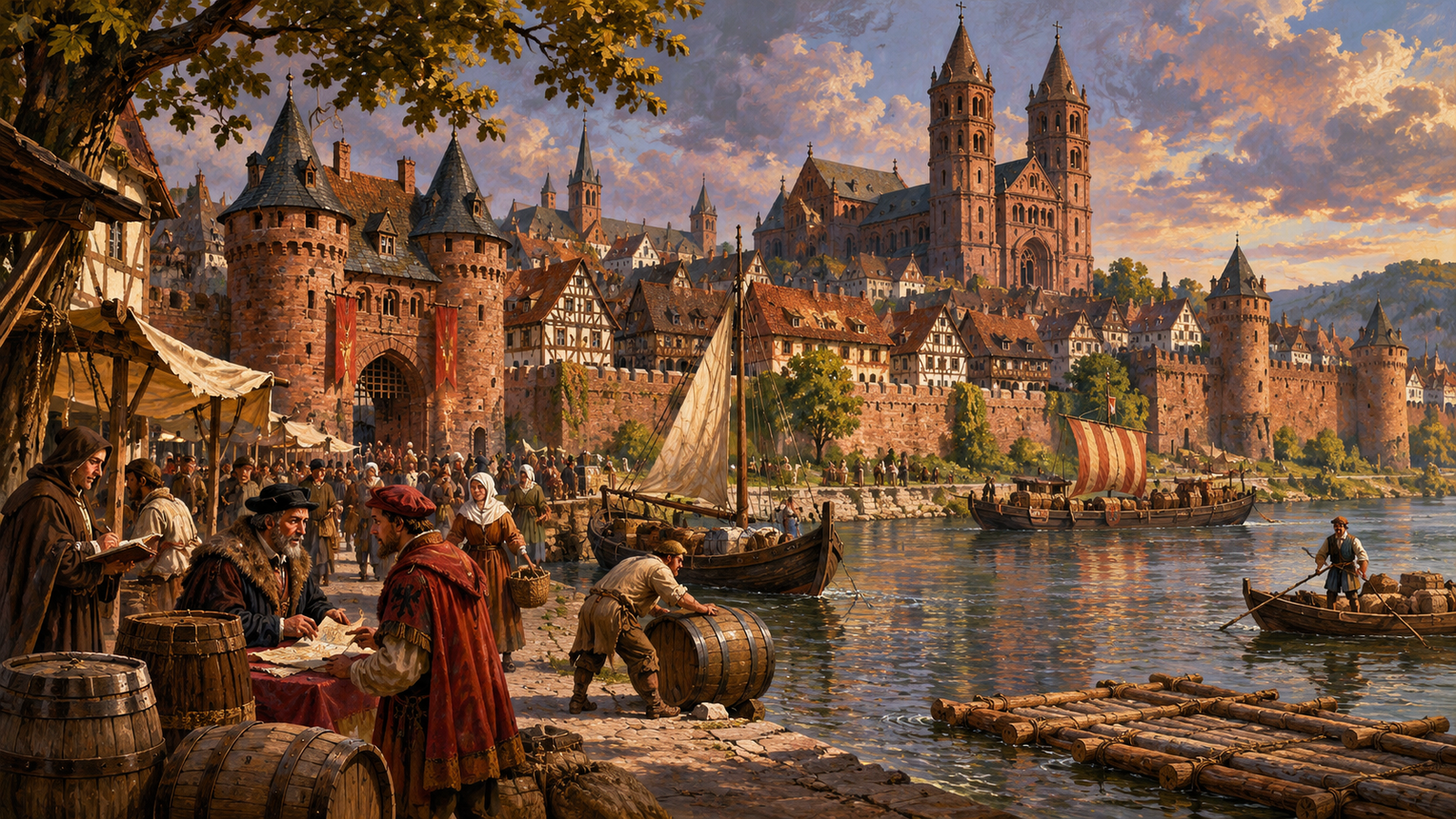
In 1454, Worms is a Rhine city of stone towers, crowded landings and stubborn civic privileges. Its councillors answer directly to the Empire, but the sacred household beside the great sanctuary holds courts, properties and immunities of its own. Merchants may hear three competing opinions about a single toll before their barrels leave the quay. The river is both the city’s trade road and the keeper of its most famous story.
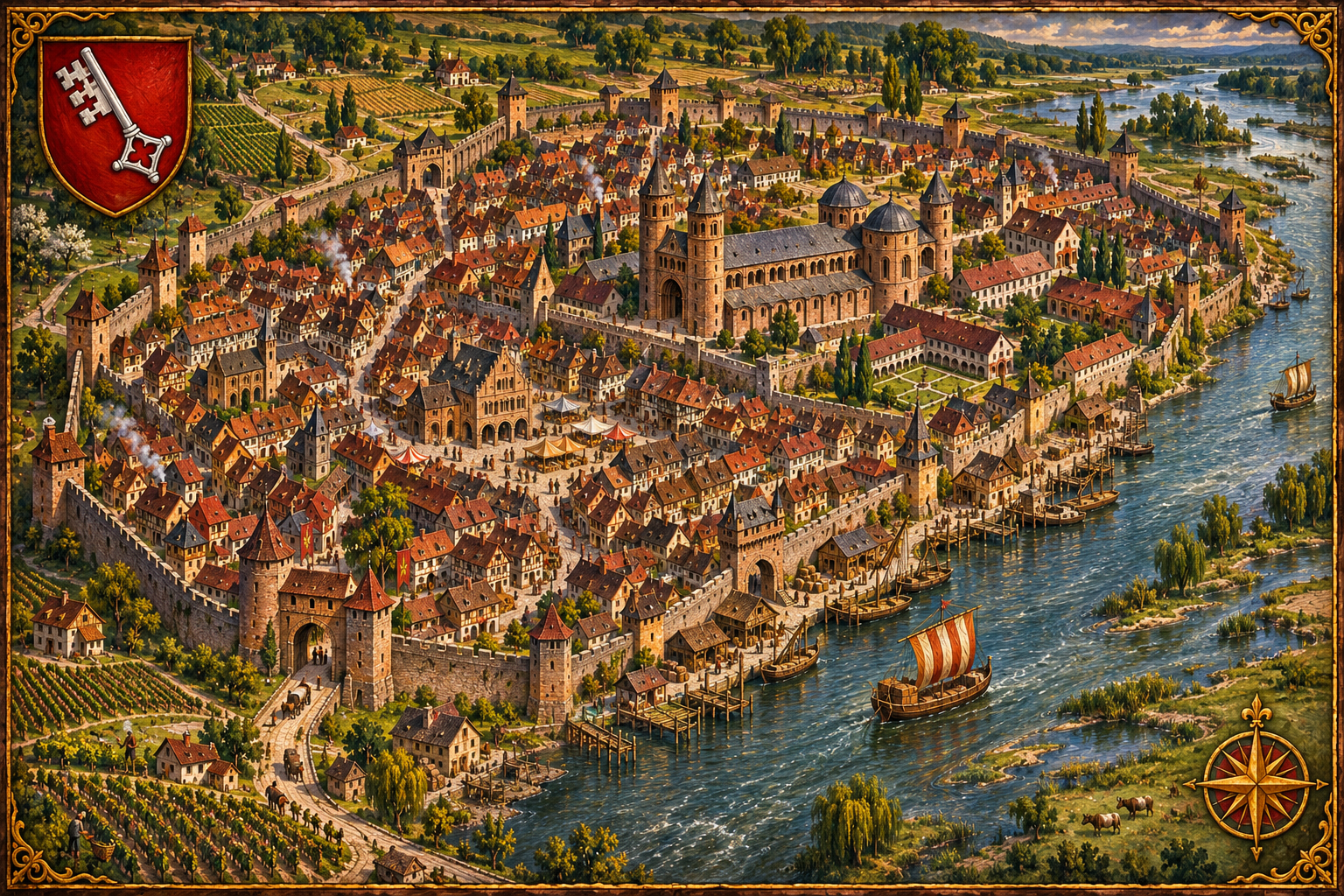
Map of Worms and the Rhine
Explore Worms: Current affairs · Play tonight · Places · People · Factions · Services and magic · Rumours · Travel and law
What Is Happening Right Now?
Two carts of wine stand detained where sacred precinct land meets a civic street. A steward claims that his household’s tenants owe no city duty; the council’s weighmaster says the barrels were sold by a townsman and must be entered into the market books. The carters cannot afford another day’s delay. Their receipts, tenancy record and the old boundary markers disagree. Neither authority wants to surrender a privilege before witnesses.
On the Rhine, salvagers are working a gravel bed exposed by a shifted channel. A crew has recovered pieces of ancient worked metal. Another says the site falls under an exclusive river concession, and the council wants every find declared before sale. The fishermen repeat the story of Hagen’s lost hoard. Even an ordinary piece of bronze becomes troublesome when everyone wants it to be royal treasure.
Run It Tonight: Two Carts, Three Claims
The characters arrive an hour before the market gates close. Two wine carts are held between the civic weighmaster’s station and the sacred precinct. The carters face a second night of storage fees. A guild merchant offers to buy the load cheaply if the dispute is not settled; a crowd gathers, hoping someone important will be embarrassed.
- What each side wants: the weighmaster needs the tax entered without weakening the council’s authority; the precinct steward wants an exemption upheld without surrendering the household’s ancient rights; the carters want their wine delivered while it is worth selling.
- What the characters can examine: two genuine seals, a market ledger recording a recent sale, an older tenancy record and boundary stones whose marks have been partly buried by street repairs. The exemption covers goods belonging to the precinct’s household, but the ledger suggests that ownership of this wine changed before it reached the gate.
- A hard choice: collecting the duty may be legal yet ruin the carters; waiving it may save them but give a wealthy trader a precedent to exploit. A negotiated deposit, witnessed by both courts, can let the carts pass while the dispute continues.
- Consequences: a fair ruling earns witnesses and useful friends among working people; a public humiliation makes an official a lasting enemy; forged papers expose a deeper trade fraud and give the council or precinct reason to follow the party’s next movements.
If the players ignore the affair, the wine is sold below value at dusk, the carters leave in debt and the victorious authority makes its claim at the next crossing. The dispute changes the city without waiting for heroes.
Important Places
- The Rhine landings: boatmen, porters and merchants bargain beside barrels, ropes and cargo tallies. Salvagers return here with anything pulled from the riverbed.
- Fischerpforte, the Fishermen’s Gateway: a narrow passage through the defences where witnesses remember who came ashore and which boats moved after dark.
- The great Romanesque sacred hall: its northern portal preserves the memory of imperial liberties; its archives, estates and custodians make it a second centre of authority within the city.
- The council’s market station: weights, seals, contracts and dues turn ordinary deliveries into political questions. An honest clerk can be more dangerous to a corrupt trader than a sword.
- The workshops and wine yards: coopers, metalworkers, cloth dealers and goldsmiths repair wares, extend credit and identify suspicious goods—often for a price.
The People of Worms
Konrad Seiler — Weighmaster of the Council
Konrad has spent twenty years measuring grain, wine and the honesty of men who swear their barrels are lighter than the scales say. His ledgers are immaculate; his patience is not. He knows the two detained wine carts changed hands before reaching the sacred precinct, but the entry was witnessed by his young apprentice, who has since vanished. Konrad will not falsify the account, even to save the carters. He will, however, give a determined investigator access to the weighing records if the apprentice is found alive. A public accusation against his office earns an enemy with authority over every merchant’s cargo.
Ruprecht Dorn — Steward of the Sacred Precinct
Ruprecht speaks softly and never arrives without a clerk. His household’s privileges shelter tenants who could not afford the city’s dues, but they also protect wealthy patrons with little claim to charity. A charter in his keeping may settle the dispute over the wine; the trouble is that its boundaries are described by a lane long since rebuilt. Ruprecht would sooner bargain privately with Konrad than let the civic council pronounce upon the precinct’s ancient rights. He offers access to records and safe lodging to those who defend his household, but he remembers every concession they ask him to make.
Greta Fischer — Boatmistress of the Lower Landing
Greta can bring a laden riverboat through a shallow channel in darkness, and the merchants who depend on her know better than to argue about the river. Her crew hauled a fragment of worked bronze from the exposed gravel bed. She has told the council where it was found, but not that a second, heavier object remains beneath the silt. A concession holder threatens to seize her boat if she returns to the site. Greta needs capable companions more than she needs treasure; anyone who betrays her confidence will find the Rhine suddenly short of willing pilots.
Matthias Brandt — Goldsmith of the Market Quarter
Matthias is asked to judge every curious ring and fragment that the Rhine yields, especially those whose owners whisper of Hagen’s lost hoard. He knows that the mark on Greta’s bronze resembles an old workshop stamp, not proof of a king’s treasure. Yet he hesitates to say so: a merchant creditor has already promised him a share of the find’s supposed value. Matthias can expose a forged antiquity or make a worthless object convincing. Which service he provides depends upon who pays his debt—and who threatens his apprentice.
Factions and Rival Claims
- The civic council: defends imperial liberties, market order and the city’s ability to judge disputes on its own streets. It rewards convincing witnesses but resists being publicly overruled.
- The sacred precinct’s household: controls estates, records, ceremonies and particular legal immunities. Its custodians protect real dependants as well as cherished privileges.
- Guild masters and merchant families: compete over access, prices, apprenticeships and who may speak for Worms. Their interests overlap but are not identical.
- River concession holders and salvagers: dispute access to profitable stretches of water, especially where the course of the Rhine has exposed old ground.
- Palatine interests: neighbouring lords and their agents can support a party to a dispute without openly ruling the city. A bargain made here may be called in elsewhere along the imperial roads and river routes.
Services, Sacred Power and Magic
Visitors can seek passage on a Rhine boat, warehouse space, a trustworthy scribe, a witness to a sale, a notary’s seal, repairs from a smith, a healer or a guild intermediary. Availability depends on the river, reputation, the relevant household’s rules and the willingness of a craftsman to accept unfamiliar coin or dangerous work. There is no open market in miraculous remedies or enchanted weapons: a petitioner must find a patron, win trust or persuade a keeper of sacred property that the need is real.
Omens concerning the Rhine and the old treasure draw storytellers, diviners and people hoping to profit from belief. A true magical sign is not automatically recognised by both courts; a purported revelation still needs a credible witness, and it may be challenged by someone with a conflicting claim.
Dangers, Rumours and Adventure Hooks
- The wrong seal: an apparently authentic exemption is used on a merchant cargo after its ownership changes. Who knew the goods were no longer exempt?
- The river’s gift: a salvage crew finds a worked ring and refuses to reveal its exact location. Three rival claimants arrive before the goldsmith can examine it.
- Witness at the gate: the only porter able to identify a smuggler has vanished. His family believes he is hiding from an official rather than the criminals.
- An imperial summons: a messenger demands documents from both council and precinct. Each side offers to pay the characters for the same sealed bundle.
- The false hoard: a broker sells a map claiming to locate Hagen’s treasure, but its river markings are accurate enough to expose a different, very real secret.
Travel, Law and Consequences
Every gate and landing has a jurisdiction. A traveller should know whether a toll applies to passage, sale, storage or a particular household’s goods; an exemption granted by one authority may not bind the other. Confiscation, a detained cargo, loss of guild protection or a demand for named witnesses can ruin a journey long before anyone draws steel. Disputes involving sacred tenants, civic merchants and river rights are not always heard by the same court.
The Rhine is the quickest highway for bulky trade but its landing places shift with water level. Road travellers carry news towards Speyer, Mainz and the surrounding Empire. A recognised merchant’s letter, a trustworthy pilot or a civic escort may be worth more than an armed retinue.
The City and the River
Worms stands beside a shifting reach of the Rhine, with fortified streets and markets on the settled ground and difficult, sometimes marshy approaches nearer the river. The roads, gates, docks and precincts do not form a single uncomplicated jurisdiction: distance matters less here than whose land a traveller crosses and whose seal is recognised.
Deeper History: Council, Privilege and Legend
The Council, the Sacred Precinct and the Emperor
Imperial privileges are matters of living law here. Frederick Barbarossa confirmed important liberties in 1184; the record was made conspicuous at the great sanctuary’s northern portal. Worms’s citizen community gained a council and defended its trading rights, while older religious property and judicial claims continued to complicate the city’s government. The guilds won a stronger voice in civic affairs after the constitutional changes of 1392, though the old urban families still guard their influence. An imperial messenger may be welcomed by both courts yet receive conflicting interpretations of the same charter.
The great Romanesque sanctuary rises above neighbouring roofs. Custodians of different divine traditions and ancestral trusts control archives, ritual property and households within their precincts. Their authority has a legal as well as sacred aspect. Outside the walls, Palatine lords have reasons to influence disputes without needing to conquer the city. A magistrate can be principled and calculating at once: every ruling creates a precedent.
Walls, Markets and the Rhine
An older Roman wall once enclosed the city. Medieval prosperity pushed later defences east towards the difficult, marshy Rhine shore; further settlement grew beyond earlier fortifications. At the Fishermen’s Gateway (Fischerpforte), river workers pass through a narrow opening in the wall; elsewhere towers and guarded streets divide the quarters. The quay becomes crowded when grain boats, timber rafts and wine barges arrive together, and a change in water level can force vessels to load farther from their usual warehouses.
Coopers, ferrymen, smiths, scribes and cloth workers make their living around those movements. A traveller can hire a boat, have a seal examined, seek a witness for a contract or find a buyer for grain. These services come with guild rules and civic dues. A sacred household’s exemption may protect its own tenant; it does not automatically give every merchant shelter from the city’s market law.
The Burgundian Circle
Siegfried, renowned for slaying Fafnir, is among the most formidable warriors of the age. Kriemhild is no less determined in her own affairs, while Brunhild guards her honour fiercely. Hagen of Tronje serves Gunther with the loyalty of a man who will do dreadful things for his lord. Their friendships and rivalries draw merchants, soldiers and courtiers into disputes far beyond Worms. None of these figures is content to be told what part to play.
The Nibelung treasure is a persistent temptation along the Rhine. Fishermen and salvagers argue over the stretch of water said to conceal it, while brokers offer suspicious maps and ancient-looking rings. Hagen has reason to know more than he says. A goldsmith asked to identify a recovered object risks attracting the attention of Hagen’s agents, Siegfried’s companions or Kriemhild’s household. The object itself may be worthless; the claims made upon it are dangerous enough.
Related Places and Journeys
Travellers along the Rhine can carry this city’s quarrels to nearby Speyer, another important city on the river, or to the territories and courts of Mainz. Beyond them lie the rival roads and lordships of the Empire. A merchant blacklisted in Worms may seek a buyer upriver; a witness to a disputed toll may be summoned back weeks later; a salvager carrying something valuable must decide which landing is safest.
Historical Sources
- City of Worms historical chronology — 1184 liberty charter, civic court and council
- Worms Erleben: medieval city walls and Rhine-facing extension around 1200
- Worms Nibelungenmuseum: Nibelung treasure and the Rhine
- City Archive: the 1226 municipal seal and early civic identity
Keep this reference growing
If this page helped with your reading or game, you can support its upkeep or explore the curated books.
Explore the Bookshop — epics, classics and stories behind imagined worlds.