
Rust Monster — Relentless Devourer of Metal

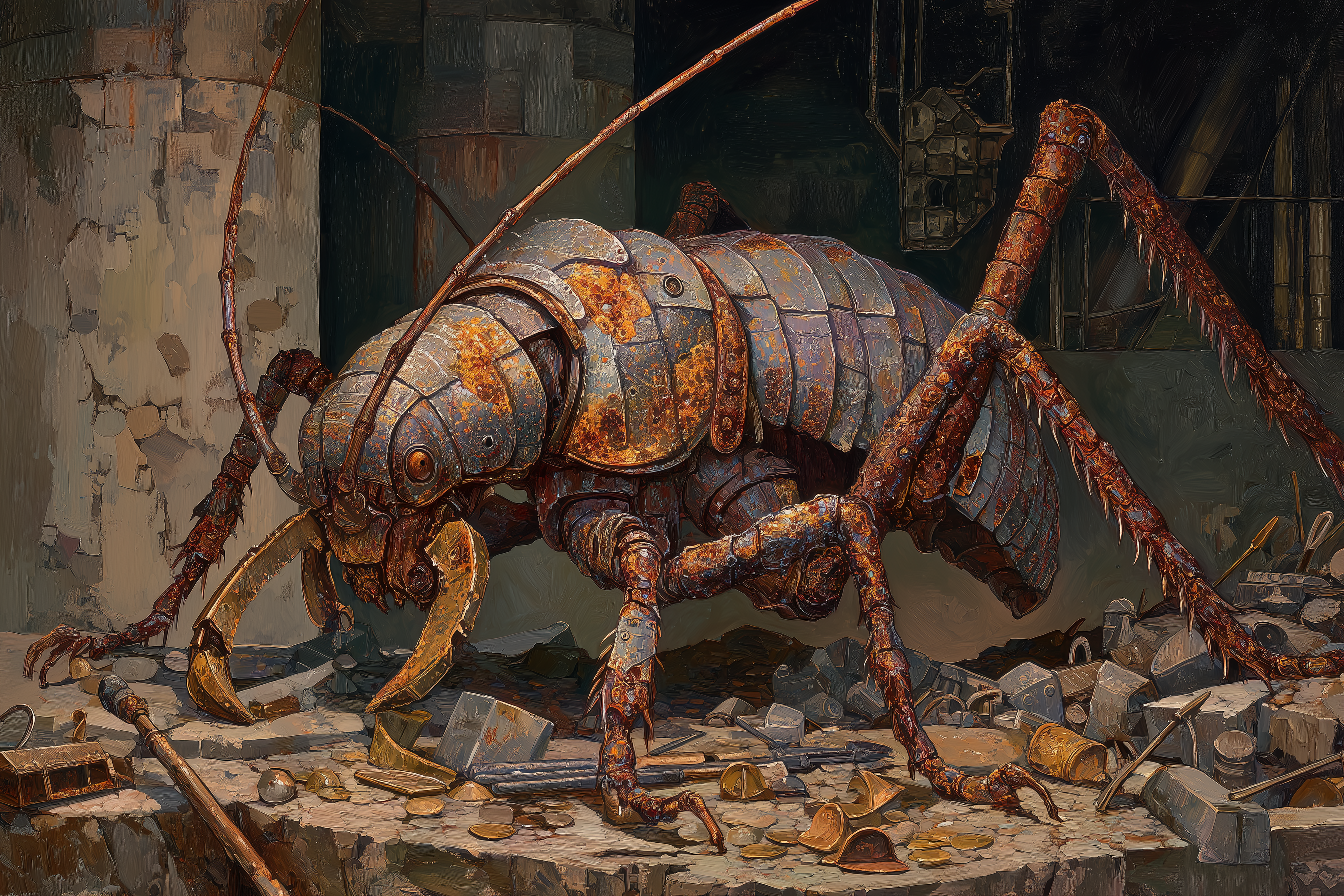
A harmless-looking scavenger until it smells steel—then armour, weapons and tools become food.
The Rust Monster is an insectile underground scavenger whose long antennae can corrode ferrous metal almost instantly. It is not malicious and usually has little interest in flesh. The danger comes from hunger: to a rust monster, a sword, shield, breastplate or iron-bound chest is simply dinner.
At a Glance
Run It Tonight
The rust monster is most effective when the party has a reason not to kill it immediately. Let it approach a dropped sword, iron door or abandoned cart first. Once the players understand what it wants, the encounter becomes a choice between protecting equipment, feeding the creature something expendable or fighting it before it ruins expensive gear.
Rules by Edition
Rust Monster
Medium Monstrosity, Unaligned
AC 14; Initiative +1 (11)
HP 27 (5d8 + 5)
Speed 40 ft.
13 (+1)
12 (+1)
13 (+1)
2 (−4)
13 (+1)
6 (−2)
Senses Darkvision 60 ft.; Passive Perception 11
Languages —
CR 1/2 (100 XP); PB +2
Traits
Iron Scent. The rust monster knows the location of ferrous metal within 30 feet of it unless that metal is behind Total Cover.
Rust Metal. When a nonmagical metal weapon hits the rust monster, that weapon takes a cumulative −1 penalty to its damage rolls after dealing damage. At −5, the weapon is destroyed. Nonmagical metal ammunition is destroyed after it deals damage.
Actions
Bite. Melee Attack Roll: +3, reach 5 ft. Hit: 5 (1d8 + 1) Piercing damage.
Antennae. The rust monster targets one nonmagical ferrous metal object it can see within 5 feet. If the object is worn or carried, its bearer can make a DC 11 Dexterity saving throw to avoid the touch. Metal armour or a shield takes a cumulative −1 penalty to the AC it provides; armour reduced to AC 10 or a shield reduced to +0 is destroyed. A metal weapon rusts as described in Rust Metal.
Rust Monster
Medium monstrosity, unaligned
Armor Class 14 (natural armor)
Hit Points 27 (5d8 + 5)
Speed 40 ft.
13 (+1)
12 (+1)
13 (+1)
2 (−4)
13 (+1)
6 (−2)
Senses darkvision 60 ft., passive Perception 11
Languages —
Challenge 1/2 (100 XP)
Traits
Iron Scent. The rust monster can pinpoint ferrous metal within 30 feet.
Rust Metal. A nonmagical metal weapon that hits the rust monster takes a cumulative −1 penalty to damage rolls after dealing damage. At −5 it is destroyed. Nonmagical metal ammunition is destroyed after dealing damage.
Actions
Bite. Melee Weapon Attack: +3 to hit, reach 5 ft., one target. Hit: 5 (1d8 + 1) piercing damage.
Antennae. The rust monster corrodes one nonmagical ferrous metal object within 5 feet. A carried or worn object can avoid the touch with a DC 11 Dexterity saving throw. Armour and shields lose AC; weapons suffer the Rust Metal penalty.
Rust Monster CR 3

XP 800
N Medium aberration
Init +3; Senses darkvision 60 ft., scent metals 90 ft.; Perception +12
Defense
AC 18, touch 13, flat-footed 15 (+3 Dex, +5 natural)
hp 27 (5d8+5)
Fort +2, Ref +4, Will +5
Offense
Speed 40 ft., climb 10 ft.
Melee bite +6 (1d3), antennae +6 touch (rust)
Statistics
Str 10, Dex 17, Con 13, Int 2, Wis 13, Cha 8
Base Atk +3; CMB +3; CMD 16 (20 vs. trip)
Feats Ability Focus (rust), Skill Focus (Perception), Weapon Finesse
Skills Climb +8, Perception +12
Special Abilities
Rust (Su). An antenna touch causes a metal object to take half its maximum Hit Points in damage and gain the broken condition. A second successful touch destroys it. Attended objects, magic objects and metal creatures can attempt a DC 15 Reflex save to negate the effect. Against metal creatures, the antennae deal 3d6+5 damage.
Scent Metals (Ex). The rust monster senses metal as though using scent, but at a range of 90 feet and only for metal objects or creatures carrying them.
Ecology
Environment any underground
Organization solitary, pair or nest (3–10)
Treasure incidental (no metal treasure)
Rust Monster
Medium Aberration
Hit Dice 5d8+5 (27 hp)
Initiative +3
Speed 40 ft. (8 squares)
Armor Class 18 (+3 Dex, +5 natural), touch 13, flat-footed 15
Base Attack/Grapple +3/+3
Attack antennae touch +3 melee (rust)
Full Attack antennae touch +3 melee (rust) and bite −2 melee (1d3)
Space/Reach 5 ft./5 ft.
Special Attacks rust
Special Qualities darkvision 60 ft., scent
Saves Fort +2, Ref +4, Will +5
Abilities Str 10, Dex 17, Con 13, Int 2, Wis 13, Cha 8
Skills Listen +7, Spot +7
Feats Alertness, Track
Environment underground
Organization solitary or pair
Challenge Rating 3
Treasure none
Alignment always neutral
Rust (Su)
An antenna touch rusts metal. Nonmagical metal immediately corrodes; magic metal can resist with a DC 17 Reflex save. Metal weapons that strike the rust monster may also corrode. The save DC is Constitution-based.
Behaviour
Rust monsters follow metal the way a predator follows blood. They are curious about living creatures only because living creatures often carry dense, refined sources of food. A rust monster that has just been fed a shield may ignore the person who threw it.
They are not tactical geniuses. Their apparent ability to “disarm” adventurers comes from repeatedly reaching for the strongest metal scent nearby.
Signs Before Initiative
- Iron nails have vanished from timber while the wood remains untouched.
- Broken weapons show deep orange corrosion far beyond normal age.
- Coin purses contain only gold and stone while iron buckles are missing.
- Mine carts collapse because axles and fittings have been eaten away.
- Strange four-legged tracks circle old armour before moving elsewhere.
If Violence Starts
The rust monster goes for equipment first. It targets exposed armour, shields and weapons with its antennae and bites only when frightened or blocked from food. If someone throws a heavy iron object away from the group, a hungry rust monster may pursue it instead.
Counterplay
Carry a nonmetal backup weapon. Wooden clubs, stone tools, spells and natural attacks avoid the creature’s signature threat. Adventurers who know they are entering a rust-monster nest often bring scrap iron specifically as bait.
Not every metal reacts equally in every campaign. The fifth-edition rules focus on ferrous metal, while PF1e is much harsher and can threaten magical equipment. Use the edition’s rules rather than assuming one universal corrosion model.
Nests and Life Cycle
Rust monsters are usually solitary, but a rich source of oxidisable metal can support a nest. Females deposit eggs near food, and larvae remain close to corroded metal until they are large enough to roam. Mines and abandoned armouries are therefore particularly vulnerable: the same place that feeds adults can support the next generation.
The older page’s Fateforge material also described unusually large matriarchs. Keep that as an optional encounter variant rather than part of the ordinary rust monster stat block.
Using a Rust Monster in an Encounter
The silent mine. Tools, rails and support fittings are disappearing faster than the miners can replace them.
The armoury breach. Nothing has been stolen from a fortress armoury, but every steel weapon inside is ruined.
The druid’s objection. Miners want a nest exterminated; local druids argue that the creatures are part of the underground ecology.
The bait shield. The party can avoid a fight entirely if someone is willing to sacrifice an expensive piece of metal.
Related Creatures
Compare the rust monster with the Copper Golem, other underground scavengers in the Aberration Bestiary, or return to the World Bestiary.
Rules Sources and Licensing
The 5e/2014 Rust Monster uses the official SRD 5.1 under CC BY 4.0. The Pathfinder 1e statistics derive from older open game material; D&D 3.5e mechanics derive from the d20 SRD. The 2024 panel is a separately adapted rules presentation; compare the official 2024 Rust Monster in SRD 5.2.1 when using it at the table.
SRD 5.1 attribution: This work includes material taken from the System Reference Document 5.1 (“SRD 5.1”) by Wizards of the Coast LLC and available at https://dnd.wizards.com/resources/systems-reference-document. The SRD 5.1 is licensed under the Creative Commons Attribution 4.0 International License available at https://creativecommons.org/licenses/by/4.0/legalcode.
SRD 5.2.1 attribution: This work includes material from the System Reference Document 5.2.1 (“SRD 5.2.1”) by Wizards of the Coast LLC, available at https://www.dndbeyond.com/srd. The SRD 5.2.1 is licensed under the Creative Commons Attribution 4.0 International License, available at https://creativecommons.org/licenses/by/4.0/legalcode.
The 5.5e/2024 block is a compatibility presentation using current rules language. The old custom rust spray, acid immunity and legendary actions have been removed because they were not part of the ordinary rust monster’s established mechanics.
Keep this reference growing
If this page helped with your reading or game, you can support its upkeep or explore the curated books.
Explore the Bookshop — epics, classics and stories behind imagined worlds.