
Kayak — The Arctic Hunter’s Skin Boat
At a Glance
- Type
- Light, low-decked paddle craft built for an individual navigator
- Where Found
- Arctic and northern maritime communities, with regional variations
- Construction
- Skin or hide stretched over a lashed frame of wood or bone
- Propulsion
- Hand paddle, commonly double-bladed in many northern traditions
- Use
- Hunting, scouting, fishing, coastal passage and journeys through broken ice
- Limits
- One principal paddler, little cargo space and exposure to cold water
- Hazards
- Broken skin seams, shifting ice, squalls, capsizing and exposure
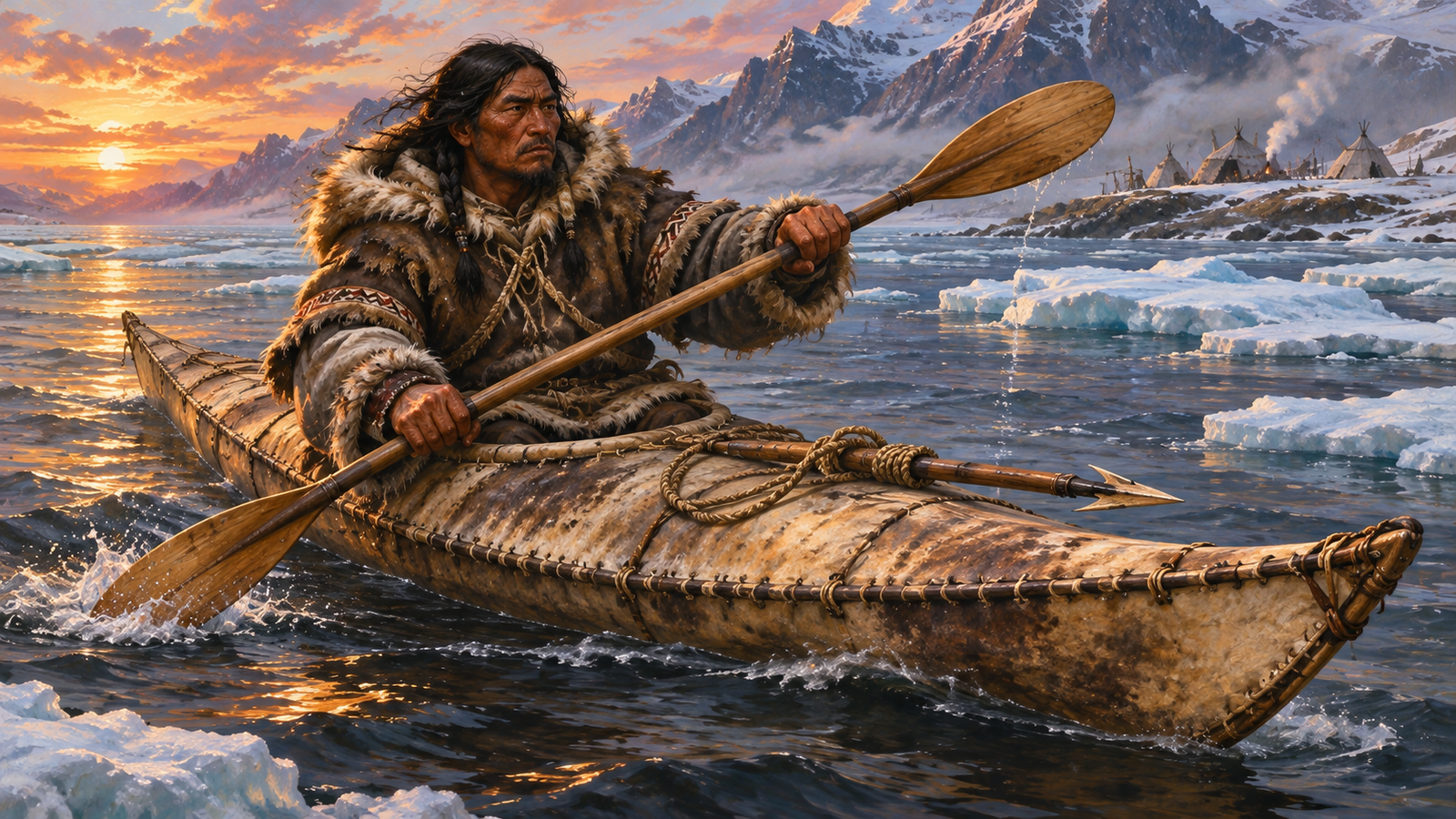
Between two moving fields of sea ice, the kayak glides in silence. Its hunter lowers the paddle and listens. Beyond the next floe, a seal surfaces once before disappearing beneath the dark water. A heavy boat would never pass here; this slender craft can approach unseen, but a single torn seam may leave its paddler fighting the cold sea.
Along northern coasts in 1454, a kayak is more than a small boat. It is a carefully fitted hunting and travelling craft whose balance, frame and opening suit the person who uses it. Skilled makers adapt their designs to local winds, seas, timber and hides. Some journeys run beside cliffs and ice, others between offshore camps and sheltered bays. Its strength lies in its lightness and agility, not in its ability to carry a merchant’s freight.
Frame, Covering and Equipment
Longitudinal wooden members and crosspieces form a flexible frame, sometimes using driftwood or bone where trees are scarce. Strong lashings allow the structure to yield to a wave rather than break. Prepared animal skin is sewn into a covering and stretched over the frame; waterproof stitches and regular treatment with oil or fat resist seepage. A single opening leaves the paddler sitting low within the hull.
Spray opening. The paddler’s clothing or a fitted skin covering can seal around the cockpit coaming, reducing the amount of water entering in rough weather. Such protection is only as sound as its fastening. A torn skirt, flooded cockpit or loss of the paddle can prove deadly.
Paddle and hunting gear. In many northern traditions a long double-bladed paddle allows alternating strokes on either side without shifting one’s hands to another implement; other regional designs favour a single blade. Harpoons, throwing tools, line and a small float may be lashed to the deck, within easy reach but clear of the paddle’s sweep.
Stores and repairs. Space inside the narrow ends of the hull is for compact, carefully packed gear rather than additional passengers. The owner carries cord, spare lashings and materials for patching a puncture. The boat must be dried and its skin treated regularly. When grounded, it is lifted and carried rather than dragged over sharp stones.
How a Kayak Moves
The paddler faces the bow and sits low, drawing each blade through the water in turn. Unlike a rowboat, a kayak has no pair of oars mounted in rowlocks and its paddler does not sit facing the stern. The moving paddle can brace the craft against an unexpected wave, but even an expert must respect bad weather and the force of a rising sea.
In calm conditions the kayak is fast and quiet. Wind, a following current or a field of ice can change a short crossing into a deadly passage. A hunter who leaves the lee of the coast must be able to return without losing sight of safe landings.
Encounters on the Northern Coast
The Sound Beneath the Ice. A hunter has vanished after following seals beyond the winter camp. His kayak returns alone on the tide, its skin unbroken and the harpoon still secured to the deck. Each night a knocking comes from beneath the frozen harbour. The elders insist that no one follow the sound, but a child claims to have heard the missing hunter answer.
The Crossing. A messenger must carry a small sealed packet across a strait blocked by drifting ice. A larger boat cannot launch, and the closest landing is watched by hostile scouts. The kayak offers stealth, but the channel narrows as the tide turns.
Practical hazards. A split seam, lost paddle, exhausted paddler or overturned kayak creates immediate choices. A companion on shore may throw a line, but a character in cold water may have little time before numb hands can no longer hold it.
Kayak — Vehicle Rules
Kayak — D&D 2024
Single-person paddled watercraft (complete setting profile). The kayak is smaller and narrower than the printed Rowboat; it does not inherit that boat’s three-passenger capacity.
| Cost | 90 GP |
|---|---|
| Unladen Weight | 50 lb. |
| Crew / Passengers | One seated paddler / none |
| Cargo | 100 lb. secured in the hull, subject to safe loading |
| Speed | 30 ft. per round under paddle propulsion |
| AC / HP | 11 / 20 |
| Propulsion | One double-bladed paddle |
Paddle and steer. The paddler takes the Utilize action on their turn to move the craft and change heading. Familiar sheltered waters require no check. Capsizing surf, narrow moving ice or dangerous current requires a DC 15 Dexterity check with Water Vehicles proficiency if applicable, or Wisdom (Survival) where navigation is the primary difficulty. On failure the kayak turns across the current and loses its controlled movement that turn.
Capsize and damage. A torn skin, lost paddle or broken frame can leave the occupant in the water. The 90 GP price and 50 lb. weight reflect a specialist design; its speed, cargo and object values are setting rules rather than published 2024 kayak statistics.
Published transport comparison: D&D 2024 Basic Rules — Waterborne Vehicles.
Kayak — D&D 2014
Specialist small watercraft (setting vehicle). Cost 90 gp; unladen weight 50 lb.; one paddler and no passenger seat; up to 100 lb. of secured gear; speed 30 ft. per round; AC 11; 20 hit points. Its manoeuvrability does not grant it the printed Rowboat’s three-passenger capacity.
Handling. The operator takes an action to paddle, turn or hold course. No check is needed in calm, familiar water. When a wave, current or floating ice threatens control, a DC 15 Dexterity check using Water Vehicles proficiency if applicable prevents a capsize or collision. Failure swings the bow across the flow and stops controlled travel for that round.
Damage and immersion. A split plank, ripped skin seam or lost paddle can leave the kayak drifting. Once reduced to 0 hit points it cannot stay afloat; resolve swimming and cold-water exposure normally. The speed, carrying capacity and handling checks are complete setting specifications, not an official 2014 kayak entry.
Published comparator: Dungeon Master’s Guide (2014), waterborne vehicles.
Kayak — Pathfinder 1e
Kayak — Large water vehicle (setting conversion); Squares 2 (5 ft. by 10 ft.); Cost 90 gp; Unladen Weight 50 lb. This is a custom kayak, not the published Pathfinder Rowboat.
Defense
AC 9; Hardness 5 (laminated wooden hull model); hp 20 (broken 9); Base Save +0.
Offense
Maximum Speed 30 ft. with one paddler; Acceleration 10 ft.; CMB +1; CMD 11; Ramming Damage 1d8 only for an unavoidable collision, not a designed attack.
Description
Propulsion muscle (pushed; one Medium paddler) or current (water); Driving Check Survival; Forward Facing bow; Driving Device double-bladed paddle; Driving Space aft square; Decks 1, enclosed cockpit; Capacity one paddler and up to 100 lb. of secured gear, without a second passenger.
Handling. Calm waters need no driving check. A dangerous turn in rough water, loose ice or swift current calls for a normal vehicle check (DC 15 for a challenging crossing). On failure the craft loses the intended turn and drifts with the current. Repair a fractured frame before exposing it to heavy seas.
Construction. The hardness 5 profile uses the wooden laminated fantasy kayak in the third-party supplement. A traditional skin-on-frame kayak has hardness 0 and may be repaired by patching its hide; all other statistics are unchanged. The 90 gp cost and 50 lb. weight come from that specialist equipment model, not official Paizo rules.
Vehicle framework: Pathfinder Ultimate Combat — Water Vehicles.
Kayak — D&D 3.5e
Third-party equipment, Ultimate Equipment Guide II (Mongoose Publishing, 2005).
| Cost | 90 gp |
|---|---|
| Weight | 50 lb. |
| Hardness | 5 (laminated timber hull) |
| HP | 20 |
| Manoeuvrability | +3 circumstance bonus to relevant handling checks |
| Speed (setting) | 30 ft. per round under a single paddler |
| Cargo (setting) | 100 lb. secured in the ends of the hull |
Paddling. The operator moves and turns the kayak with a double-ended paddle. The specialist laminated timber hull and close-fitting oiled-leather cockpit skirt protect the interior from spray. Under ordinary sheltered conditions no skill check is necessary. A difficult turn or dangerous wave requires a DC 15 Profession (sailor) check and gains the source’s +3 circumstance bonus for handling.
Capsize. A hard impact, torn cockpit seal or broken paddle may force the pilot to swim, recover the kayak or find shore. The speed and cargo above make the craft playable in combat but are explicit setting values; the original third-party figures are the 90 gp purchase, 50 lb. weight, hardness 5, 20 hp and handling bonus.
Original source: Greg Lynch and J. C. Alvarez, Ultimate Equipment Guide II (Mongoose Publishing, 2005). Core comparison: D&D 3.5e SRD — Transport.
Related Watercraft and Sources
For an open ferry boat, see the Rowboat; for carrying heavy freight along inland waterways, see the Keelboat. Return to the Vehicles catalogue.
Traditional construction and regional variation: Hudson Museum, University of Maine; Smithsonian Institution; National Maritime Museum Cornwall. Third-party game equipment figures credited to Greg Lynch and J. C. Alvarez, Ultimate Equipment Guide II, Mongoose Publishing, 2005.
Keep this reference growing
If this page helped with your reading or game, you can support its upkeep or explore the curated books.
Explore the Bookshop — epics, classics and stories behind imagined worlds.