
Word of Recall Spell
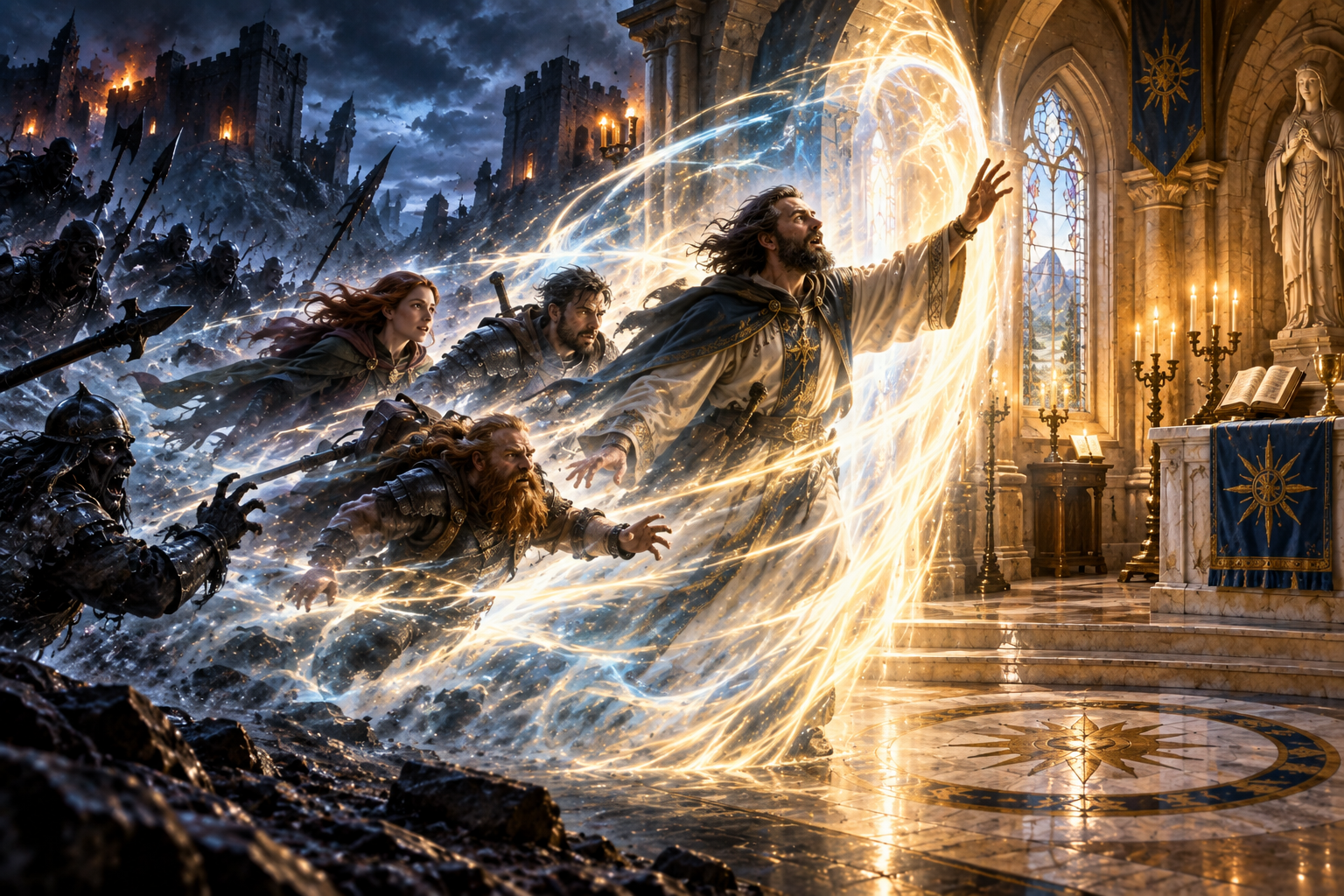
Word of Recall is emergency magic with one great advantage and one unforgiving condition: the escape route must exist before disaster strikes. A caster establishes a sanctuary in advance and can later speak the spell to carry themselves and willing companions instantly back to that refuge.
It is not a substitute for unrestricted teleportation. Word of Recall is about preparation, extraction and survival. The caster chooses safety before the expedition begins, then keeps that destination in reserve for the moment when retreat by road, ship or ordinary magic is no longer possible.
Word of Recall Rules
The spell differs significantly between modern and earlier rules. Select the rules system used by your campaign. Only one mechanics panel should be visible at a time.
Word of Recall — 5.5e / 2024
| Level | 6 |
|---|---|
| School | Conjuration |
| Class | Cleric |
| Casting Time | Action |
| Range | 5 feet |
| Components | V |
| Duration | Instantaneous |
You and up to five willing creatures within 5 feet of you instantly teleport to a sanctuary you designated beforehand. You and the creatures travelling with you appear in the nearest unoccupied spaces to the spot designated when the sanctuary was prepared.
You establish the sanctuary by casting Word of Recall at the chosen location. If you later cast the spell without having established a sanctuary first, the spell has no effect.
Practical consequence: the 2024 version supports a wider variety of prepared refuges without importing the additional religious-location restriction from the earlier version.
Word of Recall — 5e / 2014
| Level | 6th-level |
|---|---|
| School | Conjuration |
| Class | Cleric |
| Casting Time | 1 action |
| Range | 5 feet |
| Components | V |
| Duration | Instantaneous |
You and up to five willing creatures within 5 feet of you can be transported instantly to a sanctuary designated in advance. You and the other travellers appear in the nearest unoccupied spaces to the designated spot. The spell has no effect if the caster has not prepared a sanctuary first.
Under the 2014 rules, the destination carries an additional restriction: the caster designates the sanctuary by casting the spell within a location, such as a temple, dedicated to or strongly linked with the caster’s deity. Attempting to establish the sanctuary somewhere that does not satisfy that requirement has no effect.
Word of Recall — Pathfinder 1e
| School | Conjuration (teleportation) |
|---|---|
| Level | Cleric 6, Druid 8 |
| Components | V |
| Casting Time | 1 standard action |
| Range | Unlimited |
| Target | You and touched objects or other willing creatures |
| Duration | Instantaneous |
| Saving Throw | None or Will negates (harmless, object) |
| Spell Resistance | No or Yes (harmless, object) |
The caster designates the sanctuary when preparing the spell, and it must be a very familiar place. The actual point of arrival is a designated area no larger than 10 feet by 10 feet.
The spell can transport the caster any distance within the same plane but cannot carry travellers between planes. The caster can transport carried objects provided their weight does not exceed the caster’s maximum load.
The caster may also bring one additional willing Medium or smaller creature, or its equivalent, for every three caster levels. A Large creature counts as two Medium creatures, a Huge creature counts as two Large creatures, and the progression continues for still larger creatures.
All creatures being transported must remain in contact with one another, and at least one of those creatures must be in contact with the caster. Exceeding the transport limit causes the spell to fail.
An unwilling creature cannot be teleported. A creature’s Will save or Spell Resistance can prevent items in its possession from being transported. Unattended nonmagical objects receive no saving throw.
Word of Recall — D&D 3.5e
| School | Conjuration (Teleportation) |
|---|---|
| Level | Cleric 6, Druid 8 |
| Components | V |
| Casting Time | 1 standard action |
| Range | Unlimited |
| Target | You and touched objects or other willing creatures |
| Duration | Instantaneous |
| Saving Throw | None or Will negates (harmless, object) |
| Spell Resistance | No or Yes (harmless, object) |
The caster designates the sanctuary when preparing the spell, and it must be a very familiar place. The actual point of arrival is an area no larger than 10 feet by 10 feet.
The caster can travel any distance within the same plane but cannot use Word of Recall to cross between planes. Objects carried by the caster can travel as long as their total weight does not exceed the caster’s maximum load.
The caster can additionally transport one willing Medium or smaller creature, or its equivalent, per three caster levels. A Large creature counts as two Medium creatures, a Huge creature as two Large creatures, and so forth.
Everyone transported must form an unbroken chain of physical contact, with at least one creature touching the caster. Exceeding the transport limit causes the spell to fail.
An unwilling creature cannot be teleported. A creature’s Will save or Spell Resistance can prevent items in its possession from travelling. Unattended nonmagical objects receive no saving throw.
Edition Differences at a Glance
| Rule | 5.5e / 2024 | 5e / 2014 | Pathfinder 1e / 3.5e |
|---|---|---|---|
| Spell level | Cleric 6 | Cleric 6 | Cleric 6 / Druid 8 |
| Activation | Action | 1 action | 1 standard action |
| Passengers | Up to five willing creatures within 5 feet | Up to five willing creatures within 5 feet | Willing touched creatures; capacity scales with caster level and creature size |
| Sanctuary | Previously designated location | Previously designated deity-linked location | Very familiar sanctuary designated when the spell is prepared |
| Planar travel | No interplanar travel granted | No interplanar travel granted | Explicitly limited to the same plane |
How Word of Recall Works
The spell is best understood as a magical evacuation route rather than ordinary travel magic. The caster does not choose a convenient destination when trouble begins. The destination has already been chosen.
That distinction creates the spell’s character. Word of Recall rewards foresight. A company entering dangerous territory can know that, if the caster remains able to cast and the required companions are close enough, one spoken spell can turn a disastrous expedition into a retreat.
It also creates vulnerability. The destination is predictable. Enemies who discover the sanctuary may be able to watch it, occupy it or prepare an unpleasant reception.
Preparing the Sanctuary
A good sanctuary is more than a rules coordinate. It is somewhere the characters genuinely want to reach when everything has gone wrong.
Depending on edition and campaign, suitable refuges might include a sacred grove, temple chamber, ancestral hall, fortified guildhouse, hidden magical chamber, protected university room or the secure residence of an allied order.
The exact religious requirement depends on the rules being used. The 2014 spell specifically requires the deity connection. The 2024 spell does not. Pathfinder 1e and D&D 3.5e instead emphasise a very familiar designated sanctuary.
Best Uses for Word of Recall
Emergency Extraction
The obvious use is escaping a battle that has turned against the party. Because the destination is fixed beforehand, there is no last-second navigation decision: activate the spell and return to the prepared refuge.
Dangerous Expeditions
Word of Recall is particularly valuable before entering ruins, monster lairs, hostile courts, plague zones, supernatural wilderness or territories where conventional retreat may be impossible.
Protecting Important People
A powerful caster accompanying a ruler, envoy, scholar or other important traveller can make Word of Recall part of an evacuation plan, provided the edition’s passenger restrictions are satisfied.
Escaping Pursuit
Ordinary pursuit becomes largely irrelevant once the spell succeeds. The pursuers’ next move may instead be to identify the sanctuary, interrogate allies or determine where the fugitives have gone.
Limits That Matter
The sanctuary must exist first. Word of Recall is poor improvisational travel magic. Without the required preparation, the spell cannot provide its intended escape.
Passengers must qualify. Modern versions require willing creatures within 5 feet of the caster. Pathfinder 1e and D&D 3.5e instead use touch, caster-level capacity, creature size and load rules.
It is not Plane Shift. Word of Recall does not become interplanar transportation simply because the sanctuary is distant. Plane Shift exists for journeys across planar boundaries.
Teleportation can be countered. Effects specifically designed to prevent dimensional movement can matter. Dimensional Anchor, for example, is designed to prevent teleportation and similar forms of magical escape in editions where its rules apply.
The destination can become a story. Instant transportation does not guarantee that the sanctuary remains politically secure, physically undamaged or free of enemies.
Word of Recall in 1454
In 1454, distance is power. Roads are slow, mountain passes dangerous, winter can close routes entirely, and rulers depend upon messengers, horses, river traffic and ships. Against that background, Word of Recall is extraordinary.
A powerful caster can leave a prepared refuge, travel for days or weeks and still retain a magical route home. Courts, temples, magical schools, mercenary companies and wealthy patrons therefore have good reasons to value casters capable of establishing reliable sanctuaries.
The sanctuary itself may consequently become secret information. A ruler need not advertise the chamber to which a trusted spellcaster can suddenly return. An order might maintain a guarded recall room inside its headquarters. A travelling company might establish its sanctuary in the home of an ally rather than somewhere obvious.
SpiralWorlds does not require every sanctuary to resemble a conventional medieval church. Depending upon culture, rules edition and magical tradition, the refuge may be a shrine of an old pantheon, druidic grove, ancestral chamber, guild vault, sacred spring, hidden academy room or another place whose identity makes sense for the caster.
Adventure Complications
A Word of Recall sanctuary makes an excellent recurring campaign location because the characters expect it to be safe.
- The party returns to discover that the sanctuary has been occupied during their absence.
- An enemy learns where a famous caster has established their refuge.
- A ruler insists that the court’s recall sanctuary be moved after a spy uncovers it.
- The adventurers escape a monster only to arrive during an unrelated crisis at home.
- A missing caster was expected to recall days ago but never arrived.
- The characters must reach a sanctuary physically before they can establish it as their future escape point.
Word of Recall and Other Travel Magic
Word of Recall occupies a distinctive place within Conjuration. It sacrifices destination flexibility in exchange for a predetermined emergency route.
Teleportation Circle also revolves around established magical destinations, but it serves a different transportation role. Plane Shift answers the problem Word of Recall cannot solve: travelling between planes.
Refuge provides another useful comparison in the older open rules, using a prepared magical object to trigger transport rather than giving the caster a personal emergency return route.
These spells sit within the wider SpiralWorlds magic reference, where transportation magic ranges from local dimensional movement to travel across worlds and planes.
GM Guidance
Word of Recall works best when its reliability is respected. Its limitations already demand preparation, proximity or touch, and an appropriate sanctuary. Allowing the spell to perform its intended function makes the occasions when the destination genuinely has changed much more memorable.
Frequently Asked Questions
What does Word of Recall do?
It instantly transports the caster and permitted willing companions to a sanctuary designated beforehand. The exact sanctuary and passenger rules depend on edition.
Does Word of Recall need a prepared sanctuary?
Yes. The spell is built around a destination established in advance. It is not a general-purpose teleport spell that lets the caster select a new destination when making the escape.
Does the sanctuary have to be a temple?
Not under the 2024 wording. A temple is an example of a location that can be designated. The 2014 version is stricter and requires the location to be dedicated to or strongly linked with the caster’s deity. Pathfinder 1e and D&D 3.5e instead require a very familiar sanctuary designated when the spell is prepared.
Can Word of Recall travel between planes?
No interplanar capability should be added to the spell. Pathfinder 1e and D&D 3.5e explicitly restrict it to travel within the same plane. For actual planar transportation, see Plane Shift.
Can Word of Recall take unwilling creatures?
No. The spell is not an offensive teleportation effect for abducting enemies. Its creature passengers must be willing.
How many creatures can Word of Recall transport?
The 2024 and 2014 versions allow the caster plus up to five willing creatures within 5 feet. Pathfinder 1e and D&D 3.5e instead calculate additional willing creatures according to caster level and creature size.
Can Dimensional Anchor stop Word of Recall?
Where the applicable edition’s Dimensional Anchor rules prohibit the target from teleporting, that restriction can prevent the anchored target from using teleportation to escape. Use the exact rules for the edition being played rather than importing one edition’s interaction into another.
Is Word of Recall the same as Teleportation Circle?
No. Both involve prepared destinations, but Word of Recall is fundamentally an emergency return spell centred on the caster and their companions. Teleportation Circle uses a different transportation procedure and should be adjudicated from its own rules.
What happens if the sanctuary’s exact arrival point is occupied?
In the modern versions, travellers use the applicable arrival-placement rules around the designated destination. Pathfinder 1e and D&D 3.5e instead designate an arrival area no larger than 10 feet by 10 feet. Use the rules of the edition being played rather than importing an arrival rule from another edition.
Sources and Licensing
Rules sources: Word of Recall is presented here as edition-separated material. The 2024 mechanics use the current D&D Free Rules / System Reference Document 5.2.1 framework. The 2014 mechanics use the 2014 Basic Rules/SRD framework. Pathfinder 1e and D&D 3.5e use their respective open rules versions. SpiralWorlds campaign material, examples, commentary, comparisons and 1454 material are original editorial content.
5.5e / 2024: System Reference Document 5.2.1, released by Wizards of the Coast LLC under the Creative Commons Attribution 4.0 International Licence.
5e / 2014: System Reference Document 5.1 / Basic Rules material. The rules are separated from the 2024 version so that edition-specific sanctuary requirements remain attached to the correct rules system.
Pathfinder 1e: Pathfinder Roleplaying Game Core Rulebook / Pathfinder Reference Document, published by Paizo Inc. Relevant Open Game Content is used under the Open Game License Version 1.0a.
D&D 3.5e: Revised System Reference Document, published by Wizards of the Coast. Relevant Open Game Content is used under the Open Game License Version 1.0a.
Creative Commons Attribution 4.0
This work includes material from the System Reference Document 5.2.1 by Wizards of the Coast LLC, available under the Creative Commons Attribution 4.0 International Licence.
To view a copy of the licence, visit Creative Commons Attribution 4.0 International.
OPEN GAME LICENSE Version 1.0a
The following text is the property of Wizards of the Coast, Inc. and is Copyright 2000 Wizards of the Coast, Inc (“Wizards”). All Rights Reserved.
1. Definitions: (a) “Contributors” means the copyright and/or trademark owners who have contributed Open Game Content; (b) “Derivative Material” means copyrighted material including derivative works and translations (including into other computer languages), potation, modification, correction, addition, extension, upgrade, improvement, compilation, abridgment or other form in which an existing work may be recast, transformed or adapted; (c) “Distribute” means to reproduce, license, rent, lease, sell, broadcast, publicly display, transmit or otherwise distribute; (d) “Open Game Content” means the game mechanic and includes the methods, procedures, processes and routines to the extent such content does not embody the Product Identity and is an enhancement over the prior art and any additional content clearly identified as Open Game Content by the Contributor, and means any work covered by this License, including translations and derivative works under copyright law, but specifically excludes Product Identity; (e) “Product Identity” means product and product line names, logos and identifying marks including trade dress; artifacts; creatures characters; stories, storylines, plots, thematic elements, dialogue, incidents, language, artwork, symbols, designs, depictions, likenesses, formats, poses, concepts, themes and graphic, photographic and other visual or audio representations; names and descriptions of characters, spells, enchantments, personalities, teams, personas, likenesses and special abilities; places, locations, environments, creatures, equipment, magical or supernatural abilities or effects, logos, symbols, or graphic designs; and any other trademark or registered trademark clearly identified as Product identity by the owner of the Product Identity, and which specifically excludes the Open Game Content; (f) “Trademark” means the logos, names, mark, sign, motto, designs that are used by a Contributor to identify itself or its products or the associated products contributed to the Open Game License by the Contributor; (g) “Use”, “Used” or “Using” means to use, Distribute, copy, edit, format, modify, translate and otherwise create Derivative Material of Open Game Content; (h) “You” or “Your” means the licensee in terms of this agreement.
2. The License: This License applies to any Open Game Content that contains a notice indicating that the Open Game Content may only be Used under and in terms of this License. You must affix such a notice to any Open Game Content that you Use. No terms may be added to or subtracted from this License except as described by the License itself. No other terms or conditions may be applied to any Open Game Content distributed using this License.
3. Offer and Acceptance: By Using the Open Game Content You indicate Your acceptance of the terms of this License.
4. Grant and Consideration: In consideration for agreeing to use this License, the Contributors grant You a perpetual, worldwide, royalty-free, non-exclusive license with the exact terms of this License to Use the Open Game Content.
5. Representation of Authority to Contribute: If You are contributing original material as Open Game Content, You represent that Your Contributions are Your original creation and/or You have sufficient rights to grant the rights conveyed by this License.
6. Notice of License Copyright: You must update the COPYRIGHT NOTICE portion of this License to include the exact text of the COPYRIGHT NOTICE of any Open Game Content You are copying, modifying or distributing, and You must add the title, the copyright date, and the copyright holder’s name to the COPYRIGHT NOTICE of any original Open Game Content you Distribute.
7. Use of Product Identity: You agree not to Use any Product Identity, including as an indication as to compatibility, except as expressly licensed in another, independent Agreement with the owner of each element of that Product Identity. You agree not to indicate compatibility or co-adaptability with any Trademark or Registered Trademark in conjunction with a work containing Open Game Content except as expressly licensed in another, independent Agreement with the owner of such Trademark or Registered Trademark. The use of any Product Identity in Open Game Content does not constitute a challenge to the ownership of that Product Identity. The owner of any Product Identity used in Open Game Content shall retain all rights, title and interest in and to that Product Identity.
8. Identification: If you distribute Open Game Content You must clearly indicate which portions of the work that you are distributing are Open Game Content.
9. Updating the License: Wizards or its designated Agents may publish updated versions of this License. You may use any authorised version of this License to copy, modify and distribute any Open Game Content originally distributed under any version of this License.
10. Copy of this License: You MUST include a copy of this License with every copy of the Open Game Content You Distribute.
11. Use of Contributor Credits: You may not market or advertise the Open Game Content using the name of any Contributor unless You have written permission from the Contributor to do so.
12. Inability to Comply: If it is impossible for You to comply with any of the terms of this License with respect to some or all of the Open Game Content due to statute, judicial order, or governmental regulation then You may not Use any Open Game Material so affected.
13. Termination: This License will terminate automatically if You fail to comply with all terms herein and fail to cure such breach within 30 days of becoming aware of the breach. All sublicenses shall survive the termination of this License.
14. Reformation: If any provision of this License is held to be unenforceable, such provision shall be reformed only to the extent necessary to make it enforceable.
15. COPYRIGHT NOTICE
Open Game License v 1.0a Copyright 2000, Wizards of the Coast, Inc.
System Reference Document Copyright 2000–2003, Wizards of the Coast, Inc.; Authors Jonathan Tweet, Monte Cook, Skip Williams, Rich Baker, Andy Collins, David Noonan, Rich Redman, Bruce R. Cordell, John D. Rateliff, Thomas Reid, James Wyatt, based on original material by E. Gary Gygax and Dave Arneson.
Pathfinder Roleplaying Game Core Rulebook Copyright 2009, Paizo Inc.; Author Jason Bulmahn, based on material by Jonathan Tweet, Monte Cook and Skip Williams.
Open Game Content: The Pathfinder 1e and D&D 3.5e game mechanics derived from their respective Open Game Content sources are designated Open Game Content to the extent required by the Open Game License. SpiralWorlds setting text, original commentary, campaign material, artwork, presentation and other original material are not designated Open Game Content except where expressly stated.