
See Invisibility Spell
Ethereal Sight
See Invisibility is a divination spell that allows its caster to perceive creatures and objects hidden by magical invisibility and to look into the neighbouring Ethereal Plane. It does not dispel the magic, make the target visible to everyone, or grant universal supernatural sight. It changes what the caster can see.
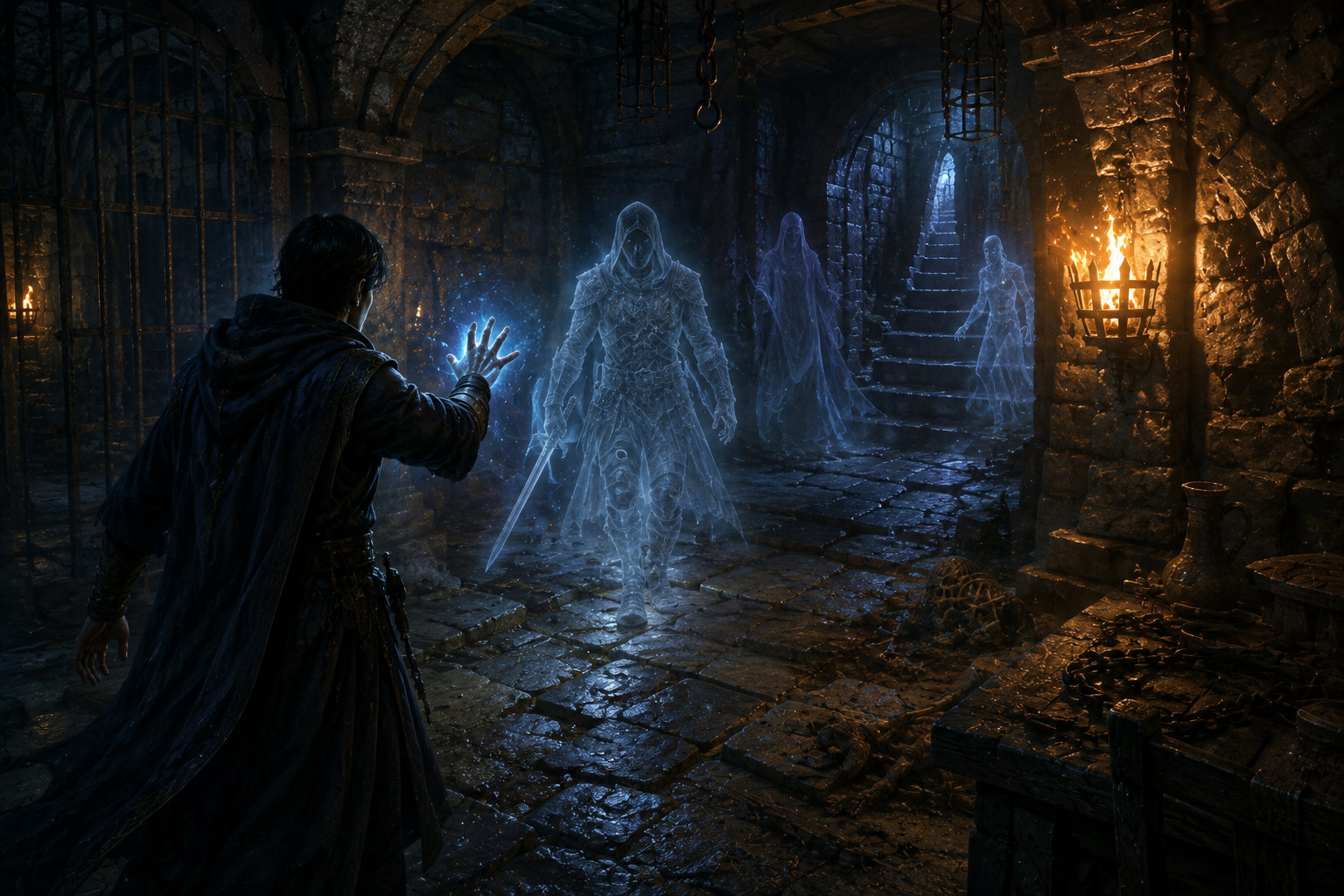
The spell reveals without removing. An assassin concealed by Invisibility may remain invisible to every other adventurer in the chamber. A duellist protected by Greater Invisibility continues to possess that spell. An ethereal creature remains on another plane. The caster simply gains the perception needed to see what ordinary eyes cannot.
At a Glance
| 5.5e / 2024 | Bard 2 • 1 hour • no concentration • talc |
|---|---|
| 5e / 2014 | Bard 2 • 1 hour • no concentration • talc and powdered silver |
| Pathfinder 1e | Bard 3 • 10 min./level; dismissible • talc and powdered silver |
| D&D 3.5e | Bard 3 • 10 min./level; dismissible • talc and powdered silver |
| School | Divination |
| Core Function | See invisible creatures and objects |
| Planar Function | See into the Ethereal Plane |
| Critical Limit | Does not end invisibility |
Spell Rules by Edition
See Invisibility — 5.5e / 2024
| Spell | Level 2 Divination |
|---|---|
| Classes | Bard, Sorcerer, Wizard |
| Casting Time | Action |
| Range | Self |
| Components | V, S, M (a pinch of talc) |
| Duration | 1 hour |
| Concentration | No |
For the duration, the caster sees creatures and objects that have the Invisible condition as though they were visible. The caster can also see into the Ethereal Plane, where creatures and objects appear ghostly.
Invisible Condition
See Invisibility does not remove the Invisible condition. Instead, it allows the caster to see the creature, overcoming those parts of the condition that depend upon the observer being unable to see it.
- The caster can visually perceive the creature.
- The caster can target it with effects that require sight, provided every other targeting requirement is satisfied.
- The Invisible creature does not gain its normal invisibility-based attack-roll benefit against the caster.
- The caster does not suffer the corresponding invisibility-based attack-roll penalty against that creature.
- Other creatures that still cannot see the target continue to resolve the Invisible condition normally.
See Invisibility and Hide
In the 2024 rules, a successful Hide action can grant the Invisible condition. See Invisibility can therefore overcome that condition as a visual barrier once the hidden creature occupies a position where an ordinarily visible creature could be seen.
The spell does not provide sight through walls, total cover or independent visual obstructions.
No Concentration
The one-hour duration requires no Concentration, making See Invisibility particularly effective when cast before entering an area where invisible creatures, magical spies or ethereal observers are expected.
Counterspell
Because Counterspell can depend upon seeing the creature casting a spell, See Invisibility can be particularly valuable against an invisible enemy spellcaster.
Rules source: System Reference Document 5.2.1.
See Invisibility — 5e / 2014
| Spell | 2nd-level divination |
|---|---|
| Classes | Bard, Sorcerer, Wizard |
| Casting Time | 1 action |
| Range | Self |
| Components | V, S, M (a pinch of talc and a small sprinkling of powdered silver) |
| Duration | 1 hour |
| Concentration | No |
For the duration, you see invisible creatures and objects as though they were visible, and you can see into the Ethereal Plane. Ethereal creatures and objects appear ghostly and translucent.
Use the 2014 Invisible, hiding, and unseen-target rules when resolving attacks. The spell grants the caster sight; it does not remove the invisibility effect, share that sight with allies, or adopt the 2024 Hide procedure.
Rules source: System Reference Document 5.1.
See Invisibility — Pathfinder 1e
| School | Divination |
|---|---|
| Level | Adept 2, Alchemist 2, Arcanist 2, Bard 3, Bloodrager 2, Inquisitor 2, Investigator 2, Mesmerist 3, Occultist 2, Psychic 2, Skald 3, Sorcerer 2, Spiritualist 2, Summoner 2, Unchained Summoner 2, Witch 2, Wizard 2 |
| Casting Time | 1 standard action |
| Components | V, S, M (talc and powdered silver) |
| Range | Personal |
| Target | You |
| Duration | 10 min./level (D) |
The caster sees invisible objects and beings within normal vision and perceives ethereal creatures as translucent shapes. The caster can distinguish ordinarily visible, invisible and ethereal creatures.
The spell does not reveal the method used to obtain invisibility, expose unrelated illusions, penetrate opaque objects or automatically reveal creatures that are merely hiding or concealed.
Ordinary Stealth Remains Stealth
Pathfinder does not use the 2024 Hide rule in which successfully hiding grants the Invisible condition. A creature using ordinary Stealth is therefore not automatically exposed by See Invisibility merely because it is hidden.
Permanency
Permanency can make See Invisibility permanent on the caster. The standard Pathfinder requirement is caster level 10th and 5,000 gp of diamond dust.
Rules source: Archives of Nethys — See Invisibility.
See Invisibility — D&D 3.5e
| School | Divination |
|---|---|
| Level | Bard 3, Sorcerer/Wizard 2 |
| Casting Time | 1 standard action |
| Components | V, S, M (a pinch of talc and a small sprinkling of powdered silver) |
| Range | Personal |
| Target | You |
| Duration | 10 min./level (D) |
The caster can see invisible creatures and objects and perceive ethereal beings. Such creatures appear as translucent forms distinguishable from normally visible creatures.
The spell does not reveal the source of invisibility, expose unrelated illusions, see through opaque objects or automatically reveal creatures that are merely hiding or concealed.
Legacy Detection Rules
D&D 3.5e uses Hide, Spot, Listen, concealment and its own invisibility rules. Do not import the 2024 Hide/Invisible-condition interaction into this edition.
Permanency
Permanency can make See Invisibility permanent on the caster at caster level 10th. The standard D&D 3.5e cost is 1,000 XP.
Rules source: D&D 3.5e SRD — See Invisibility.
What Changed
The modern versions are level-2 Bard spells lasting 1 hour without concentration. The 2024 material component is talc; the 2014 version also uses powdered silver. Both give the caster sight of invisible creatures and objects and into the Ethereal Plane.
Pathfinder and 3.5 use Bard level 3, a dismissible duration of 10 minutes per caster level, and talc with powdered silver. Their descriptions expressly distinguish translucent invisible or ethereal forms and exclude ordinary hiding, unrelated illusions, and opaque barriers. Their Permanency rules remain separate from the modern spell.
What See Invisibility Reveals
Invisible Creatures
Creatures concealed by Invisibility, Greater Invisibility, innate invisibility or another qualifying effect can be visually perceived by the caster.
Invisible Objects
Objects rendered invisible can also be seen. This can expose concealed equipment, magically hidden objects and other objects covered by the edition’s invisibility rules.
Ethereal Creatures
The caster can look into the Ethereal Plane and perceive creatures and objects there in the ghostly manner described by the relevant edition.
Planar Observers
This makes the spell useful against creatures such as the Ethereal Filcher, whose movement between the Material and Ethereal Planes can otherwise let it approach, observe or escape beyond ordinary sight.
What See Invisibility Does Not Do
See Invisibility is specialised revelation magic. Its limitations are as important as its benefits.
It Does
- Reveal invisible creatures to the caster.
- Reveal invisible objects to the caster.
- Permit sight into the Ethereal Plane.
- Allow visual targeting when all other targeting requirements are met.
- Remove sight-dependent invisibility advantages against the caster where the edition says seeing the target does so.
It Does Not
- Dispel or end the invisibility effect.
- Make the subject visible to everybody else.
- Automatically identify the source of invisibility.
- Reveal every illusion.
- See through walls or opaque barriers.
- Automatically defeat fog, darkness or other independent visual obstruction.
- Grant Truesight.
- Bring an ethereal creature onto the Material Plane.
- Automatically permit attacks to cross planar boundaries.
See Invisibility Does Not Counter Blur
Blur and invisibility are different effects.
In Pathfinder 1e and D&D 3.5e, Blur expressly remains effective against See Invisibility. In the 2024 rules, Blur likewise does not depend upon the Invisible condition: it distorts the creature’s visible form rather than making the creature invisible.
Invisibility, Hiding and Location
Invisible Does Not Mean Intangible
An invisible creature can still make noise, move objects, disturb dust, leave tracks, displace water and interact physically with its surroundings. Adventurers may therefore discover evidence of an unseen creature even without See Invisibility.
2024: Hide Can Grant the Invisible Condition
The 2024 rules require special care because the Hide action can grant the Invisible condition. See Invisibility can therefore interact directly with magically invisible creatures and creatures benefiting from that condition through Hide.
The spell still obeys ordinary geometry and sight. A hidden creature behind an opaque wall is no more visible than an ordinary visible creature behind that wall.
Pathfinder and 3.5e: Ordinary Hiding Remains Hiding
The legacy spell descriptions distinguish invisibility from simply hiding, concealment and other difficulty to see. Use Pathfinder’s Stealth and Perception rules or D&D 3.5e’s Hide, Spot and Listen rules instead.
Seeing into the Ethereal Plane
The ability to see into the Ethereal Plane is not a secondary curiosity. It is one of the defining purposes of See Invisibility.
An apparently empty dungeon can change completely when the spell takes hold. Ghostly figures stand where ordinary eyes saw bare stone. Something watches from an overlapping corridor that does not quite belong to the Material world. A creature preparing to cross the planar boundary may become visible before it appears.
Ethereal Is Not the Same as Incorporeal
Do not treat ethereal and incorporeal as interchangeable rules terms. An ethereal creature occupies the Ethereal Plane. An incorporeal creature follows its edition’s incorporeal rules. See Invisibility reveals an incorporeal creature automatically only when another applicable rule — such as invisibility — makes the spell relevant.
Sight Does Not Automatically Cross the Planar Boundary
The spell lets the caster perceive ethereal creatures. Whether a weapon, spell or supernatural ability can affect them remains a separate rules question.
Ways to Counter Invisibility
See Invisibility is one answer to an unseen opponent, but it is not always the best one. Other magic can reveal, outline, suppress or remove invisibility in different ways.
| Counter | What It Does | Main Limitation |
|---|---|---|
| See Invisibility | Lets the caster personally perceive invisible creatures and objects and see into the Ethereal Plane. | Does not make the target visible to allies and does not end the effect. |
| Faerie Fire | Uses visible magical outlining to undermine invisibility according to the edition. | Uses its own area, duration and edition-specific mechanics. |
| Glitterdust | A classic legacy-edition method of coating and visibly outlining invisible creatures. | Primarily a Pathfinder 1e and D&D 3.5e comparison. |
| Invisibility Purge | Negates invisibility within its surrounding area in the legacy rules. | Primarily a Pathfinder 1e / D&D 3.5e counter and operates only within its area. |
| Dispel Magic | Attempts to terminate the magical effect instead of seeing through it. | Does not help against every innate or non-dispellable form of invisibility. |
| Blindsight | Allows perception within its stated range without ordinary sight. | Range is limited and the sense does not automatically duplicate Ethereal sight. |
| Truesight / True Seeing | Provides broader supernatural perception capable of defeating invisibility and other visual deception. | Broader and usually more powerful than See Invisibility; exact mechanics differ by edition. |
See Invisibility or Dispel Magic?
Dispel Magic and See Invisibility solve different problems.
- Use See Invisibility when the threat may be innate, repeated, unknown, long-lasting or ethereal.
- Use Dispel Magic when ending a known ongoing spell is more valuable than merely perceiving its subject.
- Use See Invisibility first when locating or visually targeting the invisible creature is necessary before another tactic can be employed.
Best Uses and Tactics
Pre-Cast before Danger
The spell’s long duration makes preparation one of its strongest uses. In 2024 especially, the one-hour duration requires no Concentration.
Invisible Assassins
Against an opponent depending on Invisibility or Greater Invisibility, the spell removes much of the uncertainty that makes the attacker dangerous.
Counter-Magic
In 2024 play, seeing an invisible spellcaster can be crucial for sight-dependent reactions such as Counterspell.
Secure Meetings
Courts, vaults, guild councils and secret negotiations are natural places for invisible observers. See Invisibility turns magical security into active inspection.
Dungeon Exploration
Use the spell when invisible guardians, hidden magical objects or ethereal creatures may occupy apparently empty passages and chambers.
Planar Exploration
Near ethereal crossings, haunted sites and places where the planes overlap, Ethereal sight can matter even when no creature is using an invisibility spell.
Useful Spell Combinations
- Invisibility : an invisible scout using See Invisibility can watch for other unseen creatures without surrendering their own magical concealment.
- Greater Invisibility : in a magical duel, See Invisibility can deny an opposing invisible combatant the assumption that ordinary sight cannot follow them.
- Counterspell : in 2024 play, See Invisibility can restore the visual requirement needed to react to an invisible enemy caster.
- Glitterdust : in legacy play, one caster can identify an invisible target before an outlining effect makes its position easier for the rest of the party to exploit.
- Dispel Magic : seeing the creature resolves the immediate perception problem before the party decides whether the magical effect itself should be removed.
GM Adjudication
Does the Caster Know the Creature Is Invisible?
In the legacy versions, invisible and ethereal creatures are described as translucent and distinguishable from ordinarily visible creatures. In 2024, the spell sees Invisible creatures as though visible while Ethereal creatures appear ghostly. Do not automatically import every legacy visual detail into the modern effect.
Does the Spell Reveal the Source of Invisibility?
No. Seeing the creature does not tell the caster whether the effect came from a spell, magic item, innate ability, supernatural trait or another source unless some other rule provides that information.
Can Allies Attack What the Caster Sees?
Yes, if they can identify or correctly infer where to attack, but they do not gain the caster’s magical sight. Apply the relevant edition’s rules for attacking or targeting something the attacker cannot personally see.
Can the Caster Point Out the Creature’s Location?
Yes. A caster who can see the creature can communicate its position. That information does not cause allies to see the creature and may become outdated when the target moves.
Does See Invisibility Reveal a Hidden Rogue?
D&D 5.5e / 2024: it can reveal a creature benefiting from the Invisible condition gained through Hide once that creature is in a position where an ordinarily visible creature could be seen.
Pathfinder 1e and D&D 3.5e: no. Their versions distinguish magical invisibility from ordinary hiding and concealment.
Does It See through Fog?
Not merely because the caster has See Invisibility. If an independent fog or obscuring effect would prevent an ordinary visible creature from being seen, See Invisibility does not automatically remove that obstruction.
Does It See through Walls?
No. The spell does not provide x-ray vision.
Does It Counter Blur?
No. Blur is a different visual defence. Legacy rules explicitly state that See Invisibility does not counter it.
Does It Reveal All Illusions?
No. Broader illusion-piercing belongs to more powerful forms of supernatural sight such as Truesight or True Seeing.
Can the Caster Attack an Ethereal Creature?
Seeing the creature is only the first requirement. The attack or effect must also be capable of affecting a creature across the relevant planar boundary.
See Invisibility in the World
Learned magicians classify See Invisibility among the practical arts of corrected perception. The spell does not compel the hidden creature to appear and does not unmake the enchantment concealing it. Instead, it alters the observer so that an otherwise inaccessible category of sight becomes possible.
That makes the spell valuable far beyond adventuring. Court magicians use it before private councils. Guild treasurers employ it when inspecting vaults. Watch officers call for it after impossible thefts. Planar scholars use it where the Ethereal boundary grows thin. Wealthy rulers who understand invisibility magic do not trust locked doors and ordinary guards alone.
The older use of talc and silver reflects a learned magical tradition in which prepared substances, reflective materials and classified natural properties are used to train perception toward things normally inaccessible to the senses.
Historical and Folkloric Parallel: Second Sight
See Invisibility should not be treated as a direct representation of any single historical belief. A useful parallel, however, is the much broader idea of second sight: supernatural perception beyond ordinary vision.
Scottish traditions use the term for an alleged capacity to perceive distant, future or supernatural events unavailable to ordinary observers. Such beliefs are broader and more prophetic than the RPG spell, but they illustrate the enduring idea that gifted sight can reveal another layer of reality.
Historical references: Dictionary of the Older Scottish Tongue — “Second Sight” ; John Gregorson Campbell, Witchcraft & Second Sight in the Highlands & Islands of Scotland .
Related Spells, Rules and Creatures
- Magic – Fantasy RPG Reference
- Invisibility
- Greater Invisibility
- Blur
- Faerie Fire
- Glitterdust
- Invisibility Purge
- Dispel Magic
- Counterspell
- Permanency
- Ethereal Plane
- Ethereal Filcher
- Bard Spell List
- Sorcerer/Wizard Spell List
- World Bestiary
See Invisibility FAQ
Does See Invisibility remove invisibility?
No. The target remains invisible. The caster simply gains the ability to see it.
Do the caster’s allies also see the invisible creature?
No. See Invisibility affects the caster’s perception. Allies need their own appropriate sense or must act on the caster’s directions.
Does See Invisibility require Concentration in D&D 5.5e / 2024?
No. The modern version lasts for one hour without Concentration.
Which classes receive See Invisibility in D&D 5.5e / 2024?
The spell appears on the Bard, Sorcerer and Wizard spell lists.
Does See Invisibility remove the attack benefits of the 2024 Invisible condition?
Against the caster, yes. Those attack-roll benefits depend upon the opposing creature being unable to see the Invisible creature.
Does See Invisibility remove the Invisible condition itself?
No. The condition remains unless another rule or effect ends it.
Can See Invisibility reveal a creature hidden with the 2024 Hide action?
It can overcome the Invisible condition gained through Hide once the creature is in a position where an ordinarily visible creature could be seen. It does not see through walls, total cover or unrelated visual obstructions.
Can See Invisibility reveal an ordinarily hiding Pathfinder or D&D 3.5e rogue?
No. The legacy spell descriptions distinguish magical invisibility from ordinary hiding, concealment and similar difficulty to see.
Does See Invisibility reveal illusions?
Not generally. It is specialised against invisibility. Broader illusion-revealing magic belongs to more powerful forms of supernatural sight.
Does See Invisibility counter Blur?
No. Blur is a different form of visual distortion and is not ordinary invisibility.
Does See Invisibility see through walls?
No. The spell does not provide x-ray vision.
Can See Invisibility detect creatures on the Ethereal Plane?
Yes. Seeing into the Ethereal Plane is a core part of the spell.
Does seeing an ethereal creature allow the caster to attack it?
Not automatically. Perception and cross-planar interaction are separate rules questions.
Can See Invisibility be made permanent?
In Pathfinder 1e and D&D 3.5e, yes, through Permanency. Pathfinder requires caster level 10th and 5,000 gp of diamond dust. D&D 3.5e requires caster level 10th and 1,000 XP. The 2024 version has no equivalent core Permanency interaction.
Rules Sources and Licensing
This work includes material taken from the System Reference Document 5.1 (“SRD 5.1”) by Wizards of the Coast LLC and available at https://dnd.wizards.com/resources/systems-reference-document. The SRD 5.1 is licensed under the Creative Commons Attribution 4.0 International License available at https://creativecommons.org/licenses/by/4.0/legalcode.
This work includes material from the System Reference Document 5.2.1 (“SRD 5.2.1”) by Wizards of the Coast LLC, available at https://www.dndbeyond.com/srd. The SRD 5.2.1 is licensed under the Creative Commons Attribution 4.0 International License, available at https://creativecommons.org/licenses/by/4.0/legalcode.
The Pathfinder and 3.5 spell mechanics and their tables are Open Game Content under the Open Game License v1.0a. Artwork and original setting prose are excluded from that designation.
Open Game License v1.0a and copyright notices
Permission to copy, modify and distribute the files collectively known as the System Reference Document (“SRD”) is granted solely through the use of the Open Gaming License, Version 1.0a.
This material is being released using the Open Gaming License Version 1.0a and you should read and understand the terms of that license before using this material.
The text of the Open Gaming License itself is not Open Game Content. Instructions on using the License are provided within the License itself.
The following items are designated Product Identity, as defined in Section 1(e) of the Open Game License Version 1.0a, and are subject to the conditions set forth in Section 7 of the OGL, and are not Open Content: Dungeons & Dragons, D&D, Player’s Handbook, Dungeon Master, Monster Manual, d20 System, Wizards of the Coast, d20 (when used as a trademark), Forgotten Realms, Faerûn, proper names (including those used in the names of spells or items), places, Red Wizard of Thay, the City of Union, Heroic Domains of Ysgard, Ever-Changing Chaos of Limbo, Windswept Depths of Pandemonium, Infinite Layers of the Abyss, Tarterian Depths of Carceri, Gray Waste of Hades, Bleak Eternity of Gehenna, Nine Hells of Baator, Infernal Battlefield of Acheron, Clockwork Nirvana of Mechanus, Peaceable Kingdoms of Arcadia, Seven Mounting Heavens of Celestia, Twin Paradises of Bytopia, Blessed Fields of Elysium, Wilderness of the Beastlands, Olympian Glades of Arborea, Concordant Domain of the Outlands, Sigil, Lady of Pain, Book of Exalted Deeds, Book of Vile Darkness, beholder, gauth, carrion crawler, tanar’ri, baatezu, displacer beast, githyanki, githzerai, mind flayer, illithid, umber hulk, yuan-ti.
All of the rest of the SRD is Open Game Content as described in Section 1(d) of the License.
More information on the Open Game License can be found at www.wizards.com/d20.
The terms of the Open Gaming License Version 1.0a are as follows:
OPEN GAME LICENSE Version 1.0a
The following text is the property of Wizards of the Coast, Inc. and is Copyright 2000 Wizards of the Coast, Inc (“Wizards”). All Rights Reserved.
1. Definitions: (a)”Contributors” means the copyright and/or trademark owners who have contributed Open Game Content; (b)”Derivative Material” means copyrighted material including derivative works and translations (including into other computer languages), potation, modification, correction, addition, extension, upgrade, improvement, compilation, abridgment or other form in which an existing work may be recast, transformed or adapted; (c) “Distribute” means to reproduce, license, rent, lease, sell, broadcast, publicly display, transmit or otherwise distribute; (d)”Open Game Content” means the game mechanic and includes the methods, procedures, processes and routines to the extent such content does not embody the Product Identity and is an enhancement over the prior art and any additional content clearly identified as Open Game Content by the Contributor, and means any work covered by this License, including translations and derivative works under copyright law, but specifically excludes Product Identity. (e) “Product Identity” means product and product line names, logos and identifying marks including trade dress; artifacts; creatures characters; stories, storylines, plots, thematic elements, dialogue, incidents, language, artwork, symbols, designs, depictions, likenesses, formats, poses, concepts, themes and graphic, photographic and other visual or audio representations; names and descriptions of characters, spells, enchantments, personalities, teams, personas, likenesses and special abilities; places, locations, environments, creatures, equipment, magical or supernatural abilities or effects, logos, symbols, or graphic designs; and any other trademark or registered trademark clearly identified as Product identity by the owner of the Product Identity, and which specifically excludes the Open Game Content; (f) “Trademark” means the logos, names, mark, sign, motto, designs that are used by a Contributor to identify itself or its products or the associated products contributed to the Open Game License by the Contributor (g) “Use”, “Used” or “Using” means to use, Distribute, copy, edit, format, modify, translate and otherwise create Derivative Material of Open Game Content. (h) “You” or “Your” means the licensee in terms of this agreement.
2. The License: This License applies to any Open Game Content that contains a notice indicating that the Open Game Content may only be Used under and in terms of this License. You must affix such a notice to any Open Game Content that you Use. No terms may be added to or subtracted from this License except as described by the License itself. No other terms or conditions may be applied to any Open Game Content distributed using this License.
3.Offer and Acceptance: By Using the Open Game Content You indicate Your acceptance of the terms of this License.
4. Grant and Consideration: In consideration for agreeing to use this License, the Contributors grant You a perpetual, worldwide, royalty-free, non-exclusive license with the exact terms of this License to Use, the Open Game Content.
5.Representation of Authority to Contribute: If You are contributing original material as Open Game Content, You represent that Your Contributions are Your original creation and/or You have sufficient rights to grant the rights conveyed by this License.
6.Notice of License Copyright: You must update the COPYRIGHT NOTICE portion of this License to include the exact text of the COPYRIGHT NOTICE of any Open Game Content You are copying, modifying or distributing, and You must add the title, the copyright date, and the copyright holder’s name to the COPYRIGHT NOTICE of any original Open Game Content you Distribute.
7. Use of Product Identity: You agree not to Use any Product Identity, including as an indication as to compatibility, except as expressly licensed in another, independent Agreement with the owner of each element of that Product Identity. You agree not to indicate compatibility or co-adaptability with any Trademark or Registered Trademark in conjunction with a work containing Open Game Content except as expressly licensed in another, independent Agreement with the owner of such Trademark or Registered Trademark. The use of any Product Identity in Open Game Content does not constitute a challenge to the ownership of that Product Identity. The owner of any Product Identity used in Open Game Content shall retain all rights, title and interest in and to that Product Identity.
8. Identification: If you distribute Open Game Content You must clearly indicate which portions of the work that you are distributing are Open Game Content.
9. Updating the License: Wizards or its designated Agents may publish updated versions of this License. You may use any authorized version of this License to copy, modify and distribute any Open Game Content originally distributed under any version of this License.
10. Copy of this License: You MUST include a copy of this License with every copy of the Open Game Content You Distribute.
11. Use of Contributor Credits: You may not market or advertise the Open Game Content using the name of any Contributor unless You have written permission from the Contributor to do so.
12. Inability to Comply: If it is impossible for You to comply with any of the terms of this License with respect to some or all of the Open Game Content due to statute, judicial order, or governmental regulation then You may not Use any Open Game Material so affected.
13. Termination: This License will terminate automatically if You fail to comply with all terms herein and fail to cure such breach within 30 days of becoming aware of the breach. All sublicenses shall survive the termination of this License.
14. Reformation: If any provision of this License is held to be unenforceable, such provision shall be reformed only to the extent necessary to make it enforceable.
15. COPYRIGHT NOTICE
Open Game License v 1.0a Copyright 2000, Wizards of the Coast, Inc.
System Reference Document Copyright 2000-2003, Wizards of the Coast, Inc.; Authors Jonathan Tweet, Monte Cook, Skip Williams, Rich Baker, Andy Collins, David Noonan, Rich Redman, Bruce R. Cordell, John D. Rateliff, Thomas Reid, James Wyatt, based on original material by E. Gary Gygax and Dave Arneson.
Pathfinder Roleplaying Game Core Rulebook. © 2009, Paizo Publishing, LLC; Author: Jason Bulmahn, based on material by Jonathan Tweet, Monte Cook, and Skip Williams. END OF LICENSE
Additional references: Pathfinder Core Rulebook — See Invisibility; Pathfinder Permanency; D&D 3.5e Permanency.
Pathfinder is a registered trademark of Paizo Inc. This independent reference is not affiliated with or endorsed by Paizo Inc.
Original editorial text, rulings, comparisons, encounter guidance, folklore discussion and page design © 2026 SpiralWorlds.
Keep this reference growing
If this page helped with your reading or game, you can support its upkeep or explore the curated books.
Explore the Bookshop — epics, classics and stories behind imagined worlds.