
Evocation · Magical illumination · Utility cantrip
Candlelight Spell
A quiet magical glow for study, ritual, signalling and close work—steady enough to trust, yet modest enough not to announce itself across the night.
Candlelight does not conquer darkness. It creates one small, reliable place where darkness cannot be complete.
Overview
Candlelight places a small magical glow upon an object. It is weaker than the familiar Light spell, but its restraint is often the reason to prepare it. The spell illuminates a book, lock, map, altar, medical instrument or narrow section of floor without flooding an entire chamber.
The glow has no flame to gutter, no wax to consume and no smoke to betray a hidden room. It moves with the enchanted object, allowing the caster to carry it, pass it to an ally, lower it into a shaft or conceal it beneath an opaque cover.
Candlelight is not a weapon and does not imitate sunlight. Its value lies in dependable close illumination: enough to read, work, signal or perform a quiet rite while leaving most of the surrounding darkness undisturbed.
Quick Rules Reference
Mechanics
The versions below are independent SpiralWorlds compatibility conversions. Use only the panel matching the rules system being played.
Candlelight
Evocation cantrip
- Casting Time
- Action
- Range
- Touch
- Components
- V, M (a miniature candle)
- Duration
- 1 hour
- Target
- One Large or smaller object
- Concentration
- No
- Saving Throw
- None
- Classes
- Bard, Cleric, Druid, Sorcerer, Wizard
Choose one Large or smaller object that you touch. The target cannot be worn or carried by another creature when you cast the spell.
For the duration, the object sheds Bright Light in a 5-foot radius and Dim Light for a further 5 feet. You choose the colour of the glow when you cast the spell.
The light remains attached to the object and moves wherever the object moves. Completely enclosing the object in opaque material blocks the illumination until it is uncovered.
The glow creates no heat, flame or smoke. It cannot ignite material, cause damage or count as sunlight.
The spell ends early if you cast Candlelight again or if the enchanted object is destroyed.
Magical darkness: Resolve any darkness effect according to its own wording. The 2024 Darkness spell dispels Candlelight when their areas overlap because Candlelight is a cantrip.
Dispel Magic: A casting of Dispel Magic targeting the enchanted object or the ongoing spell ends Candlelight automatically.
Material component: The miniature candle is not consumed.
Candlelight
School evocation [light]
- Level
- Bard 0, Cleric 0, Druid 0, Sorcerer/Wizard 0
- Components
- V, M/DF
- Casting Time
- 1 standard action
- Range
- Touch
- Target
- Object touched
- Duration
- 1 hour/level
- Saving Throw
- None
- Spell Resistance
- No
The object touched gives off a steady glow that illuminates a 5-foot radius as an ordinary candle would. Beyond that radius, use the prevailing light conditions.
The illumination is fixed to the targeted object but travels with it when the object is moved, carried, thrown or passed to another creature. An opaque covering blocks the glow without ending the spell.
Candlelight produces no heat, smoke or open flame. It cannot ignite material, inflict damage or function as natural sunlight.
If the object is destroyed, the spell ends. The spell is not dismissible, and casting it again does not end an earlier casting.
Magical darkness: Candlelight does not counter or dispel any darkness spell. If magical darkness suppresses lower-level magical light, Candlelight provides no illumination in the overlapping area. Its glow returns after the object leaves that area, provided the duration remains.
Dispel Magic: Dispel Magic can end Candlelight through the normal caster-level check.
Arcane material component: A tiny candle. A divine caster instead supplies the required divine focus.
Candlelight
Evocation [Light]
- Level
- Bard 0, Cleric 0, Druid 0, Sorcerer/Wizard 0
- Components
- V, M/DF
- Casting Time
- 1 standard action
- Range
- Touch
- Target
- Object touched
- Duration
- 1 hour/level
- Saving Throw
- None
- Spell Resistance
- No
The object touched provides clear illumination within 5 feet, equivalent to the useful light of a mundane candle. Light conditions beyond that radius remain unchanged.
The glow stays upon the object rather than remaining at the place where the spell was cast. Moving, carrying, throwing or handing over the object does not end the effect. A lightproof covering blocks the illumination until removed.
The spell creates no heat, smoke or combustible flame. It cannot start a fire, deal damage or trigger an effect that requires sunlight.
The spell ends if the object is destroyed. It is not dismissible, and multiple castings may remain active on separate objects.
Magical darkness: Candlelight is too weak to counter or dispel magical darkness. Where darkness prevents lower-level magical illumination from functioning, the glow is suppressed in the overlapping area and returns after leaving it.
Dispel Magic: A targeted use of Dispel Magic may end Candlelight after the required dispel check succeeds.
Arcane material component: A tiny candle. Divine spellcasters use a divine focus instead.
What Candlelight Does
Creates close illumination
The spell lights a small working area rather than an entire room. A reader, healer, locksmith or ritualist can see the immediate task while most of the surrounding chamber remains dark.
Enchants an object
The spell is attached to a book, tool, coin, staff, stone or other object. The glow follows that object instead of remaining at the original casting point.
Produces no ordinary flame
Wind, rain and lack of air do not extinguish Candlelight. It provides illumination underwater or in a sealed space unless another magical effect suppresses it.
Allows deliberate concealment
A hood, box, pouch, helm or other opaque cover blocks the light. Removing the cover reveals the glow again without requiring another casting.
Rules Clarifications and Edge Cases
The target must be an object
Candlelight cannot be cast directly upon a creature, body part, cloud, empty point in space or free-floating magical effect. Clothing, armour, jewellery and equipment are objects, but the edition-specific targeting rules still determine whether the caster may touch an item that another creature is wearing or carrying.
Moving the object
The glow remains fixed to the enchanted object. Picking it up, dropping it, placing it in a container, throwing it down a passage or handing it to an ally does not end the spell.
Covering the source
An opaque covering blocks all light while it completely encloses the enchanted portion of the object. A translucent covering may colour or soften the glow but does not eliminate it. Removing the covering restores the spell’s normal illumination.
Breaking the object
If the targeted object is destroyed, Candlelight ends. Minor damage that leaves the object recognisably intact does not end the effect. When an object is divided into several separate pieces, the GM may treat the largest remaining piece as the original object or end the spell if no clear original object remains.
Water, wind and hostile environments
The spell is magical illumination rather than combustion. Water, strong wind, lack of oxygen and ordinary rain do not extinguish it. The object itself can still be damaged by the environment.
Stealth and detection
Candlelight imposes no automatic check penalty unless the chosen rules system states otherwise. Nevertheless, a visible glow may reveal a creature’s position, silhouette or route through darkness. Enemies can notice the light even when they cannot clearly see the creature carrying it.
Sunlight and fire
Candlelight is neither sunlight nor fire. It does not harm creatures affected specifically by sunlight, trigger abilities that require natural sunlight, ignite oil, burn rope, warm a room or activate smoke-sensitive mechanisms.
Invisible creatures and objects
The spell does not automatically reveal an invisible creature. Apply the edition’s normal rules for invisible objects, carried equipment and emitted illumination. The surrounding surfaces may become lit even when the precise source remains unseen.
Candlelight Compared with Other Illumination
| Spell | Primary purpose | Light and movement | Main limitation |
|---|---|---|---|
| Candlelight | Quiet close work, study, ritual and discreet marking. | Small glow fixed to one movable object. | Very short radius and weak against magical darkness. |
| Light | General exploration and room illumination. | Much broader light fixed to an object. | More conspicuous and less suited to preserving the surrounding darkness. |
| Dancing Lights | Remote illumination, distraction and moving signals. | Creates independent lights that move at the caster’s direction. | Shorter duration or concentration requirements, depending on edition. |
| Daylight | Large-scale illumination and opposition to darkness. | Powerful radiance covering a wide area. | Consumes a higher-level spell and is difficult to use discreetly. |
| Darkness | Vision denial, concealment and battlefield control. | Creates supernatural darkness rather than illumination. | Can hinder allies and defeats weaker magical light. |
Best Uses
Reading and research
Illuminate a book, tablet or writing desk without filling a library, tent or dormitory with obvious light.
Locks and mechanisms
Place the glow on a tool, key or small mirror so a character can inspect a lock, trap or delicate machine at close range.
Route marking
Mark a junction, safe door, rope, dropped token or explored passage with a glow visible to nearby companions.
Quiet signalling
Cover and uncover the object to send simple pulses of light across a short distance or through a dark window.
Medical work
Illuminate bandages, instruments or the immediate treatment area without introducing heat, smoke or an exposed flame.
Night ceremonies
Give a ritual object a controlled glow that survives wind and rain and can be concealed until the intended moment.
Tactics
Control how much the enemy can see
A torch announces a traveller from far away. Candlelight keeps the useful radius small. Place it low, shade it with the body or conceal it between uses when approaching a guarded area.
Enchant the tool rather than the bearer
A glowing lockpick, chalk stone, mirror or weapon pommel places the light where the work is happening. It also lets the bearer put the object away quickly when darkness becomes safer than visibility.
Use multiple lights carefully in older editions
Pathfinder 1e and D&D 3.5e do not automatically end an earlier Candlelight casting when another is cast. A group can therefore mark a trail or equip several workers, but numerous glowing objects sacrifice the spell’s chief advantage: discretion.
Do not depend on it against hostile darkness
Candlelight is too weak to win a contest with serious darkness magic. Carry a stronger answer such as Daylight or prepare Dispel Magic when supernatural darkness is expected.
Turn concealment into a signal
A covered Candlelight object can be revealed at a chosen moment to identify a doorway, begin an ambush, guide a climber or tell distant companions that a route is secure.
DM Notes
Candlelight should remain useful because it is small, dependable and easy to control. It should not become a miniature version of every stronger illumination spell.
- Preserve the radius. The glow is intended for one task or one person, not an entire chamber.
- Let ordinary precautions work. A hood, pocket, box or closed hand around a small enchanted object can conceal it when the covering is genuinely opaque.
- Apply normal perception rules. The spell does not automatically reveal traps, hidden writing, invisible creatures or secret doors merely because the area is lit.
- Reward practical placement. A light cast on a mirror, hanging marker, surgeon’s tool or lowered stone can solve problems that a hand-held torch cannot.
- Keep its nature clear. It is magical light without heat or combustion. It cannot burn, cook, cauterise or ignite.
- Respect magical opposition. When a darkness effect explicitly suppresses or dispels weaker light, Candlelight loses that contest.
The spell is especially effective in scenes where total darkness and broad illumination are both undesirable: a sleeping household, guarded archive, plague ward, ship at night, subterranean negotiation, observatory or woodland rite.
Spellcasting Culture and Worldbuilding
Candlelight is often one of the first spells taught to apprentices because its effect is visible, sustained and difficult to misuse. A teacher can immediately see whether the student has fixed the glow cleanly to the chosen object, maintained an even colour and prevented the magic from flaring beyond its intended boundary.
Elven observatories, woodland courts and schools of ritual magic are widely credited with preserving early forms of the spell. Their versions favour cool silver, moon-pale blue or the colour of autumn amber, depending on the purpose of the ceremony.
Human scribes use warmer shades that resemble wax flame. Physicians prefer clear white light. Miners place it on chalk stones or measuring rods. Sailors use covered lights for recognition signals that cannot be blown out by sea wind.
Because the spell requires no fuel after casting, wealthy libraries and magical colleges sometimes employ junior casters to illuminate desks and copy rooms. A hall lit by hundreds of tiny magical points displays both wealth and access to trained spellcasters.
Historical and Occult Development
Before gas and electric lighting, domestic interiors depended heavily on candles made from rendered animal fat or the cleaner but more costly beeswax. Candles were therefore practical tools, ritual objects and visible measures of household wealth.
Surviving candlesticks and lamps show how portable light became an object in its own right: shaped, decorated, carried and deliberately placed. Examples remain in the collections of the Metropolitan Museum of Art.
Oil lamps performed many of the same practical and ceremonial functions. Their reservoirs, wicks and traces of burning reveal the close relationship between illumination, household labour, travel and ritual. Historical examples can also be found in the Metropolitan Museum of Art.
Within magical practice, Candlelight represents the separation of illumination from combustion. The caster keeps the symbolic qualities of flame—attention, witness, continuity and revelation—while removing smoke, heat, fuel and the danger of fire.
This makes the spell valuable in archives, sickrooms, powder stores, crypts and enclosed ritual spaces where an ordinary flame would be unsafe. A magical light can appear at the appointed moment, remain steady through wind or rain and vanish through dispelling rather than physical extinguishing.
Mythological Parallels
Hestia and the ordered hearth
In Greek tradition, Hestia presides over the private and civic hearth, the home and the sacrificial flame. Candlelight echoes this idea on a smaller scale: one maintained point of light defining a place of safety, attention or rightful order within the surrounding dark.
Vesta and the enduring civic flame
The Roman cult of Vesta treated the tended sacred fire as a sign of continuity extending beyond a single household. In a fantasy setting, long-lived magical lights may similarly represent an institution, oath, dynasty or community whose existence must not be allowed to go dark.
The lamp of study
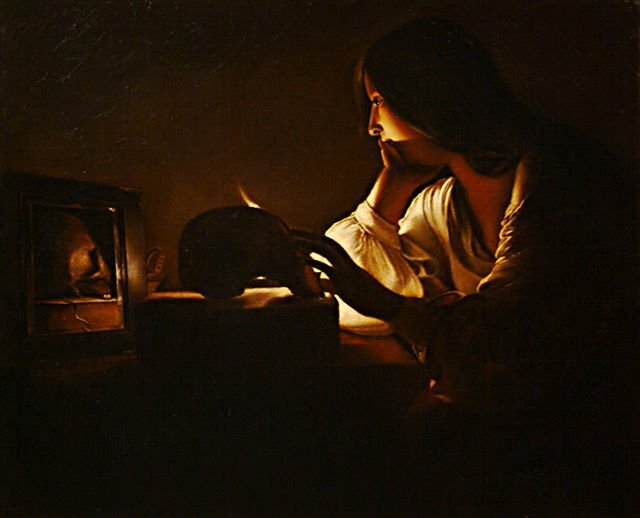
Across many cultures, the solitary scholar or diviner working beside a small lamp becomes an image of knowledge won from darkness. Candlelight turns that image into literal magic: understanding begins not with the whole world revealed, but with one page made visible.
The guiding light
Folklore frequently treats distant lights as promises, warnings or deceptions. Candlelight can serve as a trustworthy counterpart: a glow attached to a known token, staff or doorway rather than an unexplained light wandering beyond reach.
Original Inspiration and Source Note
The Candlelight spell concept first appeared as D&D 3.0 material in the Ghostwalk Web Enhancement, designed by Sean K Reynolds and published by Wizards of the Coast in 2003.
The source document identifies itself as containing no Open Game Content. This SpiralWorlds page therefore does not reproduce its descriptive passage. The prose, explanations, edge cases, setting material and edition conversions presented here are independently written.
Dungeons & Dragons and related trademarks belong to their respective owners. Pathfinder and related trademarks belong to their respective owners. The compatibility labels identify the intended rules systems and do not imply official publication or endorsement.