
Alarm
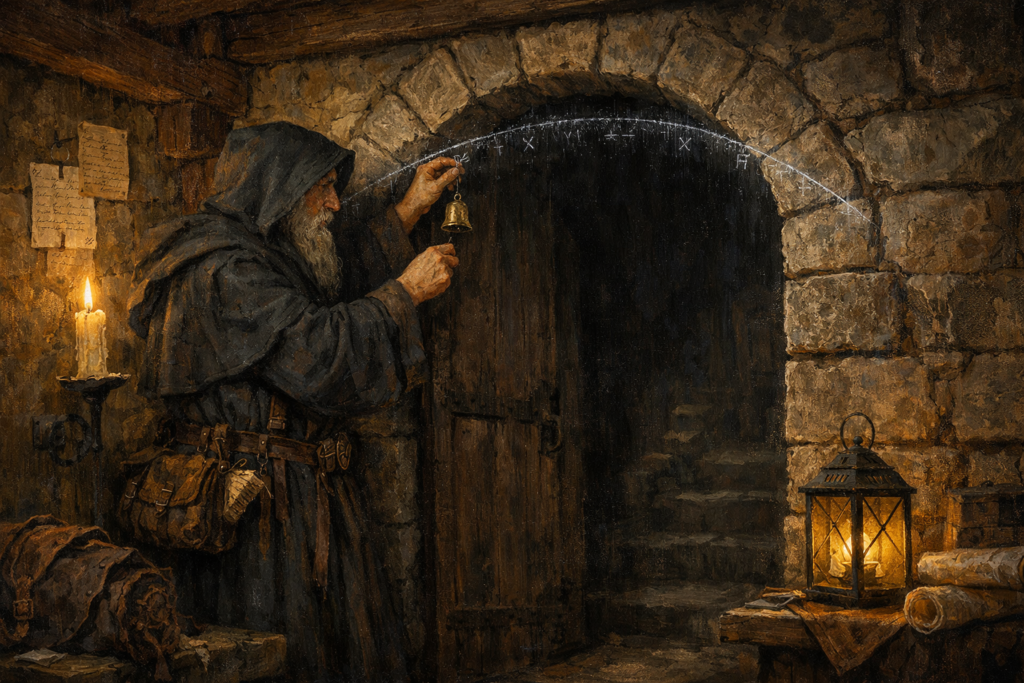
Alarm warns you when a creature crosses a warded space. Choose a bell that nearby companions can hear or a private mental ping that can wake you. The ward gives warning; it does not stop the intruder.
Alarm at a Glance
| D&D 2024 / 2014 | 1st-level Abjuration; 1 minute or Ritual; 30 feet; door, window or space up to a 20-foot cube; 8 hours. |
|---|---|
| Pathfinder / 3.5e | 1st-level Abjuration; standard action; Close range; 20-foot-radius emanation; 2 hours per caster level. |
| Warning | Mental ping within 1 mile, or audible bell normally heard within 60 feet. |
| Concentration / damage | No ongoing Concentration; no damage or saving throw. |
Spell Rules by Edition
Alarm — D&D 2024
Level and school: 1st-level Abjuration
Core spell lists: Ranger, Wizard
Casting time: 1 minute; Ritual available
Range: 30 feet; door, window or area no larger than a 20-foot Cube
Components: V, S, M (a bell and silver wire)
Duration: 8 hours; no Concentration
Attack / save: None
The ward warns you whenever a creature touches or enters it. Name any creatures exempt from triggering it when you cast. Choose one warning mode:
- Audible: A handbell sounds for 10 seconds and can be heard within 60 feet of the ward.
- Mental: You receive a ping within 1 mile of the ward; it wakes you if asleep.
The 2024 text has no minimum creature size. It lists no higher-slot increase.
Alarm — D&D 2014
Level and school: 1st-level Abjuration
Core spell lists: Ranger, Wizard
Casting time: 1 minute; Ritual available
Range: 30 feet; door, window or area no larger than a 20-foot cube
Components: V, S, M (a tiny bell and a piece of fine silver wire)
Duration: 8 hours; no Concentration
Attack / save: None
A Tiny or larger creature touching or entering the warded space triggers the warning. Designate exempt creatures and choose mental or audible warning when casting.
- Mental: A ping alerts you within 1 mile and wakes you from sleep.
- Audible: A handbell sounds for 10 seconds within 60 feet.
Higher-level slots add no listed benefit. Additional class features, including Artificer spellcasting, may also grant access.
Alarm — Pathfinder 1e
School: Abjuration
Level: Arcanist, Bard, Hunter, Inquisitor, Occultist, Psychic, Ranger, Skald, Sorcerer, Spiritualist, Summoner (including unchained), Wizard: all 1
Casting time: 1 standard action
Components: V, S, F/DF (tiny bell and fine silver wire)
Range: Close (25 feet + 5 feet per 2 caster levels)
Area: 20-foot-radius emanation centred on a point in space
Duration: 2 hours per caster level
Saving throw: None
Spell resistance: No
A Tiny or larger creature touching or entering the ward triggers it unless it speaks your chosen password. Ethereal and astral creatures do not trigger it.
Mental: A private ping reaches you within 1 mile, wakes normal sleep and does not disrupt concentration. Silence does not stop it.
Audible: The bell lasts 1 round and is clear within 60 feet. Subtract 10 feet per closed door and 20 per substantial wall. In quiet conditions it is faintly audible at 180 feet. Creatures inside Silence cannot hear it. Permanency can make the ward permanent.
Alarm — D&D 3.5e
Alarm sounds a mental or audible alarm each time a creature of Tiny or larger size enters the warded area or touches it.
This material is Open Game Content, and is licensed for public use under the terms of the Open Game License v1.0a.
Abjuration
Level Bard 1, Ranger 1, Sorcerer/Wizard 1
Components V, S, F/DF
Casting Time 1 standard action
Range Close (25 ft. + 5 ft./2 levels)
Area 20-ft.-radius emanation centered on a point in space
Duration 2 hours/level (D)
Saving Throw None
Spell Resistance No
A creature that speaks the password (determined by you at the time of casting) does not set off the alarm. You decide at the time of casting whether the alarm will be mental or audible.
Mental Alarm A mental alarm alerts you (and only you) so long as you remain within 1 mile of the warded area. You note a single mental “ping” that awakens you from normal sleep but does not otherwise disturb Concentration.
A silence spell has no effect on a mental alarm.
Audible Alarm: An audible alarm produces the sound of a hand bell, and anyone within 60 feet of the warded area can hear it clearly. Reduce the distance by 10 feet for each interposing closed door and by 20 feet for each substantial interposing wall.
In quiet conditions, the ringing can be heard faintly as far as 180 feet away. The sound lasts for 1 round. Creatures within a silence spell cannot hear the ringing.
ethereal or astral creatures do not trigger the alarm.
It can be made permanent with a permanency spell.
Arcane Focus A tiny bell and a piece of very fine silver wire
What Changed Between Editions?
2024 triggers on a creature of any size; 2014 specifies Tiny or larger. Both fifth-edition versions let you exempt named creatures and last 8 hours. Pathfinder and 3.5e use a password, a wider circular ward and caster-level duration. Their rules also explain how doors, walls, Silence and ethereal creatures interact with the alarm; 3.5e marks the duration dismissible.
Using Alarm in Play
Guard a camp entrance
Ward the approach most likely to carry an intruder, then decide who will respond to the warning. A single ward has a limited area; an unwatched path around it remains a way in. Exempt companions in fifth edition, or agree on the password in the older games.
Choose who needs to know
A mental warning lets the caster wake companions quietly or wait before confronting a trespasser. The bell can alert nearby guards at once. Place it where those guards can hear it, especially when using the older rules for intervening doors and walls.
Layer the defence
An Arcane Lock can delay entry while Alarm gives notice. A ward still needs someone ready to act: a sentry, an escape route or a defensible doorway.
Alarm in the World
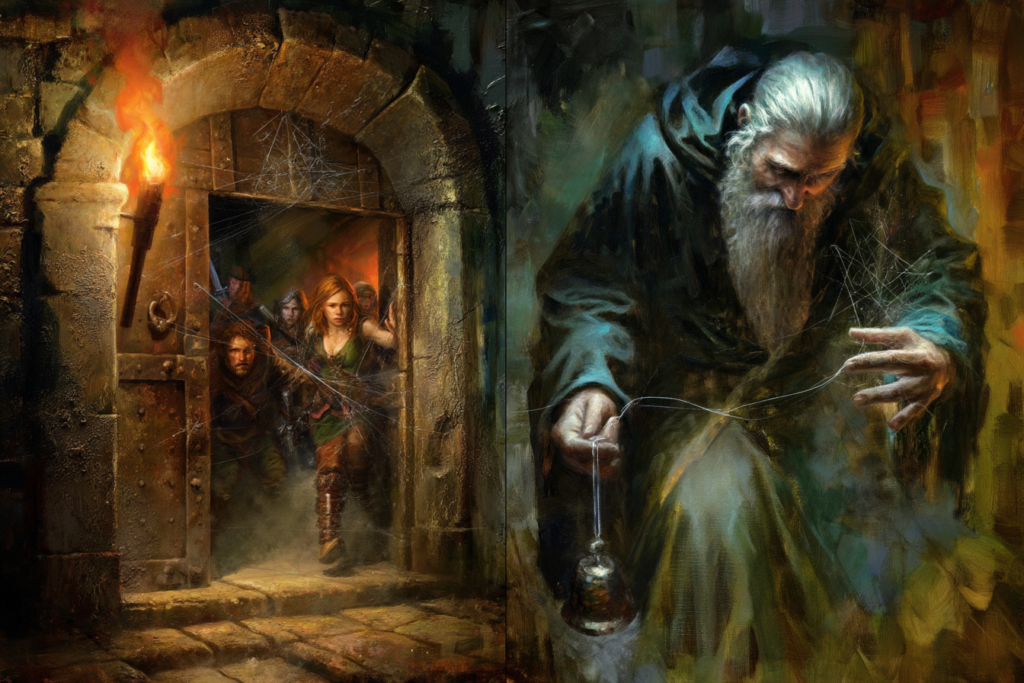
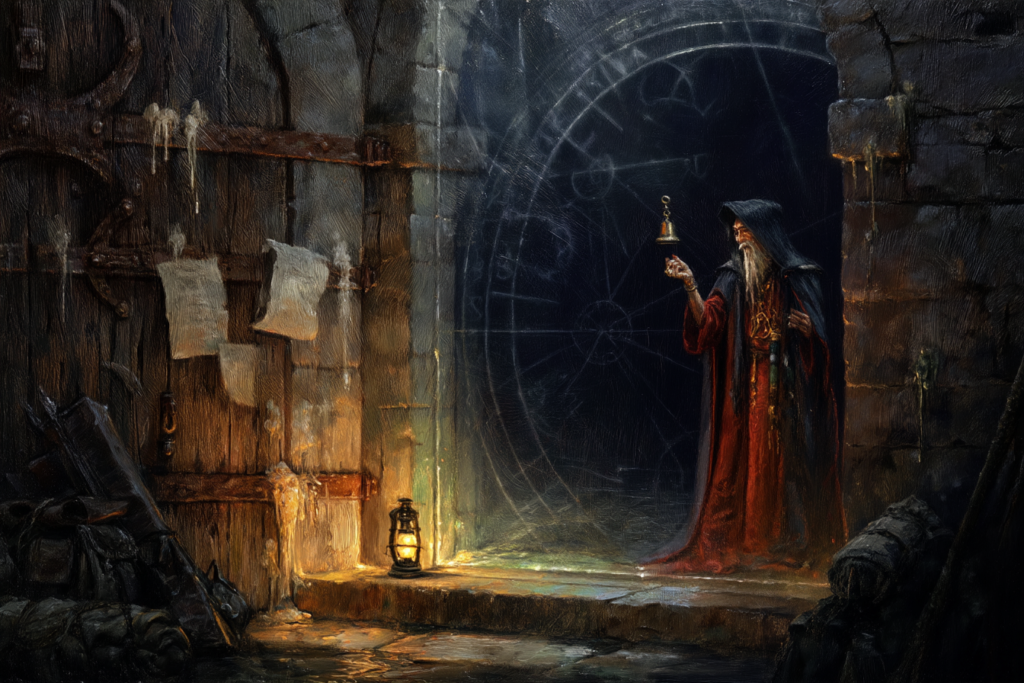
Also called Warding Alarm. An abbey may ward its reliquary door while a smuggler watches a cellar hatch. A carefully swept threshold, fine silver wire or a servant warned away from a window can hint that the place is watched. Once the ward trips, defenders must choose whether to raise a public alarm or let the intruder come further.
Sources and Licensing
D&D 2024 · D&D 2014 · Pathfinder 1e · D&D 3.5e.
The fifth-edition summaries include material from System Reference Documents 5.2.1 and 5.1 by Wizards of the Coast LLC, available from the official SRD resource, under CC BY 4.0. The summaries are reformatted and paraphrased. Pathfinder and 3.5e mechanics are Open Game Content under the Open Game License v1.0a. Artwork and original setting prose are excluded from that designation.
Open Game License v1.0a and copyright notices
OPEN GAME LICENSE Version 1.0a
The following text is the property of Wizards of the Coast, Inc. and is Copyright 2000 Wizards of the Coast, Inc (“Wizards”). All Rights Reserved.
1. Definitions: (a) “Contributors” means the copyright and/or trademark owners who have contributed Open Game Content; (b) “Derivative Material” means copyrighted material including derivative works and translations (including into other computer languages), potation, modification, correction, addition, extension, upgrade, improvement, compilation, abridgment or other form in which an existing work may be recast, transformed or adapted; (c) “Distribute” means to reproduce, license, rent, lease, sell, broadcast, publicly display, transmit or otherwise distribute; (d) “Open Game Content” means the game mechanic and includes the methods, procedures, processes and routines to the extent such content does not embody the Product Identity and is an enhancement over the prior art and any additional content clearly identified as Open Game Content by the Contributor, and means any work covered by this License, including translations and derivative works under copyright law, but specifically excludes Product Identity. (e) “Product Identity” means product and product line names, logos and identifying marks including trade dress; artifacts; creatures characters; stories, storylines, plots, thematic elements, dialogue, incidents, language, artwork, symbols, designs, depictions, likenesses, formats, poses, concepts, themes and graphic, photographic and other visual or audio representations; names and descriptions of characters, spells, enchantments, personalities, teams, personas, likenesses and special abilities; places, locations, environments, creatures, equipment, magical or supernatural abilities or effects, logos, symbols, or graphic designs; and any other trademark or registered trademark clearly identified as Product identity by the owner of the Product Identity, and which specifically excludes the Open Game Content; (f) “Trademark” means the logos, names, mark, sign, motto, designs that are used by a Contributor to identify itself or its products or the associated products contributed to the Open Game License by the Contributor (g) “Use”, “Used” or “Using” means to use, Distribute, copy, edit, format, modify, translate and otherwise create Derivative Material of Open Game Content. (h) “You” or “Your” means the licensee in terms of this agreement.
2. The License: This License applies to any Open Game Content that contains a notice indicating that the Open Game Content may only be Used under and in terms of this License. You must affix such a notice to any Open Game Content that you Use. No terms may be added to or subtracted from this License except as described by the License itself. No other terms or conditions may be applied to any Open Game Content distributed using this License.
3. Offer and Acceptance: By Using the Open Game Content You indicate Your acceptance of the terms of this License.
4. Grant and Consideration: In consideration for agreeing to use this License, the Contributors grant You a perpetual, worldwide, royalty-free, non-exclusive license with the exact terms of this License to Use, the Open Game Content.
5. Representation of Authority to Contribute: If You are contributing original material as Open Game Content, You represent that Your Contributions are Your original creation and/or You have sufficient rights to grant the rights conveyed by this License.
6. Notice of License Copyright: You must update the COPYRIGHT NOTICE portion of this License to include the exact text of the COPYRIGHT NOTICE of any Open Game Content You are copying, modifying or distributing, and You must add the title, the copyright date, and the copyright holder’s name to the COPYRIGHT NOTICE of any original Open Game Content you Distribute.
7. Use of Product Identity: You agree not to Use any Product Identity, including as an indication as to compatibility, except as expressly licensed in another, independent Agreement with the owner of each element of that Product Identity. You agree not to indicate compatibility or co-adaptability with any Trademark or Registered Trademark in conjunction with a work containing Open Game Content except as expressly licensed in another, independent Agreement with the owner of such Trademark or Registered Trademark. The use of any Product Identity in Open Game Content does not constitute a challenge to the ownership of that Product Identity. The owner of any Product Identity used in Open Game Content shall retain all rights, title and interest in and to that Product Identity.
8. Identification: If you distribute Open Game Content You must clearly indicate which portions of the work that you are distributing are Open Game Content.
9. Updating the License: Wizards or its designated Agents may publish updated versions of this License. You may use any authorized version of this License to copy, modify and distribute any Open Game Content originally distributed under any version of this License.
10. Copy of this License: You MUST include a copy of this License with every copy of the Open Game Content You Distribute.
11. Use of Contributor Credits: You may not market or advertise the Open Game Content using the name of any Contributor unless You have written permission from the Contributor to do so.
12. Inability to Comply: If it is impossible for You to comply with some or all of the terms of this License with respect to some or all of the Open Game Content due to statute, judicial order, or governmental regulation then You may not Use any Open Game Material so affected.
13. Termination: This License will terminate automatically if You fail to comply with all terms herein and fail to cure such breach within 30 days of becoming aware of the breach. All sublicenses shall survive the termination of this License.
14. Reformation: If any provision of this License is held to be unenforceable, such provision shall be reformed only to the extent necessary to make it enforceable.
15. COPYRIGHT NOTICE
Open Game License v 1.0a Copyright 2000, Wizards of the Coast, Inc.
System Reference Document Copyright 2000-2003, Wizards of the Coast, Inc.; Authors Jonathan Tweet, Monte Cook, Skip Williams, Rich Baker, Andy Collins, David Noonan, Rich Redman, Bruce R. Cordell, John D. Rateliff, Thomas Reid, James Wyatt, based on original material by E. Gary Gygax and Dave Arneson.
Pathfinder Roleplaying Game Core Rulebook. Copyright 2009, Paizo Publishing, LLC; Author: Jason Bulmahn, based on material by Jonathan Tweet, Monte Cook, and Skip Williams.
The Hypertext d20 SRD Copyright 2004, Jans W Carton; transferred to BoLS Interactive, 2016.
Keep this reference growing
If this page helped with your reading or game, you can support its upkeep or explore the curated books.
Explore the Bookshop — epics, classics and stories behind imagined worlds.