
Fast Zombie — The Unrelenting Corpse
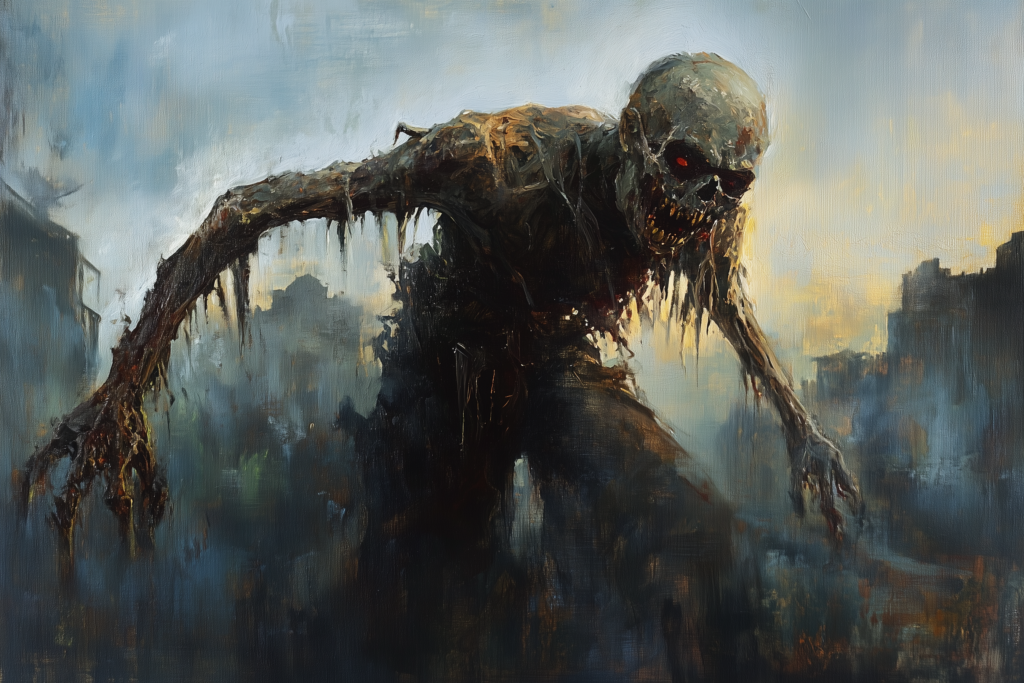
The gate is still barred when the corpse reaches it. An arrow strikes the dead soldier in the shoulder; it does not slow him. He climbs the pile of rubble without breaking stride, throws himself beneath the watchman’s spear, and seizes the man’s ankle. A moment later the rest of the bodies begin to run.
At a Glance
- Creature
- Fast Zombie — a corpse animated to run, strike repeatedly and pursue without pause
- Alignment
- Neutral Evil when animated by hostile necromancy; unreasoning rather than a moral agent
- Intellect
- Mindless; obeys its animating command but cannot plan a battle or bargain
- Haunts
- Siege breaches, charnel pits, woodland tracks, ruined villages and burial grounds disturbed by spellcraft
- Difference
- Moves swiftly, is not staggered, and strikes again during a sustained assault
- Creation
- A variation of Animate Dead; the ritual used determines which unusual speed and attack powers are present
- Warning Signs
- Tracks that begin in a grave, a body that changes direction too sharply to be alive and a sudden pounding approach from behind
- Threat
- Pursuit, unexpected extra blows and the inability to leave it behind simply by running
A fast zombie is the work of a necromancer who needs the dead to catch the living before they can escape. It has neither the patience of a wight nor the ordinary zombie’s heavy, unhurried tread. Dead muscles jerk with magical force, allowing the corpse to run past a fleeing horse for a few moments, crash through a timber door and begin striking before a guard has recovered from the first blow.
It does not hunt by instinct or devour flesh from hunger. Its apparent ferocity is the violence of an uninterrupted command: seize, pursue, kill, return. Once the spell is given, the body acts without fear and without the judgment that might tell a living soldier to preserve his life.
Fast Zombie Statistics
Fast Zombie — D&D 2024
Medium Undead, Neutral Evil · CR 2 (450 XP; PB +2) · Original adaptation
AC 14 (hardened flesh); Initiative +3 (13); HP 45 (6d8 + 18); Speed 40 ft.
| STR | DEX | CON | INT | WIS | CHA |
|---|---|---|---|---|---|
| 16 (+3) | 16 (+3) | 16 (+3) | 6 (−2) | 10 (+0) | 6 (−2) |
Saving Throws Dex +5, Wis +2; Skills Perception +2; Damage Immunities Poison; Condition Immunities Charmed, Exhaustion, Frightened, Poisoned; Senses Darkvision 60 ft., Passive Perception 12; Languages understands the languages of its creator, but cannot speak.
Traits
Undead Fortitude. When damage reduces the fast zombie to 0 HP, it makes a Constitution Saving Throw (DC 5 plus the damage taken), unless the damage is Radiant or a Critical Hit. On a success, it drops to 1 HP instead.
Relentless Sprint. The fast zombie ignores Difficult Terrain caused by loose debris, corpses and rubble, provided the surface can support its weight. The zombie cannot calculate an alternate route if the way is completely blocked.
Actions
Multiattack. The fast zombie makes two Slam attacks.
Slam. Melee Attack Roll +5, reach 5 ft., one creature. Hit: 8 (1d10 + 3) Bludgeoning damage.
Quick Strikes (Recharge 5–6). When the fast zombie uses Multiattack, it can make one additional Slam attack as part of that same Action. This feature is then expended until it recharges.
Bonus Actions
Relentless Pursuit. The fast zombie takes the Dash action. It can use this feature only while a creature it has been commanded to attack is visible or audible within 120 ft.
Original D&D 2024-compatible CR 2 creature, not official Monster Manual statistics. Its speed and extra slam express the fast-zombie variant rather than granting a low-CR monster unrelated legendary powers.
Fast Zombie — D&D 2014
Medium Undead, Neutral Evil · CR 2 (450 XP) · Original adaptation
AC 14 (natural armour); HP 45 (6d8+18); Speed 40 ft.
| STR | DEX | CON | INT | WIS | CHA |
|---|---|---|---|---|---|
| 16 (+3) | 16 (+3) | 16 (+3) | 6 (−2) | 10 (+0) | 6 (−2) |
Saving Throws Dex +5, Wis +2; Skills Perception +2; Damage Immunities Poison; Condition Immunities Charmed, Exhaustion, Frightened, Poisoned; Senses Darkvision 60 ft., Passive Perception 12; Languages understands its creator’s languages but cannot speak.
Traits
Undead Fortitude. If damage reduces it to 0 hit points, the zombie makes a DC 5 + damage taken Constitution saving throw unless the blow was radiant damage or a critical hit. Success reduces it to 1 hit point instead.
Running Corpse. It ignores difficult terrain composed of loose debris, corpses and rubble, but it cannot follow a route through an impassable barrier.
Actions
Multiattack. Two Slam attacks.
Slam. Melee Weapon Attack +5 to hit, reach 5 ft., one creature. Hit: 8 (1d10+3) bludgeoning damage.
Quick Strikes (Recharge 5–6). When the zombie takes its Multiattack action, it can add one additional Slam attack to that action, then must recharge the feature before using it again.
Bonus Actions
Relentless Pursuit. The zombie takes the Dash action when a creature it has been commanded to attack is visible or audible within 120 ft.
Original D&D 2014-compatible stat block inspired by the faster Pathfinder zombie variant, not a published official fifth-edition creature.
Fast Zombie — Pathfinder 1e
NE Medium Undead · CR ½ (200 XP) · Human Fast Zombie, Bestiary
Initiative +0; Senses Darkvision 60 ft., Perception +0; AC 14, touch 10, flat-footed 12 (+2 Dex, +2 natural); HP 12 (2d8+3); Fort +0, Ref +2, Will +3; Immunities Undead traits.
Speed 40 ft.; Melee two Slams +4 (1d6+4); Special Attacks Quick Strikes.
| STR | DEX | CON | INT | WIS | CHA |
|---|---|---|---|---|---|
| 17 (+3) | 14 (+2) | — | — | 10 (+0) | 10 (+0) |
BAB +1; CMB +4; CMD 16; Feat Toughness (B); Environment any; Organisation any; Treasure none.
Special Abilities
Quick Strikes (Ex). Whenever a fast zombie takes a Full-Attack Action, it makes one additional Slam attack at its highest attack bonus. The sample creature therefore makes three Slams at +4 when it can take a Full Attack.
Fast Zombie Template (CR +0). Increase the base zombie’s land Speed by 10 ft. and give it Quick Strikes. It loses DR 5/slashing and the Staggered special quality. Instead of lowering the base creature’s Dexterity by 2, increase it by 2. This variant can be created by adding Haste or Remove Paralysis to the usual Animate Dead ritual, following the spell and template requirements.
Published Pathfinder 1e Fast Zombie example and variant rules: Pathfinder RPG Bestiary — Zombie and Fast Zombie Template, and the sample Fast Zombie. The example’s AC and Initiative follow the printed source.
Fast Zombie — D&D 3.5e
Neutral Evil · Medium Undead · CR 2 · Original variant
HD 4d12 (26 hp); Initiative +2; Speed 40 ft.; AC 14 (+2 Dex, +2 natural), touch 12, flat-footed 12; BAB/Grapple +2/+5; Fort +1, Ref +3, Will +4; Space/Reach 5 ft./5 ft.; Darkvision 60 ft.; Undead traits.
| STR | DEX | CON | INT | WIS | CHA |
|---|---|---|---|---|---|
| 17 (+3) | 14 (+2) | — | — | 10 (+0) | 10 (+0) |
Attack Slam +5 melee (1d6+3); Full Attack two Slams +5 melee (1d6+3 each), plus Quick Strikes; Special Attacks Quick Strikes; Special Qualities Unstaggered, Mindless, Undead traits; Skills none; Feats Toughness (B); Organisation solitary or horde (4–30); Treasure none.
Special Abilities
Quick Strikes (Ex). During a Full Attack, the fast zombie gains one additional Slam attack at its highest attack bonus. Its Full Attack therefore consists of three Slams at +5.
Unstaggered (Ex). The creature may move and attack during the same round and does not suffer the ordinary zombie’s restriction to a single Move or Standard Action.
Created by Necromancy. The creature is animated as a zombie, then altered by additional haste or restoration magic in the creation rite. The variant gives no bonus to intelligence, and it cannot employ tactical judgement.
Original D&D 3.5e conversion of the fast-zombie idea, not a standard SRD monster. General Undead traits and the base 3.5e Zombie follow the System Reference Document.
What Is Happening Right Now?
A battle has ended outside a border town, and the survivors have buried their dead in a common trench. At night the sentry hears the muffled sound of a horse galloping towards the eastern gate, but no rider is visible. Then a corpse comes over the ditch at a dead run, followed by six more. Each wears the colours of a regiment destroyed three days earlier.
How the Dead Learn to Run
The ordinary zombie is raised for brute force and tireless labour. A fast zombie is made for pursuit. Its creator preserves enough of the body’s joints and tendons to carry a sudden charge and feeds the spell with additional movement magic. Its muscles may snap beneath the strain, but the corpse feels no pain and runs on until the magic fails.
The faster spell does not restore intelligence. A fast zombie cannot flank an enemy because it understands an ally’s position; if two reach the same victim from different sides, that is merely the result of both obeying the same command. Some are not raised directly by a necromancer: those killed by a mohrg can rise instantly as swift servants of the murderer. It can be diverted by a closed gate, tricked into chasing a decoy, or trapped by a break in the road its mind cannot cross. In narrow country, the creature’s lack of judgement is often the best defence the living have.
Signs at a Ruined Garrison
- Footprints leave a grave in long, unnatural strides, with no sign that the corpse paused to breathe
- Splintered doors are marked at the height of an outstretched shoulder, not by a battering ram
- Armour hangs loose where muscles have torn during repeated charges
- An orderly’s whistle receives a response from the dead, but shouted threats do not
- A single shattered leg ends a pursuit more surely than a dozen arrow wounds
Using Fast Zombies in Play
Place them on a road the adventurers believe they can outrun, or behind the last barricade they have just passed. A fast zombie turns an orderly retreat into a running fight. Let it make an immediate dash towards the rear guard, ignoring the torches and shouted warnings. Its danger lies in reaching the wounded and delivering several brutal blows before the party can reorganise.
Against a disciplined company, the dead rush into prepared hazards. A narrow bridge, a cart tipped across an alley or a steep ditch may make them arrive one by one. They cannot climb a ladder by memory or choose a better avenue of attack without orders. Their maker, however, may be nearby and willing to alter the command when the first assault fails.
The Necromancer’s Orders
A necromancer might station fast zombies at the exits of a plague settlement, use them to chase fugitives from a besieged bridge, or set them at the edge of a charnel pit to recover anyone who escapes. The spell Animate Dead remains the foundation of the ritual, but the precise motion magic used to quicken the corpses changes the creature that rises.
The dead have no affection for their masters. If the command is lost or carelessly phrased, they may continue running the same road until the spell wears away or no living creature comes within reach. A village may learn that a quiet midnight road is dangerous every fourteenth night, long after the sorcerer who cursed it has fled.
Adventure Encounters
The Last Courier. A wounded messenger must reach the fortress by sunrise, but the same three corpses follow him every time he crosses the ford. The party can hold the bridge, destroy the dead or discover who has written the courier’s name into the command that drives them.
The Orchard of the Lost. Farmers refuse to harvest the orchard because the dead among its roots sprint towards any movement between the trees. A signal flag still stands above a long-forgotten trench; beneath it lies the officer who issued the final order.
The Gate With No Guards. An empty watchtower controls the only pass before winter. Behind the gate, the dead patrol a corridor too short for the living to cross without pursuit. The necromancer is not present, but the words of his command are carved into the stone.
An Elite Pursuer
Frenzied Fast Zombie — Original D&D 2024 CR 3 Variant
Medium Undead, Neutral Evil · CR 3 (700 XP). AC 15, HP 75 (10d8+30), Speed 50 ft.; Str 18 (+4), Dex 18 (+4), Con 16 (+3), Int 5 (−3), Wis 10 (+0), Cha 6 (−2); Saving Throws Dex +6, Wis +2; Perception +2; Immunity Poison damage and Poisoned condition; Darkvision 60 ft., Passive Perception 12. Undead Fortitude as the standard Fast Zombie. Multiattack: two Slams. Slam: +6 to hit, reach 5 ft., hit 11 (2d6+4) Bludgeoning. Frenzy (Recharge 5–6): the zombie makes three Slam attacks as one Action, instead of its normal two attacks. Relentless Pursuit (Bonus Action): Dash towards an enemy within 120 ft. Reckless Lunge: after moving at least 20 ft. straight towards a creature, its next Slam that hits this turn forces a DC 14 Strength save or the target falls Prone.
This elite variant is suited to a necromancer’s chosen hunter. It does not inherit legendary actions from the old low-CR build; those actions are replaced by usable speed and charge attacks.
Sources and Licensing
The Fast Zombie template and human example originate in the Pathfinder Roleplaying Game Bestiary (Paizo 2009), whose extra attacks and speed distinguish it from the base Zombie. The D&D 2024, D&D 2014, D&D 3.5e and Frenzied versions are original adaptations, not official published stat blocks. For related foes, consult the Zombie, Apocalypse Zombie and Skeleton entries.
Return to the Undead Bestiary.
Full Open Game License 1.0a and Section 15 notices
OPEN GAME LICENSE Version 1.0a
The following text is the property of Wizards of the Coast, Inc. and is Copyright 2000 Wizards of the Coast, Inc (“Wizards”). All Rights Reserved.
1. Definitions: (a)”Contributors” means the copyright and/or trademark owners who have contributed Open Game Content; (b)”Derivative Material” means copyrighted material including derivative works and translations (including into other computer languages), potation, modification, correction, addition, extension, upgrade, improvement, compilation, abridgment or other form in which an existing work may be recast, transformed or adapted; (c) “Distribute” means to reproduce, license, rent, lease, sell, broadcast, publicly display, transmit or otherwise distribute; (d)”Open Game Content” means the game mechanic and includes the methods, procedures, processes and routines to the extent such content does not embody the Product Identity and is an enhancement over the prior art and any additional content clearly identified as Open Game Content by the Contributor, and means any work covered by this License, including translations and derivative works under copyright law, but specifically excludes Product Identity. (e) “Product Identity” means product and product line names, logos and identifying marks including trade dress; artifacts; creatures characters; stories, storylines, plots, thematic elements, dialogue, incidents, language, artwork, symbols, designs, depictions, likenesses, formats, poses, concepts, themes and graphic, photographic and other visual or audio representations; names and descriptions of characters, spells, enchantments, personalities, teams, personas, likenesses and special abilities; places, locations, environments, creatures, equipment, magical or supernatural abilities or effects, logos, symbols, or graphic designs; and any other trademark or registered trademark clearly identified as Product identity by the owner of the Product Identity, and which specifically excludes the Open Game Content; (f) “Trademark” means the logos, names, mark, sign, motto, designs that are used by a Contributor to identify itself or its products or the associated products contributed to the Open Game License by the Contributor (g) “Use”, “Used” or “Using” means to use, Distribute, copy, edit, format, modify, translate and otherwise create Derivative Material of Open Game Content. (h) “You” or “Your” means the licensee in terms of this agreement.
2. The License: This License applies to any Open Game Content that contains a notice indicating that the Open Game Content may only be Used under and in terms of this License. You must affix such a notice to any Open Game Content that you Use. No terms may be added to or subtracted from this License except as described by the License itself. No other terms or conditions may be applied to any Open Game Content distributed using this License.
3. Offer and Acceptance: By Using the Open Game Content You indicate Your acceptance of the terms of this License.
4. Grant and Consideration: In consideration for agreeing to use this License, the Contributors grant You a perpetual, worldwide, royalty-free, non-exclusive license with the exact terms of this License to Use, the Open Game Content.
5. Representation of Authority to Contribute: If You are contributing original material as Open Game Content, You represent that Your Contributions are Your original creation and/or You have sufficient rights to grant the rights conveyed by this License.
6. Notice of License Copyright: You must update the COPYRIGHT NOTICE portion of this License to include the exact text of the COPYRIGHT NOTICE of any Open Game Content You are copying, modifying or distributing, and You must add the title, the copyright date, and the copyright holder’s name to the COPYRIGHT NOTICE of any original Open Game Content you Distribute.
7. Use of Product Identity: You agree not to Use any Product Identity, including as an indication as to compatibility, except as expressly licensed in another, independent Agreement with the owner of each element of that Product Identity. You agree not to indicate compatibility or co-adaptability with any Trademark or Registered Trademark in conjunction with a work containing Open Game Content except as expressly licensed in another, independent Agreement with the owner of such Trademark or Registered Trademark. The use of any Product Identity in Open Game Content does not constitute a challenge to the ownership of that Product Identity. The owner of any Product Identity used in Open Game Content shall retain all rights, title and interest in and to that Product Identity.
8. Identification: If you distribute Open Game Content You must clearly indicate which portions of the work that you are distributing are Open Game Content.
9. Updating the License: Wizards or its designated Agents may publish updated versions of this License. You may use any authorized version of this License to copy, modify and distribute any Open Game Content originally distributed under any version of this License.
10. Copy of this License: You MUST include a copy of this License with every copy of the Open Game Content You Distribute.
11. Use of Contributor Credits: You may not market or advertise the Open Game Content using the name of any Contributor unless You have written permission from the Contributor to do so.
12. Inability to Comply: If it is impossible for You to comply with any of the terms of this License with respect to some or all of the Open Game Content due to statute, judicial order, or governmental regulation then You may not Use any Open Game Material so affected.
13. Termination: This License will terminate automatically if You fail to comply with all terms herein and fail to cure such breach within 30 days of becoming aware of the breach. All sublicenses shall survive the termination of this License.
14. Reformation: If any provision of this License is held to be unenforceable, such provision shall be reformed only to the extent necessary to make it enforceable.
15. COPYRIGHT NOTICE
Open Game License v 1.0a Copyright 2000, Wizards of the Coast, Inc.
System Reference Document. Copyright 2000, Wizards of the Coast, Inc.; Authors Jonathan Tweet, Monte Cook and Skip Williams, based on original material by E. Gary Gygax and Dave Arneson.
Pathfinder Roleplaying Game Core Rulebook © 2009, Paizo Publishing, LLC; Author Jason Bulmahn, based on material by Jonathan Tweet, Monte Cook and Skip Williams.
Pathfinder Roleplaying Game Bestiary © 2009, Paizo Publishing, LLC; Author Jason Bulmahn, based on material by Jonathan Tweet, Monte Cook and Skip Williams.
Keep this reference growing
If this page helped with your reading or game, you can support its upkeep or explore the curated books.
Explore the Bookshop — epics, classics and stories behind imagined worlds.