
Hallucigenia
At a Glance
| Nature | Marine lobopodian |
|---|---|
| Size | A few centimetres long; colonies can form swarms |
| Alignment | Neutral; natural instincts |
| Habitat | Warm primeval seas, sponge beds |
| Motivation | Feeding and avoiding predators |
| Threat | Defensive spines; symbiotic venom in the fantastic reef population |
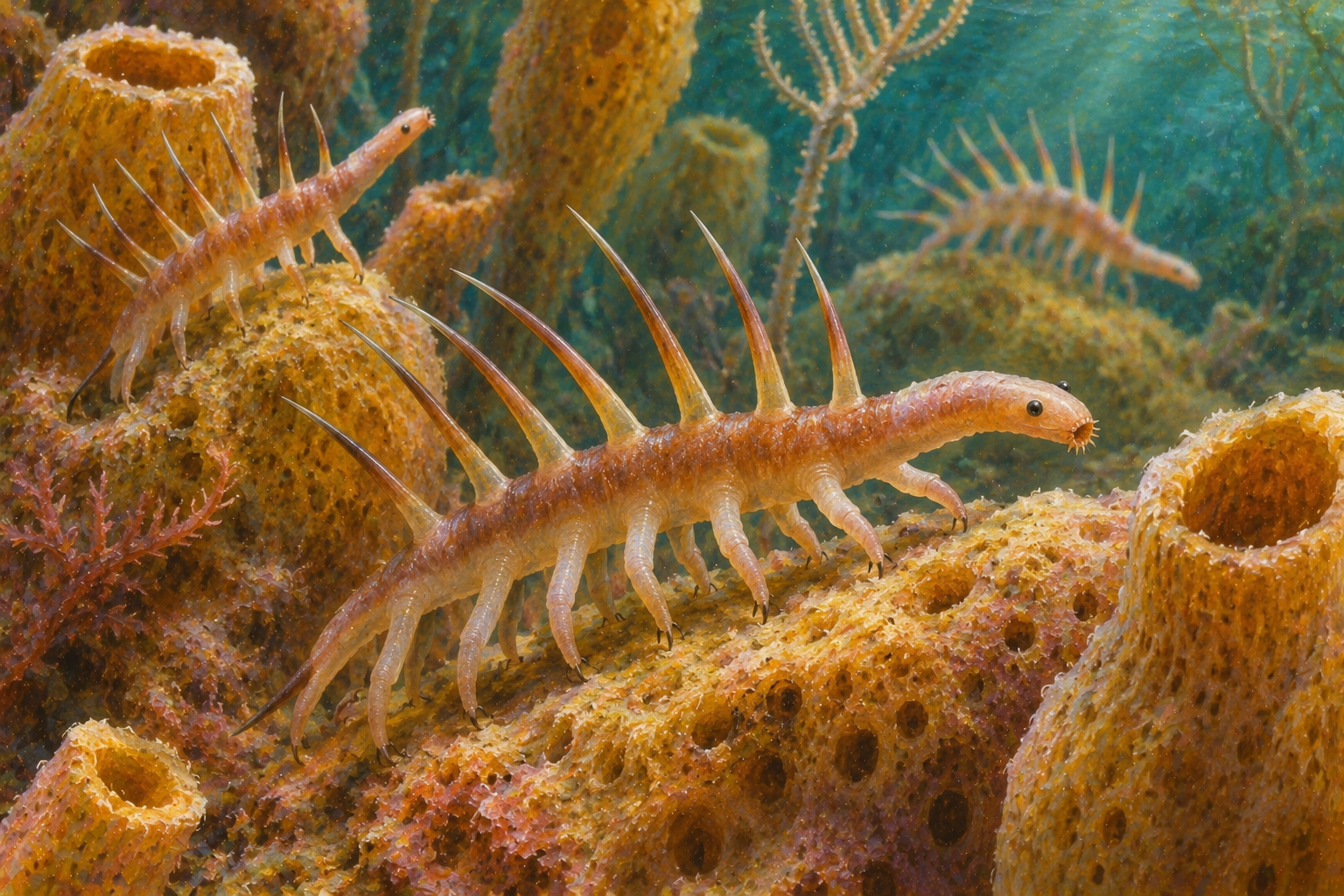
Among the sponges, a tiny wormlike animal clings to the substrate on slender clawed legs. Paired spines project from its back. In the venom-bearing reef colonies, careless contact may cause temporary paralysis.
Hallucigenia Statistics
Hallucigenia
Tiny beast, unaligned
AC 13; Initiative +2 (12)
HP 2 (1d4)
Speed 5 ft., climb 5 ft.
| Ability | Score | Mod | Save |
|---|---|---|---|
| STR | 3 | −4 | −4 |
| DEX | 14 | +2 | +2 |
| CON | 10 | +0 | +0 |
| INT | 1 | −5 | −5 |
| WIS | 10 | +0 | +0 |
| CHA | 2 | −4 | −4 |
Senses darkvision 30 ft., passive Perception 10
Languages None
CR 1/4 (50 XP; PB +2)
Traits
Water Breathing. Hallucigenia can breathe only underwater.
Defensive Spines. A creature that touches Hallucigenia directly or hits it with an unarmed strike within 5 feet must succeed on a DC 11 Constitution saving throw or be poisoned until the end of its next turn. While poisoned this way, the creature is paralyzed. A creature makes this save no more than once per turn.
Actions
Spine Contact. Melee Attack Roll: +4, reach 0 ft., one creature in its space. Hit: 1 piercing damage. The target must make the saving throw described in Defensive Spines, subject to that trait’s limit.
Original campaign adaptation of the venom-bearing form.
Swarm of Hallucigenia
Medium swarm of Tiny beasts, unaligned
AC 14; Initiative +2 (12)
HP 45 (6d8 + 18)
Speed 5 ft., climb 5 ft.
| Ability | Score | Mod | Save |
|---|---|---|---|
| STR | 6 | −2 | −2 |
| DEX | 14 | +2 | +2 |
| CON | 16 | +3 | +3 |
| INT | 1 | −5 | −5 |
| WIS | 10 | +0 | +0 |
| CHA | 2 | −4 | −4 |
Damage Resistances bludgeoning, piercing, slashing
Condition Immunities charmed, frightened, grappled, paralyzed, petrified, prone, restrained, stunned
Senses darkvision 30 ft., passive Perception 10
Languages None
CR 2 (450 XP; PB +2)
Traits
Water Breathing. Hallucigenia can breathe only underwater.
Swarm. The swarm can occupy another creature’s space and vice versa, and it can move through any opening large enough for one of its members. It cannot regain hit points or gain temporary hit points.
Defensive Spines. A creature that touches the swarm directly or hits it with an unarmed strike within 5 feet must succeed on a DC 13 Constitution saving throw or be poisoned until the end of its next turn. While poisoned this way, the creature is paralyzed. A creature makes this save no more than once per turn.
Actions
Spined Mass. Melee Attack Roll: +4, reach 0 ft., one creature in its space. Hit: 14 (4d6) piercing damage, or 7 (2d6) piercing damage if the swarm has half its hit points or fewer. The target must make the saving throw described in Defensive Spines, subject to that trait’s limit.
Original campaign adaptation of the swarm.
Hallucigenia
Tiny beast, unaligned
Armor Class 13 (natural armor)
Hit Points 2 (1d4)
Speed 5 ft., climb 5 ft.
| STR | DEX | CON | INT | WIS | CHA |
|---|---|---|---|---|---|
| 3 (−4) | 14 (+2) | 10 (+0) | 1 (−5) | 10 (+0) | 2 (−4) |
Senses darkvision 30 ft., passive Perception 10
Languages —
Challenge 1/4 (50 XP)
Traits
Water Breathing. Hallucigenia can breathe only underwater.
Defensive Spines. A creature that touches Hallucigenia directly or hits it with an unarmed strike within 5 feet must succeed on a DC 11 Constitution saving throw or be poisoned until the end of its next turn. While poisoned this way, the creature is paralyzed. A creature makes this save no more than once per turn.
Actions
Spine Contact. Melee Weapon Attack: +4 to hit, reach 0 ft., one creature in its space. Hit: 1 piercing damage. The target must make the saving throw described in Defensive Spines, subject to that trait’s limit.
Original campaign adaptation of the venom-bearing form.
Swarm of Hallucigenia
Medium swarm of Tiny beasts, unaligned
Armor Class 14 (natural armor)
Hit Points 45 (6d8 + 18)
Speed 5 ft., climb 5 ft.
| STR | DEX | CON | INT | WIS | CHA |
|---|---|---|---|---|---|
| 6 (−2) | 14 (+2) | 16 (+3) | 1 (−5) | 10 (+0) | 2 (−4) |
Damage Resistances bludgeoning, piercing, slashing
Condition Immunities charmed, frightened, grappled, paralyzed, petrified, prone, restrained, stunned
Senses darkvision 30 ft., passive Perception 10
Languages —
Challenge 2 (450 XP)
Traits
Water Breathing. Hallucigenia can breathe only underwater.
Swarm. The swarm can occupy another creature’s space and vice versa, and it can move through any opening large enough for one of its members. It cannot regain hit points or gain temporary hit points.
Defensive Spines. A creature that touches the swarm directly or hits it with an unarmed strike within 5 feet must succeed on a DC 13 Constitution saving throw or be poisoned until the end of its next turn. While poisoned this way, the creature is paralyzed. A creature makes this save no more than once per turn.
Actions
Spined Mass. Melee Weapon Attack: +4 to hit, reach 0 ft., one creature in its space. Hit: 14 (4d6) piercing damage, or 7 (2d6) piercing damage if the swarm has half its hit points or fewer. The target must make the saving throw described in Defensive Spines, subject to that trait’s limit.
Original campaign adaptation of the swarm.
Hallucigenia
CR 1/2; XP 200
N Fine vermin (aquatic)
Init +2; Senses darkvision 60 ft.; Perception +4
Defense
AC 21, touch 20, flat-footed 19 (+2 Dex, +1 natural, +8 size)
hp 2 (1/2d8)
Fort +2, Ref +2, Will +0
Immune mind-affecting effects
Offense
Speed 5 ft., climb 5 ft.
Melee spines +10 (1 piercing plus poison)
Space 1/2 ft.; Reach 0 ft.
Statistics
Str 3, Dex 14, Con 10, Int —, Wis 10, Cha 2
Base Atk +0; CMB −6; CMD 0
Feats Weapon Finesse (B)
Skills Climb +6, Perception +4, Stealth +22; racial modifiers +4 Climb, +4 Perception, +4 Stealth; uses Dexterity for Climb
Ecology
Environment warm seas, sponge beds and rocky reefs
Organization solitary or colony
Treasure none
Special Abilities
Poison (Ex). Spines, injury; Fortitude DC 15; frequency 1/round for 4 rounds; effect paralysis for 1 round; cure 1 save. The fixed DC reflects the symbiotic organisms on the spines.
Defensive Spines (Ex). Direct contact with the spines, including an unarmed strike, exposes a creature to the poison; a creature is exposed at most once per round.
Hallucigenia Swarm
CR 2; XP 600
N Fine vermin (aquatic, swarm)
Init +2; Senses darkvision 60 ft.; Perception +4
Defense
AC 21, touch 20, flat-footed 19 (+2 Dex, +1 natural, +8 size)
hp 27 (6d8)
Fort +5, Ref +4, Will +2
Immune weapon damage, mind-affecting effects, swarm traits
Offense
Speed 5 ft., climb 5 ft.
Melee swarm (2d6 plus poison)
Space 10 ft.; Reach 0 ft.
Special Attacks distraction (DC 13), poison
Statistics
Str 3, Dex 14, Con 10, Int —, Wis 10, Cha 2
Base Atk +4; CMB —; CMD —
Skills Climb +6, Perception +4, Stealth +22
Ecology
Environment warm seas
Organization solitary swarm
Treasure none
Special Abilities
Poison (Ex). Swarm, injury; Fortitude DC 15; frequency 1/round for 4 rounds; effect paralysis for 1 round; cure 1 save. The fixed DC reflects symbiotic organisms.
Original Pathfinder adaptations.
Hallucigenia
| Size/Type | Fine vermin (aquatic) |
|---|---|
| Hit Dice | 1/2d8 (2 hp) |
| Initiative | +2 |
| Speed | 5 ft. (1 square), climb 5 ft. |
| Armor Class | 21 (+8 size, +2 Dex, +1 natural), touch 20, flat-footed 19 |
| Base Attack/Grapple | +0/−20 |
| Attack | Spines +10 melee (1 piercing plus poison) |
| Full Attack | Spines +10 melee (1 piercing plus poison) |
| Space/Reach | 1/2 ft./0 ft. |
| Special Attacks | Poison |
| Special Qualities | Darkvision 60 ft., vermin traits |
| Saves | Fort +2, Ref +2, Will +0 |
| Abilities | Str 3, Dex 14, Con 10, Int —, Wis 10, Cha 2 |
| Skills | Hide +18, Move Silently +6, Spot +4, Climb +6 |
| Feats | Weapon Finesse (B) |
| Environment | Warm seas |
| Organization | Solitary or colony |
| Challenge Rating | 1/2 |
| Treasure | None |
| Alignment | Always neutral |
| Advancement | — |
| Level Adjustment | — |
Special Abilities
Poison (Ex). Injury, Fortitude DC 15; initial paralysis for 1d10 rounds, secondary paralysis for 1d10 minutes. The fixed DC represents a symbiotic organism on the spines. Contact with exposed spines, including an unarmed strike, exposes a creature to this poison no more than once per round.
Skills. +4 racial bonus on Move Silently, Climb and Spot; use Dexterity for Climb.
Legacy conversion credited to LordArchaon of the Wizards Community forums, with arithmetic corrections and contact damage clarified.
Hallucigenia Swarm
| Size/Type | Fine vermin (aquatic, swarm) |
|---|---|
| Hit Dice | 6d8 (27 hp) |
| Initiative | +2 |
| Speed | 5 ft. (1 square), climb 5 ft. |
| Armor Class | 21 (+8 size, +2 Dex, +1 natural), touch 20, flat-footed 19 |
| Base Attack/Grapple | +4/— |
| Attack | Swarm (2d6 plus poison) |
| Full Attack | Swarm (2d6 plus poison) |
| Space/Reach | 10 ft./0 ft. |
| Special Attacks | Distraction, poison |
| Special Qualities | Darkvision 60 ft., vermin traits, swarm traits, immunity to weapon damage |
| Saves | Fort +5, Ref +4, Will +2 |
| Abilities | Str 3, Dex 14, Con 10, Int —, Wis 10, Cha 2 |
| Skills | Hide +18, Move Silently +6, Spot +4, Climb +6 |
| Feats | — |
| Environment | Warm seas |
| Organization | Solitary swarm |
| Challenge Rating | 2 |
| Treasure | None |
| Alignment | Always neutral |
| Advancement | — |
| Level Adjustment | — |
Special Abilities
Poison (Ex). Injury, Fortitude DC 15; initial paralysis for 1d10 rounds, secondary paralysis for 1d10 minutes. The fixed DC represents a symbiotic organism on the spines. The swarm delivers poison with its swarm attack.
Distraction (Ex). A living creature beginning its turn in the swarm’s space must succeed on a DC 13 Fortitude save or be nauseated for 1 round.
Skills. +4 racial bonus on Move Silently, Climb and Spot; use Dexterity for Climb.
Original swarm adaptation.
Appearance and signs
Hallucigenia has a narrow, soft body, seven pairs of prominent dorsal spines in the familiar H. sparsa form, and paired flexible limbs beneath. Its elongated head bears simple eyes and a small terminal mouth; teeth line its foregut. It is an early relative of velvet worms. Its appearance is unusual, but it is not an aberration.
Habitat and ecology
These tiny marine animals inhabit primeval seabeds, where they climb over submerged surfaces and feed on small organic particles. Their exact feeding ecology is uncertain. In the fantastic reef population, they associate with sponges and other reef organisms; microorganisms associated with their spines supply a defensive toxin. This is a feature of the magical ecosystem, not an established property of fossil Hallucigenia.
Behaviour and encounters
Individuals are normally nonaggressive and retreat from disturbance. A swimmer who brushes against a venom-bearing colony may be injured by the spines. Dense colonies become dangerous when disturbed or when a creature enters their space; they do not pursue large animals as food. A cautious party can bypass them by recognising the spiny animals on the substrate.
Adventure hooks
- The living sponge bed. A scholar asks the party to document an isolated marine colony without disturbing its inhabitants.
- The reef passage. A submerged route crosses dense patches of venom-bearing lobopodians. Find a safe passage or a way to protect the travellers.
- The primeval refuge. A current carries unusual tiny animals into a fishing ground, hinting at a hidden ancient ecosystem.
Related creatures
Anomalocaris · Monstrous Trilobite · Eurypterid · Vermin Bestiary.
Sources and licensing
Legacy game conversion credited to LordArchaon of the Wizards Community forums. Other panels and swarm variants are original campaign adaptations. Scientific reference: Smith and Caron (2015), Hallucigenia’s head and the pharyngeal armature of early ecdysozoans, Nature. Rules frameworks: System Reference Documents 5.1 and 5.2.1, Wizards of the Coast LLC, under CC BY 4.0; Pathfinder Reference Document.
Keep this reference growing
If this page helped with your reading or game, you can support its upkeep or explore the curated books.
Explore the Bookshop — epics, classics and stories behind imagined worlds.