
Jinkin Gremlin – Fey Saboteur
A spiteful underworld gremlin that teaches trusted objects to fail at the worst possible moment.
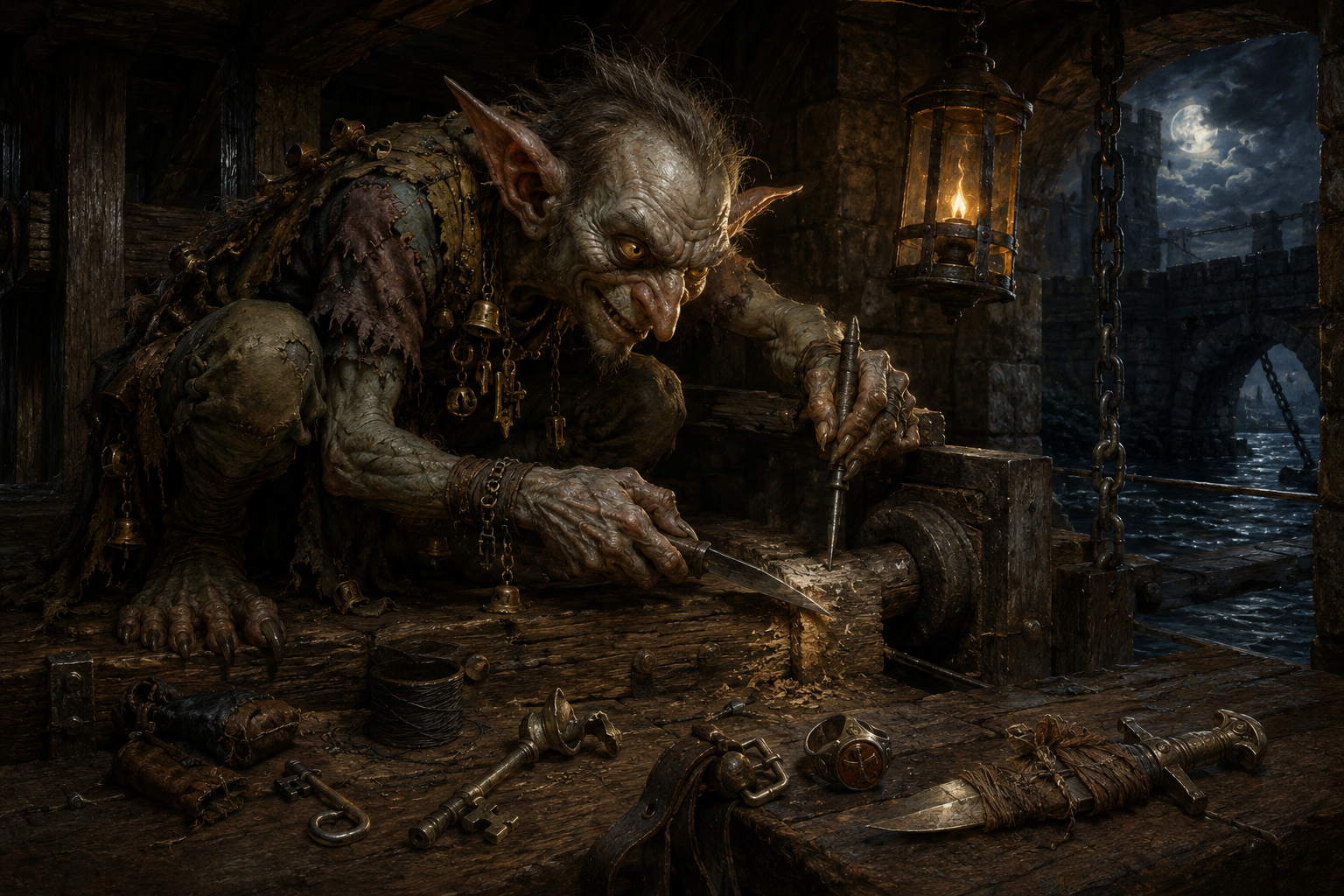
A Jinkin Gremlin is a tiny fey saboteur of cellars, mines, bridgeworks, crypts, ruined towers, siege tunnels, and forgotten workshops. It is not a comic pest and not a harmless tinkerer. It is the spite inside a snapped bowstring, the loosened pin in a drawbridge, the spoiled poultice in a healer’s kit, and the faint giggle from the dark after a lantern fails underground.
A jinkin does not merely steal. It violates trust. It takes the thing a person relies on — a rope, a sword, a holy symbol, a wagon axle, a lock, a bridge-pin, a lamp, a spell focus — and makes that thing wait for the worst possible moment to betray its owner.
Overview
Jinkins understand hinges, locks, bows, lanterns, shields, wagons, ladders, armour straps, climbing hooks, and magic items in the same way a butcher understands joints. They do not always break things at once. A jinkin prefers to make an object fail later, when the owner has already trusted it.
A party may first notice a jinkin by absence: a missing piton, a split rope, a bent key, a dead lantern, a wheel that comes loose after three miles, or a magic blade that suddenly demands some humiliating condition before it answers. The monster becomes dangerous because the players start checking everything. That is the point. A jinkin turns gear into suspicion.
In a dungeon, a jinkin is not a fair duelist. It is a pressure creature. It makes the environment hostile, turns retreat into risk, punishes arrogance, and forces the party to decide whether chasing the giggling thing into the dark is worth the obvious trap.
Appearance
A jinkin stands barely two feet high, with a narrow crooked body, oversized hands, knotted joints, needle teeth, and eyes bright with watchful malice. Its skin is the colour of damp stone, old bruises, cellar mould, or soot-stained leather. It moves with the speed of a rat and the confidence of a burglar who knows every loose board in the house.
Most jinkins carry scavenged tools: awls, hooks, bent nails, latch-wires, cracked magnifying lenses, lock picks, thin blades, bits of cursed string, snapped holy symbols, stolen buttons, and the brass teeth of broken clockwork. A jinkin’s clothing is usually stitched from scraps stolen from victims. It may wear a noble’s torn cuff as a cloak, a priest’s cord as a belt, or a knight’s badge upside down as a joke.
A jinkin that has haunted one place for a long time often takes on the colour and grime of that place. A mine-jinkin smells of iron dust and lamp oil. A bridge-jinkin has splinters and old mortar caught in its skin. A crypt-jinkin wears bone buttons and knots grave-cloth into its hair.
Habitat
Jinkins favour places where people rely on tools but cannot easily inspect them.
They thrive in old mines, dwarf roads, siege tunnels, abandoned cellars, bridge towers, ruined mills, castle undercrofts, flooded foundations, crypt workrooms, plague pits, goblin warrens, smuggler passages, fey-tainted ruins, old Roman works, and cursed battlefields where abandoned equipment still matters. They are also common around powerful monsters that leave scraps and protection behind: hags, ogres, trolls, goblin chiefs, duergar, wicked fey, devils, necromancers, or ruined noble houses.
A jinkin lair is rarely a home in the human sense. It is a nest of stolen hardware, false floors, peepholes, retreat holes, trip-lines, bait objects, and half-finished spite. Ropes are cut halfway through rather than severed. Tools appear in careful patterns no worker remembers making. Doors stick only when people flee. Warning marks, tally cuts, and chalk signs are rewritten into mockery.
Jinkins are especially dangerous in a late medieval world because society depends on craft, oath, repair, tools, inheritance, and material trust. The gremlin attacks those bonds directly. It is not merely damaging property; it is damaging the confidence that lets roads, bridges, workshops, armouries, and households function.
Ecology
Jinkins feed on scraps, vermin, stolen food, and whatever larger monsters leave behind, but their true nourishment is failure. A broken wagon pleases them. A trapped knight delights them. A spellcaster discovering that their wand has been altered gives them almost devotional joy.
Unlike a simple thief, a jinkin often discards stolen goods after ruining them. Value matters less than ownership. The object was loved, trusted, inherited, blessed, expensive, or essential. That is what made it worth attacking.
Jinkins are sometimes drawn to places already soured by bad craft, broken bargains, unsafe labour, or neglected repairs. They do not arrive to correct the wrong. They arrive because the wrong has made a place easier to ruin.
A jinkin that is humiliated, struck, denied a stolen prize, or forced to watch one of its curses removed may follow the offender for weeks. It will not always strike at once. It waits for a dangerous road, a public ceremony, a night watch, a duel, a climb, a river crossing, or a moment when the victim cannot stop to inspect every buckle and knot.
Mechanics Tabs
The rules below are mechanics compatible for different game editions.
Jinkin Gremlin 5.5e / 2024
Jinkin Gremlin, Pathfinder 1e
Jinkin Gremlin 5.5e / 2024

Tiny Fey, Chaotic Evil
AC 15
Initiative +4
HP 27 (6d4 + 12)
Speed 30 ft., climb 20 ft.
| STR | DEX | CON | INT | WIS | CHA |
|---|---|---|---|---|---|
| 5 (-3) | 18 (+4) | 14 (+2) | 14 (+2) | 13 (+1) | 14 (+2) |
Saving Throws Dex +6, Int +4
Skills Acrobatics +6, Deception +4, Perception +3, Sleight of Hand +6, Stealth +8
Tools Thieves’ tools +6
Damage Resistances Bludgeoning, Piercing, and Slashing from nonmagical attacks not made with cold iron or silvered weapons
Condition Immunities Charmed by non-fey creatures
Senses Darkvision 60 ft., passive Perception 13
Languages Sylvan, Undercommon
Challenge 1 (200 XP)
Proficiency Bonus +2
Traits
Gremlin Saboteur. The jinkin has advantage on ability checks made to hide in cramped, cluttered, underground, ruined, or workshop-like spaces. It also has advantage on checks made with thieves’ tools or tinkering tools to disable, alter, jam, or quietly damage an object.
Spiteful Tinkering. Over 1 minute, the jinkin tampers with one unattended nonmagical object it can touch, such as a rope, lock, tool, bowstring, saddle, lantern, shield strap, hinge, ladder, cart wheel, or trap mechanism. The next time the object is used under pressure within 24 hours, it fails in a fitting way chosen by the DM: disadvantage on a relevant check, a jam, a break, a loud noise, a delay, a fall, or loss of its normal benefit until repaired.
A creature that inspects the object notices the sabotage with a successful DC 14 Intelligence (Investigation) or Wisdom (Perception) check. A sabotaged object can usually be repaired with appropriate tools and 1 minute of work, or with mending if the damage is simple.
Curse Precious Object. Once per day, a jinkin can spend 10 minutes cursing one unattended magic item, heirloom, holy symbol, spell focus, masterwork object, or treasured tool it can touch. The curse lasts for 24 hours or until removed.
Choose one effect:
- The item fails the first time it is used in a dangerous scene.
- The item works only after a humiliating phrase, gesture, or condition.
- The item imposes disadvantage on the first attack roll, ability check, or saving throw made with it.
- The item emits noise, sparks, smoke, foul smell, or mocking whispers when stealth matters.
- The item attracts vermin, mould, rust, or minor fey attention.
The curse can be identified with detect magic and a successful DC 14 Intelligence (Arcana) check. It can be ended by remove curse, greater restoration, similar magic, or 10 minutes of careful cleansing with appropriate tools and materials followed by a successful DC 14 Intelligence (Arcana), Intelligence (Religion), or Wisdom (Survival) check.
This curse should create a scene, not permanently destroy a campaign-defining item unless the DM deliberately wants a larger curse adventure.
Sneak Attack. Once per turn, the jinkin deals an extra 3 (1d6) damage when it hits a creature with a weapon attack and has advantage on the attack roll, or when an ally of the jinkin is within 5 feet of the target and the jinkin does not have disadvantage.
Tiny Escape. The jinkin can move through a space as narrow as 4 inches wide without squeezing, provided it is not carrying a bulky object.
Actions
Shortsword. Melee Weapon Attack: +6 to hit, reach 5 ft., one target. Hit: 6 (1d4 + 4) piercing damage plus 3 (1d6) extra damage if Sneak Attack applies.
Bite. Melee Weapon Attack: +6 to hit, reach 5 ft., one target. Hit: 5 (1d2 + 4) piercing damage.
Thrown Hook. Ranged Weapon Attack: +6 to hit, range 20/60 ft., one target. Hit: 5 (1d2 + 4) piercing damage, and the target must succeed on a DC 12 Dexterity saving throw or drop one held object of the jinkin’s choice.
Gremlin Vanish (Recharge 5–6). The jinkin teleports up to 30 feet to an unoccupied space it can see. It can bring one Tiny or Small unattended object it is carrying.
Bonus Actions
Scuttle Away. The jinkin takes the Disengage or Hide action.
Notes
A jinkin should feel weaker than a true combat monster but more dangerous than its numbers suggest. Use it before, during, and after encounters: sabotage the bridge before the ogre arrives, curse the fighter’s blade before the duel, or steal the cleric’s holy symbol before the undead scene.
Jinkin Gremlin, Pathfinder 1e

Grimacing like a maniac, this lean little bat-eared horror displays a mouth full of needle-like teeth and glowing, orange eyes.
This content is from the Paizo Core Rules.
| Jinkin Gremlin CR 1 |
| XP 400 CE Tiny fey Init +4; Senses Darkvision 120 ft., Low-Light Vision; Perception +6 |
| DEFENSE |
| AC 18, touch 17, flat-footed 13 (+4 Dexterity, +1 Dodge, +1 natural,+2 size) hp 6 (1d6+3) Fort +0, Ref +6, Will +4 DR 5/cold iron; SR 12 |
| OFFENSE |
| Speed 40 ft. Melee short sword +6 (1d3-4/19-20), bite +1 (1d2-4) Space 2-1/2 ft.; Reach 0 ft. Special Attacks sneak attack +1d6, tinker Spell-Like Abilities (CL 1st; Concentration +3) At will – prestidigitation 1/hour – dimension door (self plus 5 lbs. only) |
| STATISTICS |
| Strength 3, Dexterity 19, Constitution 11, Intelligence 14, Wisdom 14, Charisma 15 Base Atk +0; CMB +2; CMD 9 Feats Dodge, ToughnessB, Weapon FinesseB Skills Bluff +6, Craft (traps) +10, Disable Device +9, Escape Artist +8, Perception +6, Sleight of Hand +8, Stealth +16, Use Magic Device +6; Racial Modifiers +4 Craft (traps), +4 Disable Device Languages Undercommon |
| SPECIAL ABILITIES |
| Tinker (Sp) A group of six jinkins working together over the course of an hour can create an effect identical to bestow curse on any living creature. This effect functions at CL 6th, and the target creature must be either willing or helpless (but still gets a saving throw to resist). The save is DC 14 + the Charisma modifier of the jinkin with the highest Charisma score (DC 16 for most groups of jinkins). Alternatively, the group of jinkins can attempt to infuse a magic item with a curse. The nature of this curse is determined randomly; half of these curses make the magic item unreliable (each time the item is used, there is a 20% chance it does not function), while the other half give the item a random requirement. A jinkin can take part in a tinkering only once per day, and may only tinker with a creature or object that isn’t already cursed. Once a tinkering curse is in place, it is permanent until removed via an effect like remove curse. All jinkin tinkerings function as a curse created by a 6th-level caster. |
| ECOLOGY |
| Environment any underground or urban Organization solitary, pair, mob (3-12), or infestation (13-20 with 1-3 sorcerers of 1st-3rd level, 1 rogue leader of 2nd-4th level, 2-8 trained stirges, 2-5 trained darkmantles, and 1-2 trained dire bats) Treasure standard (short sword, other treasure) |
Sneaky and sadistic, jinkin gremlins are hideous gremlins that inhabit the dark places underground. Well acclimated to the shadows, they hide in cramped quarters and attack larger creatures when they’re strategically positioned. Jinkins commonly work with or near larger or more powerful creatures; these larger creatures provide cover for the jinkins trickery. They use dimension door to exit any battle that goes badly, taking any stolen goods with them.
jinkin gremlins delight in leading larger creatures into dangerous caves or pits, usually by lunging out of the shadows to make a single sneak attack against a creature and then running away, taking care while fleeing to remain visible to their target so that they can lure the victim into a trap.
Jinkins also hold dangerous grudges, and one might follow a creature that supposedly slighted it for weeks, looking for an opportunity to take revenge. This revenge can take many forms, from leading horses astray to contaminating food supplies to directing larger monsters toward the begrudged creature.
One of the most direct and unwelcome revenges of the jinkins is the destruction or cursing of magical items. Many times they’ll observe camped enemies from a distance and either steal an item to tinker with it or just use their tinkering magic at a distance to annoy the items owner. Once a jinkin has worked its sabotage on a stolen item, the jinkin either grows bored with the item or may attempt to return it to its owner. Jinkin lairs are often cluttered with stolen items that bear curses the jinkins themselves have forgotten all about.
Dwarves in particular hate jinkins, with numerous tales in their folklore telling of tragedy at the hands of the gremlins. The loathing is largely mutual.
The average jinkin gremlin stands almost 2 feet tall and weighs about 13 pounds.
Section 15: Copyright Notice – Bestiary 2
Pathfinder Roleplaying Game Bestiary 2, © 2010, Paizo Publishing, LLC; Authors Wolfgang Baur, Jason Bulmahn, Adam Daigle, Graeme Davis, Crystal Frasier, Joshua J. Frost, Tim Hitchcock, Brandon Hodge, James Jacobs, Steve Kenson, Hal MacLean, Martin Mason, Rob McCreary, Erik Mona, Jason Nelson, Patrick Renie, Sean K Reynolds, F. Wesley Schneider, Owen K.C. Stephens, James L. Sutter, Russ Taylor, and Greg A. Vaughan, based on material by Jonathan Tweet, Monte Cook, and Skip Williams.
Combat Tactics
jinkin gremlins should almost never fight in empty rooms. Use them with narrow ledges, low tunnels, murder holes, pits, ladders, rope bridges, unstable scaffolds, half-flooded cellars, locked grates, collapsing shelves, old mine lifts, and cursed doors.
A jinkin encounter should usually begin before open conflict. Show one visible failure, one suspected failure, and one false clue before the party corners it. A buckle is half-cut. A scroll case has been opened. A ladder rung looks wrong. A lantern has been dampened. Something has been moved where no one admits moving it.
Once the fight begins, the jinkin should steal, slash, vanish, lure, and retreat. It watches who checks the rope, who carries the best weapon, who sleeps beside the spellbook, and who panics first. It interferes with the object most likely to matter later.
They flee quickly once cornered. A dead jinkin is less interesting than a living jinkin that has seen the party’s habits.
Treasure
A jinkin gremlin’s treasure should look useful before it looks valuable.
Typical jinkin treasure includes clipped coins, old trade tokens, stolen buttons, scratched gems, bent keys, damaged thieves’ tools, spoiled oil, lamp-black, glue, alchemical residue, broken lock-parts, trap components, half-mended tools, and objects taken from nearby victims.
More important than the coins are the personal items. A jinkin lair should contain at least one object someone wants back: a holy symbol, a wedding clasp, a knightly badge, a miner’s tally, a guild seal, a child’s charm, a map tube, a spell focus, a signet ring, or a tool that belonged to a dead craftsman.
Jinkin treasure often includes bait. The obvious valuable object may be cursed, rigged, or deliberately placed. A polished sword may have a loosened grip. A repaired lantern may burn too bright and blind the holder at the wrong moment. A returned relic may answer prayer only after insulting the priest who bears it.
A good jinkin gremlin hoard should make the players ask not “what is this worth?” but “what has it done to this?”
How Jinkin Gremlins Enter Play
A jinkin works best when the players first experience the consequences rather than the creature.
Let the party find the broken thing before they find the monster. The bridge gives way. The holy symbol is gone. The lock opens too easily. The rope snaps halfway down. The magic sword works, but only after the fighter says something shameful in front of witnesses. Bells ring after the accident instead of before it. Armour straps hold during inspection and fail during strain. That is the jinkin announcing itself.
The strongest jinkin scenes are built around one question: what object does the party trust too much?
Encounter Design
Do not use jinkin gremlins as simple melee enemies unless the party is very inexperienced or badly out of position. Their encounter value comes from preparation: a late trap, a stronger monster nearby, a stolen object that tempts pursuit, crawlspaces or escape routes, a time pressure that prevents careful inspection, and someone ready to blame the party for the sabotage.
A single jinkin can haunt a party for several sessions if it escapes. Several jinkins can turn a mine, crypt, or fortress undercroft into a full adventure site.
Adventure Hooks
The Bridge That Passed Inspection
A stone bridge over a gorge has collapsed three times in two years, each failure occurring after masons, priests, and engineers declared it safe. The local lord blames incompetence. The guild blames sabotage. The truth is a jinkin brood living inside the old bridge tower, cursing replacement pins, shaving wedges, and returning “repaired” tools to the workmen.
The Sword That Forgot Its Name
A knight’s ancestral blade no longer answers its command word. Worse, it now works only when the knight speaks a shameful phrase connected to an old family crime. The knight calls it a curse. The jinkin gremlins calls it honesty.
The Mine Bell Rings Backwards
A silver mine has not produced ore in weeks. Ladders snap, carts uncouple, lanterns die, and warning bells ring after the accident instead of before it. The miners believe the mountain is angry. Something in the dark has learned the mine’s routine and is improving it toward murder.