
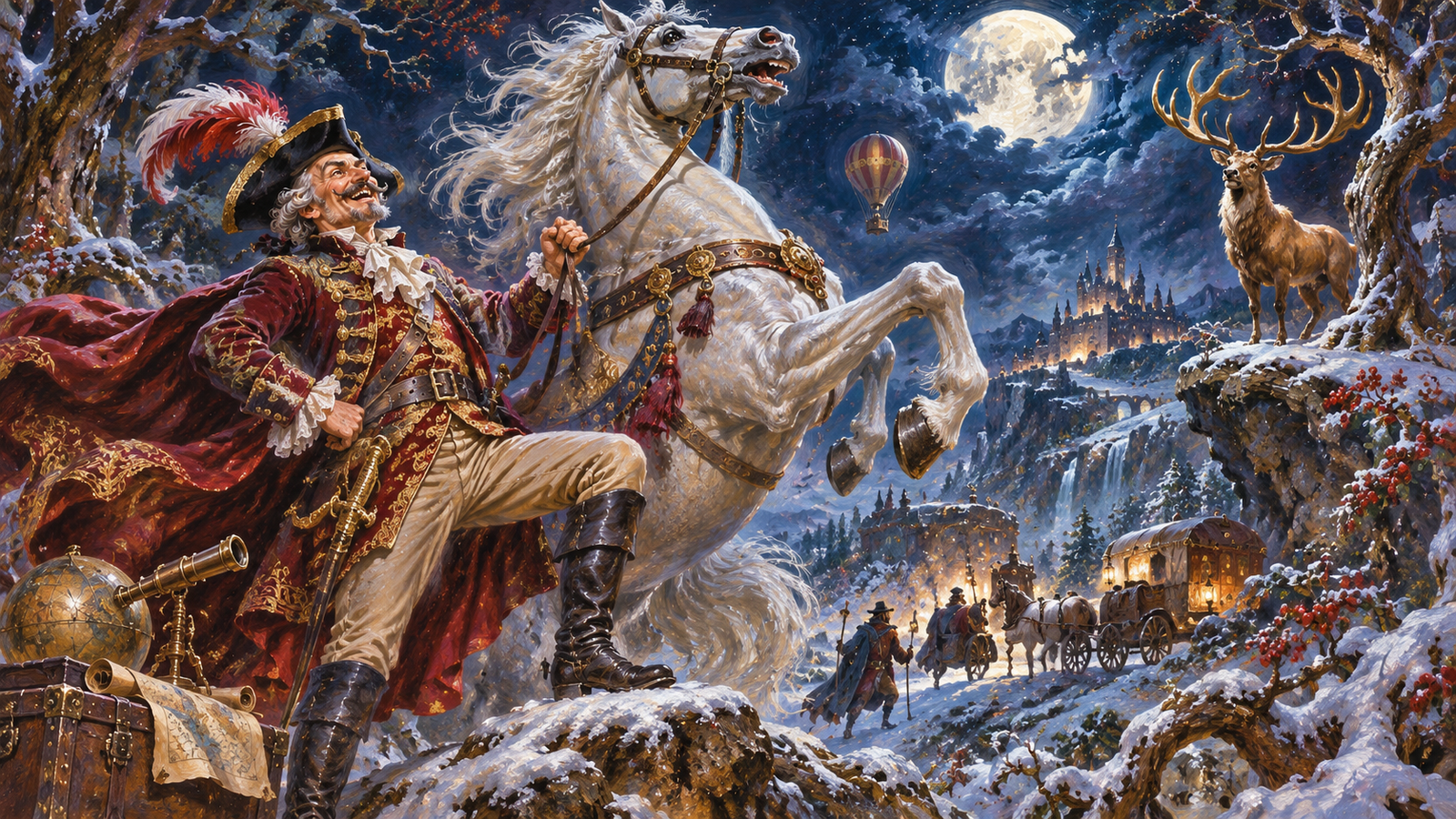
A gentleman, a cannonball, an impossible world—and not a word of it, he insists, is exaggerated.
At a Glance
| Original English collection | Baron Munchausen’s Narrative of His Marvellous Travels and Campaigns in Russia |
|---|---|
| Later familiar title | The Surprising Adventures of Baron Munchausen |
| Author | Rudolf Erich Raspe for the first English collection; subsequent material came from several hands |
| First publication | 1785 |
| Language | English; Gottfried August Bürger’s German adaptation followed in 1786 |
| Genre | Literary tall tales, satire, fantasy travel and comic adventure |
| Best for | Fans of short absurd adventures, ingenious escapes and elaborate unreliable narration |
Why read it? Baron Munchausen tells stories no reasonable person can believe, with the perfect composure of a man recounting an ordinary day. Their ingenious impossibilities, mock-serious military and sporting exploits, and refusal to distinguish fact from fantasy make these tales an early landmark of comic fantasy.
The Stories — Without Major Spoilers
An aristocratic veteran entertains his friends with recollections of campaigns, hunts and travel. A winter journey turns into a physical impossibility; a daring shot or desperate escape succeeds through an outlandish trick; distant landscapes acquire natural laws of their own. Every adventure becomes more preposterous, and every time the Baron explains himself with absolute certainty.
The book is not a single, tightly plotted modern novel. It is a family of tales that grew through editions. Famous episodes involving cannonballs, extraordinary journeys, strange animals and the Moon do not all have identical textual histories. A modern volume can contain material added by later writers and adaptors; readers should check the exact contents rather than assuming all stories appeared in the first slim 1785 book.
The Character and His World
The fictional Baron is a proud traveller and storyteller, derived from the reputation of the historical Hieronymus Karl Friedrich, Freiherr von Münchhausen. The literary figure is not a trustworthy biography of the real officer. His companions, ships, animals and extraordinary encounters change as the tales grow through translations and retellings.
The 1988 film, especially, established memorable versions of Berthold, Adolphus, Gustavus and Albrecht, as well as Sally Salt. Those film versions must not be falsely attributed as a fixed cast in Raspe’s original pamphlet.
What Makes These Tales Work?
The comedy depends on confident specificity. The Baron describes precisely how something impossible happened, as though a well-chosen detail ought to make it credible. In the process, the tales parody embellished travel accounts, boasts of aristocratic sporting prowess and the assumption that a commanding narrator deserves unquestioning belief. The landscape feels real until the rules stop applying.
History and Editions
A separate, expanded continuation appeared in 1792, adding figures such as Gog and Magog, Hilaro Frosticos, Lady Fragrantia, Sphinx and Wauwau. These characters belong to the later Munchausen tradition rather than the original short 1785 collection.
Raspe’s English chapbook appeared in 1785. Enlarged English printings and Bürger’s influential 1786 German adaptation helped establish the enduring story tradition. Later editions—including those illustrated by Gustave Doré—often represent an accumulated literary history, not a verbatim facsimile of the first edition.
Where to Start
Read The Surprising Adventures of Baron Munchausen free at Project Gutenberg. This is an accessible historical collection, not necessarily a reproduction of the original 1785 pamphlet. For a printed edition, choose a clearly described complete or abridged text and verify the editor, edition and ISBN before buying. No retailer price or invented edition-specific ISBN is presented here.
Film, Characters and Fantasy Adventures
For a very different, visual interpretation, visit The Adventures of Baron Munchausen (1988). The Baron’s campaign NPC profile treats the storyteller as a playable figure in an original fantasy setting. His version of events need not become universal truth: players can investigate, challenge, imitate or exploit his claims.
In Bürger’s 1786 telling, the Baron recruits five servants on the road to Cairo. Follow the Sharpshooter, the Strongman, the Listener and the Wind-maker through the Sultan’s wine wager and into adventures of their own.
In the earlier tales, the Lithuanian Stallion dances across a tea table and survives a falling gate through the work of a farrier and a handful of laurel shoots.
A cannonball bearing an old soldier’s insignia is found far from any battlefield; a sailor has seen a ship silhouetted against the Moon; a frustrated official tries to silence a man whose stories keep manifesting as physical evidence. These are original campaign possibilities, not scenes attributed to Raspe’s text.
Other fantastic journeys: Don Quixote, One Thousand and One Nights and Sinbad the Sailor.
Characters and Creatures from the Tales
The Lithuanian Stallion survives being cut in two at a gate. On a voyage to the Moon, the Baron encounters the Lunarians, who can carry their own heads.
Before setting out, the Baron takes counsel from Hilaro Frosticos and visits Lady Fragrantia. Count Gosamer rides Sphinx, the expedition’s sea beast. When the count is thrown, Gog and Magog take the reins.
The two giants later pursue Wauwau, a swanlike bird that foretells events. The search brings the expedition to the castle of Nareskin Rowskimowmowsky, whose bears serve dinner.
Sources
Keep this reference growing
If this page helped with your reading or game, you can support its upkeep or explore the curated books.
Explore the Bookshop — epics, classics and stories behind imagined worlds.