
Great Zimbabwe — City of Stone and Departing Kings
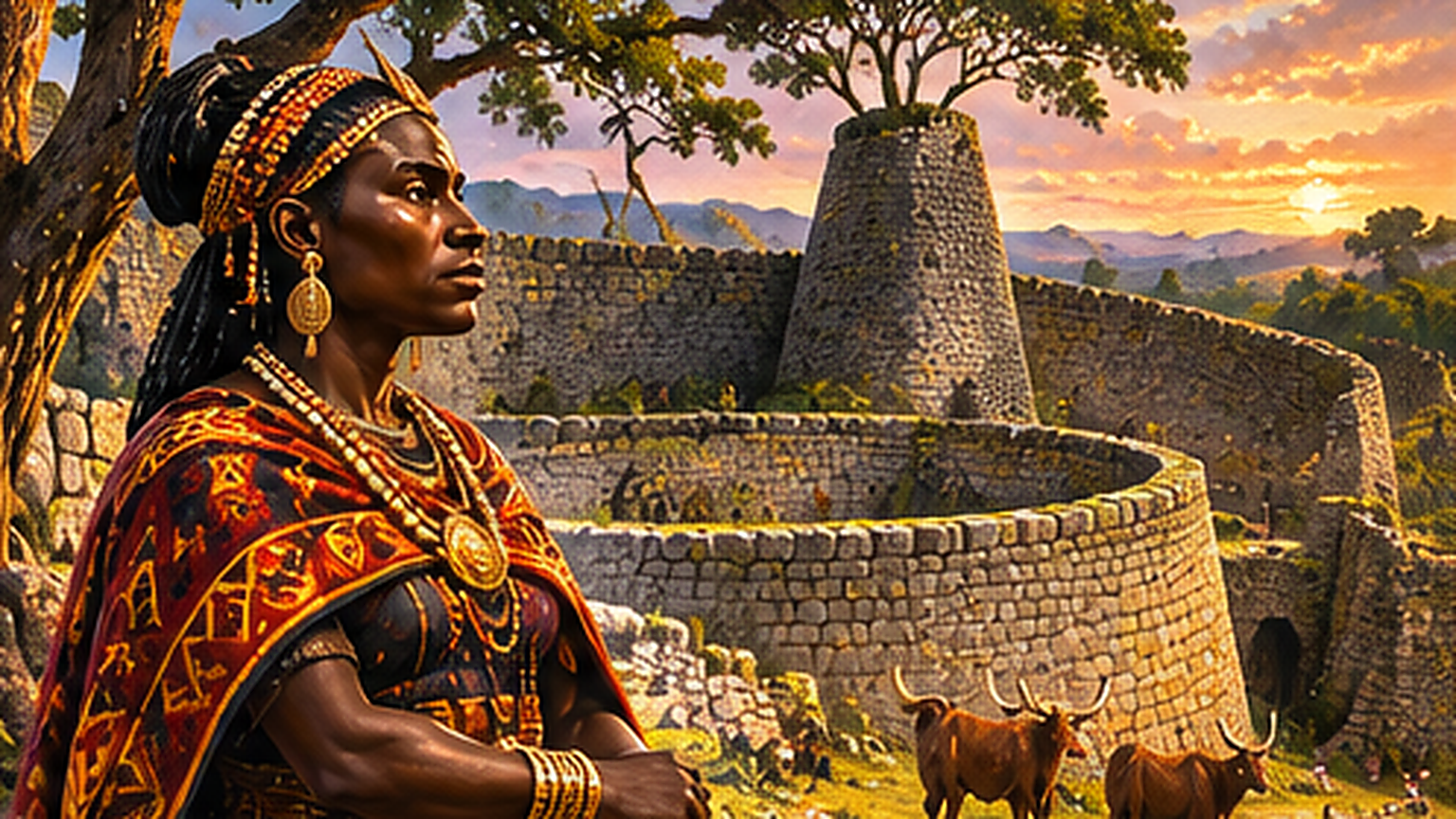
Southern African plateau · Stone-walled royal city · 1454 CE
At a Glance
| Character | Great stone enclosures, cattle grounds, homes, ancestral places and a declining royal centre |
|---|---|
| Political condition | Old rulers have lost influence; established households remain while rival courts gather strength elsewhere |
| Peoples | Communities of the Zimbabwe plateau, including Shona-speaking builders, herders, farmers, traders and ritual custodians |
| Principal sights | Hill Complex, Great Enclosure, valley homes and surrounding grazing country |
| Trade | Cattle, grain, gold, copper, iron, cloth and ivory through long regional exchange networks |
| Dangers | Falling masonry, food shortages, disputed succession, theft from departing households and long dry journeys |
| Campaign present | 1454 CE |

The great stone walls still rise above the grass, but carts no longer arrive at the royal storehouses in their former numbers. On the hill a keeper prepares offerings for the ancestors. Below, a stonemason works beside an enclosure whose owners have moved north, while a cattle family refuses to abandon the fields its grandparents planted. Great Zimbabwe is not dead. Yet even those who remain know that the roads and the kings are changing.
What Is Happening Right Now?
Great Zimbabwe’s old centre is losing people, wealth and political reach. Families and court households leave for better grazing, new trade opportunities and the rising powers of Khami and the northern Zambezi country. Royal messengers still come here, but they no longer presume obedience beyond their own loyal houses. Rivalries over cattle, granaries and the right to speak for the ancestors have become more dangerous as the stores shrink.
The remaining people do not agree about what departure means. Some hope to rebuild the old court’s strength; others believe the safest course is to escort families and their possessions to new settlements. A few seek advantage by seizing empty compounds and declaring themselves custodians of former royal land. On the roads, guards who once protected traders may now demand supplies for masters who cannot pay them.
The city is still inhabited in the campaign present. Its population and influence have declined, but its sacred places, surviving houses, cattle markets and political obligations remain alive. A deserted stone enclosure is not permission to rob the people who guard it.
Places to Explore
The Hill Complex
Narrow stone passages climb among massive granite boulders into the old royal precincts. Some enclosed spaces are occupied by guardians and surviving court households; others stand silent. The ridge commands long views over the valley, making it the natural place for lookouts and meetings. A messenger who reaches the Hill before a rival may decide which claim to the old kingship is heard first.
The Great Enclosure
Immense walls built of carefully fitted, mortarless stone surround spaces once filled with houses and purposeful activity. The great curved passage and its conical tower inspire awe, but the inhabitants know the practical work needed to keep walls, roofs and entrances sound. A single fallen stone from a vulnerable section may injure a traveller or reveal an abandoned storeroom.
Valley Compounds and Workshops
Families work in clay-and-thatch houses among stone-walled yards, tending gardens, preparing grain and repairing pottery, iron tools and cattle equipment. Some workshops now serve fewer customers. Their owners must decide whether to sell their equipment, move it across a difficult road or stay and keep their neighbours supplied.
The Cattle Roads and Granaries
Open grazing paths lead into productive country dotted with farms, water holes and defended stores. Rival claimants value cattle and grain more than decorative stone, for they are the means by which people survive and armies march. The loss of one dry-season reservoir can drive a loyal district into another ruler’s hands.
People, Authority and Sacred Life
The old royal households defend rights granted by previous generations, hoping to preserve their prestige. They can protect dependent families, but some would rather collect the last granaries than admit a district has failed. New court envoys from Khami and the northern plateau offer safe settlement and trade to those willing to move; honest promises can still conceal a demand for labour or cattle. Stoneworkers, herders and market families cannot live on ancestry alone. They bargain over tools, pasture and a fair share of remaining food.
The stone city has ritual custodians who honour the ancestors and guard important places. Carved soapstone birds and the stones themselves carry powerful associations with former rulers. The sacred custodians are neither interchangeable with the court nor powerless before it: a king may command soldiers, but he needs the people who keep the community’s shared obligations. A ruler who punishes hunger with violence may be lawful to himself and hated by everyone whose harvest he seizes.
Markets, Lodging and Help
The remaining markets offer grain, milk, dried meat, pottery, woven goods and repairs to ordinary tools. Specialist stoneworkers can strengthen a damaged wall or locate a safe passage through a fallen section. A traveller needing livestock, a guide or a secure night’s lodging must negotiate with the local household responsible for the route; inns and well-stocked commercial quarters are scarce. Supplies grow harder to obtain as more families move away.
Trade goods may still arrive from the east and north through long chains of merchants. A traveller carrying unfamiliar metalwork or fine beads is not automatically welcome, and the people along the road will ask whom the goods belong to.
Magic and Sacred Services
The custodians of the Hill keep ancestral places and carved birds whose meaning carries the memory of former rulers. Some insist one bird casts no shadow when a false claimant is brought before it. A healer from the valley can aid injured workers and failing herds, but demands that a royal household share its dwindling grain with those repairing its walls. The sacred obligation is inseparable from the survival of the people who remain.
Dangers and Adventure Hooks
- The last granary: a departing noble intends to claim a store needed to feed the remaining families. His papers are genuine, but an elderly keeper insists that the grain was laid aside under an older oath.
- The wall that fell at night: a section of the Great Enclosure collapses, revealing a sealed court passage. Two rival households demand custody of its contents; the stoneworker who knows the safest route is missing.
- Cattle without a home: an arriving herd belongs to families moving toward Khami. The current occupants of the pasture will shelter them for one night only, unless the party can broker a lasting agreement.
- Messenger from the north: a young envoy offers safe passage to new settlements. Her escort has been attacked, and the only evidence lies beside a well claimed by two settlements who refuse to speak to one another.
Travel and Wider Geography
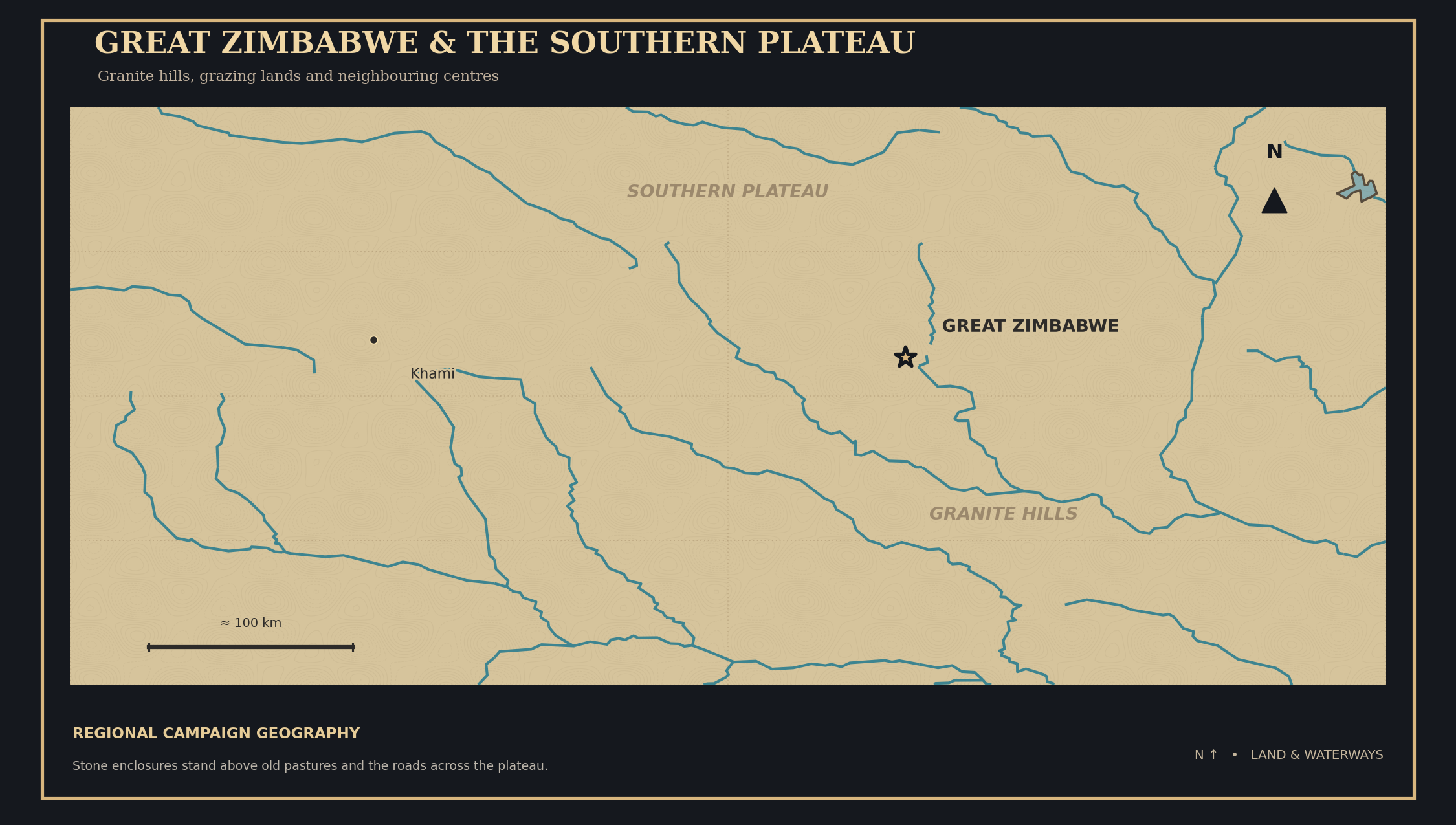
The site stands among hills and grazing country of the southern plateau. Journeys require water, pack carriers, food stores and introductions to those who control the next settlement. Grassland routes pass between granite outcrops, cultivated valleys and seasonal water sources. Heading north brings travellers toward the shifting Zambezi world and the emerging Mutapa rulers; farther southwest lie the growing courts around Khami. These are not all provinces of one still-powerful Zimbabwe empire.
Return to Africa for the continental roads, African History for older kingdoms, or the African Bestiary for creatures tied to particular lands.
Deeper History
The stone buildings are the achievement of generations of African builders, rulers, farmers and craftspeople. The settlement grew into a major centre of the Zimbabwe plateau from the eleventh century and was at its height in the fourteenth. By the middle of the fifteenth century, its political centre was weakening and populations were moving. The extent and timing of abandonment are debated, while its descendants’ traditions and later settlements continued. Here, in 1454, the city retains a diminished community and a contested ceremonial significance.
Historical Sources
UNESCO: Great Zimbabwe National Monument · Metropolitan Museum: Great Zimbabwe · National Museums and Monuments of Zimbabwe.
Keep this reference growing
If this page helped with your reading or game, you can support its upkeep or explore the curated books.
Explore the Bookshop — epics, classics and stories behind imagined worlds.