
Faction · Italian free companies
Jacopo Piccinino’s Bracceschi
At a Glance
| Type | Contracted army and captain’s political-military following |
|---|---|
| Captain | Jacopo Piccinino |
| Operating sphere | Lombardy, Venetian affairs and neighbouring Italian courts |
| Current position | Venetian service, with renewal uncertain in the campaign’s late-1454 period |
| Goal | Secure continued employment, loyal strongholds and political protection |
| Assets | Experienced officers, mounted troops, former Milanese contacts, military intelligence |
| Principal tension | Venice’s peace obligations versus the survival of an expensive armed following |
Company Emblem

An army can survive the end of a war. The harder question is who will pay it tomorrow.
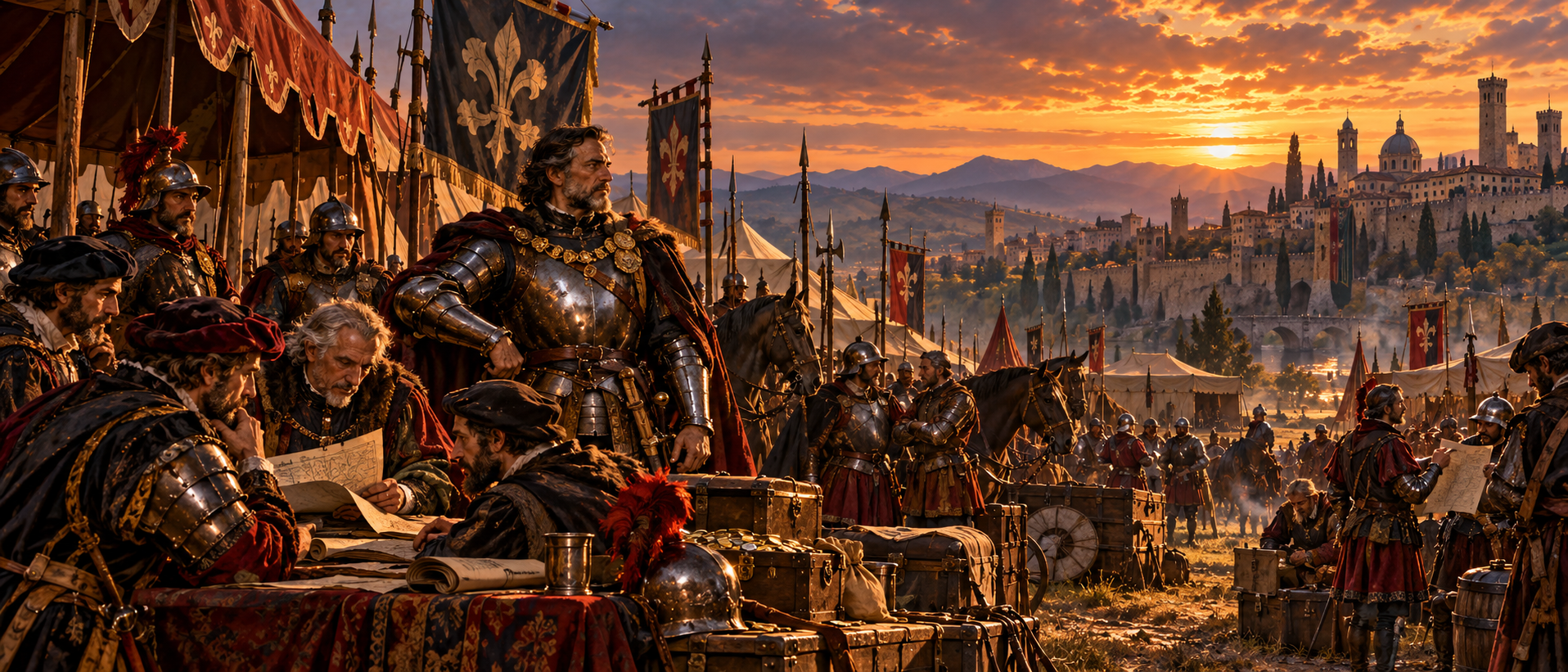
Jacopo Piccinino commands a formidable military following rooted in the Bracceschi tradition. His men have fought for powerful states, defended endangered allies and pursued their captain’s own political network. In 1454 the peace settlements threaten the contracts that keep this force together. Officers who once counted enemies now count outstanding wages and possible employers.
What Is Happening Right Now?
Everyone knows the next contract matters more than the last battle. Piccinino served as a leading Venetian commander in the wars against Francesco Sforza and cultivated alliances among Milanese exiles and smaller northern lords. By the autumn of 1454 Venice is signalling that his Bracceschi contract will not be renewed. This is not a company already dispersed: it is an armed power facing an uncertain future.
Three Sealed Offers
Envoys arrive with rival offers of pay and protection, one of which is forged. The characters can authenticate the seals, carry a private response or reveal the bidder who hopes to provoke another war.
The Veterans’ Petition
A detachment refuses to leave its quarters until arrears are paid. Townspeople ask for help before an angry council closes the gates. The party must protect civilians while deciding who truly owes the money.
The Exiles’ List
A ledger connects displaced Milanese households to secret cash and supplies. Recovering it could save families from reprisals, expose a plot, or make the characters targets of multiple governments.
Officers, Loyalties and Rivalries
Piccinino’s network is more than a single camp. Captains have veterans who trust them personally; agents speak with exiles, regional lords and merchants; quartermasters negotiate fodder and credit; hired soldiers weigh the cost of staying against the shame and risk of leaving. Some hope Piccinino will gain a fresh contract; others are quietly talking with rivals.
Francesco Sforza’s Milan is not simply an enemy that can be defeated in one skirmish. Former republicans, Guelph adherents and displaced families have political stakes in any bargain. Venice has interests that can diverge from those of its own commanders. A good faction scene forces players to decide whom they actually promised to protect.
What the Company Can Offer
| Access | Required favour | Risk |
|---|---|---|
| Veteran guides and guarded passage | Retrieve supply papers or witness a contract | The company may soon have a different patron |
| Armed escort through disputed territory | Coin or trusted intelligence | Local gates may refuse the captain’s authority |
| An introduction to exiled nobles | Keep names and safe houses confidential | A government investigator may trail the party |
| Service with experienced soldiers | Obey agreed orders and uphold the company articles | Disbandment could strand the new recruits |
How Adventurers Meet Them
In a crowded inn the paymaster offers a courier job with an unexpectedly generous fee. On a road outside a town, mounted veterans guard a wagon of account books more closely than the silver beside it. Or an innkeeper begs the party to negotiate with soldiers who have paid for lodgings with a promissory note nobody will honour.
If No One Interferes
The army’s future becomes an auction conducted through intermediaries. Officers bargain separately, vulnerable communities suffer from unpaid quarters, and rival rulers try to prevent the entire force from entering an opponent’s service. One false letter can tip a military negotiation into open bloodshed.
Hawkwood’s White Company
Word that the veteran John Hawkwood, aged about 54, and his White Company, founded in 1435, are bidding for Italian contracts alarms officers already uncertain of Piccinino’s future employer. Neither company must be an enemy: the party can arrange a credible joint commission or expose the court attempting to hire both for opposite ends of one bridge.
Further Paths and Sources
Return to Free Companies or visit the Italian campaign regions. The historical background for Piccinino’s command, alliances and the 1454 Venetian non-renewal comes from Treccani’s Dizionario Biografico. The letters, ledger, disputes and player choices above are fictional play material built from those conditions.
Keep this reference growing
If this page helped with your reading or game, you can support its upkeep or explore the curated books.
Explore the Bookshop — epics, classics and stories behind imagined worlds.