
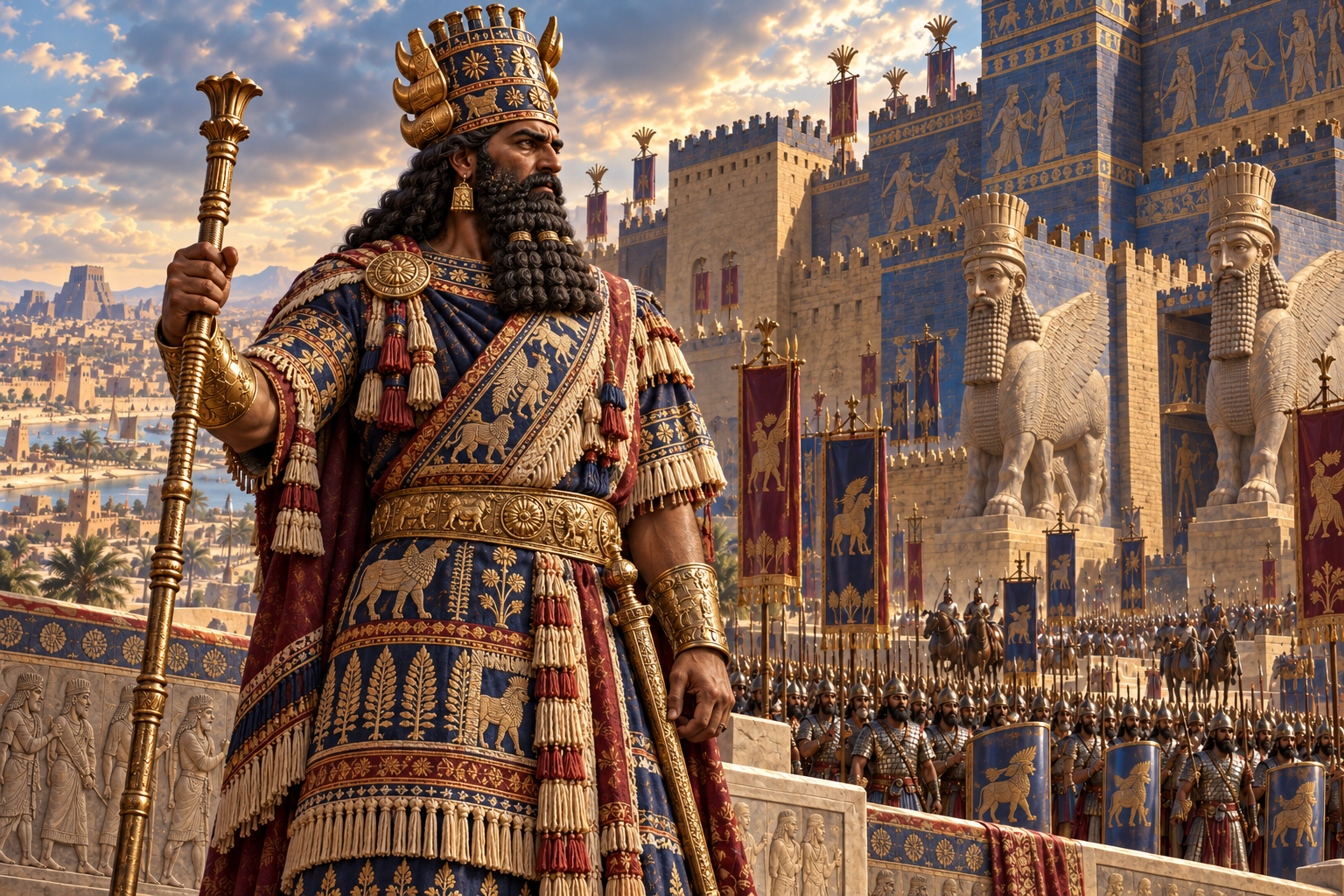
At a Glance
Pantheon: Assyrian / Mesopotamian. Divine Rank: Greater Deity. Alignment: Lawful Neutral. Titles: Lord of Assyria; King of the Gods of Assyria; Guardian of the Royal Line. Portfolio: kingship, sovereignty, war, civic order, oaths, imperial authority, protection of Assyria. Symbol: the royal standard of Aššur; campaign art should avoid treating any single winged-disc figure as a securely identified portrait of the god. Sacred Animal: eagle. Favoured Weapon: mace or bow. Worshippers: rulers, officers, soldiers, judges, governors, scribes of royal decrees and communities preserving Assyrian identity. Great Cult Centre: Aššur/Assur. Divine Realm: The High City of the Royal Standard, within the Divine Cities of the Two Rivers.
Aššur is the divine embodiment of Assyria: god, city and royal authority bound so tightly together that the same name can signify all three. He is not merely a war god. He is the sacred claim that a city, its ruler and its ordered people may stand as one power beneath the judgement of heaven.
Game Mechanics
5.5e / 2024 — Direct Divine Manifestation
Large Celestial (Greater Deity), Lawful Neutral. AC 29; HP 990; Speed 40 ft., fly 90 ft. (hover); CR 38 (epic campaign extrapolation); PB +11. STR 36, DEX 24, CON 36, INT 30, WIS 32, CHA 36. Saving Throws Str +24, Dex +18, Con +24, Int +21, Wis +22, Cha +24. Damage Resistances acid, cold, fire, lightning, thunder; Damage Immunities poison, psychic, radiant. Condition Immunities charmed, exhaustion, frightened, paralyzed, poisoned, stunned. Truesight 240 ft.; telepathy 1 mile.
Greater Divine Nature. Aššur requires no air, food, drink or sleep and cannot be transformed against his will. Legendary Resistance (5/Day). Magic Resistance. Sovereign of the City: while Aššur stands within a settlement, fortress or divine estate that recognises his authority, allies of his choice within 120 feet gain +2 AC and Advantage on saves against fear; hostile creatures cannot benefit from being hidden from him by crowds, walls thinner than 1 foot, or ordinary darkness. Royal Mandate: once per round when an ally within 120 feet fails a d20 Test, Aššur may allow it to reroll.
Actions: Multiattack — three attacks with Royal Mace or Arrow of the King. Royal Mace: +23 to hit, reach 15 ft., 4d10+12 force plus 6d8 radiant. Arrow of the King: +21 to hit, range 300/900 ft., 4d12+10 piercing plus 6d8 radiant. Edict of Victory (Recharge 5–6): chosen allies within 120 feet may use their Reactions to move up to half their Speed and make one weapon attack; chosen enemies make DC 31 Wisdom saves or lose their Reactions and have Disadvantage on their next attack before the end of their next turn. Break the Siege (Recharge 6): structures, siege engines and conjured barriers in a 40-foot cube within 240 feet take 100 force damage; creatures in the area make DC 31 Dexterity saves, taking 55 force damage on a failure, half on success.
Legendary Actions (5/round): Advance the Standard — move up to half Speed without provoking Opportunity Attacks; Royal Strike — one weapon attack; Issue Command (2) — one ally moves up to its Speed or takes the Help action; Shield the Host (2) — one ally within 120 feet gains resistance to all damage until the start of Aššur’s next turn; Judgement of the Throne (3) — one creature makes a DC 31 Charisma save or becomes Frightened until the end of its next turn and cannot knowingly speak a lie during that time.
5.5e cleric themes: Order, War and Knowledge are suitable published thematic fits. Campaign Sovereignty Domain spells: command, shield of faith; zone of truth, spiritual weapon; beacon of hope, crusader’s mantle; compulsion, guardian of faith; geas, wall of force.
Pathfinder 1e — Campaign Adaptation
CR 38 / MR 10; Large outsider (divine, lawful); AC 60; hp 900; Fort +39, Ref +32, Will +40; DR 20/epic; SR 49. Speed 40 ft., fly 90 ft. (perfect). Signature abilities: Royal Mandate (Su), allowing one ally per round within 120 feet to reroll a failed attack, save or skill check; Assyrian Standard (Su), a 60-foot aura granting allies +4 morale to saves against fear and +2 sacred AC; Edict of Victory (Su), 3/day granting allies an immediate move or attack; Break the Siege (Su), 1/day functioning as disintegrate against fortifications and force effects in an area. Domains: Law, Nobility, Protection, War, Glory. Favoured weapon: heavy mace or composite bow.
D&D 3.5e — Campaign Adaptation
Greater Deity; Divine Rank 17; Outsider 20 / Fighter 20 / Cleric 20; Lawful Neutral. Suggested CR 55 (epic encounter estimate). DR 30/epic; SR 69; divine aura 17 miles. Salient divine abilities: Alter Reality, Avatar, Battlesense, Divine Battle Mastery, Divine Shield, Divine Weapon Focus, Divine Weapon Mastery, Mass Divine Blast, Power of Truth, Wound Enemy. Domains: Law, Nobility, Protection, War, Glory. Favoured weapon: heavy mace. His most important mechanical identity is command and civic defence, not raw damage.
What Is Aššur Doing Right Now?
Aššur is rebuilding influence through memory rather than empire. Old Assyrian seals, royal inscriptions, military standards and temple foundations are beginning to answer prayers again. He does not need Assyria restored exactly as it was; he needs mortals willing to believe that order, oath and city can still be sacred things.
His agents seek archives before treasure. A fragment of a royal annal may matter more than a chest of gold if it proves which ruler once swore which oath before the god. A governor who invokes Aššur falsely may find every seal on his orders cracking. A commander who protects civilians under a sworn standard may discover that frightened soldiers suddenly stand their ground.
Appearance & Manner
Aššur appears as a mature bearded king in layered Assyrian robes and a horned divine crown. He is formal, economical with praise and impossible to hurry. He does not roar commands merely to sound powerful. When he speaks, everyone present understands exactly who has been ordered to do what.
Origins & Mythic Development
Aššur is unusually difficult to separate from place. The city of Assur and the god Aššur share the same name, and Assyrian identity increasingly made the deity the sacred embodiment of the land and its royal order. Later theology could identify him with or grant him traits associated with older high gods, but those developments should be treated as historical syncretism rather than a list of interchangeable aliases.
Divine Relationships
Ninlil/Mullissu becomes especially important beside Aššur in later Assyrian theology. Enlil is both predecessor and theological comparison: titles and roles associated with Enlil could be transferred into Aššur’s expanding supremacy. Ishtar remains an immensely powerful Assyrian deity in her own right rather than a subordinate decorative consort. Zababa and Ninurta provide martial parallels but remain distinct gods.
Worship & Priesthood
Aššur’s temples value records, lawful appointment, public oath and service to the city. Priests often work beside scribes, judges and officers. A campaign cult need not be expansionist: exiles may worship Aššur as the god who remembers a lost homeland, while frontier settlements may call upon him to keep walls, laws and chains of command from collapsing.
Omens, Favour & Displeasure
Favour appears as an unbroken seal after disaster, an eagle circling a city standard, soldiers finding their formation without shouted orders, or a disputed inscription becoming suddenly legible. Aššur dislikes false claims of authority, cowardice hidden behind rank, forged decrees, commanders who waste the lives entrusted to them and rulers who demand oaths they refuse to keep.
Encounters & Adventure Use
The Broken Standard: a royal Assyrian standard recovered from a ruin causes every soldier who sleeps near it to dream the same command. The Two Kings: rival rulers produce authentic-looking tablets claiming the same ancient divine title. The Silent Gate: a ruined city gate cannot be crossed by anyone who has broken an oath of office.
Divine Realm
The High City of the Royal Standard is a celestial Assur of immense terraces, archives, arsenals and audience courts. Its walls are not endless because Aššur fears invasion; they are perfect because every gate, watchtower and storehouse expresses ordered responsibility. No official may enter the central court without carrying a record of the lives affected by their decisions.
Relics & Sacred Magic
The Standard That Does Not Fall is an artifact-sized campaign relic that anchors morale and makes magical fear nearly impossible within its shadow, but turns inert if carried by a commander who knowingly abandons sworn dependants. Lesser relics include seal cylinders that expose forged orders, royal bows that refuse to shoot fleeing noncombatants and tablets that record the exact wording of an oath spoken over them.
Historical & Mythological Context
Historically, Aššur was the supreme national god of Assyria and was deeply bound to the city of Assur, royal ideology and the identity of the Assyrian state. His theology changed over time, including identification with other high gods and cosmological roles. The divine realm, game statistics, relics, present activity and adventure hooks above are campaign developments.
Sources & Licensing
ORACC — Aššur, divine embodiment of Assyria: https://oracc.museum.upenn.edu/nimrud/ancientkalhu/thepeople/ashur/index.html . ORACC Royal Inscriptions corpora for Aššur divine-name attestations. Game mechanics and campaign material are original adaptation.
Keep this reference growing
If this page helped with your reading or game, you can support its upkeep or explore the curated books.
Explore the Bookshop — epics, classics and stories behind imagined worlds.