
MAGICAL BEAST
Rat King
Mythic Beast for Fantasy RPGs
More than a swarm. A single, terrible will.
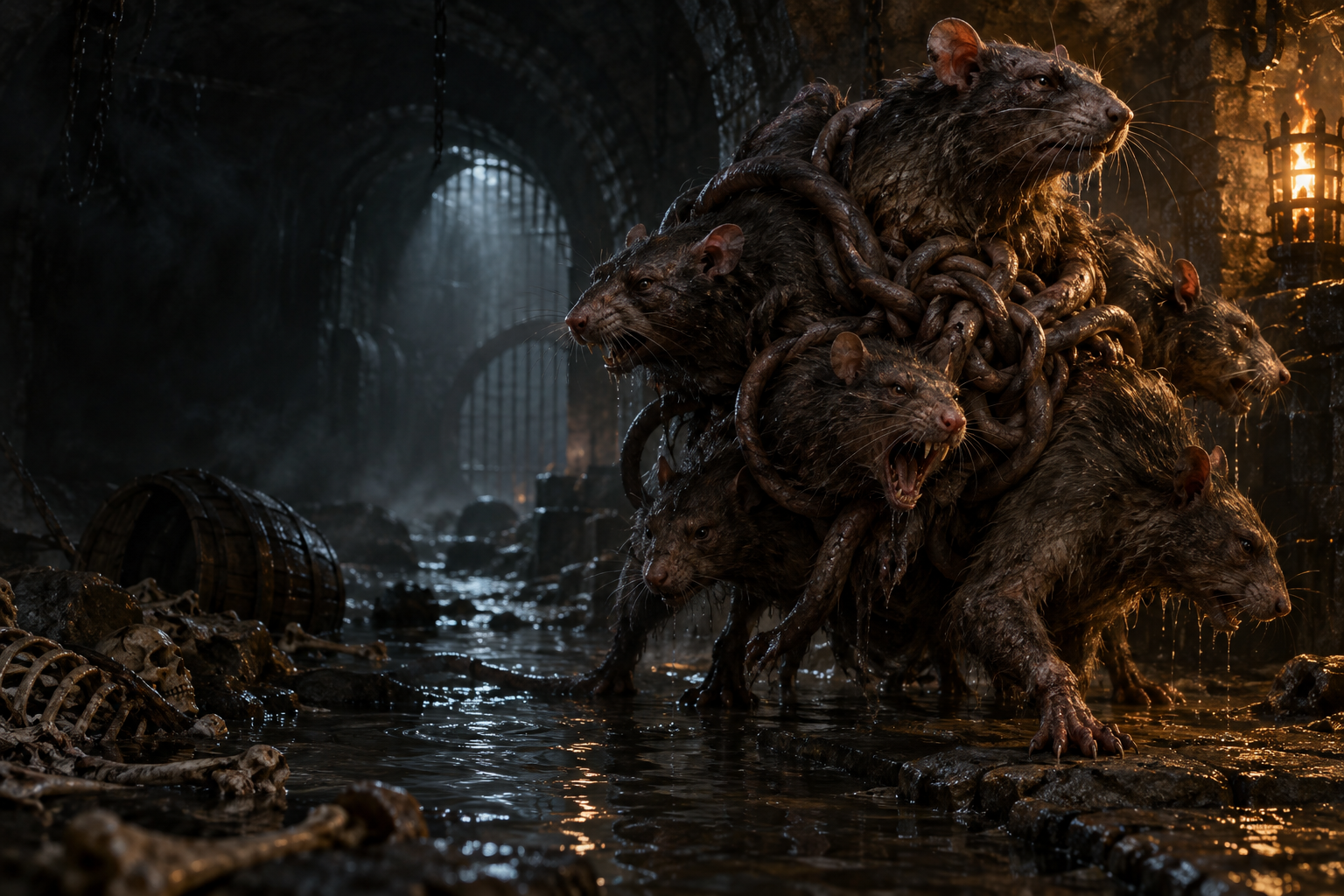
A rat king is a living knot of rats whose bodies remain separate but whose minds have fused into one cunning, plague-bearing predator. It hunts in sewers, cellars and buried passages, squeezes through spaces larger creatures cannot follow, communicates with ordinary rats and turns every nearby vermin nest into a more dangerous reservoir of disease.
At a Glance
Game Statistics
Each panel is a complete version of the creature for that ruleset. The Pathfinder 1e statistics preserve the published Bestiary 4 monster; the D&D 5.5e/2024, D&D 5e/2014 and D&D 3.5e panels are conversions built around the same defining creature.
Rat King — D&D 5.5e / 2024
Small Monstrosity, Neutral
AC 16 Initiative +4 (14) HP 105 (14d6 + 56) Speed 30 ft., Climb 20 ft., Swim 20 ft.
| STR | DEX | CON | INT | WIS | CHA |
|---|---|---|---|---|---|
| 12 (+1) | 19 (+4) | 18 (+4) | 5 (−3) | 14 (+2) | 11 (+0) |
Saving Throws Dex +7, Con +7, Wis +5
Skills Perception +5, Stealth +7
Condition Immunities Prone
Senses Darkvision 60 ft.; Passive Perception 15
Languages —
CR 5 (1,800 XP; PB +3)
Traits
Collective Anatomy. A critical hit against the Rat King becomes a normal hit. The Rat King has Advantage on saving throws against effects that would give it the Charmed, Paralyzed, or Stunned condition.
Compression. The Rat King can move through an opening at least 1 foot wide without squeezing and can squeeze through an opening at least 6 inches wide.
Plaguebringer. The saving throw DC of a disease transmitted by the Rat King or by a rat, giant rat, or rat swarm within 100 feet of it increases by 2. The DC of the Rat King’s Bubonic Plague below already includes this bonus.
Speak with Rats. The Rat King can communicate simple and complex ideas to Beasts that are rats. A creature using Speak With Animals to communicate with rats can also communicate with the Rat King even though it is a Monstrosity.
Actions
Multiattack. The Rat King makes five Bite attacks. It can direct the attacks against one target or several targets in reach.
Bite. Melee Attack Roll: +7, reach 5 ft. Hit: 7 (1d6 + 4) Piercing damage, and the target is exposed to Bubonic Plague. A creature makes no more than one saving throw against this disease per turn, regardless of how many Bite attacks hit it.
Bubonic Plague (Disease)
A Humanoid or Beast exposed to the Rat King’s plague must succeed on a DC 17 Constitution saving throw or become infected. The disease is dormant for 1d3 days. Once symptoms begin, the infected creature makes a DC 17 Constitution saving throw after each Long Rest. On a failed save, it gains 1 Exhaustion level and cannot reduce Exhaustion while the disease persists. On a successful save, it gains no Exhaustion. Two consecutive successful saves end the disease. Greater Restoration or other magic that explicitly ends disease also ends the infection.
Running the 5.5e Rat King
The Rat King reaches its intended threat when it can use narrow routes and rat allies. Its five attacks make it dangerous to an isolated target, but Plaguebringer is the ability that changes the encounter: add any supporting rats or rat swarms to the encounter budget separately rather than treating them as free parts of the Rat King’s CR.
Rat King — D&D 5e / 2014
Small monstrosity, neutral
Armor Class 16 (natural armor)
Hit Points 105 (14d6 + 56)
Speed 30 ft., climb 20 ft., swim 20 ft.
| STR | DEX | CON | INT | WIS | CHA |
|---|---|---|---|---|---|
| 12 (+1) | 19 (+4) | 18 (+4) | 5 (−3) | 14 (+2) | 11 (+0) |
Saving Throws Dex +7, Con +7, Wis +5
Skills Perception +5, Stealth +7
Condition Immunities prone
Senses darkvision 60 ft., passive Perception 15
Languages —
Challenge 5 (1,800 XP)
Traits
Collective Anatomy. A critical hit against the Rat King becomes a normal hit. The Rat King has advantage on saving throws against being charmed, paralyzed, or stunned.
Compression. The Rat King can move through a space as narrow as 1 foot wide without squeezing, and through a space as narrow as 6 inches while squeezing.
Plaguebringer. The saving throw DC of a disease transmitted by the Rat King or by a rat, giant rat, or swarm of rats within 100 feet of it increases by 2. The DC of the Rat King’s Bubonic Plague already includes this increase.
Speak with Rats. The Rat King can communicate with rats, giant rats, and swarms of rats. A creature using speak with animals to communicate with rats can also communicate with the Rat King.
Actions
Multiattack. The Rat King makes five bite attacks.
Bite. Melee Weapon Attack: +7 to hit, reach 5 ft., one target. Hit: 7 (1d6 + 4) piercing damage, and the target is exposed to Bubonic Plague. A creature makes no more than one saving throw against the disease on a turn, regardless of how many bite attacks hit it.
Bubonic Plague
A humanoid or beast exposed to the disease must succeed on a DC 17 Constitution saving throw or become infected. The disease has an incubation period of 1d3 days. Once symptoms appear, the infected creature makes a DC 17 Constitution saving throw at the end of each long rest. On a failed save, it gains one level of exhaustion. On a successful save, it gains no exhaustion. Two consecutive successful saves cure the disease. Lesser restoration or other magic that cures disease also ends the infection.
Running the 5e Rat King
In 2014 rules, the Rat King is a CR 5 skirmishing controller. Use its climb, swim, Compression and rat allies to keep it moving rather than leaving it in an open melee. Supporting rat swarms are separate creatures and should be included separately when judging encounter difficulty.
Rat King — Pathfinder 1e
CR 5 XP 1,600
N Small magical beast
Defense
AC 18, touch 16, flat-footed 13 (+4 Dex, +1 dodge, +2 natural, +1 size)
hp 57 (6d10+24)
Fort +9, Ref +9, Will +4
Defensive Abilities critical hits, flanking, effects that target a specific number of creatures
Offense
Speed 30 ft., climb 15 ft., swim 15 ft.
Melee 5 bites +11 (1d4+1 plus disease)
Special Attacks disease, plaguebringer
Statistics
Str 12, Dex 19, Con 18, Int 5, Wis 14, Cha 11
Base Atk +6; CMB +6; CMD 21 (can’t be tripped)
Feats Dodge, Skill Focus (Perception), Weapon Finesse
Skills Climb +9, Diplomacy +0 (+4 when influencing rats), Knowledge (local) −2, Perception +11, Stealth +13, Swim +9; Racial Modifiers +4 Diplomacy when influencing rats
SQ compression, speak with rats
Ecology
Environment any urban or underground
Organization solitary, pack (2–4), or infestation (5–12)
Treasure standard
Special Abilities
Disease (Ex) — Bubonic Plague. Inhaled or bite—injury; save Fort DC 19; onset 1d3 days; frequency 1/day; effect 1d4 Str damage, 1 Cha damage, and fatigue; cure 2 consecutive saves. The save DC is Constitution-based and includes the +2 from the Rat King’s Plaguebringer ability.
Plaguebringer (Ex). A Rat King increases the disease DC of rats, including rat kings, rat swarms, and dire rats, within 100 feet by +2.
Speak with Rats (Ex). A Rat King can communicate with normal rats, including rat swarms and dire rats, as if using Speak With Animals. It can use Diplomacy to alter a rat’s attitude and gains a +4 racial bonus on that check. Any ability that permits communication with rats can also communicate with a Rat King.
Compression (Ex). The Rat King can move through an area as small as one-quarter its space without squeezing, or one-eighth its space when squeezing.
Rat King — D&D 3.5e
Small Magical Beast
Hit Dice: 6d10+24 (57 hp)
Initiative: +4
Speed: 30 ft. (6 squares), climb 15 ft., swim 15 ft.
Armor Class: 18 (+1 size, +4 Dex, +2 natural, +1 dodge), touch 16, flat-footed 13
Base Attack/Grapple: +6/+3
Attack: Bite +11 melee (1d4+1 plus disease)
Full Attack: 5 bites +11 melee (1d4+1 plus disease)
Space/Reach: 5 ft./5 ft.
Special Attacks: Disease, plaguebringer
Special Qualities: Collective anatomy, compression, darkvision 60 ft., low-light vision, speak with rats
Saves: Fort +9, Ref +9, Will +4
Abilities: Str 12, Dex 19, Con 18, Int 5, Wis 14, Cha 11
Skills: Climb +9, Diplomacy +4 when influencing rats, Hide +13, Listen +4, Move Silently +8, Spot +11, Swim +9
Feats: Dodge, Skill Focus (Spot), Weapon Finesse
Environment: Any urban or underground
Organization: Solitary, pack (2–4), or infestation (5–12)
Challenge Rating: 5
Treasure: Standard
Alignment: Usually neutral
Advancement: 7–12 HD (Small); 13–18 HD (Medium)
Level Adjustment: —
Collective Anatomy (Ex)
A Rat King is not subject to critical hits or flanking and cannot be tripped. An effect that can affect only a fixed number of individual creatures does not affect the Rat King unless it can affect all of the component rats at once.
Compression (Ex)
The Rat King can move through an area as small as one-quarter its space without squeezing, or one-eighth its space while squeezing.
Disease (Ex) — Bubonic Plague
Bite; Fortitude DC 19; incubation period 1d3 days; damage 1d4 Str and 1 Cha plus fatigue. Two consecutive successful Fortitude saves end the disease. The save DC includes the Rat King’s Plaguebringer bonus.
Plaguebringer (Ex)
The disease save DC of rats, rat swarms and dire rats within 100 feet of the Rat King increases by +2.
Speak with Rats (Ex)
The Rat King can communicate with ordinary rats, rat swarms and dire rats as though using speak with animals. It gains a +4 racial bonus on Diplomacy checks made to influence rats. Any ability that permits communication with rats can also communicate with the Rat King.
Run the Rat King Tonight
Start with the terrain. Give the Rat King drains, wall cavities, flooded channels, collapsed masonry or refuse piles it can cross more easily than the adventurers. Its Compression ability should matter before initiative is rolled.
Put rats in the scene. A lone Rat King can fight, but Plaguebringer exists to make a larger rat problem worse. One or two rat swarms create pressure without hiding what the encounter is about.
Make disease a consequence, not bookkeeping clutter. The immediate fight should remain readable. Record who was exposed, then let symptoms and cure attempts matter after the combat.
Give it an escape route. If badly hurt, a Rat King does not stand in the centre of a room waiting to die. It squeezes into a crack, dives into foul water or retreats toward more rats.
Tactics
A Rat King prefers to attack a separated or hindered enemy while its rat allies clog movement and threaten several squares at once. It uses climb and swim routes that armoured pursuers dislike, repeatedly disappearing behind grates, rubble or timber before striking again. If the party destroys its supporting rats quickly, the Rat King becomes far less effective and is likely to retreat rather than continue a fair fight.
Against a heavily protected front line, it shifts to exposed spellcasters, scouts or injured characters. It has enough intelligence to recognise doors, light sources, fire, obvious healing magic and repeated tactics. It is not a military genius, but it is considerably more calculating than an ordinary animal.
Weaknesses and Counterplay
Open the battlefield. A Rat King loses much of its advantage when the party can see every approach and deny it cracks, drains and flooded escape routes. Force it into open ground before committing to melee.
Kill or disperse the supporting rats. Plaguebringer is most dangerous when ordinary rats and rat swarms remain in the fight. Area attacks, smoke, barriers and movement control can strip away the creatures that turn the Rat King from a single predator into an infestation.
Block the exits. Once bloodied, a Rat King is likely to retreat rather than fight fairly. Grates, boards, magical barriers and readied attacks can turn its usual escape route into a trap.
Treat exposure after the fight. Disease is part of the monster’s threat even when everyone survives combat. Record who was bitten, identify the infection quickly and use the appropriate medicine or curative magic before the delayed symptoms become the next problem.
Behaviour
The creature behaves like a colony with a single appetite. The individual rats still bite, scramble and recoil, but they do so as parts of one mind. Hunger, shelter and protection of the local rat population dominate its decisions. It stalks prey when food is scarce, drives competitors away from productive warrens and treats large concentrations of ordinary rats as both community and defensive screen.
A Rat King is capable of communication when magic or rat-empathy bridges the language gap. That does not make it friendly. It can bargain over food, safe passage, territory or threats to its warren, and it remembers creatures that betray an agreement. Clever characters can sometimes solve a Rat King problem by understanding what the creature wants rather than simply entering the sewer with torches.
Habitat and Ecology
Rat Kings thrive where rats already have food, darkness, moisture and hiding places: sewers, granaries, abandoned cellars, crypts, wharves, midden pits, collapsed foundations and the spaces beneath crowded buildings. Their fused shape is clumsy in open country but ideal for the hidden routes beneath a settlement.
Two explanations compete among natural philosophers and monster hunters. One holds that ordinary rats nesting too tightly become hopelessly entangled by tails, filth and nesting matter; prolonged survival in that state eventually produces a fused consciousness. The other holds that the physical knot is only the beginning and that magic, alchemy or deliberate experimentation is required before the animals become one creature. Both explanations fit observed Rat Kings, and neither accounts for every case.
Most subterranean creatures avoid established Rat Kings because of disease. Those willing to accept the risk sometimes keep one near a lair as a living alarm, plague reservoir or guardian for a larger rat colony.
Rat Kings in 1454
In a crowded town, the sight of a Rat King is enough to turn fear of vermin into fear of catastrophe. A cellar door is nailed shut, neighbours refuse to draw water from the nearest well, grain stores are inspected, and streets around the suspected warren can be closed while householders argue over who must pay for the cleansing. The creature does not need to understand human panic to exploit it.
Rat Kings are especially dangerous in ports, river towns and fortified cities where food stores, refuse, drains and dense housing keep rat populations high. Their tunnels can cross property lines, walls and defensive works unnoticed. A single warren may therefore connect a merchant’s cellar, a monastery drain, a riverside warehouse and a forgotten foundation beneath the street.
For adventurers, the most important clue is coordinated rat behaviour. Ordinary rats do not normally scout a doorway, retreat in formation and return with reinforcements. When they do, something beneath the district is thinking through them.
Signs of a Rat King
They withdraw toward the same drain, crack or cellar and return in organised waves.
A broad dragging pattern appears among ordinary paw prints where several bodies moved as one.
Grain, meat and refuse are repeatedly dragged toward a route too small for a dog or person.
Rat bites that should be isolated accidents begin producing a much more dangerous cluster of sickness.
Motivations and Reactions
| Situation | Likely reaction |
|---|---|
| Food is plentiful | Defends the warren and avoids unnecessary open combat. |
| Its rats are being exterminated | Ambushes isolated hunters, attacks stores and moves the colony through hidden routes. |
| A stronger monster occupies its territory | Tests the intruder indirectly with rats before risking itself. |
| Someone communicates with rats | Listens, bargains if useful and expects concrete payment or safety. |
| Badly wounded | Retreats through the smallest available route and abandons treasure rather than die. |
Encounter Scaling
Solitary. Use one Rat King when the cramped environment and disease are the main complications. This is the cleanest introduction to the monster.
Pack (2–4). Multiple Rat Kings create overlapping Plaguebringer auras only if the ruleset allows the same named effect to stack; otherwise treat the aura as one stronger environmental pressure rather than multiplying the numerical bonus. Their real advantage is multiple escape routes and five-bite full attacks coming from different angles.
Infestation (5–12). This is not a routine corridor fight. Treat it as a district-scale problem, nest-clearing operation or major underground set piece with separate groups, terrain objectives and opportunities to break the colony apart.
Adventure Hooks
| The Quarantine Bell | A riverside lane is sealed after three families fall sick. The authorities blame imported cargo, but every infected house shares the same buried drain. |
|---|---|
| The Warren’s Bargain | A druid speaking with cellar rats hears the same answer from dozens of mouths: food and safe passage in exchange for the name of the person poisoning the district. |
| The Alchemist’s Knot | A captured thief carries notes describing how to force rats into living knots. One experimental Rat King escaped before the laboratory was abandoned. |
| Under the Granary | Grain disappears without broken locks. The thieves are rats, but the creature directing them is stockpiling food for an infestation below the city wall. |
| The Empty Rat Traps | Every trap in a wealthy quarter is sprung but contains no corpse. Someone is deliberately releasing the rats and teaching them which houses to avoid. |
Folklore and the 1683 Strasbourg Rat King
The monster takes its name from real European reports of groups of rats found with their tails tangled or joined together. A surviving broadside from Strasbourg, dated to about 1683, depicts six rats caught in a cellar with their tails bound into a knot.
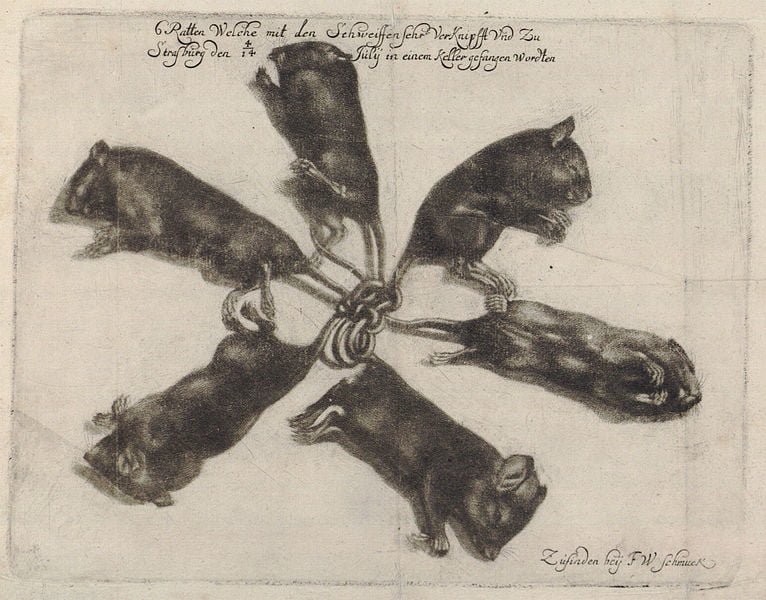
The physical phenomenon has long attracted folklore, museum specimens and arguments about how particular examples formed. The fantasy creature goes much further: its fused intelligence, supernatural coordination and Plaguebringer ability are game elements, not claims about real animal behaviour.
Treasure
A Rat King has little use for coins but may drag valuable objects into its nest because they smell of food, blood, leather, wax or people it has watched. Useful treasure includes lost keys, signet rings, broken jewellery, sealed messages, medicine packets, small holy objects and coins carried into the warren with refuse. The best finds explain where the rats have been and who has already crossed their path.
Related Entries
- Rat Swarm — the most natural supporting creature for a Rat King encounter.
- Bubonic Plague — disease reference for the Rat King’s signature infection.
- Speak With Animals — a route to negotiation and information rather than automatic combat.
- World Bestiary — browse further creatures by role, region and type.
Rat King FAQ
Is a Rat King treated as a swarm?
No. It is one creature made from several physically joined rats. Its rules give it some swarm-like defenses, but it uses a single stat block, occupies one space and can make five bite attacks.
Can Speak With Animals communicate with a Rat King?
Yes. The creature’s Speak with Rats ability specifically allows magic or abilities that communicate with rats to communicate with the Rat King, even in rulesets where its creature type would not normally qualify.
Should a Rat King fight alone?
It can, but its signature Plaguebringer ability is more interesting when ordinary rats or rat swarms are nearby. In a larger encounter, count those supporting creatures separately when judging difficulty.
Sources, Attribution and Licensing
Rules and Creature Sources
- Pathfinder Roleplaying Game Bestiary 4, p. 225 — published Pathfinder 1e Rat King.
- Pathfinder Reference Document: Rat King — online rules reference used to verify the PF1e statistics.
- System Reference Document 5.1 — rules foundation for the D&D 5e / 2014 conversion.
- System Reference Document 5.2.1 — rules foundation for the D&D 5.5e / 2024 conversion.
Historical Artwork
Rattenkönig c1683, unknown artist, c. 1683, depicting six rats found in a Strasbourg cellar. Source: Universitätsbibliothek Erlangen-Nürnberg; public-domain reproduction via Wikimedia Commons.
SRD 5.1 Attribution
This work includes material taken from the System Reference Document 5.1 (“SRD 5.1”) by Wizards of the Coast LLC. The SRD 5.1 is licensed under the Creative Commons Attribution 4.0 International License.
SRD 5.2.1 Attribution
This work includes material from the System Reference Document 5.2.1 (“SRD 5.2.1”) by Wizards of the Coast LLC, available at https://www.dndbeyond.com/srd. The SRD 5.2.1 is licensed under the Creative Commons Attribution 4.0 International License.
Open Game Content
The mechanical rules material inside the Pathfinder 1e and D&D 3.5e mechanics panels is designated Open Game Content only to the extent that it derives from material already released as Open Game Content under the Open Game License version 1.0a.
No other portion of this page is designated Open Game Content. Setting material, modern game conversion material, historical discussion, artwork, CSS, page design, adventure material and editorial presentation are excluded from that designation except where separately licensed.
Open Game License v1.0a + applicable Section 15 notices
OPEN GAME LICENSE Version 1.0a
The following text is the property of Wizards of the Coast, Inc. and is Copyright 2000 Wizards of the Coast, Inc (“Wizards”). All Rights Reserved.
1. Definitions: (a) “Contributors” means the copyright and/or trademark owners who have contributed Open Game Content; (b) “Derivative Material” means copyrighted material including derivative works and translations (including into other computer languages), potation, modification, correction, addition, extension, upgrade, improvement, compilation, abridgment or other form in which an existing work may be recast, transformed or adapted; (c) “Distribute” means to reproduce, license, rent, lease, sell, broadcast, publicly display, transmit or otherwise distribute; (d) “Open Game Content” means the game mechanic and includes the methods, procedures, processes and routines to the extent such content does not embody the Product Identity and is an enhancement over the prior art and any additional content clearly identified as Open Game Content by the Contributor, and means any work covered by this License, including translations and derivative works under copyright law, but specifically excludes Product Identity; (e) “Product Identity” means product and product line names, logos and identifying marks including trade dress; artifacts; creatures; characters; stories, storylines, plots, thematic elements, dialogue, incidents, language, artwork, symbols, designs, depictions, likenesses, formats, poses, concepts, themes and graphic, photographic or other visual or audio representations; names and descriptions of characters, spells, enchantments, personalities, teams, personas, likenesses and special abilities; places, locations, environments, creatures, equipment, magical or supernatural abilities or effects, logos, symbols, or graphic designs; and any other trademark or registered trademark clearly identified as Product Identity by the owner of the Product Identity, and which specifically excludes the Open Game Content; (f) “Trademark” means the logos, names, mark, sign, motto, designs that are used by a Contributor to identify itself or its products or the associated products contributed to the Open Game License; (g) “Use”, “Used” or “Using” means to use, Distribute, copy, edit, format, modify, translate and otherwise create Derivative Material of Open Game Content; (h) “You” or “Your” means the licensee in terms of this agreement.
2. The License: This License applies to any Open Game Content that contains a notice indicating that the Open Game Content may only be Used under and in terms of this License. You must affix such a notice to any Open Game Content that You Use. No terms may be added to or subtracted from this License except as described by the License itself. No other terms or conditions may be applied to any Open Game Content distributed using this License.
3. Offer and Acceptance: By Using the Open Game Content You indicate Your acceptance of the terms of this License.
4. Grant and Consideration: In consideration for agreeing to use this License, the Contributors grant You a perpetual, worldwide, royalty-free, non-exclusive license with the exact terms of this License to Use the Open Game Content.
5. Representation of Authority to Contribute: If You are contributing original material as Open Game Content, You represent that Your Contributions are Your original creation and/or You have sufficient rights to grant the rights conveyed by this License.
6. Notice of License Copyright: You must update the COPYRIGHT NOTICE portion of this License to include the exact text of the COPYRIGHT NOTICE of any Open Game Content You are copying, modifying or distributing, and You must add the title, the copyright date, and the copyright holder’s name to the COPYRIGHT NOTICE of any original Open Game Content you Distribute.
7. Use of Product Identity: You agree not to Use any Product Identity, including as an indication as to compatibility, except as expressly licensed in another, independent Agreement with the owner of each element of that Product Identity. You agree not to indicate compatibility or co-adaptability with any Trademark or Registered Trademark in conjunction with a work containing Open Game Content except as expressly licensed in another, independent Agreement with the owner of such Trademark or Registered Trademark. The use of any Product Identity in Open Game Content does not constitute a challenge to the ownership of that Product Identity. The owner of any Product Identity used in Open Game Content shall retain all rights, title and interest in and to that Product Identity.
8. Identification: If you distribute Open Game Content You must clearly indicate which portions of the work that you are distributing are Open Game Content.
9. Updating the License: Wizards or its designated Agents may publish updated versions of this License. You may use any authorized version of this License to copy, modify and distribute any Open Game Content originally distributed under any version of this License.
10. Copy of this License: You MUST include a copy of this License with every copy of the Open Game Content You Distribute.
11. Use of Contributor Credits: You may not market or advertise the Open Game Content using the name of any Contributor unless You have written permission from the Contributor to do so.
12. Inability to Comply: If it is impossible for You to comply with any of the terms of this License with respect to some or all of the Open Game Content due to statute, judicial order, or governmental regulation then You may not Use any Open Game Material so affected.
13. Termination: This License will terminate automatically if You fail to comply with all terms herein and fail to cure such breach within 30 days of becoming aware of the breach. All sublicenses shall survive the termination of this License.
14. Reformation: If any provision of this License is held to be unenforceable, such provision shall be reformed only to the extent necessary to make it enforceable.
15. COPYRIGHT NOTICE
Open Game License v 1.0a Copyright 2000, Wizards of the Coast, Inc.
System Reference Document Copyright 2000–2003, Wizards of the Coast, Inc.; Authors Jonathan Tweet, Monte Cook, Skip Williams, Rich Baker, Andy Collins, David Noonan, Rich Redman, Bruce R. Cordell, John D. Rateliff, Thomas Reid, James Wyatt, based on original material by E. Gary Gygax and Dave Arneson.
Pathfinder Roleplaying Game Core Rulebook © 2009, Paizo Publishing, LLC; Author: Jason Bulmahn, based on material by Jonathan Tweet, Monte Cook and Skip Williams.
Pathfinder Roleplaying Game Reference Document © 2011, Paizo Publishing, LLC.
Pathfinder Roleplaying Game Bestiary © 2009, Paizo Publishing, LLC; Author: Jason Bulmahn, based on material by Jonathan Tweet, Monte Cook and Skip Williams.
Pathfinder Roleplaying Game Bestiary 4. © 2013, Paizo Publishing, LLC; Authors: Dennis Baker, Jesse Benner, Savannah Broadway, Ross Byers, Adam Daigle, Tim Hitchcock, Tracy Hurley, James Jacobs, Matt James, Rob McCreary, Jason Nelson, Tom Phillips, Stephen Radney-MacFarland, Sean K Reynolds, F. Wesley Schneider, Tork Shaw, and Russ Taylor.
Original SpiralWorlds setting material, modern game conversion material, page structure and editorial content Copyright © 2026 SpiralWorlds. All rights reserved except material separately identified as Open Game Content or licensed under Creative Commons Attribution 4.0 International.
Keep this reference growing
If this page helped with your reading or game, you can support its upkeep or explore the curated books.
Explore the Bookshop — epics, classics and stories behind imagined worlds.