
Lotus Fruit – Magical Island Fruit
Lotus Fruit – Magical Island Fruit
A golden island fruit that feeds the body, softens the will, and makes the road home feel like someone else’s problem.
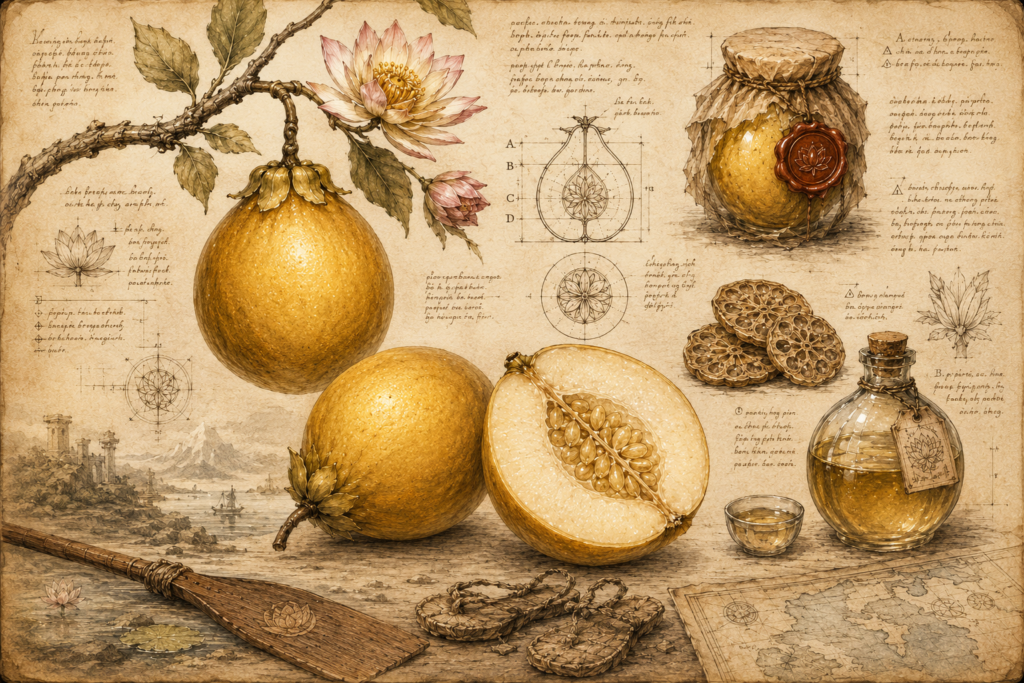
Lotus fruit grows on strange flowering trees found only on remote islands, hidden valleys, dream-haunted coasts, and places where mortal purpose weakens under warm air and sweet scent. The fruit resembles a pear, though it is rounder, smoother, and more golden, with crisp flesh and a sweetness somewhere between apple, pear, honey, and sleep.
One lotus fruit is enough to serve as a full meal. That is part of its danger. It does not look like poison. It does not taste like poison. To a starving sailor, wounded traveller, escaped prisoner, or exhausted adventurer, it feels like mercy.
The enchantment does not merely stupefy the eater. It attacks urgency. Duties become distant. Companions become irritating. Vows, quests, homes, wars, inheritances, warnings, and divine commands lose their force. The eater wants to remain where the fruit grows and eat more.
Lotus fruit works best as a story item rather than a simple trap. It asks whether the characters can rescue someone who no longer wants rescue.
Physical Description
A lotus fruit is roughly the size of a pear, with smooth golden-yellow skin that deepens toward amber as it ripens. The flesh is crisp, pale gold, and fragrant, with juice that beads like honeyed dew when cut.
The fruit keeps well while attached to its native tree, but once picked it begins to lose potency after a few days unless sealed in wax, preserved by magic, or packed in damp leaves from the same grove. Dried lotus fruit keeps some of its flavour but usually loses most of its enchantment unless prepared by an expert.
Why Lotus Fruit Matters
Lotus fruit is dangerous because it offers comfort instead of violence. It can defeat a crew without a battle, halt an expedition without a monster, or turn a loyal retainer into someone who smiles gently while the ship sails away without them.
It belongs in adventures about delay, temptation, exile, false paradise, captivity, forgetfulness, and the cost of abandoning purpose. Its best use is not as a random food trap. Its best use is as evidence that something has already gone wrong.
An abandoned ship lies ready on the shore, but no one repairs it. A missing heir sits happily beneath a flowering tree. A prophet has forgotten the warning they crossed the sea to deliver. A village survives because nobody there wants anything enough to leave.
What Makes Lotus Fruit Dangerous
Lotus fruit does not threaten characters with pain. It threatens them with comfort.
A poisoned cup says, “You may die.”
A cursed blade says, “You may be wounded.”
A lotus fruit says, “You do not need to go home.”
That is why it frightens sailors, rulers, prophets, heirs, and adventurers. It does not conquer the body first. It conquers purpose.
Lotus Fruit, 5.5e / 2024
Lotus Fruit, Pathfinder 1e / 3.5e
Lotus Fruit, 3.0e
Lotus Fruit, 5.5e / 2024
Wondrous item, uncommon, consumable
A lotus fruit is a golden, pear-like fruit from an enchanted tree that grows only in remote and difficult-to-reach places. Eating one fruit provides enough nourishment for one day.
When a creature eats a lotus fruit, it must make a DC 16 Wisdom saving throw.
On a successful save, the creature is Incapacitated until the end of its next turn as a wave of dreamy stillness passes through it.
On a failed save, the creature becomes lotus-addled for 24 hours. While lotus-addled, the creature suffers the following effects:
- Its Intelligence score is reduced by 10, to a minimum of 3.
- It cannot cast spells.
- It has no desire to leave the area where it ate the fruit.
- It wants to eat more lotus fruit whenever possible.
- It treats efforts to remove it from the area or deny it more fruit as hostile interference.
At the end of each hour, the affected creature repeats the Wisdom saving throw, ending the effect on itself on a success. Each additional lotus fruit eaten before the effect ends increases the saving throw DC by 5 for that creature.
If another creature tries to drag, force, restrain, magically compel, or physically carry the affected creature away from the lotus trees, or if it directly prevents the affected creature from eating more lotus fruit, the affected creature flies into a rage for 1 minute. During this rage, it resists removal, breaks restraints, seizes fruit, shoves aside allies, or attacks creatures preventing it from remaining.
The lotus-addled effect ends early if the creature goes 24 consecutive hours without eating another lotus fruit.
Suggested Price: 800 gp
Weight: 1/4 lb.
Lotus Fruit, Pathfinder 1e / 3.5e
Aura faint enchantment; CL —
Slot none; Price 800 gp; Weight 1/4 lb.
This naturally occurring fruit grows on strange flowering trees found only on remote islands and similarly isolated places. It resembles a pear, though it is more golden in colour and slightly rounder. Lotus fruit is crisp, sweet, and filling; a single fruit provides enough nourishment for one meal.
Upon eating a lotus fruit, a creature must succeed at a DC 16 Will save.
On a successful save, the creature is dazed for 1 round.
On a failed save, the creature takes a –10 penalty to Intelligence, cannot cast spells, and wants nothing more than to remain in the area and eat more lotus fruit. The affected creature may attempt a new Will save each hour to end the effect. Each additional lotus fruit consumed before the effect ends increases the save DC by 5.
If another creature attempts to remove the affected creature from the area or deprive it of more lotus fruit, the affected creature bursts into a berserk rage. The creature resists removal, fights restraint, and attempts to regain access to the fruit.
The penalties and compulsion end if the creature goes one full day without eating another lotus fruit.
Construction Requirements: none; lotus fruit is naturally occurring and is not usually crafted.
Lotus Fruit, 3.0e

Relics & Rituals: Olympus
© 2004 White Wolf Publishing, Inc. Distributed for Sword and Sorcery Studios by White Wolf Publishing, Inc.
By W. Jason Peck, Aaron Rosenberg, Christina Stiles and Relics & Rituals: Olympus team
This naturally occurring fruit comes from a strange flowering tree that grows only on remote islands. It resembles a pear, but with a more golden color and a slightly rounder shape. Lotus fruit is very tasty, as crisp as an apple but sweet as a pear, and very filling ‘ a single fruit is enough for one meal.
Upon eating one of these fruits, the person must make a DC 16 Will save. If he succeeds, he is dazed for one round. Failing the save means that the individual suffers a -10 penalty to Intelligence, cannot cast any spells, and wants nothing more than to stay in this location and eat more lotus fruit. The individual can make a new Will save each hour, but each additional fruit consumed increases the DC by 5.
Attempting to take the person away from this location, or to deprive him of more lotus fruit, will cause him to burst into a berserk rage. The penalties vanish if the person goes one full day without eating another lotus fruit.
Faint enchantment; CL -; none; Price 800 gp; Weight: 1/4 lb.
How Lotus Fruit Is Used
Lotus fruit is rarely bought as ordinary produce. It is gathered by desperate sailors, island cults, smugglers, dream-priests, poisoners, decadent courts, and rulers who prefer quiet captivity to visible chains.
Most lotus fruit enters play in one of three ways.
It may appear as food freely offered by the inhabitants of a lotus island. It may arrive at court as an imported luxury. Or it may be used deliberately to keep prisoners, witnesses, heirs, prophets, or sailors docile without guards.
Fresh lotus fruit is the most dangerous form because its magic is still tied to the tree, the soil, and the place where it grows. Once removed from its native grove, it becomes harder to preserve and easier to detect.
Failure, Risk, and Misuse
Lotus fruit should create pressure, not simply remove a character from play. The effect works best when it changes the situation at the table.
| Situation | Useful Consequence |
|---|---|
| A scout eats the fruit | The scout returns calm, slow, and unreliable, insisting the island is safe. |
| A spellcaster fails the save | The party loses magical support until the caster is kept away from the fruit. |
| A crew is affected | The ship cannot leave unless the party recovers, replaces, or commands the crew. |
| An NPC refuses rescue | The problem becomes moral and social rather than purely tactical. |
| A villain controls the supply | The fruit becomes a quiet prison rather than a battlefield weapon. |
| A character eats several fruits | The rising save DC turns delay into danger; every hour matters. |
The rage caused by removal should not make every affected creature a mindless murderer. The rage is defensive and possessive. A lotus-addled knight may shove companions away, draw steel, block a path, or threaten violence, but the emotional centre is simple: do not make me leave.
Characters who investigate the fruit, the grove, or the behaviour of affected creatures should usually receive clues before anyone is forced into danger. Use ordinary ability checks only when the answer is uncertain: Nature or Survival to recognise the strange fruit, Arcana or Religion to sense enchantment, Insight to realise an affected creature is not acting freely, and Medicine to understand that repeated consumption is worsening the condition.
Value in the World
Lotus fruit is valuable because it is rare, magical, nourishing, and dangerous. A court alchemist may pay handsomely for a preserved specimen. A tyrant may want a grove. A temple may order the fruit destroyed. A sailor may refuse even to speak of the island where it grows.
The listed price of 800 gp assumes a fresh, magically active fruit suitable for use as written. Fruit from the same tree after its magic has faded may still be delicious and nourishing, but it should not command the same price.
Trade, Craft, and Common Variants
Lotus fruit is not usually crafted. It is gathered, preserved, smuggled, distilled, or served. The prices below assume the preparations are genuine and magically active.
| Form | Price | Effect |
|---|---|---|
| Fresh Lotus Fruit | 800 gp | The standard full-strength fruit. It uses the normal lotus fruit rules. |
| Wax-Sealed Lotus Fruit | 1,000 gp | A preserved fruit that keeps its full effect for up to 3 months if the seal remains intact. If the wax is broken, it loses potency after 1d6 days. |
| Dried Lotus Slices | 150 gp | A weaker preparation. A creature that consumes a full serving must succeed on a DC 13 Wisdom save or become drowsy and suggestible for 1 hour. During this time, it has disadvantage on Wisdom checks made to notice danger, resist persuasion, or remember urgent duties. In Pathfinder or 3.5e, use a DC 13 Will save instead. |
| Lotus Wine | 600 gp per bottle | A bottle contains 6 servings. A creature that drinks one serving must make a DC 14 Wisdom save. On a failed save, it becomes lotus-addled for 1 hour, but its Intelligence is not reduced and it can still cast spells. It wants to remain comfortable, avoid conflict, and continue drinking. In Pathfinder or 3.5e, use a DC 14 Will save instead. |
Lotus wine works best as a feast, court, or prison plot device rather than ordinary treasure. Dried lotus slices are useful for intrigue, hospitality, and slow corruption, but they should not replace the full danger of fresh fruit from the tree.
Using Lotus Fruit in Your Game
Lotus fruit should be visible before it is dangerous. Give the players signs they can notice without needing a perfect check: people who never finish repairing boats, guards who smile at intruders, old armour rusting beside flowering trees, letters home used as food wrappers, or sailors who remember the sea only as an unpleasant rumour.
Checks can reveal stronger details: enchantment magic, a pattern of memory loss, the rising danger of repeated consumption, or the fact that the local peace depends on no one wanting to leave.
Do not use lotus fruit as an unavoidable punishment for curiosity. Its best scenes happen when the characters have a choice: eat and rest, refuse and offend the hosts, rescue someone who begs to be left alone, or burn the grove and destroy the only food source on the island.
Adventure and Worldbuilding Hooks
The Heir in the Orchard: A missing heir is found alive in a lotus grove, happy, barefoot, and unwilling to return to the inheritance that could prevent a civil war.
The Gentle Prison: A ruler keeps dangerous witnesses on an island where no chains are needed. The prisoners are fed, housed, and smiling, but none of them can bring themselves to testify.
The Fruit at Court: Wax-sealed lotus fruit appears at a feast. By morning, a treaty, marriage, military campaign, or succession agreement has collapsed because the people responsible no longer care enough to act.
Source and Literary Context
Lotus Fruit is adapted from Relics & Rituals: Olympus, published by Sword and Sorcery Studios / White Wolf Publishing in 2004. The item draws on the ancient Greek story of the Lotus-Eaters, most famously encountered by Odysseus in Book 9 of the Odyssey.
In that episode, the danger of the lotus is not death, but forgetfulness, contentment, and the loss of the desire to return home. That makes lotus fruit especially useful in fantasy roleplaying as a temptation, prison, delay, or false paradise rather than a simple poison.
For a concise reference on the Lotus-Eaters, see Encyclopaedia Britannica: Lotus-Eater. For a public-domain English text of the relevant passage from Homer’s Odyssey, see Theoi Classical Texts Library: Homer, Odyssey Book 9.
Keep this reference growing
If this page helped with your reading or game, you can support its upkeep or explore the curated books.
Explore the Bookshop — epics, classics and stories behind imagined worlds.