
Flesheater Rod Magic Item
A brown scepter crowned with a tooth-filled mouth, the Flesheater Rod releases false green imps that cannot be slain, only dispelled, as they strip the flesh from one chosen victim.
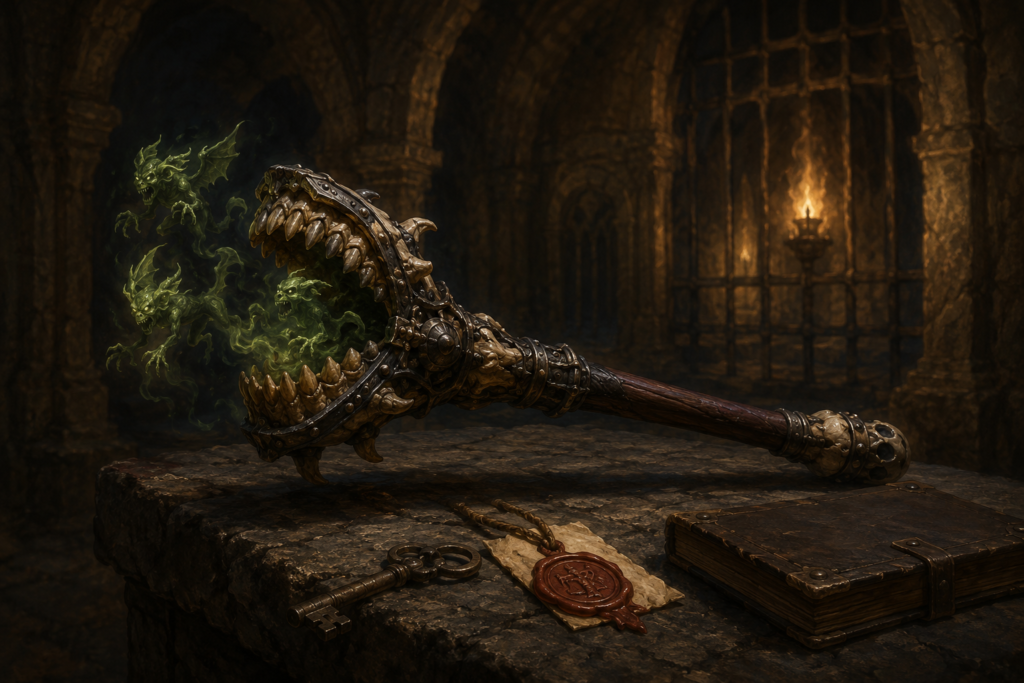
The Flesheater Rod is a vile executioner’s scepter, built for terror rather than open war. It does not summon true imps, quasits, demons, devils, or spirits. Instead, it releases a swarm-like magical effect shaped like tiny greenish fiends: winged, clawed, toothy things no larger than a child’s thumb, all moving with the frantic hunger of vermin.
When the Flesheater Rod is activated, the tooth-filled mouth at its head chatters open. Green light leaks between the teeth. Then the flesheaters pour out in a shrieking rush and descend on one chosen victim.
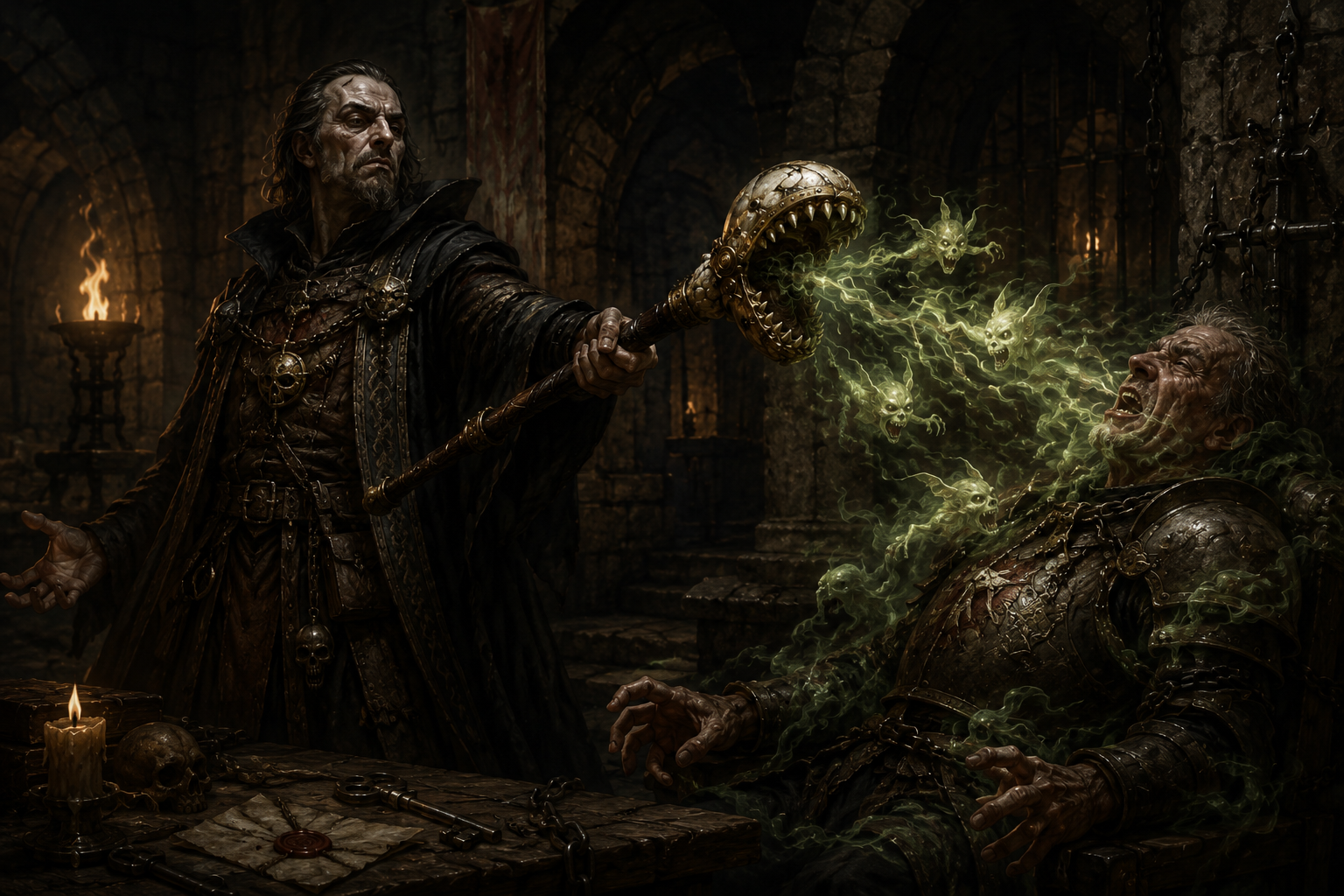
The horror of the rod is tactical as much as physical. The victim appears to be surrounded by attackers, but those attackers cannot be fought. A guard who cuts at them risks striking the victim. An archer who shoots into the swarm may hit the person trapped beneath it. A spellcaster who understands the effect must spend magic ending the curse rather than attacking the wielder.
The correct answers are dispelling, suppression, protection, healing, escape, or stopping the wielder before the rod is used. Steel is the wrong answer, and that is what makes the item memorable.
Physical Description
The rod is a brown scepter, usually between two and three feet long, heavy enough to feel like a club but balanced like a ceremonial baton. Its shaft may be dark hardwood, stained bone, lacquered horn, or a fused material that looks grown rather than carved. Fine cracks often run along the grip like old bite marks.
The head of the rod is its defining feature: a mouth-like device packed with small uneven teeth. It is not shaped exactly like a human jaw, animal muzzle, or fiendish maw, but borrows from all three. The mouth usually remains shut when the rod is dormant. When held by a rightful wielder, the lips flex slightly, as if tasting the air.
After use, the teeth may appear wet with greenish saliva, though the fluid evaporates before it can be bottled or tested. Some rods whisper after feeding. Others remain silent.
Why This Item Matters
The Flesheater Rod turns a single victim into the centre of the encounter. It forces the table to solve a problem quickly: the target is being eaten by visible magical attackers that cannot be cut down.
It belongs to tyrants, cult magistrates, battlefield punishers, infernal agents, corrupt priests, sadistic nobles, and executioners who want punishment to be witnessed. It is not a clean assassin’s tool. It leaves marks, invites investigation, and creates witnesses who remember exactly what they saw.
Used well, the rod changes the scene from “kill the enemy” to “save the person being eaten before the magic finishes its work.”
Mechanics Tabs
The rules below are mechanics tabs for different game editions.
Flesheater Rod 5.5e / 2024
Flesheater Rod, Pathfinder 1e
Flesheater Rod 3.0e
Flesheater Rod 5.5e / 2024
Rod, rare, requires attunement by a spellcaster
This brown scepter is topped with a tooth-filled mouth. While holding the rod, you can use a Magic action to choose one creature you can see within 60 feet of yourself. The rod releases a swarm of tiny greenish magical flesheaters that surround the target.
The target must make a DC 15 Constitution saving throw. On a failed save, roll 1d6 + 1 to determine the number of times the effect can deal damage. The target takes 10 (3d6) necrotic damage at the start of each of its turns until the effect has dealt damage that many times, then the effect ends. On a successful save, the target takes no damage and the effect ends immediately.
The flesheaters are magical effects, not creatures. They cannot be attacked, damaged, grappled, shoved, turned, charmed, frightened, restrained, poisoned, knocked prone, banished, or targeted as creatures. If a creature makes an attack against the flesheaters, the attack is resolved against the affected target instead, provided the target is within the attack’s reach or range.
The effect ends early if it is dispelled, if the target enters an area where magic is suppressed, or if another effect specifically ends ongoing magical necrotic damage.
Once the rod has been used, it cannot be used again until the next dawn.
Save DC: 15 Constitution
Damage: 10 (3d6) necrotic damage per damage instance
Duration: 1d6 + 1 damage instances on a failed save
Range: 60 feet
Use: Once per day
Rarity: Rare
Attunement: Required by a spellcaster
Suggested Value: 8,000 gp
Weight: 3 lb.
Notes
The flesheaters are magical effects, not monsters, swarms, conjured creatures, familiars, spirits, undead, or summoned outsiders. Do not give them AC, hit points, initiative, movement, actions, reactions, or saving throws.
Dispel Magic can end the effect. Treat the rod’s effect as a 3rd-level spell effect for this purpose.
Area effects do not harm the flesheaters. If the affected target is inside an area effect, resolve that effect against the target normally.
The flesheaters are not fiends, despite their appearance. Effects that target fiends, summoned creatures, or creatures generally do not affect them unless they also suppress or end hostile magic.
Attacking the wielder after the rod has been activated does not automatically end the effect. The default rod creates an independent magical effect once used.
Flesheater Rod, Pathfinder 1e
Aura: moderate conjuration and necromancy
CL: 5th
Slot: none
Price: 18,000 gp
Weight: 3 lb.
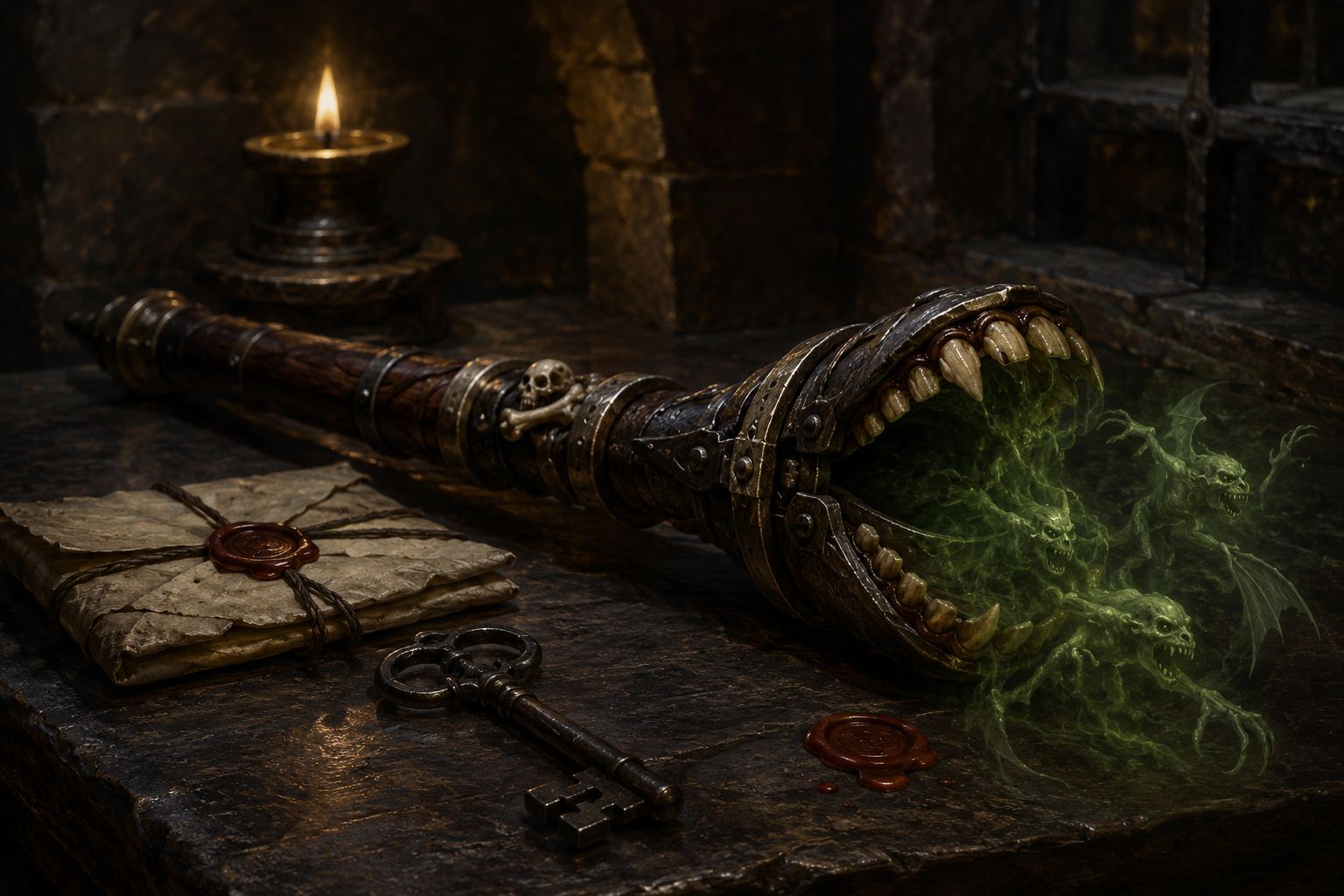
This brown scepter is topped with a device shaped like a tooth-filled mouth.
Once per day, the wielder may activate the rod as a standard action, choosing one target within close range. The rod summons horrible little creatures of greenish magical energy that resemble minuscule imps or quasits. These flesheaters tear at the target’s flesh as they swarm around it.
The flesheaters are not actual creatures, but magical effects. They can be dispelled, but not attacked. Attacks directed against them instead strike the rod’s target if the attack roll is otherwise capable of hitting that target.
The target must succeed at a DC 18 Fortitude save or take 3d6 points of damage per round for 1d6 + 1 rounds. A successful save negates the effect.
The flesheaters cannot be targeted by weapon attacks, combat maneuvers, poison, disease, mind-affecting effects, critical hits, sneak attacks, bane effects, turning effects, or spells that require a creature target. They may be ended by dispel magic, antimagic, or similar effects that suppress or remove magical effects.
Construction Requirements: Craft Rod, summon monster III
Cost: 9,000 gp
Notes
Keep the save as Fortitude. The victim’s body is resisting a flesh-rending magical assault, not dodging a swarm or disbelieving an illusion.
The flesheaters may look like imps or quasits, but they are not outsiders. Effects such as dismissal, banishment, protection from evil, or outsider-bane weapons do not destroy them unless the effect can suppress or remove the rod’s magic.
The damage begins on the wielder’s next turn after activation unless your table uses start-of-target-turn timing for ongoing damage. Use one timing consistently.
Flesheater Rod 3.0e
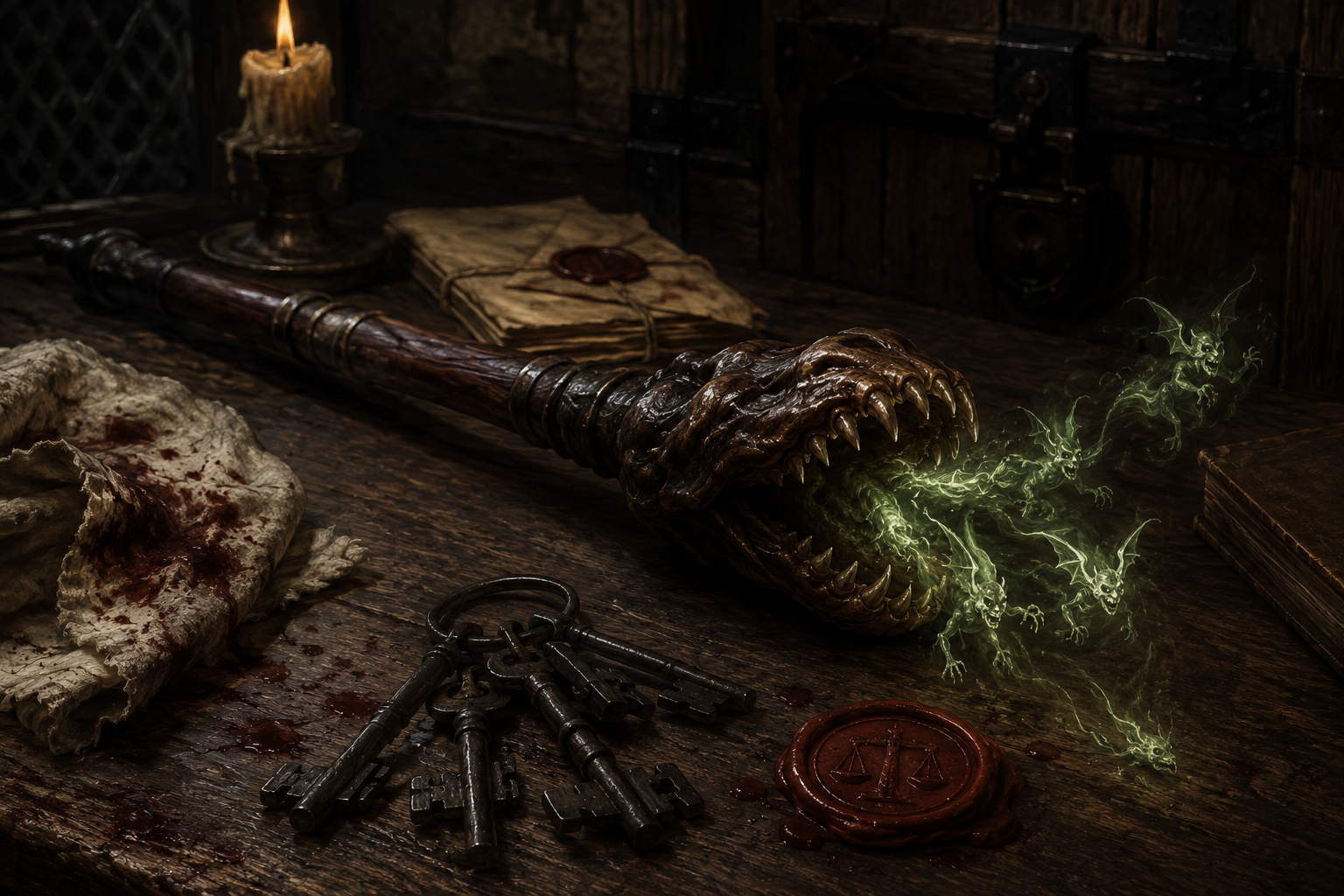
This brown scepter is topped with a device that looks like a tooth-filled mouth.
Book of Vile Darkness 3.5
By Monte Cook
Once per day, the wielder can summon horrible little creatures of greenish energy that look like minuscule imps or quasits. These creatures tear at the flesh of one target, eating it as they swarm around. The flesheaters are not actual creatures, but instead magical effects. They can be dispelled, but not attacked; attacks directed against them hit the rod’s target instead.The target must succeed at a Fortitude save (DC 18) to resist the flesheaters. If this save is failed, the target takes 3d6 points of damage per round for 1d6+1 rounds.
Caster Level: 5th; Prerequisites: Craft Rod, summon monster III; Market Price: 18,000 gp; Weight: 3 lb.
How the Rod Enters Play
The Flesheater Rod should enter a campaign with a stain already on it.
It may be found in an execution chamber, locked court evidence room, cult shrine, battlefield commander’s baggage, infernal reliquary, plague tribunal, noble torture cabinet, or assassin’s cache. It is not treasure that should feel casually abandoned. Someone made it. Someone used it. Someone probably still wants it.
The rod is strongest when the characters first encounter its effects before they possess it. Let them find a survivor covered in tiny bite wounds. Let them hear a witness describe “green devils” that could not be killed. Let them watch a villain activate the tooth-mouth in a crowded hall. The item’s rules become more interesting when the players learn its danger through play rather than from an inventory line.
Failure, Risk, and Misuse
The rod leaves wounds that suggest ritual torture, magical vermin, or fiendish punishment. A healer, inquisitor, witch-finder, necromancer, executioner, or experienced battlefield surgeon may recognise that the injury pattern is not natural.
Using the rod in public creates consequences even if the target was guilty. A noble may lose allies. A priest may invite investigation. A mercenary captain may frighten their own soldiers. An adventurer may discover that carrying the rod is enough to make courts, temples, guilds, and civic watches treat them as dangerous.
The rod should be allowed as player treasure only if the campaign can handle the consequences of owning a vile punishment device. Selling it may be difficult. Keeping it may be incriminating. Using it may change how witnesses describe the party.
Value in the World
A Flesheater Rod is valuable because it is dangerous, incriminating, and difficult to trade safely.
In a lawful city, it may be evidence of murder, torture, unlawful execution, cult practice, infernal contract, or noble abuse. In some courts, possession of the rod is itself a capital matter unless the owner is an officer of the state.
Its political value may matter more than its sale value. A ruler who keeps one can frighten a court. A rebel who steals one can expose a regime. A priest who destroys one can become famous. A villain who loses one may kill to recover it.
When the Flesheater Rod Appears
The rod belongs in stories where law, punishment, magic, and cruelty overlap.
It works especially well in:
- a late medieval court where justice has become spectacle;
- a corrupt city where prisoners disappear into sealed cells;
- a plague-haunted region where officials punish suspected corpse-thieves or disease-bearers;
- an infernal cult that stages executions as offerings;
- a noble household where servants know too much;
- a battlefield where champions are broken before armies;
- a mage’s collection of illegal rods, wands, and punishment devices.
The rod should not become routine adventuring gear. If the party keeps it, the world should notice.
Adventure and Worldbuilding Hooks
The Witness Who Survived
A merchant survives an attack by the rod and is left with hundreds of tiny wounds. The city guard calls it animal damage. A healer knows better. The merchant was due to testify against a powerful household, and now the attacker needs the witness dead before the scars are examined by someone who understands forbidden magic.
The Rod in Evidence
A Flesheater Rod is locked inside a courthouse evidence vault after a cult trial. Days later, a clerk is found half-eaten in the records chamber. The vault seal is unbroken. Either the court displayed a false rod, someone copied the key, the true owner can command the item from afar, or the court itself is lying.
The Gentle Magistrate
A magistrate famous for mercy has abolished public mutilation and reduced executions. Secretly, he uses the rod against prisoners he believes the law cannot safely release. The city is quieter than it was. The cells beneath the courthouse are not.
Historical and Mythic Context
The Flesheater Rod is best understood through the old image of the devouring mouth: a supernatural maw that consumes, punishes, and turns the body into evidence of judgement. Its tooth-filled head is not just ornament. It makes the rod feel like a handheld mouth of punishment, a small ritual object built around the same fear as larger images of monstrous jaws swallowing the condemned.
The closest historical visual parallel is the Hellmouth, a gaping monstrous mouth used in medieval European art to represent the entrance to the underworld or a place of punishment. These images often show bodies being swallowed by a beast-like maw, making judgement visible as physical consumption. For SpiralWorlds use, this should be treated as historical image-language rather than imported theology: the important idea is the devouring threshold, the mouth that turns law, curse, or damnation into bodily destruction.
A strong medieval example is the Winchester Psalter, also known as the Psalter of Henry of Blois, produced in the twelfth century. Its famous Hellmouth imagery shows the underworld as a great mouth containing human beings and devils. The British Library’s image record describes Hell as “a great mouth” with figures inside it, while the Library of Congress notes the wider tradition of jaws of hell imagery in medieval and early printed Apocalypse scenes. See: British Library: Winchester Psalter, Harrowing of Hell; Library of Congress: The Apocalypse, the Hellmouth, and Spectral Imaging.
This makes the Flesheater Rod more than a rod that deals damage. It belongs to the symbolic family of curse objects, punishment implements, execution devices, and ritual tools that turn a mouth into an instrument of authority. A ruler’s rod can represent command; an executioner’s tool can carry command into the body. The Flesheater Rod corrupts both ideas. It looks like a scepter, but its authority is hunger.
The tiny green flesheaters resemble imps or quasits, placing the item near infernal and demonic imagery, but the most important point is that they are not creatures. They are magical effects shaped like fiends. This makes the rod closer to a curse-object or punishment relic than to a summoning item. The victim appears to be attacked by little monsters, yet there are no monsters to kill.
The item itself originates in Book of Vile Darkness, a Dungeons & Dragons 3.5 sourcebook written by Monte Cook and published by Wizards of the Coast in 2002. The original version presents a brown scepter topped with a tooth-filled mouth that releases greenish, imp-like magical effects to tear at one target’s flesh. See: Book of Vile Darkness overview; BookFinder ISBN listing for Book of Vile Darkness.
In campaign terms, the Flesheater Rod belongs where punishment, fear, and forbidden magic meet: corrupt courts, execution chambers, plague tribunals, infernal shrines, private torture rooms, and sealed evidence vaults. It is not merely a damaging rod. It is a magic item built around the image of a mouth that has been given permission to eat.
Keep this reference growing
If this page helped with your reading or game, you can support its upkeep or explore the curated books.
Explore the Bookshop — epics, classics and stories behind imagined worlds.