
Blade II (2002)
A new breed of vampires threatens humans and the old vampire houses alike, forcing Blade into an alliance with fighters trained to destroy him.
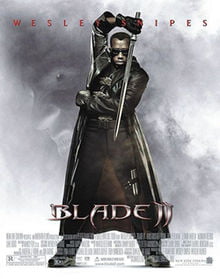
Blade II (2002), directed by Guillermo del Toro and written by David S. Goyer, brings Wesley Snipes back as the vampire-hunting Daywalker. A voracious strain known as the Reapers is spreading through the hidden vampire world, threatening to consume ordinary people and traditional vampires alike. Blade agrees to work with Nyssa (Leonor Varela) and the Bloodpack, an elite vampire combat team whose original purpose was to hunt him. The result is a creature-focused action horror film with del Toro’s fascination for monstrous anatomy, fragile alliances and people who become dangerous to the very society that created them.
Content note: An adult action-horror film containing graphic bloodshed, disturbing body transformations and frightening predatory creatures.
At a Glance
| Film | Blade II (2002) |
|---|---|
| Director | Guillermo del Toro |
| Screenplay | David S. Goyer |
| Source | The Marvel Comics Blade character, created by Marv Wolfman and Gene Colan |
| Principal cast | Wesley Snipes, Kris Kristofferson, Leonor Varela, Ron Perlman, Luke Goss, Norman Reedus and Thomas Kretschmann |
| Music | Marco Beltrami |
| Cinematography | Gabriel Beristain |
| US release | 2002 |
| Running time | Approximately 117 minutes for common theatrical editions |
| Genre | Vampire action horror; dark fantasy; comic-book sequel |
Why This Film Matters
The first Blade film introduced an apparently organised supernatural society that hid from humanity. Its sequel makes that society the victim of something even more dangerous. The Reapers are not simply stronger versions of ordinary vampires: their feeding, anatomy and spread threaten the existing balance between hunters and prey. That allows del Toro to shift the film from a revenge thriller towards creature horror without abandoning the action that defined Snipes’s character.
The uneasy partnership with the Bloodpack is equally important. Blade does not trust the vampires, and they have been trained to kill him. Yet their shared enemies and limited knowledge force cooperation. This arrangement provides tension beyond the question of who wins a particular fight.
The Story — Without Major Spoilers
Blade continues hunting vampires and searches for his old ally Abraham Whistler, whose fate has remained uncertain after the first film. He is assisted by Scud, a young specialist in weapons and electronics. When representatives of the ancient vampire leadership approach him, they reveal the emergence of Reapers: infected predators capable of feeding upon humans and other vampires.
Blade is asked to lead the Bloodpack against the growing threat. Its members include the capable Nyssa and the openly hostile Reinhardt, who resents taking orders from a Daywalker. The group tracks the creatures through clubs, underground spaces and laboratories where the new strain seems to have developed. Their discoveries raise questions about how the Reapers came to exist and whether the vampire elders have been entirely truthful.
Characters and Performances
Blade (Wesley Snipes) is still an efficient hunter, but the presence of new vampires he does not understand requires him to listen and investigate as well as fight. Snipes’s precise physical performance anchors the increasingly fantastic action. Whistler (Kris Kristofferson) restores the films’ abrasive but loyal partnership, while Scud (Norman Reedus) offers a different approach to weapons and technical support.
Nyssa (Leonor Varela) is a proud member of the vampire leadership whose sense of duty complicates any simple alliance with Blade. Reinhardt (Ron Perlman) is a combative Bloodpack fighter with reasons to resent the partnership. Nomak (Luke Goss) is a terrifying Reaper whose personal circumstances make him more than a mindless creature. Damaskinos (Thomas Kretschmann) is an influential leader of the older vampire society.
The Reapers and the Underworld
Del Toro’s Reapers are defined through unsettling physical design. Their split-jaw feeding mechanism makes ordinary human features suddenly unreliable, and their bodies behave differently from those of familiar screen vampires. Their capacity to threaten both humans and vampires raises the stakes without requiring an abstract prophecy about the end of the world.
The film’s spaces reinforce its claustrophobic horror: industrial clubs, corridors, holding rooms and laboratory interiors place characters uncomfortably close to predators they cannot fully identify. Darkness offers no automatic refuge to the traditional vampires, while combatants must reconsider weapons and tactics as they learn more about the new strain.
Behind the Camera
Guillermo del Toro directed the sequel after Stephen Norrington’s original, working from another screenplay by Goyer. Del Toro’s earlier films had explored unsettling relationships between bodies, machines and immortality, and those interests are visible in the creature design. Gabriel Beristain photographed the film, while Marco Beltrami composed its score. Donnie Yen played Bloodpack member Snowman and contributed to the action choreography.
The picture combines practical creature work, makeup, stunt choreography and digital effects. Some highly stylised computer-assisted combat is conspicuous, but the more effective scenes allow grotesque physical details and actors’ reactions to make the monsters convincing. The result is less concerned with broad superhero world-building than with the immediate problem of surviving a predatory outbreak.
The Comics and the Film Series
Blade remains a Marvel Comics creation, but the movie’s Reaper strain and Bloodpack plot belong to this particular screen story. The film develops continuity from Blade (1998) while allowing del Toro’s visual sensibility to transform its vampires. It should not be presented as a faithful filmed version of a specific Tomb of Dracula comic issue.
The series continues in Blade: Trinity (2004), which shifts again to a different director and new allies. For the comic character rather than the screen version, see the separate Blade comics profile.
Themes and Critical Assessment
Distrust, biological vulnerability and unintended consequences define the story. The Reapers threaten an established hierarchy, but the danger is entangled with questions about that hierarchy’s own decisions. Blade has good reasons to distrust the vampire leadership, yet the immediate threat demands that he assess evidence and the interests of specific individuals.
What works: the Reapers’ memorable design, del Toro’s dark atmosphere, Ron Perlman and Luke Goss’s performances, the Bloodpack’s strained alliance and sharply staged combat. What works less well: some disposable supporting fighters, exposition about the strain’s origins and a few digital action scenes that feel weightless. The sequel is particularly strong as an imaginative monster film.
Related Films and SpiralWorlds
The film occupies the middle chapter of the Blade trilogy. The site’s Undead Bestiary includes independently developed vampire creatures, but those are not licensed Reapers and need not share their feeding or disease mechanics. For a different horror-action transformation, compare Spawn (1997).
Ideas for the Table
Enemies forced together: two factions agree to cooperate against a spreading threat, but some members were specifically trained to kill the new allies. The players decide what precautions, disclosure and shared objectives make cooperation possible.
The changed predator: a new type of hunter threatens a creature population that once preyed on surrounding communities. The party can investigate origins, protect civilians and decide how much assistance to give a former enemy.
The dangerous laboratory: evidence of supernatural experimentation is scattered across different groups. Witnesses can reveal what happened, but the investigators must avoid repeating the experiment’s worst mistakes.
Sources and Credits
- American Film Institute — Blade II (2002) (director, writer and film credits).
- British Film Institute — Blade II (film record).
- Rotten Tomatoes — Cast and crew (roles and production).
- BFI Southbank — Blade II programme notes (historical production context).
Blade, the film’s creatures and promotional artwork remain the property of their respective rights holders. This independent review includes original roleplaying material.
Keep this reference growing
If this page helped with your reading or game, you can support its upkeep or explore the curated books.
Explore the Bookshop — epics, classics and stories behind imagined worlds.