
SpiralWorlds Timeline · Cosmic History
Raw Power and Hidden Cracks Eons IX–XII
Magic becomes a universal medium. Elemental power gathers into the Inner Planes, intelligent elemental beings emerge, two great mirror realms unfold, and the Weeping Wound gives ordered creation its first access to the Far Realm.
01 · Overview
From Ordered Reality to Transformative Power
Raw Power and Hidden Cracks covers the four eons in which the structured cosmos becomes magically responsive, develops its great elemental and reflective realms, and encounters an existence beyond the limits described by the Codices.
Foundations of Order ends with matter operating beneath dependable physical and metaphysical law. Stars and galaxies burn within material space. The Astral Plane , the Positive and Negative Energy Planes and the Outer Planes already possess independent reality, while the Elder Gods remain active within ordered creation.
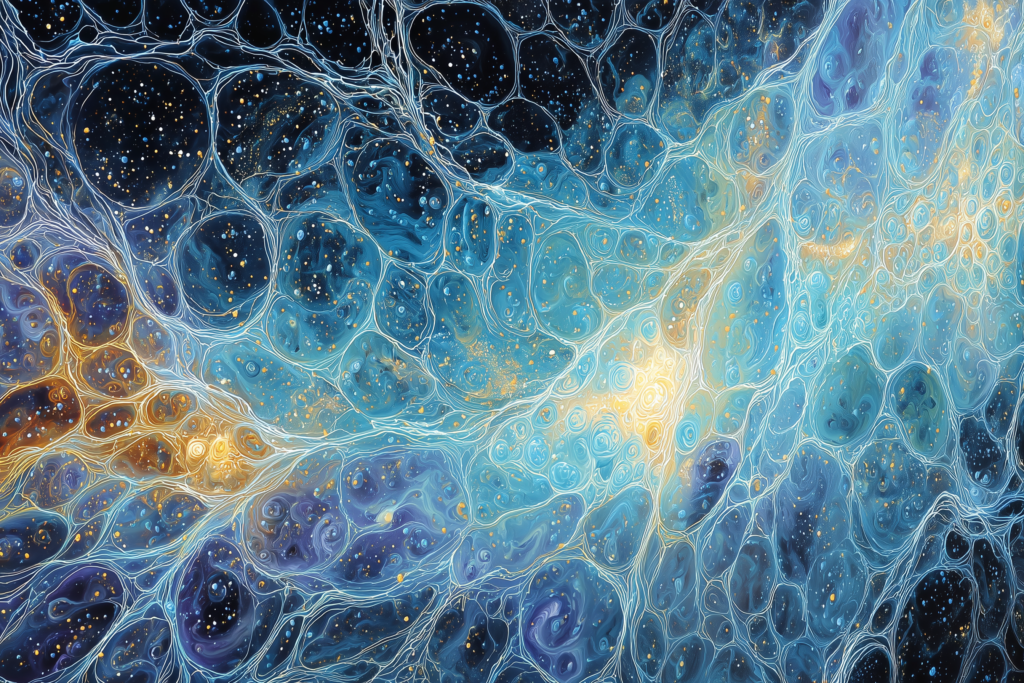
Eon IX joins magical relationship, intention and symbol through the Living Weave.
Eon X gathers elemental properties into the Planes of Air, Earth, Fire and Water. Elemental patterns develop memory and intention, discrete elementals acquire persistent identity, and the immense powers Flame, Tide, Stone and Gale stand among the great intelligences of the age. Primordial beings including Apsu, Kishar and Mummu are also present within the elemental cosmology.
Eon XI produces the Fey World and Shadow Plane as heightened and attenuated reflections of material existence. Dream and Dusk emerge from their deepest recurring patterns.
Eon XII opens the Weeping Wound. For the first time, ordered creation can reach—and be reached by—the Far Realm and the alien intelligences already existing beyond the Codices.
How This Period Follows Foundations of Order
The Codices establish dependable relationships throughout the young cosmos. Eon IX does not replace those relationships. It provides a universal medium through which intention, meaning, identity and symbol can address them.
Eon IX · The Universal Medium
Weaving the Primal Threads of Magic
Astral meaning and dependable cosmic law are joined through the Living Weave, allowing patterned intention to produce repeatable change.
From Repeatable Law to Responsive Reality
The Codices already define relationships between substance and form, cause and consequence, identity and name, motion and duration, choice and possibility.
The Elder Gods seek a means by which will, knowledge and meaning can act through those relationships.
Their work begins within the Astral Plane , where intention possesses direction, identity carries weight and sustained ideas can acquire form.
The Elder Gods weave those Astral properties through the Codices, joining thought and symbol to the stable relationships governing the wider cosmos.
The result is the Living Weave: a universal medium through which reality can be addressed, persuaded, redirected, reinforced, transformed or wounded.
Matter, Thought, Soul and Symbol
Matter
Substance possesses stable properties that magic can identify and address. Heat, weight, motion, shape, cohesion and transformation become reachable through correctly formed relationships.
Thought
Attention, memory, imagination, discipline and emotion can gather power, select an outcome and maintain intention.
Soul
Enduring spiritual identity can receive blessing, injury, obligation, corruption and transformation while retaining continuity.
Symbol
Names, words, gestures, numbers, images, offerings and rites can identify the relationship between an intention and the part of creation it seeks to affect.
The Structure of Magical Action
Magic works through relationship.
Knowledge identifies what can be addressed. Symbol gives the act coherent form. Will selects and sustains the intended outcome. Power carries the change through the resistance of existing reality.
The Codices determine what must be overcome, exchanged or redirected. Stone resists transformation through established identity. Spiritual identity resists hostile change through continuity and will. A protected boundary can gain strength from law, oath, repetition or divine authority.
Resonance, Density and Resistance
The Living Weave settles unevenly.
Astral currents, energetic poles, planar boundaries, repeated divine acts and concentrations of matter create knots, channels, wells and quiet regions.
Some places answer readily to particular magical relationships. Others resist, distort or demand unusual conditions.
The First Limits of Magical Address
The Elder Gods discover locations where a magical address produces an incomplete, contradictory or delayed answer.
Some preserve damage inflicted during the First Cosmic Schism. Others occur where lawful relationships meet without fully resolving their differences.
These stress lines become increasingly important as elemental concentration and reflected reality place greater pressure upon the structure carried by the Living Weave.
Eon IX Establishes
- Magic as a universal responsive medium.
- The Living Weave joining matter, thought, soul and symbol.
- Magical action through intention, knowledge, symbol and power.
- Resonance, magical density and resistant regions.
- Detectable stress lines within ordered magical relationships.
Eon X · The Inner Reservoirs
Elemental Foundations
Existing properties of substance and energy gather into four immense planes where Air, Earth, Fire and Water become dominant realities.
The Gathering of Existing Power
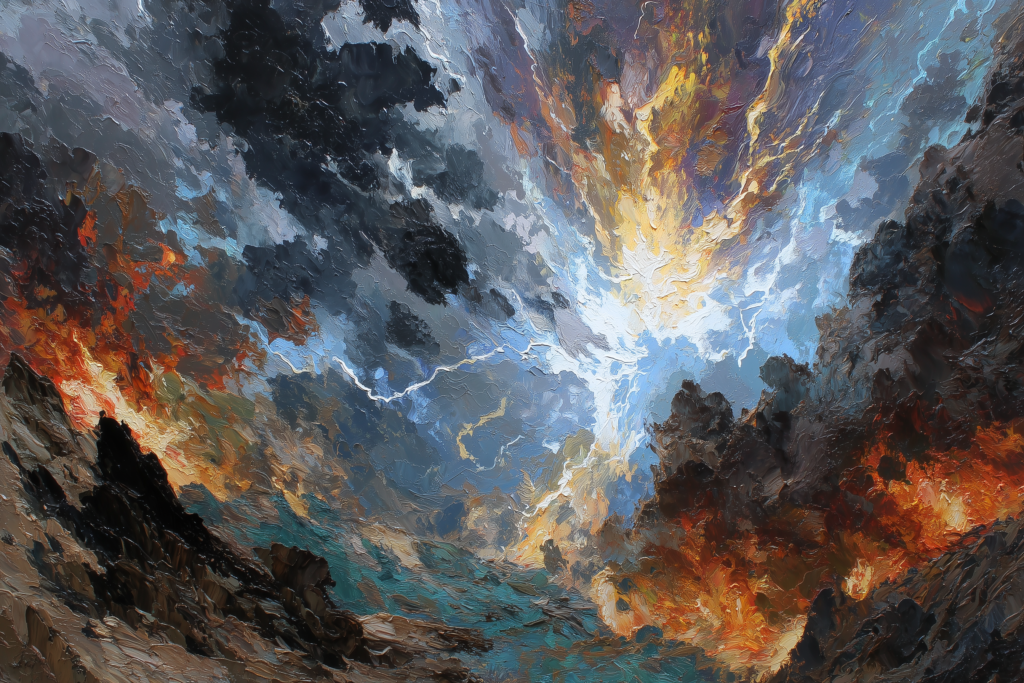
Matter and energy already fill the material cosmos. The Elemental Planes form when recurring physical relationships gather into stable, self-sustaining concentrations.
Motion, pressure and open distance draw together. Density, cohesion and mineral structure gather elsewhere. Heat, radiance and rapid transformation establish another realm. Flow, pressure, dissolution and cohesion establish another.
The Elder Gods use the Living Weave and the repaired Codices to preserve boundaries between these concentrations while allowing exchange.
These reservoirs become the Elemental Planes .
The Plane of Air
Motion, breath, pressure, sound, storm and open distance gather into the Infinite Sky, where current provides road, boundary and direction.
The Plane of Earth
Density, cohesion, mineral structure, endurance and buried pressure gather into an immeasurable depth of stone, crystal, metal and fault.
The Plane of Fire
Heat, combustion, radiance, release and rapid transformation gather into the Eternal Furnace of flame, ember, ash and searing light.
The Plane of Water
Flow, cohesion, pressure, dissolution, current and depth gather into the Worldsea Without Shore.
Mixed Frontiers
The four planes remain capable of exchange.
Where their dominant relationships meet, mixed frontiers develop: smoke, magma, mud, ice, steam, dust, mineral brine, lightning and stranger combinations.
Primal Elemental Intelligences
Repeated elemental patterns begin preserving memory.
Storms return to earlier paths. Flames distinguish fuel from obstruction. Stone retains the history of pressure and fracture. Currents respond differently to familiar and unfamiliar intrusion.
Some patterns acquire intention.
A storm can remember. A flame can choose. Stone can recognise disturbance. A current can deliberately alter its course.
The First Discrete Elementals
Some elemental awakenings become capable of retaining identity even when the substance composing them changes.
Air gathers into self-directed bodies of wind and storm. Earth rises as mobile stone, crystal and mineral. Fire maintains coherent identity within flame and radiance. Water gathers into conscious currents and moving bodies of fluid.
These are discrete elemental beings: individual intelligences with memory, continuity and elemental identity.
The Four Primal Titans
Four elemental concentrations possess identity on an immense scale: Flame, Tide, Stone and Gale.
They embody the deepest powers of Fire, Water, Earth and Air and can act across their respective planes as singular intelligences.
Primordial Powers Present in the Elemental Age
The elemental realms also contain ancient named powers whose traditions describe them as primordial beings. Their exact first manifestation is not established by this eon, but their presence belongs within the elemental cosmology of the period.
Apsu is a primordial power of freshwater, ancient memory, stillness and depth whose home lies within the Elemental Plane of Water.
His manifested form is explicitly draconic: a colossal serpentine being formed from primordial freshwater.
Apsu therefore establishes the presence of a named primordial draconic power within this elemental age without defining the origin of dragonkind as a whole.
Kishar embodies foundation, stability, endurance and the condition by which earth and stone retain coherent structure.
Her nature is both divine and primordial. She can be perceived as a being of earth and clay, but at greater scale the land itself becomes her manifestation.
Mummu is a primordial power of Water, chaos and unrealised potential whose domain reaches into the deepest regions of the Elemental Plane of Water.
Mummu manifests through turbulent water, darkness, vapour, whirlpools and continually changing form.
How the Primordials Fit the Timeline
Apsu, Kishar and Mummu are not substituted for the Primal Titans and are not treated as the creators of the already established cosmos.
Their culture-specific creation genealogies preserve later mythic interpretations of powers whose existence is placed within the master chronology rather than above it.
Pressure upon Planar Boundaries
Elemental concentration strengthens creation while placing sustained pressure upon planar boundaries.
The Living Weave must carry elemental force without allowing one dominant relationship to overwrite every neighbouring condition.
The Elder Gods reinforce these boundaries and map recurring stress lines. The flaws detected during Eon IX become increasingly clear.
Eon X Establishes
- The coherent Planes of Air, Earth, Fire and Water.
- Mixed elemental frontiers.
- Primal elemental intelligences.
- The first discrete elemental beings.
- The Primal Titans Flame, Tide, Stone and Gale.
- The presence of primordial elemental powers including Apsu, Kishar and Mummu.
- Apsu as a named primordial power capable of a true draconic manifestation.
- Increasing stress upon the boundaries carried by the Living Weave.
Eon XI · Reflective Creation
The Mirror Veils
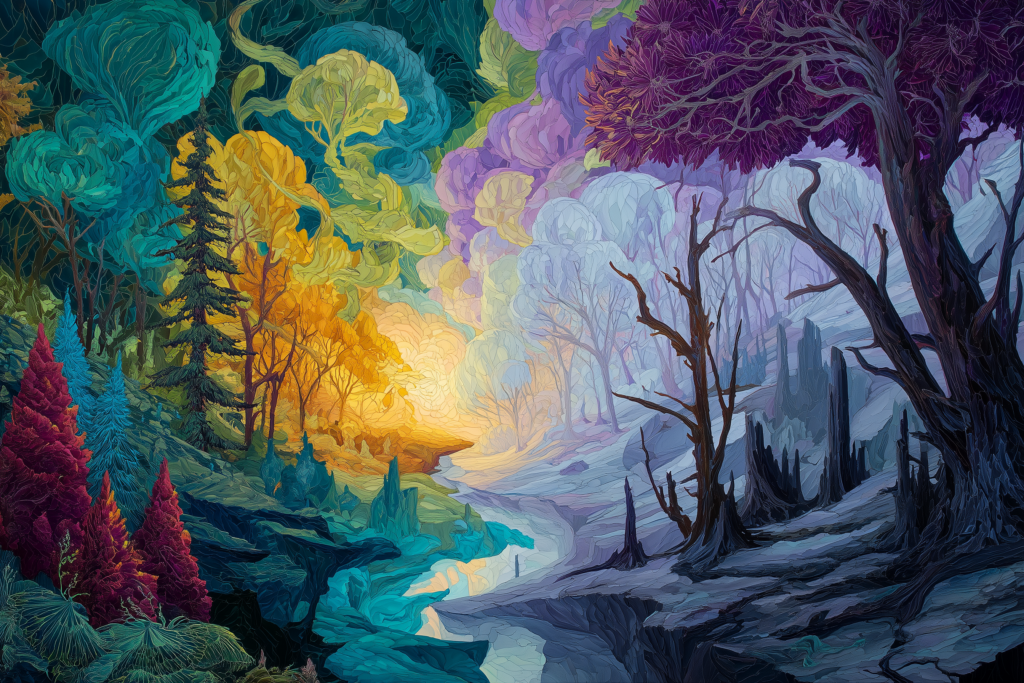
The responsive material cosmos develops two great reflections: one heightens possibility and experience, while the other gathers attenuation, distance, residue and loss.
When Reality Begins to Reflect Itself
The Living Weave carries meaning as well as force.
Once elemental relationships become stable, the material cosmos develops enough complexity to cast sustained metaphysical reflections.
Possibilities exceeding ordinary material expression gather in one direction. Faded presence, weakened connection and compressed distance gather in another.
The Overbright Reflection
The Fey World gathers heightened possibility.
Colour intensifies. Growth and transformation become vigorous principles. Season, emotion, beauty, appetite and wonder acquire visible force.
Distance responds to relationship as readily as measurement. A place can draw near because it is desired, feared, promised or remembered.
The realm contains immense potential landscapes, recurring seasons and local magical awakenings.
The Dim Reflection
The Shadow Plane gathers attenuation.
Light weakens, colour recedes, distance compresses, neglected places draw together and memory can outlast the object or event that produced it.
Residue, concealment, separation and the persistence of form after vitality has faded shape its geography.
Local intelligences awaken within the dim reflection.
Dream and Dusk
The deepest recurring patterns of the mirror veils gather into two Titan-scale identities.
Dream emerges from possibility seeking image, story and emotional form.
Dusk emerges from presence becoming distance, memory and ending.
Dream and Dusk join Flame, Tide, Stone and Gale among the great Primal Titans active within the cosmos.
Reflection Exposes the Hidden Cracks
Reflection reveals inconsistencies that direct observation conceals.
A reflected event can appear before its source. A boundary can cast a shadow without a corresponding object. A possibility can remain visible after every lawful route towards it has closed.
The Elder Gods compare these discrepancies with the stress lines discovered during Eons IX and X.
They conclude that some boundaries mark the limit of an established cosmic relationship rather than the final extent of existence.
Eon XI Establishes
- The Fey World as the overbright reflection of possibility.
- The Shadow Plane as the dim reflection of attenuation and residue.
- Mirror crossings and reflected geography.
- Local embryonic intelligences within both mirror realms.
- The Primal Titans Dream and Dusk.
- Evidence of an outer limit to the relationships described by the Codices.
Eon XII · First Contact Beyond the Codices
The Weeping Wound
An attempt to trace the outer limit of magical relationship opens the first route between ordered creation and the Far Realm.
The Inquiry at the Edge of Relationship
The Elder Gods study the discrepancies exposed by the mirror veils.
They seek to determine whether each unanswered magical address represents damage to the Living Weave, an incomplete relationship within the Codices or a genuine boundary beyond which those laws possess no authority.
At one convergence of Astral meaning, elemental pressure and reflected possibility, they attempt to trace the boundary through the Living Weave.
Something beyond the Codices answers.
The First Far Realm Breach
The answering pressure tears open the Weeping Wound.
This is the first point at which the Far Realm becomes accessible from the present multiverse.
The Wound does not create the Far Realm. It establishes a relationship through which two previously separated orders of existence can reach one another.
Existence without Shared Assumptions
Far Realm entities obey forms of existence alien to the structures carried by the Codices.
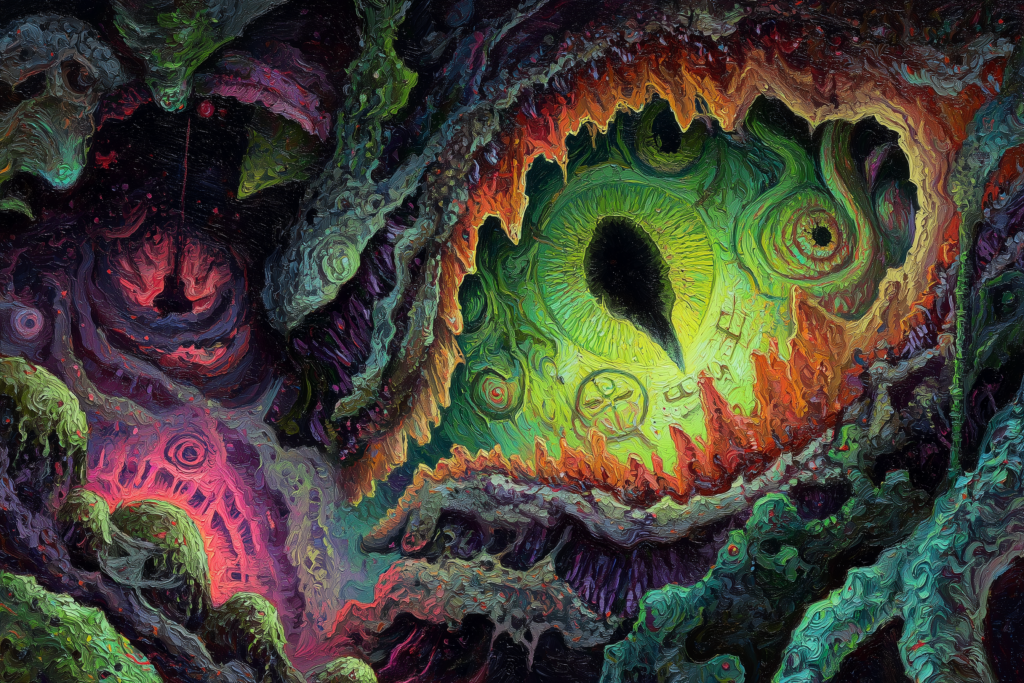
Their bodies may treat inside and outside as interchangeable. Their thoughts may occupy incompatible sequences. A single identity can be distributed across creatures, locations, dreams and mutually exclusive states.
When alien existence crosses into the Living Weave, ordered reality attempts to translate it into relationships the Codices can carry.
The result can be living geometry, impossible anatomy, contradictory memory, contagious dreams or local laws attempting to replace their surroundings.
The first contacts include alien organisms, intrusive patterns and immense intelligences recorded collectively as Elder Abominations.
Powers Beyond the Wound
The Elder Gods do not discover an empty alien realm. Powerful intelligences already exist beyond the newly opened boundary.
Uvuudaums are among the great native powers of the Far Realm. Their presence reshapes their surroundings without requiring the familiar structures of throne, kingdom or government.
They represent one of the clearest established intelligent populations encountered beyond the Weeping Wound.
Azathoth exists within the Far Realm as a primordial alien deity associated with chaos, madness, entropy and states of existence hostile to ordered comprehension.
Azathoth does not create the Weeping Wound and is not identified as the intelligence that answers the Elder Gods’ inquiry.
Accounts of the Far Realm report a vast entity called the Neverborn Maw within its deeper reaches.
Its existence is preserved as a report rather than a confirmed participant in the first breach.
These names survive in accounts of enormous intelligences within the Far Realm whose thoughts can infect or alter lesser minds.
Their presence is reported, but the Weeping Wound record does not identify either as an invader or commander during Eon XII.
What the Breach Establishes
Eon XII establishes contact with an already inhabited alien reality. It does not establish a universal origin date for every aberrant species associated with the Far Realm, and it does not require every Far Realm power to cross through the Wound.
Qlippoths and Far Realm Entities
The Qlippoths originate in the Void Between Universes and already possess their own history within the Abyss.
They are not Far Realm beings.
The entities beyond the Weeping Wound belong to an alien reality outside the structures described by the Codices. The two threats can exploit damaged boundaries, but their origins remain distinct.
The Elder Gods and Alien Divinity
The Elder Gods remain the Astral-born divine generation active within ordered creation.
Azathoth and other divine-scale powers beyond the Weeping Wound belong to a separate alien order of existence.
Their immense antiquity does not make them members of the Astral-born Elder Gods.
Containment and Mobilisation
The Elder Gods contain the immediate expansion of the Weeping Wound, but the relationship created by the breach remains embedded within the Living Weave.
Alien pressure travels along Astral connections and magical stress lines.
The Fey World produces possibilities whose structures do not arise from its own reflective principles.
The Shadow Plane gathers residues of events that ordered reality cannot reconcile.
Elemental frontiers develop contradictions in substance, motion and form.
Flame, Tide, Stone, Gale, Dream and Dusk answer the summons of the Elder Gods.
Great instruments are prepared to reinforce cosmic law, isolate contaminated regions and force alien manifestations back towards the Wound.
Eon XII closes with the defenders of ordered creation mobilised and the first battlefronts forming.
Eon XII Establishes
- The Weeping Wound as the first accessible route to the Far Realm.
- Contact with an already inhabited alien reality.
- Alien organisms, intrusive patterns and Elder Abominations reaching ordered creation.
- Uvuudaums as major native intelligences of the Far Realm.
- Azathoth as a primordial alien deity existing beyond the breach.
- Reports of the Neverborn Maw, Whispering Madness and Unseeing Eye.
- A clear distinction between Far Realm entities and Qlippoths.
- The mobilisation of the Elder Gods and six Primal Titans.
02 · Chronology
The Four Eons in Sequence
Each eon extends the capacity of creation. Dependable cosmic law becomes responsive magic. Magic concentrates elemental power. Elemental stability permits enduring reflection. Reflection reveals a boundary beyond which ordered relationships no longer provide a complete description of existence.
| Eon | Central development | Intelligences and powers | Permanent result |
|---|---|---|---|
| Eon IX | Astral meaning is woven through dependable cosmic law. | The Elder Gods remain the principal active divine powers. | The Living Weave makes ordered reality responsive to patterned magical intention. |
| Eon X | Elemental properties gather into four coherent Inner Planes. | Primal elemental intelligences, discrete elementals, Flame, Tide, Stone, Gale, Apsu, Kishar and Mummu. | Air, Earth, Fire and Water become self-sustaining elemental realities inhabited by intelligent powers. |
| Eon XI | Material existence develops overbright and dim reflections. | Local mirror intelligences, Dream and Dusk. | The Fey World and Shadow Plane become enduring reflective realities. |
| Eon XII | The Elder Gods trace the outer limit of the Codices and receive an alien answer. | Uvuudaums and other Far Realm powers already exist beyond the breach; alien organisms and Elder Abominations enter ordered creation. | The Weeping Wound establishes the first accessible relationship with the Far Realm. |
Where the Chronology Goes Next
The spreading consequences of the Weeping Wound lead directly into Cosmic Reckoning & Recovery .
03 · Enduring Legacy
What Survives from Eons IX–XII
Ancient Weave Patterns
Some regions preserve magical relationships close to their Eon IX form. Names, symbols, emotions or exact conditions can trigger powers embedded in the surrounding Weave.
Elemental Memory
Ancient elemental regions can retain memories of pressure, motion, fracture, flame or current as though those events form part of a living mind.
Ancient Elementals
Some elemental beings possess identities of extraordinary antiquity and preserve fragments of the first age of discrete elemental life.
Primordial Powers
Apsu, Kishar and Mummu preserve forms of elemental divinity and primordial identity reaching into the earliest elemental age.
Titan Remnants
Names, seals, fragments and concentrated powers of Flame, Tide, Stone, Gale, Dream and Dusk remain connected to the Primal Titans.
Mirror Dislocations
A Fey or Shadow reflection can cease agreeing with its material counterpart, preserving a road, season, memory or possibility whose source has changed or vanished.
Far Realm Pressure
The relationship established by the Weeping Wound allows alien conditions to exert pressure upon the Living Weave even when the original breach is constrained.
Alien Powers
Uvuudaums, Azathoth and other immense Far Realm intelligences demonstrate that divine or Titan-scale consciousness exists outside the Astral and elemental histories of ordered creation.
04 · Campaign Use
Using Raw Power and Hidden Cracks in Adventures
The Forgotten Pattern
An ancient magical relationship alters identity through the connection between name and substance. Each use strengthens the pattern and allows it to respond with increasing independence.
The Elemental Memory
A mountain begins repeating an ancient Stone-pressure cycle. Roads fold into crystal while deep strata move according to a memory older than the landscape above them.
The Stillwell
A route reaches waters bearing the unmistakable presence of Apsu. The current carries memories that no ordinary archive could have preserved.
Kishar Moves
A stable region begins behaving as one immense body. The problem cannot be solved by confronting a creature because the ground itself is the manifestation.
The Reflection without a Source
A complete landscape exists in both mirror realms without a matching material location. Each reflection preserves a different memory of the missing original.
The First Address
A surviving cosmic instrument contains part of the inquiry that opened the Weeping Wound. Activating it produces another answer from beyond the Codices.
The Uvuudaum Shadow
An alien intelligence does not cross bodily. Its presence changes geometry, memory and identity around a thin point in the Living Weave.
The Titan Muster
Six ancient relics call to one another across the elemental, Fey and Shadow realms, each preserving part of a Primal Titan’s will.
05 · Knowledge and Canon
What the Surviving Record Establishes
Knowledge of Eons IX–XII survives through divine testimony, Astral evidence, ancient planar correspondences, elemental memory, Titan relics, preserved Weave structures and scars surrounding the Weeping Wound.
Primordial Names and Mythic Genealogies
Apsu, Kishar and Mummu are genuine primordial powers present within the elemental cosmology.
Their surviving religious traditions also contain stories in which they or their relatives precede, create or organise all existence. Those stories preserve cultural interpretations of primordial powers; they do not replace the established chronology of the present universe.
Apsu and Draconic Form
Apsu’s manifestation as a primordial freshwater dragon is part of his established identity.
This records a named draconic power in the elemental age. It does not by itself establish a biological origin date for all dragons.
Far Realm Powers
The Far Realm is already inhabited when the Weeping Wound opens. Uvuudaums are among its major native powers.
Azathoth also exists there as a primordial alien deity. Descriptions of Azathoth as the creator or dreamer of ordered reality belong to cosmic-horror theology surrounding the being rather than the objective sequence recorded by the SpiralWorlds timeline.
The Neverborn Maw, Whispering Madness and Unseeing Eye remain reported or rumoured presences within the Far Realm. The surviving Eon XII record does not identify them as participants in the first breach.
Reliable Points of Agreement
- The Living Weave becomes a universal magical medium during Eon IX.
- The Planes of Air, Earth, Fire and Water are coherent realities during Eon X.
- Primal elemental intelligences possess memory and intention.
- Discrete elementals possess persistent individual identity.
- Flame, Tide, Stone and Gale are great elemental Primal Titans.
- Apsu, Kishar and Mummu are primordial powers present within the elemental cosmology.
- Apsu possesses a primordial draconic manifestation.
- The Fey World and Shadow Plane are active reflective realms during Eon XI.
- Dream and Dusk are the great Primal Titans of the mirror veils.
- The Weeping Wound establishes the first accessible relationship between ordered creation and the Far Realm during Eon XII.
- The Far Realm is already inhabited when the Wound opens.
- Uvuudaums are major native Far Realm powers.
- Azathoth exists as a primordial alien deity within the Far Realm.
- Qlippoths remain distinct from Far Realm entities.
06 · Key Questions
Raw Power and Hidden Cracks Clarified
When does magic become universal?
During Eon IX. The Living Weave joins the dependable relationships of the Codices to intention, thought, soul and symbol.
What are the first discrete elementals?
They are elemental intelligences capable of retaining identity even while the air, stone, flame or water composing their manifestation changes.
Who are Flame, Tide, Stone and Gale?
They are Titan-scale elemental intelligences expressing the deepest powers of Fire, Water, Earth and Air.
Does Apsu originate during Eon X?
The timeline does not establish Eon X as Apsu’s birth. It establishes that Apsu belongs among the primordial powers present within the elemental cosmology of this age.
Is Apsu a dragon?
Apsu possesses a primordial draconic manifestation: an immense serpentine dragon formed from freshwater power.
Who is Kishar?
Kishar is a primordial Earth and foundation power associated with stability, endurance and the persistence of coherent ground.
Who is Mummu?
Mummu is a primordial Water power associated with chaos, potentiality, turbulence and changing form.
When do the mirror realms exist?
The Fey World and Shadow Plane emerge as enduring reflective realities during Eon XI.
Who are Dream and Dusk?
Dream and Dusk are Titan-scale intelligences emerging from the deepest recurring structures of the two mirror realms.
Does Eon XII create the Far Realm?
No. Eon XII creates access to an alien reality that already exists.
Who already inhabits the Far Realm?
Uvuudaums are among its major native powers. Azathoth exists there as a primordial alien deity, while other immense beings are reported within its deeper reaches.
Does Azathoth open the Weeping Wound?
No such role is established. The Wound opens when the Elder Gods’ inquiry into the outer limit of the Codices receives an alien answer.
Are Qlippoths Far Realm beings?
No. Qlippoths originate in the Void Between Universes. The Far Realm is a separate alien reality.
07 · Wider Context
Scientific, Philosophical and Literary Reference Points
Raw Power and Hidden Cracks is SpiralWorlds fantasy cosmology. Its magical structures, elemental realms and alien breach use scientific, philosophical and literary ideas as inspiration while remaining part of the setting’s own chronology.
Keep this reference growing
If this page helped with your reading or game, you can support its upkeep or explore the curated books.
Explore the Bookshop — epics, classics and stories behind imagined worlds.