
Helen of Troy, Queen of Sparta
Helen of Troy is the most beautiful woman in the world, and every king, god, lover, soldier, and witness who tries to possess that fact reveals what they are willing to destroy.
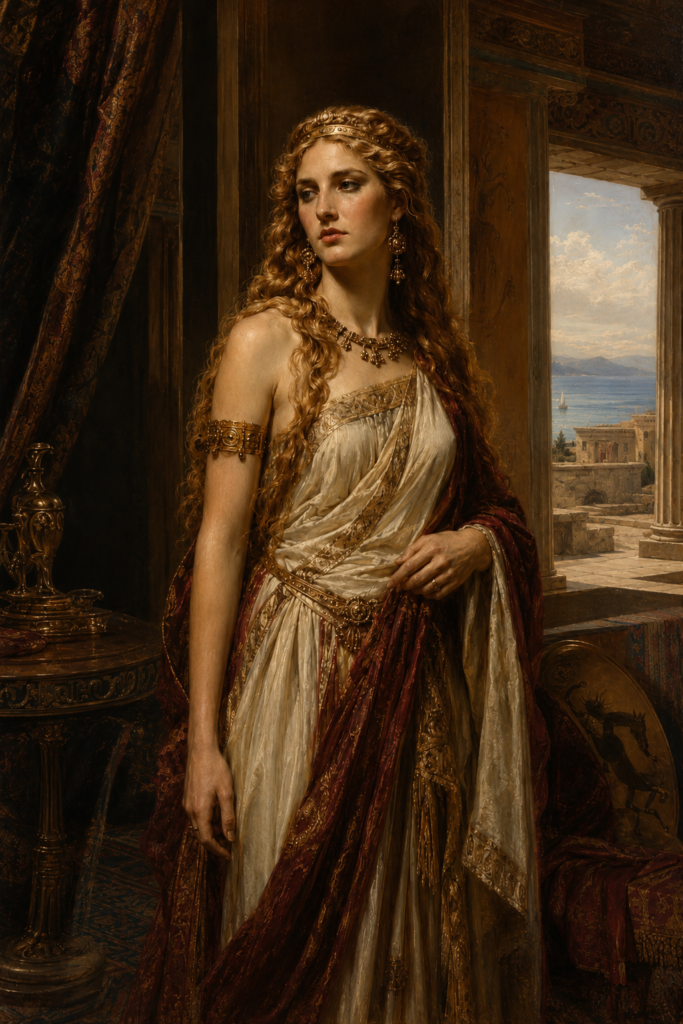
- Name: Helen of Troy
- True Royal Identity: Helen of Sparta, Queen of Sparta
- Also Known As: Helen, Daughter of Zeus; Helen of Sparta; the Face That Launched the Thousand Ships; the Swan-Born Queen
- Campaign Weight: Major / Legendary / Campaign-Shaping
- Primary Role: Queen, divine-born beauty, political catastrophe, sacred prize, accused traitor, survivor of kings
- Best Used For: Court intrigue, war diplomacy, divine manipulation, royal scandal, treaty scenes, hostage negotiations, moral pressure, and mythic consequence
Helen of Troy, Queen of Sparta is the most beautiful woman in the world.
That is not rumour, court flattery, or a poet’s exaggeration. It is a divine fact. Her beauty is sacred inheritance, political weapon, curse, miracle, and accusation. People do not merely desire Helen. They reveal themselves around her.
Kings call her honour. Soldiers call her cause. Poets call her wonder. Priests call her a sign. Rivals call her ruin. Husbands call her stolen. Lovers call her chosen. None of those names are large enough to contain her.
Helen should never be written as a passive prize. She has spent her life watching men turn appetite into law and ambition into honour. She understands court politics because she has been the centre of them. She understands war because armies have marched under her name. She understands beauty because everyone else thinks it gives them the right to explain her.
The strongest version of Helen keeps both truths at once:
She is the most beautiful woman in the world.
She is not reducible to beauty.
In a campaign, Helen of Troy, Queen of Sparta is a living centre of pressure. Helping her, accusing her, hiding her, rescuing her, judging her, or delivering her to someone else should all carry consequences. She is not just a person in danger. She is the person around whom everyone else’s danger becomes visible.
Appearance
Helen of Troy, Queen of Sparta’s beauty should feel unsettlingly complete.
She is not simply young, flawless, or seductive. Her presence changes the room before anyone admits it has changed. Guards stand straighter. Courtiers forget prepared insults. Artists become reckless. Old enemies lower their voices. Jealous rivals look for imperfections and hate her more when they cannot find one.
Her beauty does not make everyone love her. Some people pity her. Some resent her. Some want to protect her. Some want to possess her. Some want to punish her for the weakness they feel in themselves. Some turn away because looking at her makes them aware of every cowardly or hungry part of their own soul.
Helen should not glow like a spell unless the scene calls for divine revelation. Most of the time, her beauty is worse because it is natural. She looks mortal enough to blame and divine enough to fear.
Character and Lore
Helen belongs to Sparta before she belongs to Troy.
She is a queen, a daughter of dangerous blood, and a woman whose marriage was never merely private. Her hand was a political settlement. Her body became dynastic property. Her absence became legal grievance. Her desire, if desire was truly allowed to matter, became an international crisis.
The Trojan War should not be reduced to “Helen caused it.” That is the lazy version powerful men prefer.
The war begins where divine vanity, royal marriage, oath-bound kings, wounded honour, opportunistic conquest, and male possession all meet. Helen stands at the centre, but the centre is not the same as the cause.
Paris may have loved her. He may also have accepted a prize no man had the right to receive.
Menelaus may have loved her. He may also have treated her as a stolen royal claim.
Aphrodite may have blessed her. She may also have used her.
Agamemnon may have called the war justice. He may also have seen the chance to lead kings.
Helen’s tragedy is that everyone can point to her and avoid looking at themselves.
Private Truth
Helen of Troy, Queen of Sparta knows beauty is power.
She also knows it is not freedom.
Her face can stop a room. Her name can move ships. Her presence can soften a verdict, ignite a duel, calm a mob, or ruin a negotiation. Yet much of that power is usable by others before it is usable by her.
Her private question is not:
Am I loved?
It is:
Can anyone see me clearly after seeing my face?
Motives
Helen of Troy, Queen of Sparta wants survival, but not only survival.
She wants one part of her life to remain her own. One choice. One truth. One loyalty. One memory that is not rewritten by kings, poets, husbands, priests, or gods.
She may want to protect Sparta, even while resenting how Sparta used her. She may pity Troy, even if Troy made her into a royal possession. She may love Paris and despise his weakness. She may respect Menelaus and reject his claim over her. She may fear Aphrodite more than any mortal army.
Her best motive in play is simple:
Helen wants one decision in her life to belong to Helen.
Fears
Helen of Troy, Queen of Sparta fears becoming an explanation.
She fears every corpse being laid at her feet because that is easier than blaming kings. She fears widows being told their sons died for her beauty. She fears poets making her either monster or miracle because both versions erase the woman.
She fears divine ownership most of all. Mortal men can be negotiated with, deceived, outlived, or escaped. A goddess who has decided what Helen means is far harder to resist.
Allies, Enemies, and Pressure Web
- Menelaus: Husband, king, injured claimant, possible wounded lover. He has a legal and political claim, but that does not make the moral situation simple.
- Paris: Lover, abductor, chosen instrument, beautiful disaster. Paris may genuinely love Helen, but he also accepts a divine prize no one had the right to give him.
- Aphrodite: Patron, manipulator, divine creditor. Aphrodite does not need to be written as evil to be terrifying. She makes desire sacred and leaves mortals to bleed from it.
- Clytemnestra: Sister, mirror, warning. Clytemnestra shows what happens when royal women stop accepting the stories men write around them.
- Castor and Pollux: Brothers, protectors, divine-adjacent family pressure. They remind everyone that Helen’s bloodline is not safely mortal.
- Agamemnon: War-maker, opportunist, commander of kings. He benefits from a simple story in which Helen’s recovery justifies everything.
- Priam and Hecuba: Royal hosts of Troy. They must decide whether Helen is guest, queen, curse, hostage, or divine burden.
- Odysseus: One of the few men clever enough to understand that Helen is both person and political weapon.
How Helen Should Feel at the Table
Helen should create decisions, not admiration scenes.
A weak Helen scene says: “Everyone thinks she is beautiful.”
A strong Helen scene asks: “What does each person become when beauty, blame, power, and desire are placed in the same room?”
Use Helen where every option has witnesses. The party should immediately feel that speaking for her, refusing to speak for her, escorting her, hiding her, returning her, or asking what she wants will change alliances.
She is especially useful when the campaign needs a scene where the morally obvious answer is not the politically survivable one.
Helen of Troy, Queen of Sparta
Helen of Troy, Queen of Sparta, Pathfinder 1e / 3.5e
Helen of Troy, Queen of Sparta 3.0
Helen of Troy, Queen of Sparta 5.5e / 2024
Medium Humanoid, Neutral
Armor Class: 14
Initiative: +3
Hit Points: 110 (17d8 + 34)
Speed: 30 ft.
Proficiency Bonus: +4
| STR | DEX | CON | INT | WIS | CHA |
|---|---|---|---|---|---|
| 10 (+0) | 16 (+3) | 14 (+2) | 17 (+3) | 18 (+4) | 24 (+7) |
Saving Throws: Dex +7, Wis +8, Cha +11
Skills: Deception +11, History +7, Insight +12, Persuasion +15, Performance +11, Religion +7
Senses: Passive Perception 14
Languages: Greek, Trojan, courtly dialects, and three additional diplomatic or royal languages
Challenge: 9 in social/political scenes; 4 or lower in direct combat
Role: Legendary social NPC, queen, and mythic political force
Mythic Social Traits
The Most Beautiful Woman in the World
Helen’s beauty is a divine condition, not ordinary attractiveness. Creatures that can see her do not automatically love, obey, or desire her. Instead, her presence forces the truth of their reaction into the open.
When a creature that can see Helen begins a hostile social or physical action against her, it must make a DC 17 Wisdom saving throw. On a success, the creature acts normally and is immune to this trait for 24 hours.
On a failure, the creature hesitates until the end of its current turn and must choose or reveal one response from the table below. The response is obvious to Helen and to any creature within 30 feet that can see the creature.
| Revealed Response | Mechanical Effect |
|---|---|
| Awe | The creature cannot target Helen with an attack, harmful spell, or hostile feature until the start of its next turn. |
| Shame | The creature has Disadvantage on its next Charisma check before the end of the scene. |
| Desire | The creature cannot willingly move farther away from Helen until the start of its next turn. |
| Envy | The creature has Disadvantage on its next Wisdom saving throw before the end of its next turn. |
| Pity | The creature cannot deal lethal damage to Helen until the start of its next turn. |
| Anger | The creature has Disadvantage on its next attack roll against a creature other than Helen before the end of its next turn. |
| Possessiveness | The creature must use its next spoken words to claim, defend, judge, rescue, protect, condemn, or speak for Helen. |
| Fear | The creature cannot move closer to Helen until the start of its next turn. |
This trait does not make the creature friendly, Charmed, obedient, or magically infatuated. It exposes the emotional truth behind the hostile action and gives witnesses something real to act on.
Once a creature fails this saving throw and suffers one revealed response, it is immune to this trait for 24 hours.
Witness Pressure
Helen is strongest when others are watching.
When at least three non-hostile creatures can see and hear Helen, she gains the following benefits:
- Helen has Advantage on Charisma checks made to delay violence, expose hypocrisy, demand testimony, or force a public answer.
- A creature that fails a saving throw against The Most Beautiful Woman in the World cannot hide its revealed response without succeeding on a DC 17 Charisma (Deception) check.
- If a creature attacks Helen in front of witnesses after failing that save, Helen may immediately use Name the Cost without spending a Legendary Action.
Queen Beneath Accusation
Helen has Advantage on Charisma checks made in royal courts, treaty halls, marriage negotiations, ransom scenes, hostage exchanges, and trials involving honour, legitimacy, desire, betrayal, or blame.
In addition, when Helen succeeds on one of these checks by 5 or more, she may choose one neutral witness who heard her. That witness becomes unwilling to support immediate violence against Helen unless threatened, bribed, magically compelled, or presented with new evidence.
Divine Entanglement
Magic that would compel Helen’s love, rewrite her memory, alter her appearance, bind her by oath, magically determine her guilt, or reveal her destiny is unstable.
The caster must succeed on a DC 17 spellcasting ability check. On a failure, the spell does not function cleanly. Instead, the DM chooses one result:
| d6 | Divine Interference |
|---|---|
| 1 | The spell reveals Aphrodite’s influence rather than Helen’s will. |
| 2 | The spell reveals a contradictory omen implicating another figure. |
| 3 | The spell shows Helen as queen, captive, willing lover, and unwilling prize at once. |
| 4 | The caster has Disadvantage on the next check made to accuse or command Helen. |
| 5 | A witness receives a brief vision of their own desire, guilt, or ambition. |
| 6 | The spell succeeds, but also alerts a divine power invested in Helen’s fate. |
Blame Cannot Hold One Shape
Once per scene, when a creature publicly accuses Helen of causing war, betrayal, ruin, or dishonour, Helen may force the accuser to make a DC 17 Charisma saving throw.
On a failure, the accuser must name one king, god, oath, army, law, ambition, bargain, or political interest that profited from blaming her. If the accuser refuses or cannot answer, it has Disadvantage on Persuasion checks against neutral witnesses for 1 hour.
On a failure by 5 or more, one neutral witness openly questions the accusation.
Social Encounter Engine: The Room’s Mood
For important scenes involving Helen, the DM may track The Room’s Mood. This is optional, but it makes Helen’s scenes feel distinct from ordinary Persuasion checks.
Start the room at 0.
| Mood Score | State of the Room |
|---|---|
| -3 | Violent. The room wants blood, punishment, seizure, or forced removal. |
| -2 | Hostile. Accusations dominate. |
| -1 | Suspicious. Helen is being judged. |
| 0 | Unsettled. No one controls the story yet. |
| +1 | Listening. Witnesses are willing to hear her. |
| +2 | Divided. Helen’s accusers are losing certainty. |
| +3 | Reversed. The room now questions the people blaming her. |
Changing the Room’s Mood
The Room’s Mood shifts by +1 when:
- Helen succeeds on a Persuasion, Performance, or Insight check in a public exchange.
- A hostile creature fails its save against The Most Beautiful Woman in the World.
- A creature fails its save against Blame Cannot Hold One Shape.
- The party presents credible evidence that another person benefited from blaming Helen.
- A witness publicly admits doubt.
The Room’s Mood shifts by –1 when:
- Helen is caught in a lie.
- A credible witness accuses her with evidence.
- A divine sign appears to condemn her.
- A creature harmed by the war speaks truthfully and movingly against her.
- The party silences witnesses or uses obvious coercion in her favour.
Effects of the Room’s Mood
At +2 or higher, creatures have Disadvantage on checks made to justify immediate violence against Helen.
At +3, any attempt to seize, execute, or forcibly remove Helen in public triggers outrage, division, or political consequence.
At –2 or lower, Helen has Disadvantage on Charisma checks made to gain mercy unless the party introduces new evidence, divine intervention, or a credible witness.
At –3, violence becomes likely unless someone changes the scene immediately.
Actions
Silver Dagger
Melee Weapon Attack: +7 to hit, reach 5 ft., one target.
Hit: 5 (1d4 + 3) piercing damage.
Unanswerable Question
Helen asks one creature within 60 feet a question that exposes desire, guilt, fear, or ambition.
The target must make a DC 17 Charisma saving throw. On a failure, it cannot knowingly lie to Helen until the end of its next turn. If the target takes a hostile action before then, it has Disadvantage on the first attack roll, ability check, or saving throw made as part of that escalation.
If this occurs before witnesses, the Room’s Mood shifts by +1.
Command the Room
Helen chooses up to three creatures within 60 feet that can see and hear her. Each target must make a DC 17 Wisdom saving throw.
On a failure, the target cannot interrupt Helen, shout her down, or physically approach her until the end of Helen’s next turn. This effect ends early for a creature if Helen or her allies attack it.
If at least one hostile creature fails this save in front of witnesses, the Room’s Mood shifts by +1.
Name the True Cause
Helen names a person, oath, god, army, law, ambition, bargain, or political interest that has benefited from blaming her.
One creature within 60 feet that has publicly accused Helen must make a DC 17 Charisma saving throw. On a failure, the creature has Disadvantage on Persuasion and Deception checks against witnesses for 10 minutes.
If the target fails by 5 or more, the Room’s Mood shifts by +1.
Reactions
Do Not Pretend This Is Honour
When a creature within 60 feet justifies violence in Helen’s name, Helen may force it to make a DC 17 Wisdom saving throw.
On a failure, the creature has Disadvantage on its next attack roll or Charisma check before the end of its next turn. If the action occurs before witnesses, the creature must also reveal whether it is acting from duty, desire, fear, pride, vengeance, obedience, or ambition.
The Room Turns With Her
When Helen is targeted by an attack while at least three non-hostile creatures can see her, she may move up to half her Speed without provoking Opportunity Attacks. The crowd shifts, hesitates, blocks sightlines, or instinctively makes space.
If the attack misses, the attacker has Disadvantage on its next Charisma check made before those witnesses.
Let Them Hear You
When a creature within 60 feet lies about Helen, speaks for her without permission, or claims to know what she wants, Helen may force that creature to repeat the claim clearly before all witnesses.
The creature must make a DC 17 Charisma saving throw. On a failure, it either corrects itself or has Disadvantage on its next Deception or Persuasion check before the end of the scene.
Legendary Actions
Helen can take 2 Legendary Actions, choosing from the options below. Only one Legendary Action can be used at a time and only at the end of another creature’s turn.
Look Toward the Witness
Helen looks at one creature she can see. Until the start of Helen’s next turn, she has Advantage on Wisdom (Insight) checks against that creature.
Name the Cost
Helen names one personal, political, or divine consequence of the current conflict. One creature that hears her must succeed on a DC 17 Wisdom saving throw or lose Advantage on its next attack roll, saving throw, or ability check made to escalate the conflict.
Step Behind the Claimant
Helen moves up to 15 feet toward a creature that has claimed to protect, rescue, possess, avenge, judge, or speak for her. Attacks against Helen have Disadvantage until the start of her next turn if that creature stands between Helen and the attacker.
Turn the Witness
Helen chooses one neutral witness within 60 feet. That witness must be able to see and hear her. Until the end of Helen’s next turn, that witness will not support immediate violence against her unless directly threatened, bribed, magically compelled, or shown new evidence.
Mythic Social Lair Actions
Use these only in a major court, treaty hall, royal camp, temple hearing, siege negotiation, or public accusation scene.
On initiative count 20, Helen may take one of the following lair actions. These are not physical lair powers. They represent the pressure of witnesses, reputation, beauty, divine attention, and public blame.
The Silence After Her Name
A hush falls after Helen is named, accused, defended, or claimed. Until initiative count 20 on the next round, the first creature to speak a direct accusation or claim over Helen must succeed on a DC 17 Charisma saving throw or reveal an emotional motive behind the claim.
Every Eye Turns
One creature Helen can see becomes the centre of attention. Until initiative count 20 on the next round, that creature has Disadvantage on Deception checks and cannot benefit from being hidden in a social sense. Its body language, hesitation, or appetite is too visible.
The Gods Are Listening
A divine pressure enters the room. Until initiative count 20 on the next round, the first spell or magical effect used to compel, expose, disguise, judge, or bind Helen triggers Divine Entanglement, even if it would not normally qualify.
Helen of Troy, Queen of Sparta, Pathfinder 1e / 3.5e
Female human aristocrat 5 / expert 5
N Medium humanoid
Init +3; Senses Perception +14
Defense
AC 17, touch 14, flat-footed 13; Dodge, courtly grace
hp 68 (10 HD; 5d8+5d8+20)
Fort +5, Ref +7, Will +13
Defensive Abilities divine beauty, queen beneath accusation, witness pressure
Offense
Speed 30 ft.
Melee silver dagger +9/+4 (1d4+1/19–20)
Special Attacks command the room, name the true cause, unanswerable question
Statistics
Str 10, Dex 16, Con 14, Int 17, Wis 18, Cha 24
Base Atk +7; CMB +7; CMD 21
Feats Deceitful, Dodge, Iron Will, Negotiator, Persuasive, Skill Focus (Diplomacy), Skill Focus (Sense Motive)
Skills Bluff +24, Diplomacy +29, Disguise +12, Knowledge (history) +16, Knowledge (nobility) +21, Knowledge (religion) +16, Linguistics +8, Perception +14, Perform (oratory) +20, Sense Motive +25
Languages Greek, Trojan, and three additional courtly or diplomatic languages
SQ blame cannot hold one shape, divine entanglement, royal education
Special Abilities
Divine Beauty (Su)
Helen of Troy, Queen of Sparta is the most beautiful woman in the world. This is not a charm effect and does not force love, obedience, or desire.
When a creature that can see Helen attempts to begin a direct hostile action against her in a social, courtly, or non-battlefield scene, it must succeed at a DC 22 Will save or hesitate for 1 round. During this hesitation, the creature reveals one visible response from the table below. The response is obvious to Helen and to any creature within 30 feet that can see the creature.
| Revealed Response | Mechanical Effect |
|---|---|
| Awe | The creature cannot target Helen with an attack, harmful spell, or hostile ability for 1 round. |
| Shame | The creature takes a –4 penalty on its next Charisma-based skill check before the end of the scene. |
| Desire | The creature cannot willingly move farther away from Helen for 1 round. |
| Envy | The creature takes a –2 penalty on its next Will save before the end of its next turn. |
| Pity | The creature cannot deal lethal damage to Helen for 1 round. |
| Anger | The creature takes a –2 penalty on its next attack roll against a creature other than Helen before the end of its next turn. |
| Possessiveness | The creature must use its next spoken words to claim, defend, judge, rescue, protect, condemn, or speak for Helen. |
| Fear | The creature cannot move closer to Helen for 1 round. |
A creature that succeeds at the save is immune to Helen’s divine beauty for 24 hours. A creature already engaged in open combat with Helen or her allies gains a +4 bonus on the saving throw. The save DC is Charisma-based.
Witness Pressure (Ex)
When at least three non-hostile creatures can see and hear Helen of Troy, Queen of Sparta, she gains a +2 circumstance bonus on Bluff, Diplomacy, Perform (oratory), and Sense Motive checks made to delay violence, expose hypocrisy, demand testimony, or force a public answer.
A creature that fails a save against Helen’s divine beauty before witnesses takes a –4 penalty on Bluff checks to conceal the emotional response it revealed.
Queen Beneath Accusation (Ex)
Helen of Troy, Queen of Sparta gains a +4 insight bonus on Bluff, Diplomacy, Perform (oratory), and Sense Motive checks made during royal hearings, marriage negotiations, hostage exchanges, treaty scenes, trials of honour, accusations of betrayal, or disputes over legitimacy.
If Helen succeeds on one of these checks by 5 or more, one neutral witness becomes unwilling to support immediate violence against her unless threatened, bribed, magically compelled, or shown credible new evidence.
Divine Entanglement (Su)
Spells and supernatural effects that would compel Helen of Troy, Queen of Sparta’s love, alter her appearance, rewrite her memory, force an oath, magically determine her guilt, or reveal her destiny must overcome her divine entanglement.
The caster must succeed at a caster level check against DC 22. If the check fails, the spell does not function cleanly. The GM chooses one result:
| d6 | Divine Interference |
|---|---|
| 1 | The spell reveals Aphrodite’s influence rather than Helen’s will. |
| 2 | The spell reveals a contradictory omen implicating another figure. |
| 3 | The spell shows Helen as queen, captive, willing lover, and unwilling prize at once. |
| 4 | The caster takes a –4 penalty on the next check made to accuse or command Helen. |
| 5 | A witness receives a brief vision of their own desire, guilt, or ambition. |
| 6 | The spell succeeds, but also alerts a divine power invested in Helen’s fate. |
Blame Cannot Hold One Shape (Ex)
Once per scene, when a creature publicly accuses Helen of causing war, betrayal, ruin, or dishonour, Helen may force the accuser to attempt a DC 22 Will save.
On a failure, the accuser must name one king, god, oath, army, law, ambition, bargain, or political interest that benefited from blaming her. If the accuser refuses or cannot answer, it takes a –4 penalty on Diplomacy and Perform checks against neutral witnesses for 1 hour.
If the accuser fails by 5 or more, one neutral witness openly questions the accusation.
Unanswerable Question (Ex)
Three times per day, Helen of Troy, Queen of Sparta may ask one creature within 60 feet a question that exposes desire, guilt, fear, or ambition.
The target must succeed at a DC 22 Will save or be unable to knowingly lie to Helen for 1 round. If the target attempts hostile action before the end of its next turn, it takes a –2 penalty on its first attack roll, skill check, or saving throw made to escalate the scene.
Command the Room (Ex)
Three times per day, Helen of Troy, Queen of Sparta may command attention through royal presence rather than magic.
Up to three creatures within 60 feet that can see and hear her must succeed at a DC 22 Will save or be unable to interrupt, shout over, or physically approach Helen for 1 round. This effect ends for a creature if Helen or her allies attack it.
Name the True Cause (Ex)
Once per scene, Helen may name one person, oath, god, army, law, bargain, or ambition that has profited from blaming her.
One creature within 60 feet that has publicly accused Helen must succeed at a DC 22 Will save or take a –4 penalty on Bluff, Diplomacy, and Perform checks against witnesses for 10 minutes.
Royal Education (Ex)
Helen treats Knowledge (history), Knowledge (nobility), Knowledge (religion), Perform (oratory), and Sense Motive as class skills.
Encounter Rule: The Court’s Mood
For important courtly, diplomatic, legal, or public accusation scenes involving Helen, the GM may track The Court’s Mood. This optional rule makes Helen’s scenes feel distinct from ordinary Diplomacy checks and gives the table a clear way to measure whether the court is turning against her, listening to her, or beginning to question her accusers.
Start the court at 0.
| Mood Score | State of the Court |
|---|---|
| -3 | Violent. Seizure, execution, or forced removal is imminent. |
| -2 | Hostile. Accusers dominate. |
| -1 | Suspicious. Helen is being judged. |
| 0 | Unsettled. No one controls the story. |
| +1 | Listening. Witnesses are willing to hear her. |
| +2 | Divided. Her accusers are losing certainty. |
| +3 | Reversed. The court now questions the people blaming her. |
Changing the Court’s Mood
The Court’s Mood shifts by +1 when Helen succeeds on a Bluff, Diplomacy, Perform (oratory), or Sense Motive check made before witnesses, when a hostile creature fails its save against Divine Beauty, when an accuser fails its save against Blame Cannot Hold One Shape, when the party presents credible evidence that someone else benefited from blaming Helen, or when a witness publicly admits doubt.
The Court’s Mood shifts by –1 when Helen is caught in a lie, when a credible witness accuses her with evidence, when a divine sign appears to condemn her, when a creature harmed by the war speaks truthfully and movingly against her, or when the party silences witnesses or uses obvious coercion in her favour.
Effects of the Court’s Mood
At +2 or higher, creatures take a –4 penalty on Bluff, Diplomacy, Intimidate, and Perform checks made to justify immediate violence against Helen.
At +3, any attempt to seize, execute, or forcibly remove Helen in public creates immediate political backlash. Guards hesitate, witnesses object, rival factions intervene, or a formal challenge is demanded.
At –2 or lower, Helen takes a –4 penalty on Diplomacy checks made to gain mercy unless new evidence, divine intervention, or a credible witness changes the scene.
At –3, violence becomes likely unless the party changes the situation immediately.
Helen of Troy, Queen of Sparta 3.0
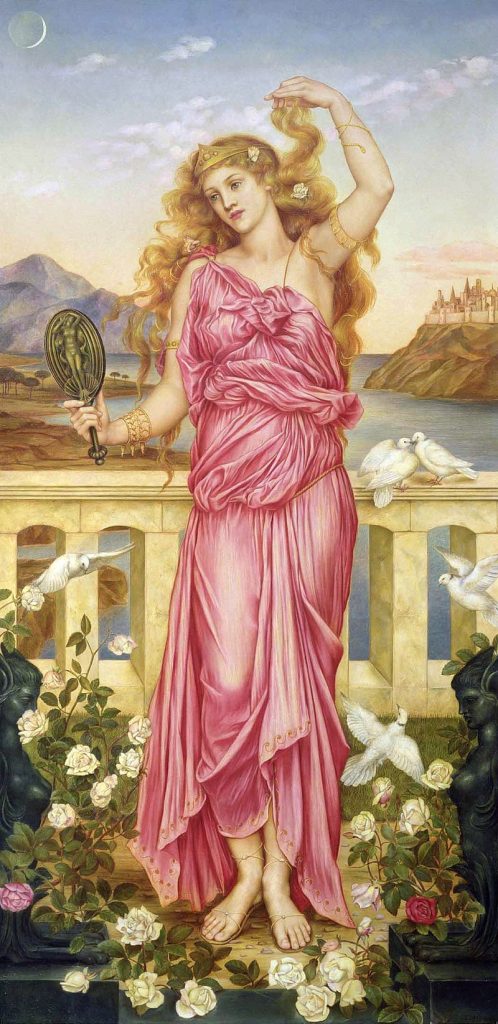
Helen is the daughter of Leda, queen of Sparta, and Zeus. Sister to Polydeuces and half-sister to Castor and Clytemnestra. Wife of Menelaus, Helen was abducted by Paris, and this event contributed to the start of the Trojan War.
Trojan War: Roleplaying in the Age of Homeric Adventure
A Mythic Vistas Sourcebook for the d20 System
Written by Aaron Rosenberg
Helen is the most beautiful woman in the world, tall and shapely with long golden hair and lovely blue eyes. She is the daughter of Zeus and Leda and the wife of Menelaus of Sparta. Paris seduced her and convinced her to run away to Troy with him, where she lives as his wife. Her departure was the cause of the Trojan War.
Helen is very soft-spoken and very tenderhearted. She feels a great deal of guilt for her part in the war, and constantly berates herself for giving in to Paris’ entreaties. Helen does her best to stay out of the way of the other Trojan women, who despise her for what she has caused. Her only real allies are Priam and Hector, who are both kind to her, and of course, Paris himself.
| Helen | |
| Female major divine off spring Bard 4 | |
| Medium-size humanoid | |
| Hit Dice | 4d6+4; hp 18 |
| Initiative | +3 |
| Speed | 35 ft. |
| Armor Class | 16, touch 13, flat-footed 13; |
| Base Attack/Grapple | +3/+3; |
| Attack | +3 melee (1d4, dagger); |
| Full Attack | +3 melee (1d4, dagger); |
| Space/Reach | 5 ft./5 ft. |
| Special Attacks | spells |
| Special Qualities | bardic knowledge, bardic music, countersong, fascinate, inspire competence, inspire courage +1, +4 to saving throws against divine spells; |
| Saves | Fort +2, Ref +5, Will +6; |
| Abilities | Strength 11, Dexterity 16, Constitution 12, Intelligence 10, Wisdom 14, Charisma 21. |
| Skills | Appraise +7 (+9 woven goods), Craft (weaving) +7, Diplomacy +14, Intimidate +7, Knowledge (nobility and royalty) +7, Perform (sing) +12, Sense Motive +9; |
| Feats | Distinctive*, Stunning*. |
| Environment | – |
| Organization | – |
| Challenge Rating | 6 |
| Treasure | – |
| Alignment | Chaotic Neutral |
Bard Spells Known (Cast per Day 3/3/1; save DC 13 + spell level):
- 0 – daze, detect magic, light, lullaby, mending, Song of Serenity;
- 1st – Allure, charm person, remove fear;
- 2nd – Beguile, eagle’s splendor.
Possessions: elegant robes and girdle, beaded sandals, ivory-handled dagger.
Treasure
Helen of Troy, Queen of Sparta does not carry treasure like a dungeon opponent. Her possessions are royal, diplomatic, and politically dangerous.
Typical Gear: silver dagger, royal Spartan jewellery worth 2,000 gp, fine court garments worth 500 gp, signet or royal token, sealed correspondence, and one divine or politically sensitive keepsake tied to Sparta, Troy, Aphrodite, Menelaus, Paris, or her brothers.
Campaign Treasure: Helen’s true treasure is access. Her favour may open courts, delay wars, expose false treaties, reveal divine pressure, or force kings to answer questions they would rather bury.
Best Uses in Play
The Treaty That Names Her but Excludes Her
Two kingdoms negotiate a settlement over Helen’s fate. The treaty discusses dowry, insult, restitution, honour, hostage exchange, and divine appeasement. Helen is present, silent, and legally central.
If the characters insist she speak, the treaty may become more just, but much harder to sign.
The Goddess’s Debt
Aphrodite’s servants arrive to remind Helen that divine gifts are not free. They do not threaten her crudely. They ask her to smile at the right man, soften the right witness, enter the right city, or remain silent at the right moment.
Refusing them protects Helen’s agency but risks divine retaliation.
The Widow’s Accusation
A woman whose sons died in war confronts Helen in public. The scene should not be solved by proving the widow wrong. The better question is whether Helen, the party, and the court can face grief without turning it into propaganda.
Adventure and Worldbuilding Hooks
The False Helen
A court claims Helen never went to Troy at all, and that a divine phantom, glamour, or substitute bore the blame. This may be true, false, or politically useful. The party must decide whether exposing the truth would heal the war’s memory or destroy the last fragile peace.
The Oath Reawakens
The old oath around Helen’s marriage is invoked again. Descendants of former kings are being compelled by divine law to answer a claim they thought long dead. The party must decide whether the oath is sacred justice, legal rot, or a weaponised relic.
The Face No Artist Can Finish
Every artist who paints Helen either goes mad, paints someone else, or produces an image that causes violence among viewers. A temple wants the party to recover the only completed portrait, sealed beneath a ruined shrine of Nemesis.
Running Helen Without Making Her Boring
Do not make Helen of Troy, Queen of Sparta a simple charm effect.
Do not make every man stupid around her.
Do not make every woman jealous of her.
Do not make her innocent in a dull way.
Do not make her guilty in a lazy way.
The stronger rule is:
Helen makes people reveal themselves.
A loyal knight becomes protective.
A weak prince becomes possessive.
A bitter queen becomes cruel.
A grieving mother becomes fearless.
A poet becomes dishonest.
A king becomes opportunistic.
A priest becomes afraid of what the gods have done.
A clever player character may realise that the real question is not whether Helen is beautiful, but who benefits from making her beauty the explanation for everything.
Source and Literary Context
Helen of Troy, Queen of Sparta belongs to one of the richest and most contested traditions in Greek myth and epic. She is usually remembered as the most beautiful woman in the world and as the woman whose departure with Paris became the human centre of the Trojan War. A useful general reference is Encyclopaedia Britannica’s entry on Helen of Troy.
Her story should not be flattened into a simple tale of seduction or blame. The divine background matters. The Judgement of Paris places Helen inside a quarrel among goddesses before mortal politics can contain her. Theoi’s material on the Judgement of Paris is useful for understanding how Aphrodite’s promise of Helen binds desire, divine rivalry, and royal disaster together.
For campaign use, Helen of Troy, Queen of Sparta works best as a living legendary queen rather than a distant literary symbol. She is beautiful because the myth requires it. She is dangerous because everyone else decides what that beauty means.
Keep this reference growing
If this page helped with your reading or game, you can support its upkeep or explore the curated books.
Explore the Bookshop — epics, classics and stories behind imagined worlds.