
Little John — Giant of the Greenwood
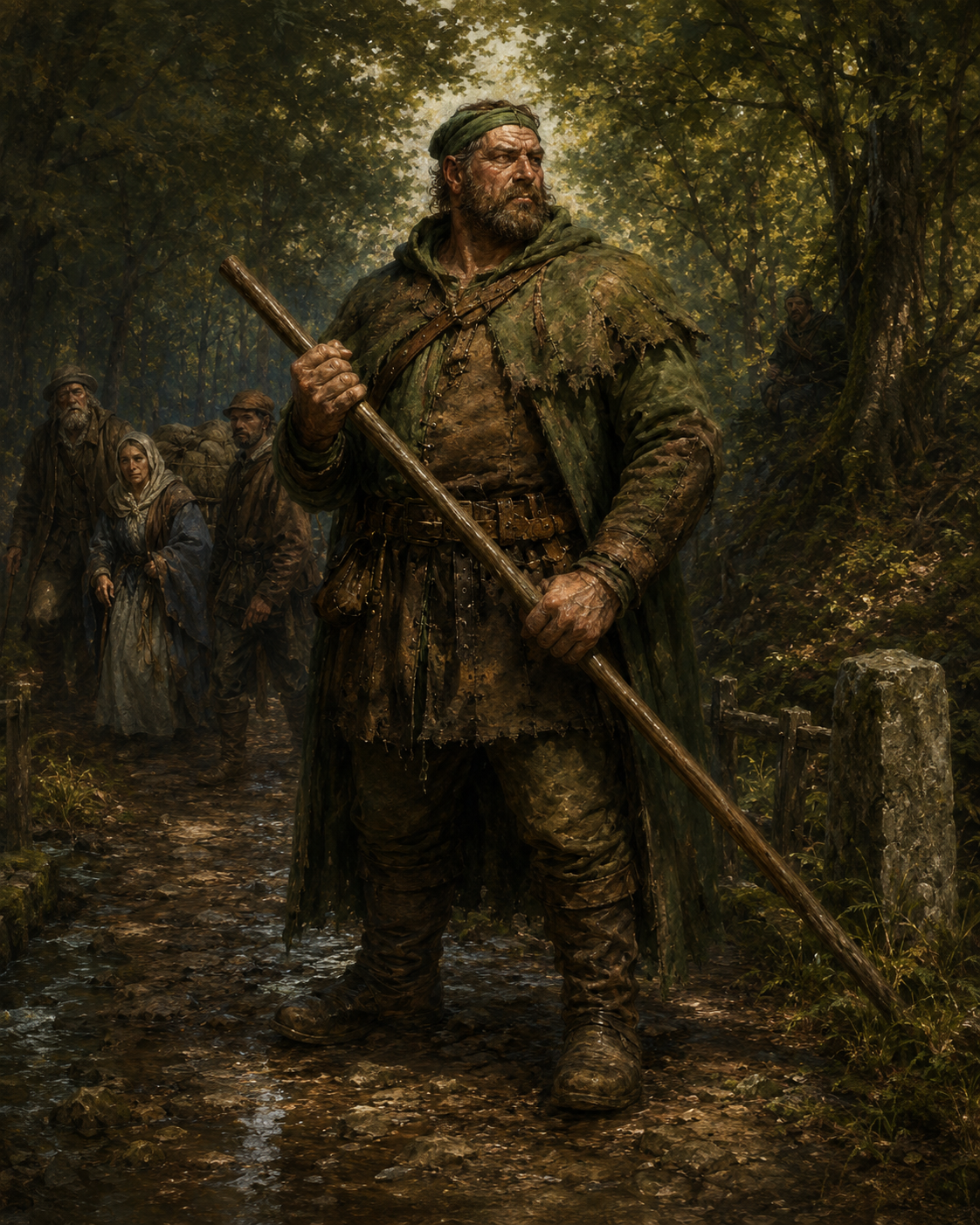
A towering staff-master and Robin Hood’s most trusted companion, Little John is the outlaw who holds the bridge, breaks the sheriff’s line, and keeps the greenwood band from becoming ordinary thieves.
At a Glance
- Name: Little John
- Possible Birth Name: John Little
- Aliases: John Naylor, the Giant of the Greenwood, Robin Hood’s Right Hand, the Bridge-Holder
- Gender: Male
- Race: Human
- Occupation: Outlaw lieutenant, quarterstaff master, forester, ambush captain, protector of the Merry Men
- Religion: Old English woodland custom; reverence for oath-places, ancestral dead, household spirits, sacred groves, and the hidden powers of the greenwood
- Nationality: English
- Region: Sherwood Forest, Barnsdale, Nottinghamshire, Yorkshire road country, royal forests
- Base of Operations: Hidden greenwood camps, outlaw shelters, river crossings, mill tracks, deer paths, and road ambush sites
- Languages: English, local road cant, outlaw signs, forest calls
- Alignment: Chaotic Good
- Affiliations: Robin Hood; the Merry Men; dispossessed yeomen; poor tenants; sympathetic millers, charcoal-burners, tinkers, widows, and forest labourers
- Allies: Robin Hood, Much the Miller’s Son, Will Scarlet, Alan-a-Dale, loyal foresters, poor informants, hidden village supporters
- Enemies: The Sheriff of Nottingham, corrupt royal foresters, tax collectors, greedy abbots or temple-officials, hired serjeants, bounty hunters, oath-breaking nobles
- Significant Relationships: Robin Hood as captain and sworn friend; the Merry Men as chosen kin; the poor as the people whose suffering justifies his outlawry
Little John is the great weight at the centre of Robin Hood’s company. Robin is the famous archer, outlaw captain, and laughing enemy of unjust power; Little John is the man who makes the legend survive hunger, betrayal, winter rain, and pursuit.
His size is the first thing people remember. His steadiness is the second. He is broad enough to block a doorway, strong enough to turn a quarterstaff into a battlefield weapon, and patient enough to wait all night beside a road if that is what the rescue requires. His name is a joke, an insult, an oath-name, and a badge of affection all at once: “Little” because no one who sees him could mistake him for small.
He is not Robin’s servant. He is Robin’s second. In the strongest versions of the tradition, Little John earns his place by meeting Robin in open challenge, fighting him with staves at a narrow crossing, and proving himself worthy before friendship begins. That matters. Little John follows Robin because he has judged him, tested him, and chosen him.
At the table, Little John should not feel like a generic brute. He is a practical heroic outlaw: a staff-master, ambush captain, camp protector, oath-keeper, and the man most likely to stop the Merry Men from becoming what their enemies claim they are.
Character
Little John’s defining virtue is loyalty, but it is not blind obedience. He follows Robin because Robin’s outlawry has a purpose: redress, rescue, ransom, public humiliation of corrupt authority, and food for those crushed by law without mercy.
He is one of the few men in the band who can contradict Robin and survive the moment. If Robin becomes vain, reckless, or cruel, Little John says so. He may do it with a joke, a warning hand on the staff, or a blunt sentence spoken where only Robin can hear it.
Little John is morally practical. He will rob a corrupt official, lie to a sheriff’s officer, break a forester’s wrist, and hide stolen coin in a widow’s thatch without apology. But he despises pointless cruelty. Prisoners, poor travellers, servants, children, and frightened villagers are not prey. Any outlaw who forgets that becomes his problem.
Life and Exploits
Little John’s most famous origin is the staff-fight at the crossing. Robin meets a huge stranger on a narrow bridge, log, or stream crossing. Neither man yields. Words become blows. The fight is not merely comic; it is a test of pride, courage, balance, and public honour. When the stranger proves Robin’s match, he is welcomed into the band and given the ironic name Little John.
This scene gives Little John his strongest campaign function. He is not recruited because he is useful muscle. He earns belonging through danger. That makes his loyalty difficult to buy, frighten, or flatter away.
Later, he becomes Robin’s chief man: the one who escorts prisoners, guards hidden camps, carries heavy coin, tests strangers, rescues trapped allies, and holds the line when the sheriff’s men finally find a path through the trees. He may disguise himself as a servant, traveller, porter, beggar, or guard, but he is never truly invisible. Something about his size, gait, or silence always gives him away to anyone who knows how outlaws move.
Motives
Little John wants the greenwood band to remain just.
He knows hunger can turn rebels into thieves and vengeance can turn wronged men into murderers. Robin’s name protects the poor only while the band behaves better than the men hunting them. If that oath breaks, the forest becomes a den of killers, and every village that once sheltered them will pay.
He also wants unjust power embarrassed in public. Quiet revenge is useful, but public humiliation changes the story. A sheriff robbed before witnesses, a greedy temple official forced to dine with the poor, a tax-cart returned to the villages it bled — these things matter because they make fear change sides.
Fears
Little John fears Robin’s death less than what may follow it. If Robin falls, every ambitious knife-man, hungry exile, and pardoned informer may try to claim the outlaw king’s name. The poor will be punished for songs they did not write. The forest will fill with men who remember the freedom but not the oath.
He also fears betrayal from within. Soldiers can be fought. Dogs can be misled. Hunger can be endured. But one frightened informant with knowledge of the winter camp can destroy everything.
Game Statistics
5.5e / 2024
Little John, Giant of the Greenwood
Little John, Giant of the Greenwood
Medium Humanoid, Chaotic Good
Armour Class 16
Initiative +2
Hit Points 112
Speed 30 ft.
Proficiency Bonus +3
Saving Throws Str +8, Con +7, Wis +5
Skills Athletics +11, Insight +5, Intimidation +5, Perception +5, Stealth +5, Survival +5
Senses passive Perception 15
Languages English, road cant, outlaw signs, forest calls
Challenge 6
| STR | DEX | CON | INT | WIS | CHA |
|---|---|---|---|---|---|
| 20 (+5) | 14 (+2) | 18 (+4) | 11 (+0) | 15 (+2) | 13 (+1) |
Greenwood Giant. Little John counts as one size larger when determining what he can carry, push, drag, lift, grapple, or shove.
Bridge-Holder. Little John has advantage on ability checks and saving throws made to resist being shoved, knocked prone, grappled, dragged, or forcibly moved.
Outlaw’s Restraint. Little John can deal nonlethal damage with any melee weapon attack. When he reduces a creature to 0 hit points this way, he may also knock it prone or disarm it.
Forest Ambusher. Little John has advantage on Dexterity checks made to hide or move quietly in forests, hedgerows, rain, dusk, broken roads, or natural cover.
Robin’s Right Hand. When an ally Little John can see within 30 feet is hit by an attack, Little John can use his reaction to move up to half his speed toward that ally. If he ends this movement within 5 feet of the ally, the ally gains resistance to the attack’s damage.
Actions
Multiattack. Little John makes two Quarterstaff attacks. He may replace one attack with a Shove, Grapple, or Disarm attempt.
Quarterstaff. Melee Weapon Attack: +8 to hit, reach 10 ft., one target. Hit: 14 (2d8 + 5) bludgeoning damage. If the target is Medium or smaller, Little John may force it to make a DC 16 Strength saving throw. On a failure, the target is knocked prone, pushed 5 feet, or disarmed.
Hooking Sweep. Little John makes one Quarterstaff attack against up to two creatures within 10 feet of him. A creature hit by this attack takes 14 (2d8 + 5) bludgeoning damage and must succeed on a DC 16 Strength saving throw or fall prone.
Greenwood Grapple. Melee Attack: +8 to hit, reach 5 ft., one creature. Hit: 9 (1d8 + 5) bludgeoning damage, and the target is grappled. Until the grapple ends, the target has disadvantage on attack rolls against creatures other than Little John.
Longbow. Ranged Weapon Attack: +5 to hit, range 150/600 ft., one target. Hit: 6 (1d8 + 2) piercing damage. Little John can use a bow, but he is not Robin Hood.
Bonus Actions
Plant the Staff. Until the start of his next turn, Little John controls the ground around him. A hostile creature that enters his reach for the first time on a turn provokes an opportunity attack from him.
Shoulder Through. Little John moves up to 10 feet in a straight line. If he moves through the space of a Medium or smaller hostile creature, that creature must succeed on a DC 16 Strength saving throw or be pushed 5 feet aside.
Reactions
Staff-Parry. Little John adds +3 to his AC against one melee attack that would hit him. If the attack misses, he may move the attacker 5 feet to an unoccupied space within his reach.
Take Me Instead. When a creature within 5 feet of Little John is targeted by a melee attack, Little John may become the target instead.
Little John — 5e / 2014
Medium humanoid (human), chaotic good
Armor Class 16; Hit Points 112; Speed 30 ft.; Challenge 6 (2,300 XP; proficiency bonus +3)
STR 20 (+5), DEX 14 (+2), CON 18 (+4), INT 11 (+0), WIS 15 (+2), CHA 13 (+1)
Saving Throws Str +8, Con +7, Wis +5; Skills Athletics +11 (expertise), Insight +5, Intimidation +5, Perception +5, Stealth +5, Survival +5; Senses passive Perception 15; Languages English, outlaw signs
Traits
Greenwood Giant. Little John counts as one size larger when determining carrying capacity and the weight he can push, drag or lift; he remains Medium for combat and grappling size limits.
Bridge-Holder. Little John has advantage on ability checks and saving throws against being knocked prone, grappled or moved against his will.
Forest Ambusher. Little John has advantage on Dexterity (Stealth) checks made in natural forest cover.
Outlaw’s Restraint. When Little John reduces a creature to 0 hit points with a melee attack, he may knock it unconscious rather than kill it, following the 2014 rules for knocking a creature out.
Actions
Multiattack. Little John makes two quarterstaff attacks, and he may replace one with a grapple or shove attempt.
Quarterstaff. Melee Weapon Attack: +8 to hit, reach 10 ft., one target. Hit: 14 (2d8 + 5) bludgeoning damage; the oversized staff and combat training are NPC-specific and do not modify an ordinary player’s quarterstaff.
Hooking Sweep. Little John makes one quarterstaff attack against each of up to two different creatures within 10 feet. A creature hit must succeed on a DC 16 Strength saving throw or fall prone.
Longbow. Ranged Weapon Attack: +5 to hit, range 150/600 ft., one target. Hit: 6 (1d8 + 2) piercing damage.
Reaction
Robin’s Right Hand. When an ally Little John sees within 30 feet is hit, he may move up to half his speed towards that ally without provoking opportunity attacks. If he ends within 5 feet of the ally, the ally gains resistance to the triggering attack’s damage.
Original NPC adaptation using 5e/2014 grappling, attack and damage terminology.
Pathfinder 1e
Little John, Giant of the Greenwood
CR 7
XP 3,200
Male human outlaw fighter
CG Medium humanoid
Init +2; Senses Perception +12
Defence
AC 20, touch 12, flat-footed 18
hp 91
Fort +11, Ref +7, Will +5
Defensive Abilities bravery +2, uncanny footing
Offence
Speed 30 ft.
Melee masterwork quarterstaff +16/+11 (1d6+10) or heavy club +15/+10 (1d8+7)
Ranged longbow +11/+6 (1d8+2/x3)
Special Attacks staff sweep, powerful shove, nonlethal mastery
Statistics
Str 20, Dex 14, Con 18, Int 11, Wis 15, Cha 13
Base Atk +8; CMB +13; CMD 25
Feats Combat Expertise, Combat Reflexes, Improved Bull Rush, Improved Trip, Power Attack, Stand Still, Toughness, Weapon Focus (quarterstaff)
Skills Acrobatics +8, Climb +13, Intimidate +10, Knowledge (local) +8, Perception +12, Sense Motive +10, Stealth +10, Survival +12, Swim +10
Languages English, road cant, outlaw signs, forest calls
Gear masterwork quarterstaff, longbow with 20 arrows, heavy knife, leather jack, greenwood cloak, rope, horn, stolen warrants, field rations, mixed coin worth 40 gp
Special Abilities
Staff Sweep. As a standard action, Little John may make a trip attempt against one creature within reach without provoking an attack of opportunity. If the attempt succeeds by 5 or more, he may also push the target 5 feet.
Powerful Shove. Little John gains a +2 bonus on bull rush and reposition attempts against creatures of his size or smaller.
Uncanny Footing. Little John gains a +4 bonus to CMD against bull rush, trip, reposition, and overrun attempts while standing on a bridge, stream crossing, road, threshold, fallen tree, riverbank, or similarly narrow terrain.
Nonlethal Mastery. Little John may deal nonlethal damage with his quarterstaff without taking the normal penalty.
Little John — D&D 3.5e
CR 7; male human fighter 6/rogue 2; CG Medium humanoid (human); Hit Dice 6d10+2d6+32 (74 hp); Initiative +6; Speed 30 ft.
Defence
Armour Class 19, touch 13, flat-footed 17 (+5 +1 chain shirt, +2 Dex, +1 deflection, +1 dodge); Fort +9, Ref +7, Will +4; Special Qualities evasion, trapfinding.
Offence
Base Attack/Grapple +7/+12; Attack masterwork quarterstaff +14 melee (1d6+7), or longbow +9 ranged (1d8/×3); Full Attack masterwork quarterstaff +14/+9 melee (1d6+7), or longbow +9/+4 ranged (1d8/×3); Space/Reach 5 ft./5 ft.; Special Attacks sneak attack +1d6 when conditions apply.
Greenwood Giant (Ex). Little John counts as one size category larger for carrying capacity and breaking ordinary objects. He remains Medium for reach, grapples and weapon damage unless an independent effect states otherwise.
Bridge-Holder (Ex). John gains a +4 bonus on opposed ability checks to resist bull rush, grapple or trip attempts while standing on solid ground.
Nonlethal Mastery (Ex). John may deal nonlethal damage with a quarterstaff without the usual −4 attack penalty.
Statistics
Abilities Str 20, Dex 14, Con 18, Int 11, Wis 14, Cha 13; Feats Cleave, Combat Reflexes, Endurance, Improved Bull Rush, Improved Initiative, Improved Overrun, Power Attack, Toughness, Weapon Focus (quarterstaff).
Skills Climb +14, Hide +7, Intimidate +10, Jump +14, Listen +11, Move Silently +7, Sense Motive +9, Spot +11, Survival +11, Swim +12; Languages English, cant and forest signs.
Equipment +1 chain shirt, masterwork quarterstaff, longbow and 20 arrows, ring of protection +1, rough cloak, bridge rope and forest provisions.
Tactics
Before Combat John takes a narrow bridge or choke point. During Combat He protects weaker companions, shoves intruders back and uses nonlethal blows whenever possible. Morale He falls back when the Merry Men are safely away.
Original 3.5e version of the established Sherwood fighter. His quarterstaff is wielded as a two-handed weapon; the normal 3.5e reach, attacks of opportunity and grappling rules apply. Encounter XP for Robin Hood’s other allies is separate.
What Is Little John Doing Now?
Little John is keeping the Merry Men organised while Robin moves between negotiations, ambushes and village contacts. He tests new recruits, guards crossings, inspects camps and makes sure fear or hunger does not turn the band into common robbers.
Encounters
- The Bridge: John blocks a crossing and demands to know whose business the party carries into Sherwood.
- The Broken Camp: A safe camp has been compromised and John needs help moving wounded outlaws.
- The New Recruit: John asks the party to test someone who claims to have escaped the Sheriff.
Personality
Blunt, steady and protective. John enjoys contests of strength but distrusts showmanship when lives are at stake. He is often the person willing to tell Robin that a clever plan is becoming too clever.
Relationships
Robin Hood: closest friend and captain. Friar Tuck: trusted sparring partner and counsellor. Will Scarlet: younger outlaw John watches when enthusiasm outruns judgement.
Equipment and Treasure
Little John does not carry treasure like a knight or lord. His wealth is practical, hidden, and usually held for the band.
At a Glance
- Masterwork quarterstaff: A long, seasoned ash or oak staff, battered at both ends and worn smooth at the grip.
- Greenwood cloak: Heavy wool treated by smoke, mud, rain, and use; good for concealment, warmth, and sleeping rough.
- Outlaw horn: Used to call allies, signal danger, or scatter a camp before soldiers arrive.
- Hidden purse: 20–80 gp in mixed coin, usually taken from tax men, corrupt officials, or wealthy travellers.
- Rescue cache: A larger hidden fund of 300–600 gp may be buried in a hollow oak, miller’s loft, charcoal pit, or widow’s outbuilding. It is used for ransoms, bribes, food, medicine, replacement tools, and buying back seized land.
- Captured warrants: Useful evidence against the sheriff’s men, especially if the party needs proof rather than another ambush.
Using Little John in Your Game
Little John works best when introduced in action.
He may be holding a bridge while frightened peasants cross behind him. He may be disguised as a porter in a noble hall, quietly watching which door the guards protect. He may block the party’s road and demand to know why armed travellers are moving under the sheriff’s protection.
He should create immediate pressure. If the party is just but reckless, he tests them. If they are cruel, he opposes them. If they are hunted, he can become the difference between escape and a hanging. If they betray the poor, he becomes an enemy who knows the roads better than they do.
Do not play him as stupid muscle. Little John is not subtle in the courtly sense, but he understands hunger, fear, informants, ambushes, road movement, hostage exchanges, and the difference between lawful authority and justice.
Adventure Hooks
The Bridge That Will Not Yield: A narrow forest bridge is blocked by a huge outlaw with a staff. He refuses passage unless the party explains why armed travellers are moving under the sheriff’s protection. This can become a duel, negotiation, test of honour, or recruitment scene.
Robin Is Taken: Robin Hood has been captured after trusting the wrong messenger. Every known Merry Man is being watched, so Little John needs outsiders to help attempt the rescue. The party must choose between legal safety and outlaw justice.
The Sheriff’s False John: The sheriff hires a giant mercenary to dress as Little John and commit murders in his name. The real Little John wants the impostor exposed publicly before the villages turn against the Merry Men.
Source and Literary Context
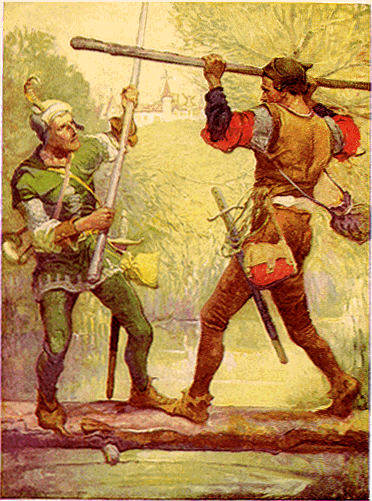
Little John is one of the central companions of Robin Hood and one of the most enduring figures in the Robin Hood tradition. He is usually presented as Robin’s close companion, lieutenant, and mighty staff-fighter. His name is generally treated as ironic, since he is commonly portrayed as exceptionally large. Joseph Ritson’s public-domain collection Robin Hood: A Collection of All the Ancient Poems, Songs, and Ballads includes several Little John episodes, including “Little John and the Four Beggars” and “Robin Hood and Little John,” the latter presenting their first meeting, fierce encounter, agreement, and the origin of his name. For the text, see Project Gutenberg’s edition of Ritson’s Robin Hood collection.
The Robin Hood tradition is not a single fixed biography, but a layered body of ballads, local claims, antiquarian collections, plays, and later retellings. That makes Little John especially useful in a campaign: he can be treated as a grounded English outlaw, a legendary greenwood champion, or both at once. His defining literary image is the huge stranger at the crossing, staff in hand, refusing to yield until Robin himself proves worthy of friendship. His strongest role is not simply as Robin Hood’s large companion, but as the oath-keeper and practical second-in-command who keeps the outlaw band tied to justice rather than mere theft.
Related Places and People
Mythical and Historical Context
Little John is one of the oldest named companions of Robin Hood. His prominence in early ballads is older than the familiar bridge-staff duel, whose popular surviving versions were recorded centuries after 1454. Here, the bridge-keeper and second-in-command is a living legendary figure active during the campaign’s present. For the distinctions between early and later traditions, see the University of Rochester’s Little John research.
Sources and Adaptation
Adapted from the public-domain Robin Hood ballad and folk tradition, where Little John is Robin’s great staff-fighting companion and one of the central Merry Men. No text is reproduced from modern copyrighted adaptations.
Keep this reference growing
If this page helped with your reading or game, you can support its upkeep or explore the curated books.
Explore the Bookshop — epics, classics and stories behind imagined worlds.