
Sir Lionel of Ganis — Fierce Brother-Knight of the Round Table
Sir Lionel is the Round Table’s fierce brother-knight: noble, loyal, and terrifying when wounded honour becomes wrath.
- Name: Sir Lionel
- Also Known As: Lyonel, Lionello, Lionel of Ganis, the Lion-Wrath of Ganis
- Tradition: Arthurian romance, especially the Lancelot-Grail and Malory traditions
- Culture: Arthurian / Breton-Gaulish romance tradition
- Lineage: Son of King Bors of Ganis and Queen Evaine
- Kin: Brother of Sir Bors the Younger; kinsman of Sir Lancelot
- Role: Knight of the Round Table, prince-knight of Ganis, Grail-era trial figure
- Status: Living heroic NPC by default
- Homeland: Ganis / Gaunes / Gannes, with strong ties to Camelot and Lancelot’s kinship network
- Sacred Allegiance: The Round Table oath, the Grail mystery, and the honour of his house
- Suggested Alignment: Lawful Good, wrath-troubled
- Creature Type: Humanoid
- Use in Play: Ally, rival, judge, tournament threat, oath-crisis NPC, tragic Round Table pressure point
Quick DM Use
Use Sir Lionel when a heroic knight needs to make the situation harder rather than easier. He is brave, legitimate, and dangerous. He protects honour, punishes oathbreakers, and escalates scenes where patience might have saved lives.
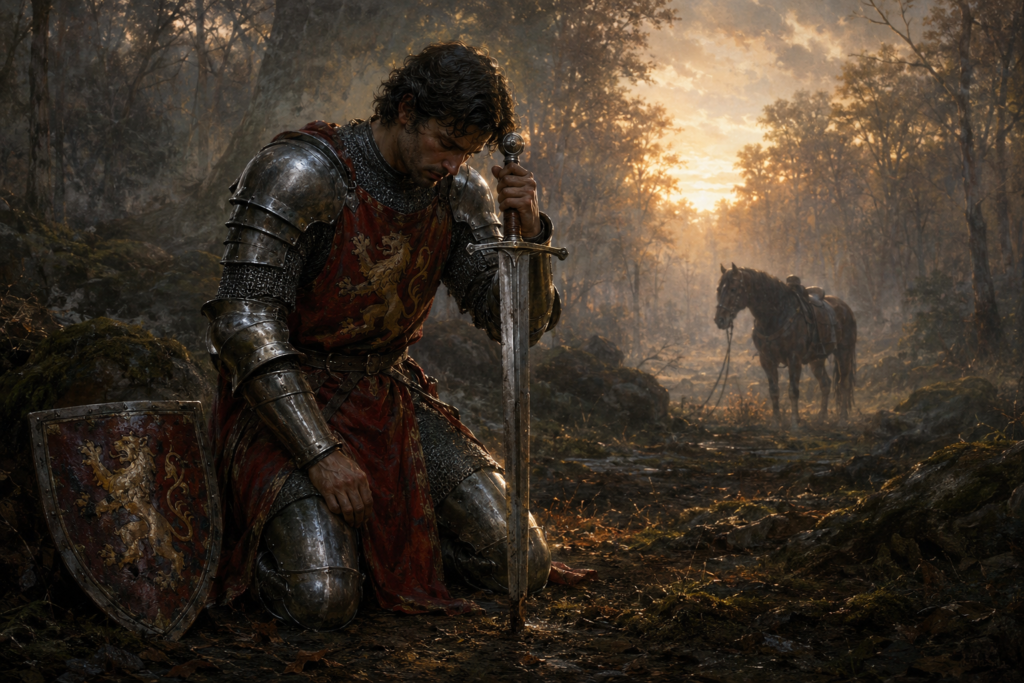
His core pressure point is humiliation remembered as betrayal. As a young knight, Lionel is captured and brutalised by Turquine. Later, during the Grail Quest, he sees Bors choose to save a threatened maiden rather than rescue him. Lionel survives, but the pattern repeats in his mind: once again he was helpless, beaten, and left behind.
That wound makes him useful at the table. He is not merely angry. He is a knight who cannot bear being abandoned twice.
Mechanics Tabs
The rules below are mechanics compatible for different game editions.
Sir Lionel 5.5e
Sir Lionel, Pathfinder 1e / 3.5e
Sir Lionel 5.5e-Compatible Rules
Sir Lionel, Lion-Wrath of Ganis
Medium Humanoid, Lawful Good, Wrath-Troubled
Challenge: 9
Proficiency Bonus: +4
Armor Class: 20, plate and shield
Initiative: +1
Hit Points: 153
Speed: 30 ft.
| STR | DEX | CON | INT | WIS | CHA |
|---|---|---|---|---|---|
| 18 (+4) | 12 (+1) | 16 (+3) | 12 (+1) | 13 (+1) | 16 (+3) |
Saving Throws: Str +8, Con +7, Wis +5, Cha +7
Skills: Animal Handling +5, Athletics +8, History +5, Insight +5, Intimidation +7, Perception +5, Persuasion +7
Senses: passive Perception 15
Languages: French, Breton, Latin; formal Arthurian heraldic speech
Equipment: plate armour, shield, longsword, lance, dagger, warhorse if encountered mounted
Traits
Knight of the Round Table. Lionel has advantage on saving throws against being frightened while he can see a sworn ally, noble banner, or recognised knightly standard within 60 feet.
House of Ganis. Lionel has advantage on Charisma checks made among Arthurian knights, Breton nobles, Lancelot’s kin, and courts that honour the Round Table.
Lion-Wrath. When Lionel is reduced to half his hit points or fewer, or when a creature he can see publicly dishonours him, betrays an oath, imprisons him, abandons him, or harms one of his kin, he can enter Lion-Wrath for 1 minute. While in Lion-Wrath, Lionel has advantage on melee weapon attacks, and his melee weapon attacks deal an extra 1d8 damage. During this state, he has disadvantage on Wisdom checks and Wisdom saving throws made to disengage from a personal challenge, accept surrender, or show mercy.
Dangerous Honour. If a creature Lionel has challenged willingly moves more than 30 feet away from him without first taking the Disengage action, Lionel can use his reaction to move up to half his speed toward that creature and make one melee attack.
Mercy Test. The first time Lionel would reduce a creature he knows as kin, sworn ally, guest, or fellow knight to 0 hit points, he must make a DC 15 Wisdom saving throw. On a success, he may leave the creature at 1 hit point. On a failure, he must complete the blow unless stopped by another creature, sacred intervention, or a successful DC 17 Charisma check made as an action by someone invoking kinship, oath, public honour, or the Round Table.
Recognised Knight. In lands that recognise Arthurian or Breton-Gaulish chivalry, killing, imprisoning, or humiliating Lionel without lawful cause can trigger feud, ransom demand, formal challenge, or court inquiry.
Actions
Multiattack. Lionel makes three Longsword attacks.
Longsword. Melee Weapon Attack: +8 to hit, reach 5 ft., one target. Hit: 8 (1d8 + 4) slashing damage, or 9 (1d10 + 4) slashing damage if used with two hands. While Lion-Wrath is active, the attack deals an extra 4 (1d8) slashing damage.
Lance. Melee Weapon Attack: +8 to hit, reach 10 ft., one target. Hit: 10 (1d12 + 4) piercing damage. If Lionel is mounted and moved at least 20 feet straight toward the target immediately before the hit, the target takes an extra 7 (2d6) piercing damage and must succeed on a DC 16 Strength saving throw or be knocked prone.
Shield-Hammer. Melee Weapon Attack: +8 to hit, reach 5 ft., one target. Hit: 7 (1d6 + 4) bludgeoning damage, and the target must succeed on a DC 16 Strength saving throw or be pushed 10 feet.
Lionel’s Challenge. Lionel chooses one creature he can see within 60 feet. Until the start of Lionel’s next turn, that creature has disadvantage on attack rolls against creatures other than Lionel while Lionel is within its reach or line of sight.
Bonus Actions
Press the Shame. Lionel targets one creature he has hit this turn. The target must succeed on a DC 15 Wisdom saving throw or have disadvantage on the next attack roll it makes before the end of its next turn unless that attack includes Lionel as a target.
Knightly Advance. Lionel moves up to 15 feet toward a creature he has challenged. This movement does not provoke opportunity attacks from that creature.
Reactions
Interpose Shield. When an ally within 5 feet of Lionel is hit by an attack, Lionel can impose disadvantage on the attack roll, potentially causing it to miss.
No Flight from Honour. When a creature Lionel has challenged leaves his reach, Lionel makes one Longsword attack against it.
Combat Tactics
Lionel opens with formal challenge, then closes aggressively. Mounted, he favours the lance and tries to unhorse proud opponents in public view. On foot, he uses shield pressure and relentless sword-work.
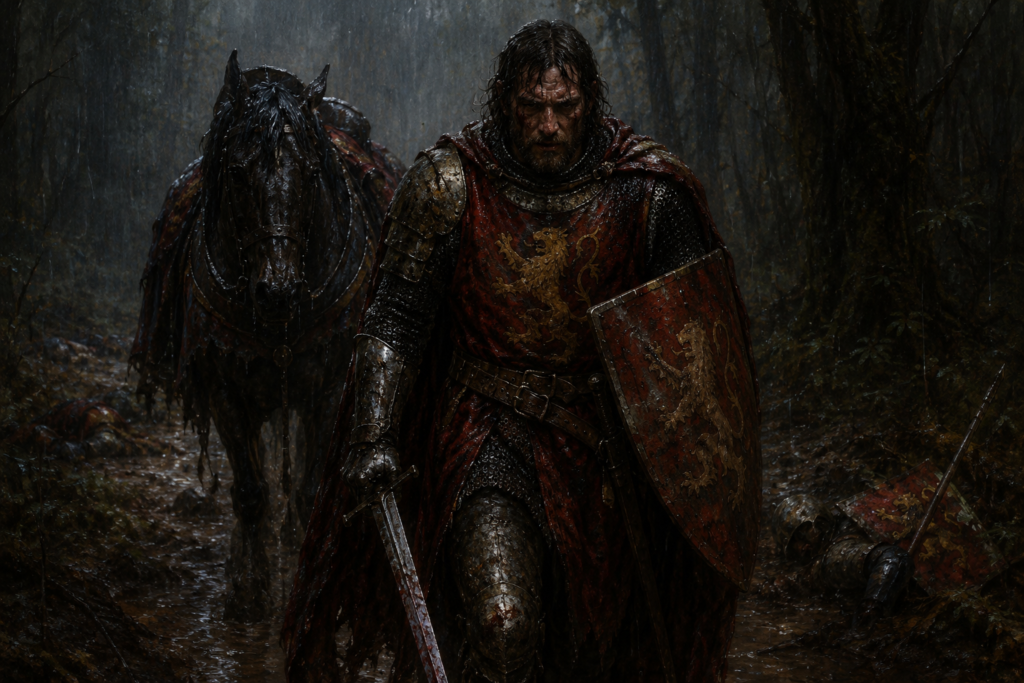
Once Lion-Wrath begins, he stops fighting like a disciplined court champion and starts fighting like a man trying to answer pain with steel.
Against strangers, Lionel may accept yield. Against oathbreakers, false knights, kin-betrayers, captors, or those who shame him publicly, he may need to be restrained or forced to see what he is becoming.
Sir Lionel, Pathfinder 1e / 3.5e-Compatible Rules
Sir Lionel, Lion-Wrath of Ganis
CR: 10
XP: 9,600
Male human knight 11
Alignment: Lawful good, wrath-troubled
Init: +2
Senses: Perception +13
Defence
AC: 24, touch 11, flat-footed 23
hp: 112
Fort: +10
Ref: +5
Will: +10
Defensive Abilities: bravery +3, knightly resolve 2/day
Offence
Speed: 20 ft. in armour, 30 ft. without armour
Melee: +2 longsword +18/+13/+8 (1d8+6/19–20)
Mounted Melee: +1 lance +16/+11/+6 (1d8+5/x3); mounted charge damage x3 with Spirited Charge
Ranged: dagger +13 (1d4+4)
Special Attacks: challenge 4/day, lion-wrath, mounted charge, oathbound strike
Statistics
| STR | DEX | CON | INT | WIS | CHA |
| 18 | 14 | 16 | 12 | 13 | 16 |
Base Atk: +11
CMB: +15
CMD: 27
Feats: Mounted Combat, Ride-By Attack, Spirited Charge, Power Attack, Weapon Focus (longsword), Shield Focus, Iron Will, Improved Initiative
Skills: Diplomacy +15, Handle Animal +14, Intimidate +17, Knowledge (nobility) +12, Perception +13, Ride +16, Sense Motive +13
Languages: French, Breton, Latin
Gear: +1 full plate, heavy steel shield, +2 longsword, +1 lance, dagger, noble riding gear, warhorse
Special Abilities
Challenge. Lionel may challenge a visible foe as a swift action. Against that foe, he gains +3 damage on melee attacks. He takes a –2 penalty to AC against attacks made by creatures other than the challenged foe while the challenge remains active.
Lion-Wrath. Once per day, when Lionel is reduced below half hit points or sees a serious oath-breach, betrayal of kin, public dishonour, imprisonment, abandonment, or helpless captivity, he may enter Lion-Wrath for 10 rounds. While in this state, he gains a +2 morale bonus to attack rolls, weapon damage rolls, and Will saves against fear, but takes a –2 penalty to Wisdom-based skill checks and Will saves made to accept surrender, break off combat, or show mercy.
Knightly Resolve. Twice per day, Lionel may reroll a failed saving throw against fear, charm, compulsion, or humiliation-based magical effects. He must take the second result.
Oathbound Strike. Against a foe who has broken a sworn oath, attacked a guest under protection, betrayed kin, imprisoned a knight, or struck a surrendered foe, Lionel’s first successful melee attack each round deals +2d6 precision damage.
Mercy Test. If Lionel would reduce a known kinsman, sworn ally, guest, or fellow Round Table knight to 0 or fewer hit points, he must attempt a DC 18 Will save. On a success, he may halt the blow. On a failure, he continues unless physically restrained, magically checked, or confronted by an authority invoking kinship, oath, or sacred law.
Overview
Sir Lionel is one of the hard-edged knights of the Round Table. He is not a shining innocent, not a villain, and not a courtly lover pining after Guinevere. His story is about the violence hidden inside chivalry when honour becomes more sacred than mercy.
Lionel is the brother of Sir Bors the Younger and a kinsman of Sir Lancelot. His bloodline places him inside one of the great Arthurian houses, but his dramatic value comes from the wound beneath the heraldry. As a young man travelling with Lancelot, Lionel is captured by the rogue knight Turquine, whipped with briars, and thrown into prison. That early humiliation marks him.
The wound returns during the Grail Quest. Bors sees Lionel being beaten and dragged away, but must choose between rescuing his brother and saving a young woman being carried off in the opposite direction. Bors saves the woman and fears Lionel dead. Lionel survives, but the abandonment burns into him. When he later meets Bors, he comes not as a brother, but as judge, accuser, and executioner.
Use Lionel when loyalty, oath, family, reputation, public shame, and old trauma need to become dangerous.
Appearance
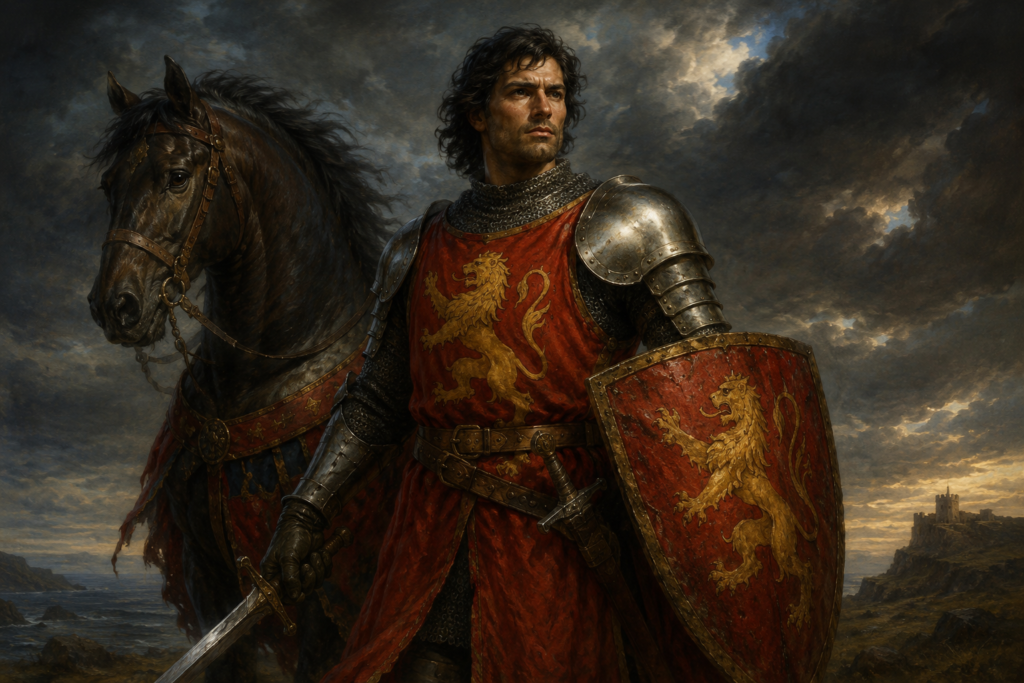
Lionel is a broad-shouldered knight with the controlled stillness of a man used to armour. His face is handsome but severe, with dark, watchful eyes and a jaw that tightens when challenged.
He wears polished plate over mail, a lion-marked surcoat, a heavy sword, and a shield bearing the arms of his house. His colours are deep red, old gold, black leather, and weathered steel.
When calm, he carries himself like a prince. When angered, the courtly surface drops away and the lion appears.
Personality and Behaviour
Lionel is loyal, brave, proud, and painfully sensitive to dishonour. He does not fear wounds, exile, hardship, or death. He fears humiliation. He fears helplessness. He fears being judged lesser than Bors, Lancelot, Galahad, or the holier knights of the Grail.
He is formal before violence. He names the offence, identifies the wrongdoer, and gives the appearance of lawful challenge. That appearance can break quickly if the matter touches captivity, abandonment, broken oath, kinship, or public shame.
Lionel does not enjoy random cruelty. He does not prey on peasants or weak travellers. He is dangerous because he is socially legitimate, politically protected, and strong enough to turn a private wound into a public crisis.
His great flaw is simple: he can mistake vengeance for justice.
Mythic Role
Lionel is the failed mercy test of the Round Table.
Turquine’s dungeon gives him the first wound: a noble knight reduced to a beaten prisoner. The Grail Quest repeats the wound at a higher spiritual level: Bors chooses the innocent stranger over the endangered brother. Bors proves himself worthy by refusing to answer wrath with wrath. Lionel proves himself unworthy by letting pain become murder.
This is why Lionel matters. He is not evil. He is brave, noble, and still spiritually dangerous. He shows that “knightly” does not always mean safe. A sacred quest can reveal holiness in one brother and ruin in another.
Currently in the World
Sir Lionel rides between Camelot, Ganis, and the courts that still remember Lancelot’s house. He appears where oaths are under strain: tournaments, border disputes, noble quarrels, ransom cases, family betrayals, and quests where one life must be weighed against another.
He may arrive as a champion, judge, escort, accuser, or dangerous ally. If the characters insult him, abandon someone under his protection, imprison a knight unlawfully, or expose cowardice in his presence, Lionel does not forget.
He is not a random encounter in armour. He is a prince-knight of major reputation. Harming him, humiliating him, or killing him without lawful cause creates political consequences.
Relationships
Sir Bors the Younger: Bors is Lionel’s brother and deepest wound. Lionel loves him, but the Grail Quest turns that love into rage. Bors sees Lionel being beaten and dragged away, but chooses to rescue a threatened maiden instead. Spiritually, Bors makes the right choice. Personally, Lionel experiences it as abandonment.
Lionel does not hate Bors because Bors is evil. He nearly kills him because Bors chose a higher duty, and Lionel cannot bear the cost of that choice. Bors proves himself worthy by refusing to fight back. Lionel proves the opposite by killing those who try to restrain him.
Sir Lancelot: Lancelot is kin, leader, and impossible standard. Lionel respects him deeply, follows his faction when the Round Table fractures, and lives in the shadow cast by Lancelot’s fame.
Lancelot also belongs to Lionel’s first wound. Lionel is travelling with him when Turquine captures him, and Lancelot’s world is the world into which Lionel’s humiliation is carried.
Sir Turquine: Turquine is the rogue knight who captures Lionel, whips him with briars, and throws him into prison. He is not merely an early enemy. He is the first proof that a noble knight can be made helpless, shamed, and unseen.
Any later captor, jailer, or torturer can awaken this memory in Lionel.
King Arthur: Arthur is Lionel’s king by oath and the centre of the Round Table order. Lionel honours him, but his loyalty to Lancelot’s kin can pull him into conflict when Arthur’s fellowship begins to break.
Sir Calogrenant / Colgrevance: Calogrenant, also called Colgrevance in some Arthurian traditions, is the fellow knight who tries to stop Lionel from killing Bors. His death proves that Lionel’s wrath has crossed from private grievance into public sin.
The Hermit: The slain hermit represents sacred restraint. Lionel’s attack on him marks the moment when anger stops being knightly grievance and becomes spiritual catastrophe.
Adventure Hooks
Turquine’s Briars
Rumours spread that a rogue knight has revived Turquine’s old cruelty: defeated knights are being whipped with briars and thrown into a private dungeon. Lionel joins the hunt, but the crime touches his oldest wound. The characters must stop the captor before Lionel turns justice into slaughter.
The Brother Left Behind
A rescue mission forces the characters to choose between saving a noble ally and protecting a helpless captive elsewhere. Lionel hears of the choice and demands judgement. Bors understands the dilemma. Lionel understands only the wound.
The Lion at the Tournament
Lionel enters a major tournament where rival factions want him provoked into public violence. Insults about Turquine, Bors, captivity, and the Grail are being seeded through the lists. The characters must expose the manipulation, protect his honour, or defeat him before a courtly contest becomes blood-feud.
Treasure, Rewards, and Consequences
Lionel’s arms and armour are not ordinary loot. They are noble property, family property, and signs of status. Taking them without lawful right creates feud consequences.
A defeated but living Lionel may grant safe conduct, speak for the characters before Lancelot’s kin, provide a sealed challenge, or owe a favour.
If Lionel dies, his shield, sword, horse, and signet become politically dangerous objects. Returning them honourably may earn more than selling them.
Mythic and Historic Context
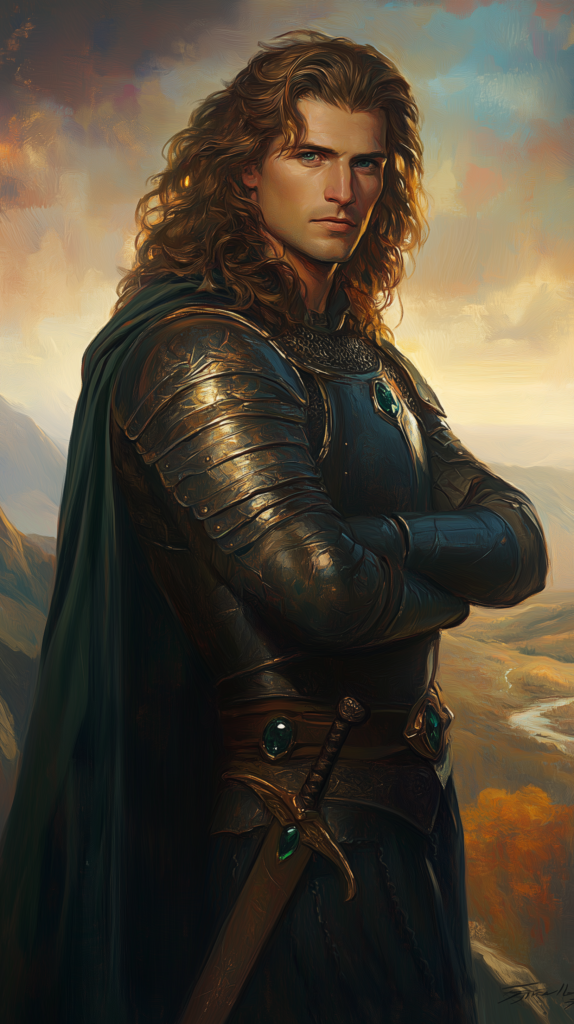
Sir Lionel, also written Lyonel or Lionello, is an Arthurian knight associated with the Lancelot-Grail tradition, Malory’s Le Morte d’Arthur, the house of King Bors of Ganis, Sir Bors the Younger, and Sir Lancelot. This entry concerns the Arthurian Lionel of Ganis, not every later or similarly named Lionel in romance, theatre, or modern adaptation.
Lionel’s story is shaped by captivity, humiliation, and failed mercy. As a young knight travelling with Lancelot, he is captured by the rogue knight Turquine, beaten with briars, and imprisoned. Lancelot’s rescue of Turquine’s captives belongs to the wider Arthurian pattern in which rogue knights test the honour and endurance of Arthur’s fellowship.
Malory’s strongest Lionel episode appears during the Grail material. Sir Bors sees Lionel being beaten and dragged away, but must choose between rescuing his brother and saving a maiden in danger. Bors saves the woman and fears Lionel dead. Lionel survives, but later attacks Bors in fury. Bors refuses to fight back, proving his spiritual worth, while Lionel kills the hermit who tries to protect Bors and then kills the intervening Round Table knight, named Colgrevance in Malory and often linked with Calogrenant in later discussion.
The source tradition frames the final interruption in explicitly Christian terms, with divine power stopping the brothers before the violence reaches its last blow. In this campaign-facing entry, that moment is treated as the sacred fire of the Grail mystery rather than as a reason to import wider Abrahamic religion into the setting.
This entry uses Turquine’s dungeon and the Grail Quest together. The first episode gives Lionel his wound; the second repeats it under sacred pressure. Lionel is brave, noble, and still spiritually dangerous because remembered humiliation has become stronger than mercy.
Later Arthurian tradition also remembers Lionel as part of Lancelot’s kin during the collapse of Arthur’s fellowship. Some accounts have him slain after Camlann or while seeking Lancelot. This page treats those deaths as source context rather than forcing the campaign version to be a ghost, shade, or undead figure. By default, Lionel is presented as a living heroic NPC whose tragedy is still active in the world.
Keep this reference growing
If this page helped with your reading or game, you can support its upkeep or explore the curated books.
Explore the Bookshop — epics, classics and stories behind imagined worlds.