
The Lost World (1925)
At a Glance
- Year and country
- 1925; United States
- Director
- Harry O. Hoyt
- Screenplay and source
- Marion Fairfax, from Arthur Conan Doyle’s 1912 novel
- Creature effects
- Willis H. O’Brien and his miniature-animation team
- Principal cast
- Wallace Beery, Bessie Love, Lewis Stone and Lloyd Hughes
- Form and setting
- Silent expedition adventure; a remote South American plateau and London
- Useful at the table
- Lost valleys, dangerous crossings, dwindling supplies and the consequences of capturing a living monster
An expedition follows evidence of surviving dinosaurs to an isolated plateau, then discovers that reaching the place was the easier part of the journey. The Lost World brings Conan Doyle’s Professor Challenger to the screen through Wallace Beery’s performance and Willis O’Brien’s pioneering stop-motion creatures.
Its strongest adventure idea is the change in the expedition’s objective. Finding proof becomes finding a way home; bringing that proof back creates a new danger in London. First National produced and distributed the film, which entered the United States National Film Registry in 1998. Conan Doyle’s introductory appearance survives in some versions, while restorations differ in footage and running time.
The Lost World at the Table
The plateau makes geography part of every decision. A crossing can be lost, a predator can close a route, and a specimen can become too heavy to move. Build several connected places with different ways through them, then let the creatures change which routes remain safe. The party needs an exit plan as much as weapons.
For another O’Brien creature adventure, explore King Kong (1933). Build an expedition with the creatures in the Bestiary and the regions in Geography.
Prehistoric Creatures and Game References
The Lost World fills its plateau with meat-eating dinosaurs, horned and armoured herbivores, long-necked sauropods and a pterosaur. Each presents a different danger. For encounters, use Allosaurus, Brachiosaurus, Brontosaurus, Edmontosaurus, Pteranodon, Stegosaurus, Triceratops and Tyrannosaurus. These are game references: the film’s early reconstructions, including its Agathaumas-like horned creature, should not be treated as a modern identification guide.
The smaller wildlife also matters. Monkeys, a chimpanzee, cranes, owls and peccaries make the plateau feel inhabited between major encounters. The approach includes snakes, caiman or alligator, jaguar, macaw, spectacled bears and sloths, some shown through stock footage. Bull Montana’s human-like antagonist belongs to the film’s adventure story rather than to its dinosaur catalogue.
Run an Expedition with a Broken Exit
A storm has torn loose the rope bridge that joins the plateau to the return trail. The party has enough line to repair it, but a crate holding its captured specimen cannot cross without a second support. Fresh tracks lead from the damaged camp towards the only standing trees large enough to supply timber.
- First warning: the camp’s pack animals refuse the treeline. Beyond it, bark has been stripped well above a person’s reach.
- Immediate choice: abandon the specimen and cross on foot, seek timber, or find another descent before the remaining water runs out.
- Complication: a frightened herbivore is guarding its young near the fallen equipment. Noise or an attempted capture brings it towards the bridge.
- Ways through: wait for the family to move, draw it away with food, recover the supplies quietly, or leave the crate and carry home drawings and bones instead.
- Consequences: returning with a live animal also means feeding, containing and transporting it through a settled port. The expedition does not end when the plateau disappears behind them.
Film Craft Worth Borrowing
Show a creature changing the landscape before asking the players to fight it: a tree gives way, birds rise from the canopy, or a familiar trail ends in churned mud. O’Brien’s animals have weight because their movements affect their surroundings. Give encounters that same physical consequence.
Watch and Read Further
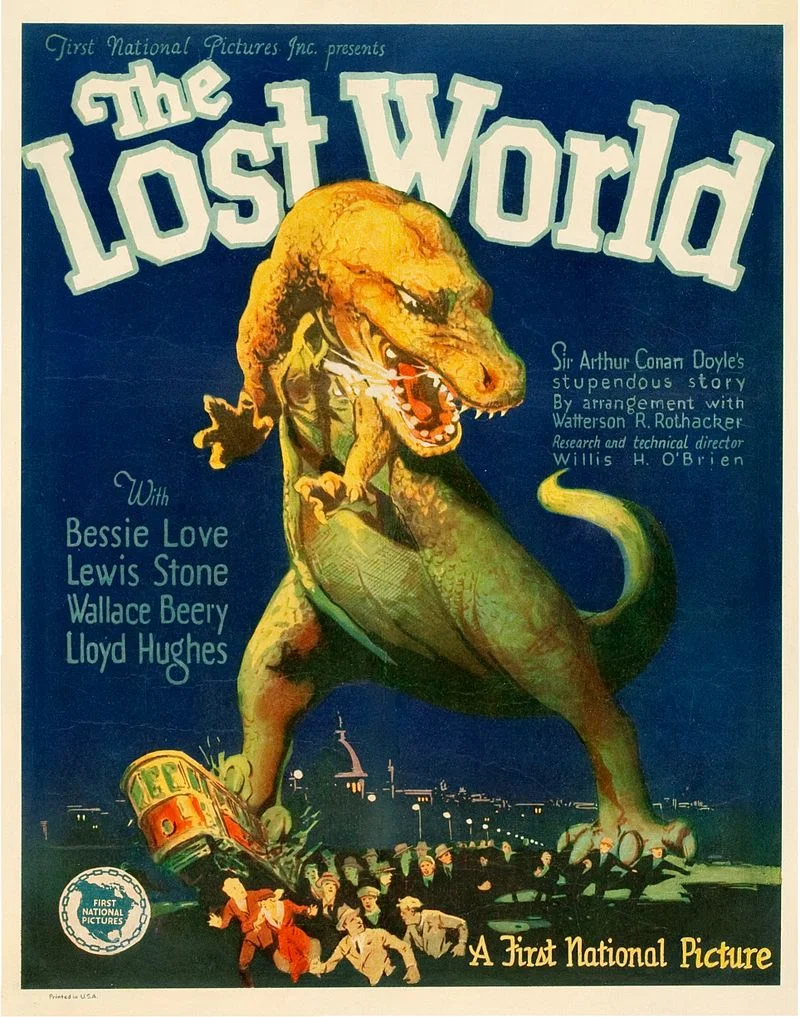
The George Eastman Museum’s restored presentation includes an introduction explaining the surviving film and its restoration. For film history, see the Library of Congress centenary essay and its 1998 National Film Registry announcement. The window card above is credited to First National Pictures; its linked Commons record documents the historical image and United States public-domain status.
Keep this reference growing
If this page helped with your reading or game, you can support its upkeep or explore the curated books.
Explore the Bookshop — epics, classics and stories behind imagined worlds.