
Web Spell, ” Snare of Binding Threads” — Battlefield Control, Escape Rules, Cover, and Fire Tactics
A battlefield-control spell that turns the way forward into a white, clinging trap.
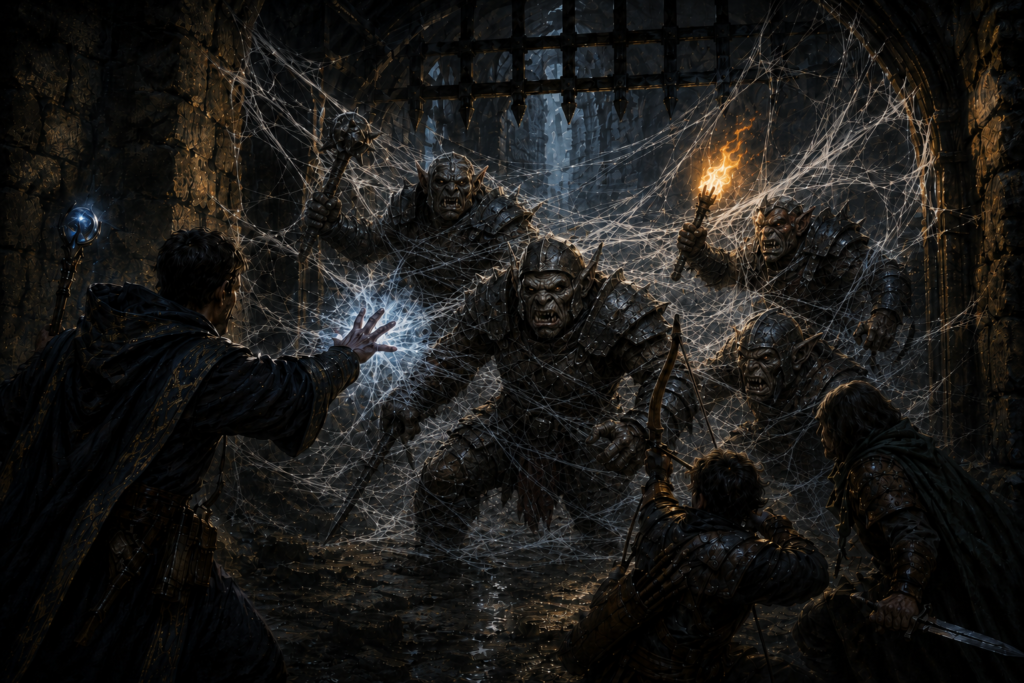
Web changes a fight by taking space away from the enemy. It blocks routes, traps movement, breaks formations, protects retreats, delays pursuit, and forces creatures to spend actions escaping instead of attacking.
The spell is strongest when cast into terrain that can support it. A bare field is poor ground. A gatehouse, mine passage, bridge, alley, woodland path, ruined hall, ship rigging, cavern mouth, dungeon corridor, or stairwell is ideal. Used well, Web does not merely fill an area; it decides where the fight can happen.
Its power comes from practical pressure: anchoring, restraint, slow movement, cover, fire risk, and lost time. A creature caught in the strands may be separated from allies, delayed under missile fire, blocked from escape, or forced to choose between struggling free and burning the obstacle away.
Effect
You conjure a layered mass of thick, sticky webbing that clings to solid supports and fills the chosen area with restraining strands.
The web must have something to hold it: walls, pillars, trees, beams, ship timbers, doorframes, dungeon stonework, cave walls, or similar anchors. Without suitable support, the spell collapses and vanishes.
Creatures caught in the web must resist being trapped. Those that fail are held fast or entangled, depending on the rules version used. Those that avoid full restraint still have to fight through clinging strands while they remain inside the area.
Dense webbing can provide cover, block sight, and interrupt clean lines of attack. The strands are also flammable. Fire can clear webbing, but burning strands may injure creatures trapped inside them and ignite the surrounding scene.
Web Spell 5.5e / 2024
Web Spell, Pathfinder 1e / 3.5e
Web Spell 3.0e
Web Spell 5.5e / 2024
2nd-level Conjuration
Casting Time: Action
Range: 60 feet
Components: V, S, M; a bit of spider web
Duration: Concentration, up to 1 hour
Available To: Sorcerer, Wizard
Saving Throw: Dexterity
Alternative Spell Name: Snare of Binding Threads
You conjure a mass of thick, sticky webbing at a point you can see within range. The web fills a 20-foot Cube for the duration. The area is Difficult Terrain and Lightly Obscured.
The web must be anchored between two or more solid masses, such as walls, pillars, trees, beams, rocks, ship timbers, doorframes, or similar supports. It can also be layered across a floor, wall, or ceiling. If the web is not anchored or supported in this way, the spell ends at the start of your next turn.
When the web appears, each creature in the area must make a Dexterity saving throw. On a failed save, a creature has the Restrained condition while it remains in the web or until it breaks free. On a successful save, the creature is not Restrained, but the web’s area remains Difficult Terrain.
A creature Restrained by the web, or another creature that can reach it, can take an action to make a Strength (Athletics) check against your spell save DC. On a success, the Restrained condition ends.
A creature can use an action to attack a section of webbing. A 5-foot Cube of webbing has AC 10, 10 hit points, vulnerability to fire damage, immunity to poison damage, and immunity to psychic damage. Destroying that section clears that 5-foot Cube, but does not end the spell.
Fire destroys a 5-foot Cube of webbing in 1 round. Any creature that starts its turn in burning webbing takes 5 (2d4) fire damage.
The web’s area is Lightly Obscured. If at least 5 feet of dense webbing lies between a creature and its target, the target has Half Cover. If at least 20 feet of dense webbing lies between them, the target has Three-Quarters Cover, or cannot be targeted by sight-based effects if the strands and terrain fully block line of sight.
5.5e Rules Guidance
Anchoring: Web is strongest in corridors, forests, ruins, caverns, buildings, ships, gatehouses, bridges, and enclosed terrain. Good anchor points include walls, ceilings, trees, heavy branches, pillars, statues, ship masts, ropes, rigging, ruins, arches, broken masonry, cave walls, stalactites, portcullises, doorframes, bridge rails, and support beams.
Open Ground: Web cannot hang unsupported in empty air. In a bare open field with no trees, walls, rocks, wagons, ruins, ceiling, bridge, rigging, or similar supports, the spell ends at the start of your next turn. A caster does not get an ability check to make unsupported webbing work. The spell needs anchors.
Flying Creatures: A flying creature caught in anchored webbing makes the spell’s normal Dexterity saving throw. On a failed save, it has the Restrained condition and cannot continue flying freely until it escapes. If it is flying through empty air above a bare field, Web does not catch it because the spell cannot create unsupported aerial nets.
Cutting Webs: Destroying one section clears only that 5-foot Cube. It does not end the spell, collapse the whole web, or automatically free every creature in the area.
Environmental Fire: If the web is attached to dry timber, thatch, rope, sails, oil, cargo, brush, paper, or similar flammable scenery, treat that as a separate environmental fire.
Allies and Hostages: Web affects all creatures in the area. Allies, mounts, hostages, prisoners, servants, and fleeing civilians make the same saving throws and suffer the same restrictions as enemies.
Balance Note: Do not let Web become a universal “restrain anything anywhere” spell. The anchoring rule is what makes its use tactical rather than automatic.
Web Spell, Pathfinder 1e / 3.5e
Conjuration (Creation)
Level: Sorcerer/Wizard 2
Components: V, S, M
Casting Time: 1 standard action
Range: Medium; 100 ft. + 10 ft./level
Effect: Webs in a 20-ft.-radius spread
Duration: 10 minutes/level (D)
Saving Throw: Reflex negates; see text
Spell Resistance: No
Material Component: A bit of spider web
You create a many-layered mass of strong, sticky strands. These strands resemble spider webs, but are far larger, tougher, and magically reinforced.
The web must be anchored to two or more solid and opposing points, such as walls, trees, pillars, ship timbers, ceiling beams, cavern stone, or similar structures. If the web cannot anchor itself, it collapses and disappears.
Creatures in the spell’s area when it is cast must make a Reflex save.
On a failed save, a creature is entangled and cannot move from its space. It can break free by spending 1 round and succeeding on a DC 20 Strength check or DC 25 Escape Artist check.
On a successful save, the creature is entangled but is not stuck in place. It can move through the web, though slowly and with difficulty.
Once a creature is loose, it remains entangled while inside the web. Each round it spends moving through the strands allows it to attempt another Strength check or Escape Artist check. The creature moves 5 feet for every full 5 points by which the check result exceeds 10.
A creature attacking someone trapped in the web does not become entangled simply by making the attack.
A creature can attack a 5-foot section of webbing as an unattended object. The section has hardness 0 and 5 hit points. Slashing weapons, claws, axes, and similar cutting attacks are suitable for clearing strands. Destroying a section clears that space, but does not end the spell.
If at least 5 feet of webbing lies between a creature and an opponent, the web provides cover. If at least 20 feet of webbing lies between them, the web provides total cover.
The web is flammable. Fire burns away a 5-foot square of webbing in 1 round. Creatures caught in burning webbing take 2d4 fire damage.
A permanency spell can make Web permanent. A permanent web that is damaged but not destroyed regrows in 10 minutes.
Pathfinder / 3.5e Rules Guidance
Anchoring: Web needs solid and opposing supports. Walls, trees, pillars, rigging, cavern stone, ceiling beams, doorframes, bridge rails, gatehouses, portcullises, and ship timbers are all suitable. Loose furniture, thin brush, ordinary grass, soft mud, drifting fog, empty air, and flat open ground are not enough by themselves.
Open Ground: In a featureless open field, the spell fails unless the caster can layer it across a suitable surface or between believable supports. A bare road is weak. A road between trees, walls, wagons, ruins, or rocky outcrops may work. A caster does not get a Spellcraft, Knowledge, or skill check to make unsupported webbing hang in empty air.
Flying Creatures: A flying creature caught in anchored webbing makes the spell’s normal Reflex save. On a failed save, it is entangled and cannot continue flying freely until it escapes. If it is flying through unsupported open air, Web does not catch it.
Movement: The spell should cost trapped creatures time. A creature may not be helpless, but it loses tempo while escaping. That delay is the spell’s real battlefield value.
Cutting Webs: Destroying one section clears only that 5-foot section. It does not end the spell, collapse the whole web, or automatically free every creature in the area.
Environmental Fire: If the web is attached to dry timber, thatch, rope, sails, oil, cargo, brush, paper, or similar flammable scenery, the surrounding material may catch fire normally.
Allies and Hostages: Web does not distinguish friend from foe. Allies, mounts, servants, prisoners, witnesses, hostages, and civilians make the same saving throws and suffer the same movement restrictions as enemies.
Cover and Sight: Cover is part of the spell’s strength. 5 feet of webbing provides cover. 20 feet of webbing provides total cover. Use those thresholds when deciding whether archers, spellcasters, and creatures with line-of-sight effects can target through the strands.
Web Spell 3.0e
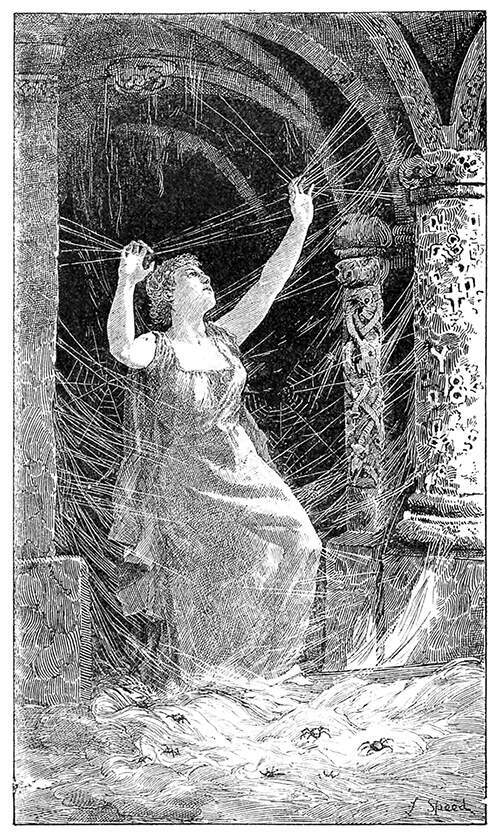
Web creates a many-layered mass of strong, sticky strands.
This material is Open Game Content, and is licensed for public use under the terms of the Open Game License v1.0a.
Conjuration (Creation)
Level Sorcerer/Wizard 2
Components V, S, M
Casting Time 1 standard action
Range Medium (100 ft. + 10 ft./level)
Effect Webs in a 20-ft.-radius spread
Duration 10 min./level (D)
Saving Throw Reflex negates; see text
Spell Resistance No
These strands trap those caught in them. The strands are similar to spider webs but far larger and tougher. These masses must be anchored to two or more solid and diametrically opposed points or else the web collapses upon itself and disappears. Creatures caught within a web become entangled among the gluey fibers. Attacking a creature in a web won’t cause you to become entangled.
Anyone in the effect’s area when the spell is cast must make a Reflex save. If this save succeeds, the creature is entangled, but not prevented from moving, though moving is more difficult than normal for being entangled (see below).
If the save fails, the creature is entangled and can’t move from its space, but can break loose by spending 1 round and making a DC 20 Strength check or a DC 25 Escape Artist check. Once loose (either by making the initial Reflex save or a later Strength check or Escape Artist check), a creature remains entangled, but may move through the web very slowly. Each round devoted to moving allows the creature to make a new Strength check or Escape Artist check. The creature moves 5 feet for each full 5 points by which the check result exceeds 10.
- If you have at least 5 feet of web between you and an opponent, it provides cover.
- If you have at least 20 feet of web between you, it provides total cover.
The strands of a web spell are flammable. A magic flaming sword can slash them away as easily as a hand brushes away cobwebs. Any fire can set the webs alight and burn away 5 square feet in 1 round. All creatures within flaming webs take 2d4 points of fire damage from the flames.
Web can be made permanent with a permanency spell. A permanent web that is damaged (but not destroyed) regrows in 10 minutes.
Material Component A bit of spider web.
Why This Spell Is Dangerous in the World
Web is dangerous because it turns ordinary terrain into a trap. A doorway becomes a sealed threshold. A bridge becomes a snare. A stairwell becomes a killing ground. A ship’s rigging becomes a hanging prison.
In settlements and castles, the spell is feared because it can block exits, trap guards, delay messengers, panic horses, and create a fire risk in crowded places. In war, it can stop a charge, seal a breach, clog a gatehouse, or hold soldiers in place while archers choose their targets.
The spell’s danger is not only restraint. It is lost time. A trapped creature can hear the fight moving on without them. A commander can watch the front rank disappear into white strands. A thief can reach the door and find it sealed. A torch can become both rescue and threat.
Best Uses
Seal a choke point: Cast Web across a doorway, corridor, bridge, stairwell, gate, or breach to make enemies spend actions before they can reach the party.
Split a formation: Catch the front ranks while the rear ranks remain outside the area, leaving the enemy unable to support itself properly.
Protect a retreat: Drop the web behind the party while withdrawing through a tunnel, alley, ruin, bridge, or ship passage.
Disrupt ranged attackers: Place webbing between the party and archers or spellcasters to create cover, block sight, and force movement.
Set up controlled damage: Hold enemies in place long enough for allies to use arrows, thrown weapons, prepared attacks, or carefully placed fire.
Capture rather than kill: Use the spell to hold guards, scouts, beasts, or fleeing enemies when the party wants prisoners or witnesses alive.
Tactics
A good caster does not cast Web at the nearest enemy by reflex. They cast it where the enemy must go.
Use it on choke points, retreat paths, ladders, doors, stairwells, alleys, bridges, rigging, wooded tracks, and broken ruins. The spell is strongest when it makes enemies choose between losing time, burning through, breaking formation, or abandoning their approach.
A misplaced web can also hurt the party. It may block allies, obscure targets, trap hostages, cut off escape routes, or create a fire hazard. The best placement is usually slightly ahead of the enemy line, not directly on top of every creature in sight.
Good Combinations
- Grease: Makes the approach to the web worse, especially near stairs, ramps, and narrow crossings.
- Fog Cloud: Turns the web into a hidden obstacle, though it may also reduce the party’s visibility.
- Controlled flame spells or small fire effects: Burn selective sections, threaten trapped enemies, or open a path when needed.
- Thunderwave: Pushes enemies into the web or away from the safe edge.
- Silence: Stops trapped spellcasters from using verbal components while they struggle inside the web.
- Spike Growth: Creates a layered battlefield where movement is punished before and after the web.
- Wall of Fire: Deadly when placed with care, but dangerous near hostages, allies, wooden structures, or flammable cargo.
Using This Spell in Your Game
Web should create decisions, not simply delay.
A trapped enemy might shout for help, cut loose an ally, set the web alight, drop a weapon, surrender, or try to bargain. A trapped monster might thrash, panic, tear down supports, or damage the structure holding the web. A disciplined military unit might burn through the strands in formation while shield-bearers protect the front line.
For exploration, Web can seal a tomb passage, protect a camp, slow pursuit through a ruin, or mark a forbidden threshold. For social play, it can become evidence of unlawful magic, a sign of witchcraft, a siege tool, or a crime-scene clue.
Spellcasting Culture and Worldbuilding Hooks
In cities, Web is restricted less because it is mysterious than because it is dangerous in crowded places. It can block exits, trap servants, stop emergency movement, panic horses, delay fire crews, and turn a single lamp or torch into a disaster.
Castle stewards, harbour authorities, guild wardens, and watch captains may treat unauthorized use as sabotage. In a siege, the same spell that protects a breach can also doom defenders trapped behind it.
In frontier regions, the spell is more practical. Hunters, scouts, hedge-wizards, witches, and military mages may use it to stop beasts, block cave mouths, protect camps, or defend narrow bridges.
Among spider-associated cults, fey courts, cave-dwelling peoples, and underworld traditions, Web may be treated as a sacred pattern rather than a mere spell. The strands can mark boundaries, oaths, hunting grounds, or places where trespassers are meant to be held until judged.
Adventure and Worldbuilding Hooks
The Door Sealed in Silk: A witness runs for the manor door, only to find it covered in thick white strands. The caster did not mean to kill her; they meant to keep her from reaching the courtyard.
The Burning Gatehouse: Soldiers trapped in a magically webbed gatehouse beg the party not to use fire. The web blocks an enemy advance, but burning it may kill the defenders as well as clear the breach.
The Web That Regrows: A permanent web in an abandoned tower returns after every attempt to clear it. Something behind the strands is still alive, still feeding, or still being protected.
Source and Literary Context
Web is based on Open Game Content from the 3.5 System Reference Document, where it appears as a 2nd-level conjuration spell that creates strong, sticky strands capable of trapping creatures, providing cover, slowing movement, and burning when exposed to fire. Its core identity is battlefield control: the spell changes where creatures can move, what they can see, how quickly they can escape, and whether a passage remains usable at all.
The spell’s literary strength comes from the image of the spider’s web as a visible trap. A web is not only an obstacle; it is a warning that the space has already been claimed by something patient, hidden, and predatory. In play, Web uses that same image without needing to summon a spider. The strands themselves become the threat: sticky, layered, difficult to cross, and dangerous to burn.
Classical myth gives the spider’s web one of its strongest associations through Arachne, the mortal weaver whose skill, pride, and punishment are tied to transformation into a spider. In that tradition, weaving is not passive decoration. It is craft, contest, entanglement, and consequence. That makes Arachne a more suitable literary reference for this spell than broader examples of nets or traps, because Web is specifically about webbing as magical restraint.
For a concise mythic reference, see Theoi: Arachne. For the classical source, see Ovid, Metamorphoses Book 6. For the Open Game Content spell reference, see d20SRD: Web.
Keep this reference growing
If this page helped with your reading or game, you can support its upkeep or explore the curated books.
Explore the Bookshop — epics, classics and stories behind imagined worlds.