
Song of Discord
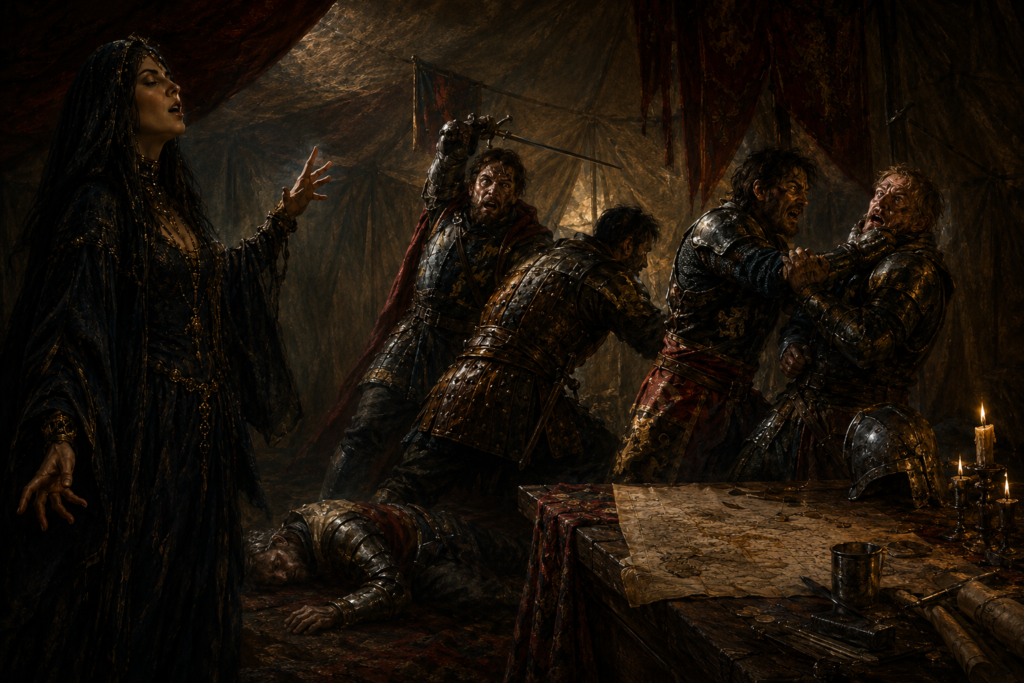
A battlefield hymn that makes loyalty fail at the worst possible moment.
Song of Discord is a legacy Bard spell from Pathfinder 1e and D&D 3.5e. There is no direct official D&D 5e / 2014 or D&D 5.5e / 2024 version. The previous modern conversion on this page has been removed rather than presented as official rules.
The closest modern core spell is Confusion. It shares the theme of uncontrolled actions and accidental attacks, but it is a distinct 4th-level spell with its own d10 behaviour table rather than Song of Discord’s 50% chance to attack the nearest creature.
Song of Discord at a Glance
| 5.5e / 2024 | No official spell by this name in SRD 5.2.1; Confusion is a distinct alternative |
|---|---|
| 5e / 2014 | No 2014 core spell by this name; do not import the older 50% attack rule |
| Pathfinder 1e | Bard 5; 20-foot-radius spread, mind-affecting sonic compulsion; Will negates, spell resistance yes |
| D&D 3.5e | Bard 5; legacy sonic compulsion, 1 round/level |
| Witch archive | 5th-level legacy Witch-list entry; this is not a default Pathfinder Witch class spell |
Quick Rules Reference
- 5.5e / 2024: no direct official Song of Discord spell.
- 5e / 2014: no direct official Song of Discord spell.
- Closest modern spell: Confusion, 4th-level Enchantment.
- Pathfinder 1e / D&D 3.5e: Bard 5, 20-foot-radius spread, 1 round/level, Will negates, Spell Resistance yes.
- Core legacy effect: each affected creature has a 50% chance at the start of each turn to attack the nearest target.
- Otherwise: the creature acts normally for that round.
- Compelled attack: victims use their strongest practical attacks and tactics, but do not attack unconscious targets.
Rules
Song of Discord by Edition
5.5e / 2024 — No Direct Official Song of Discord
The 2024 Basic Rules do not include Song of Discord as a spell. Do not use the previous 5th-level homebrew conversion as though it were an official rule.
Closest official spell: Confusion
| Level | 4th-level Enchantment |
|---|---|
| Range | 90 feet |
| Area | 10-foot-radius Sphere |
| Duration | Concentration, up to 1 minute |
| Save | Wisdom |
Confusion uses a d10 behaviour table. Some results cause random movement or inaction; one result forces a melee attack against a random creature in reach. This resembles Song of Discord thematically but is not the same spell.
5e / 2014 — No Direct Official Song of Discord
The 2014 Basic Rules likewise do not include a direct Song of Discord spell.
The nearest core analogue is Confusion, another 4th-level Enchantment that produces uncontrolled behaviour through a d10 table.
Song of Discord — Pathfinder 1e
| School | Enchantment (Compulsion) [mind-affecting, sonic] |
|---|---|
| Level | Bard 5 |
| Casting Time | 1 standard action |
| Components | V, S |
| Range | Medium (100 ft. + 10 ft./level) |
| Area | Creatures in a 20-ft.-radius spread |
| Duration | 1 round/level |
| Saving Throw | Will negates |
| Spell Resistance | Yes |
An affected creature has a 50% chance each round to attack the nearest target. Roll at the start of that creature’s turn. If it does not attack its nearest neighbour, it acts normally for that round.
When compelled to attack, the creature uses the deadliest spells and most advantageous combat tactics available to it. It does not attack an unconscious target.
Song of Discord — D&D 3.5e
| School | Enchantment (Compulsion) [Mind-Affecting, Sonic] |
|---|---|
| Level | Bard 5 |
| Casting Time | 1 standard action |
| Components | V, S |
| Range | Medium (100 ft. + 10 ft./level) |
| Area | Creatures in a 20-ft.-radius spread |
| Duration | 1 round/level |
| Saving Throw | Will negates |
| Spell Resistance | Yes |
Each affected creature has a 50% chance at the start of every turn to attack the nearest target. If the roll does not compel an attack, it acts normally.
A compelled creature uses its strongest practical spells, attacks and tactics against its fellows, but will not attack an unconscious creature.
What Changed?
- Song of Discord has no direct official 5e/2014 or 5.5e/2024 spell. The previous modern conversion has been removed.
- Modern Confusion is the nearest thematic analogue, not a replacement: it uses a d10 behaviour table and can produce movement, inaction, attacks or normal behaviour.
- PF1e and D&D 3.5e use the same core Song of Discord procedure: 50% chance each round to attack the nearest target.
- The legacy spell affects everyone who fails the save in the spread, making friendly placement and formation important.
- The sonic and mind-affecting descriptors are legacy mechanics and should not be imported into modern D&D as unstated rules.
Legacy 3.0e Song of Discord
Enchantment (Compulsion) [Mind-Affecting, Sonic]
Level: Bard 5
Components: V, S
Casting Time: 1 standard action
Range: Medium (100 ft. + 10 ft./level)
Area: Creatures in a 20-ft.-radius spread
Duration: 1 round/level
Saving Throw: Will negates
Spell Resistance: Yes
Each affected creature has a 50% chance each round to attack the nearest target; otherwise it acts normally. Compelled creatures use their most effective attacks but do not attack unconscious targets.
Lore and Campaign Use
Why Song of Discord Is Dangerous in the World
Song of Discord is feared because it leaves responsibility tangled.
A soldier killed by an enemy blade is mourned as a casualty. A soldier who survives this spell may remember striking the comrade he had sworn to protect. Even when the law recognises magical compulsion, families, temples, guilds, and military orders may not forgive cleanly. The victim is dead. The hand that killed them is still present. The caster may already be gone.
This makes the spell especially vile in places built on public trust. A court session, wedding feast, temple rite, treaty escort, coronation, military council, or hostage exchange can be destroyed by one hidden voice. The spell does not need to win a battle. It only needs to make the survivors doubt one another.
Among honour-bound warriors, it is often treated as coward’s magic. Among witches and curse-singers, it may be regarded as judgement: a way to make a false peace reveal the violence beneath it. Among spies, it is priceless.
Best Uses in Play
Break the bodyguard ring.
A protected leader is often safest when surrounded by loyal defenders. Song of Discord turns that protection into a liability.
Punish crowded confidence.
The spell thrives in corridors, gatehouses, shield walls, chapel aisles, council chambers, ships, bridges, and ritual circles.
Ruin command structure.
A captain cannot easily command troops who have just seen their own line turn inward.
Create an escape window.
The caster may not need to defeat anyone. They may need only enough panic to flee, steal a relic, break a prisoner free, or reach a locked door.
Expose hidden danger.
Sudden violence reveals instincts: concealed weapons, trained killers, secret spellcasters, oath-bound guards, zealots, cowards, and monsters wearing polite faces.
Tactics
Song of Discord rewards patience. It is best cast after enemies have committed to a confined position or clustered around something important. Guards around a prince, priests around an altar, soldiers in a breach, mercenaries on a bridge, and cultists inside a summoning circle are all ideal targets.
The spell pairs well with terrain pressure. Narrow streets, locked doors, smoke, barricades, pits, crowded halls, and difficult ground make it harder for victims to scatter once the discord begins.
It is weaker against solitary creatures, loose formations, mindless enemies, creatures protected from mental influence, and disciplined forces trained to spread out when enchantment is suspected.
For villains, the strongest use is often social rather than purely tactical. A hidden caster at a feast or trial can create consequences that last far beyond the encounter.
DM Notes
Before resolving the spell, establish positioning. This avoids arguments and keeps the scene moving. In theatre-of-the-mind play, use simple bands: beside, near, across the room, behind cover, out of reach.
For each affected creature, resolve three questions quickly: did the discord take hold this turn, who is the nearest valid conscious target, and what would this creature use if it truly meant harm?
Let the compelled action reflect the victim’s identity. A duelist strikes cleanly. A fanatic invokes sacred violence. A coward attacks from safety. A wizard reaches for the spell that solves the immediate problem. A monster uses the natural violence that defines it.
The spell should not feel like random slapstick. It should feel like a terrible interruption of trust.
Failure, Risk, and Misuse
Song of Discord can easily turn against careless casters. If allies are too close to the affected group, they may become the nearest targets. If the caster stands within reach, the spell may draw violence back toward them. If the spell is used in public, witnesses may not understand who is responsible.
The greater risk is aftermath. A town may not accept “they were magically compelled” as a complete answer. A lord may demand compensation for dead retainers. A temple may require purification. A military order may execute suspected discord-singers without waiting for a court. Survivors may seek revenge even when they know, in reason, that magic was involved.
This is not a clean spell. It wins scenes by dirtying everyone inside them.
Spellcasting Culture and Worldbuilding Hooks
Bards who know Song of Discord rarely advertise it. In respectable courts, the spell belongs to rumours: the forbidden note, the broken mode, the treasonous refrain sung once before a dynasty collapsed. Court musicians accused of knowing it may be watched by guards, banned from private chambers, or forced to perform with their hands visible and their songs approved in advance.
Witches may preserve the spell as curse-song. In that form, it is not merely battlefield magic but vengeance against households, oath-bands, militias, and families that have hidden a crime. A village that betrayed a guest might later find its defenders turning on one another at the gate.
Military orders that have suffered the spell develop grim countermeasures. They train in looser formations, use hand signals, carry waxed earplugs, assign watchers for sudden friendly violence, and teach officers to identify the singer before the line collapses.
Adventure and Worldbuilding Hooks
The Trial That Became a Slaughter
A noble court descended into bloodshed during a public accusation. The surviving guards swear they were compelled, the accused has vanished, and the families of the dead want someone punished before the next moon.
The Choir of Broken Oaths
A travelling choir is blamed for outbreaks of violence in three towns. They may be guilty, cursed, hunted by the true caster, or carrying a hymn they do not understand.
The Mercenary Company That Will Not Speak
A veteran company survived Song of Discord on campaign. Now its members refuse to stand beside one another, and the secret of what really happened could destroy the lord who hired them.
Good Combinations
- Silence: Protects allies, shuts down rival singers, or shapes where sonic magic can function. It is especially useful when the caster wants to control the battlefield before unleashing the spell.
- Wall of Force: Keeps affected enemies trapped together while limiting their ability to reach the caster. This combination is strongest against elite guards or monsters that rely on close protection.
- Fear: Panic and discord together can collapse discipline, especially among troops already uncertain of their command. Use carefully, since too much forced behaviour can make a scene feel less interactive.
- Hold Person: Freezes a key figure in place while violence breaks around them. This can turn a protected leader into the centre of a dangerous knot.
- Fog Cloud: Adds confusion and separation, though it may also complicate target selection if creatures cannot perceive one another clearly.
Rules Edge Cases and Table Answers
Does Song of Discord only make victims attack allies?
No. The spell points violence toward the nearest valid conscious target. That target may be an ally, enemy, neutral creature, summoned creature, or bystander.
Can victims attack the caster?
Yes. The spell does not protect the caster. If the caster is the nearest valid target, or if the affected creature is free to act normally, the caster may be attacked.
Does the spell force self-harm?
No. It turns victims against nearby targets. It does not command them to injure themselves.
Does the spell make victims stupid?
No. Affected creatures use dangerous and effective methods. The horror of the spell is that competence remains while loyalty fails.
Can a creature waste a useless attack to satisfy the spell?
No. When compelled, the creature should make a serious hostile attempt within the limits of the situation.
Does the spell affect mindless undead or constructs?
Not under the standard rules if they are immune to mind-affecting effects.
Using Song of Discord in Play
Song of Discord is strongest when cast into a formation where proximity matters: guards shoulder-to-shoulder, a warband around its leader, or a crowded chokepoint. The spell does not make creatures foolish; it makes their existing weapons, positioning and competence dangerous to the people nearest them. Players should think about spacing and target order, while Games Masters should track the nearest valid conscious target each round.
Mythical Context
Song of Discord belongs to the old fear that music can move people before reason can defend them. In Greek tradition, Orpheus could move beasts, stones, trees, and even the powers of the underworld with his music, while the Sirens used song as lethal enchantment, drawing sailors toward ruin.
Historical Context
The spell also inverts the real historical purpose of military music. Drums, horns, trumpets, pipes, and marching rhythms helped soldiers keep pace, receive signals, and act as one body in war. The Metropolitan Museum of Art notes the long military association of drums and martial music in European tradition.
Seen through that lens, Song of Discord is not simply a magical confusion effect. It is the nightmare reversal of sacred chant, court song, war music, and curse-poetry: a voice that breaks discipline, poisons loyalty, and makes a company turn inward against itself.
Rules Sources and Licensing
Pathfinder 1e and D&D 3.5e use the legacy Song of Discord mechanics. The 2024 and 2014 sections are status guidance and point players toward edition-appropriate alternatives rather than presenting an invented conversion.
Keep this reference growing
If this page helped with your reading or game, you can support its upkeep or explore the curated books.
Explore the Bookshop — epics, classics and stories behind imagined worlds.