
Righteous Wrath of the Faithful
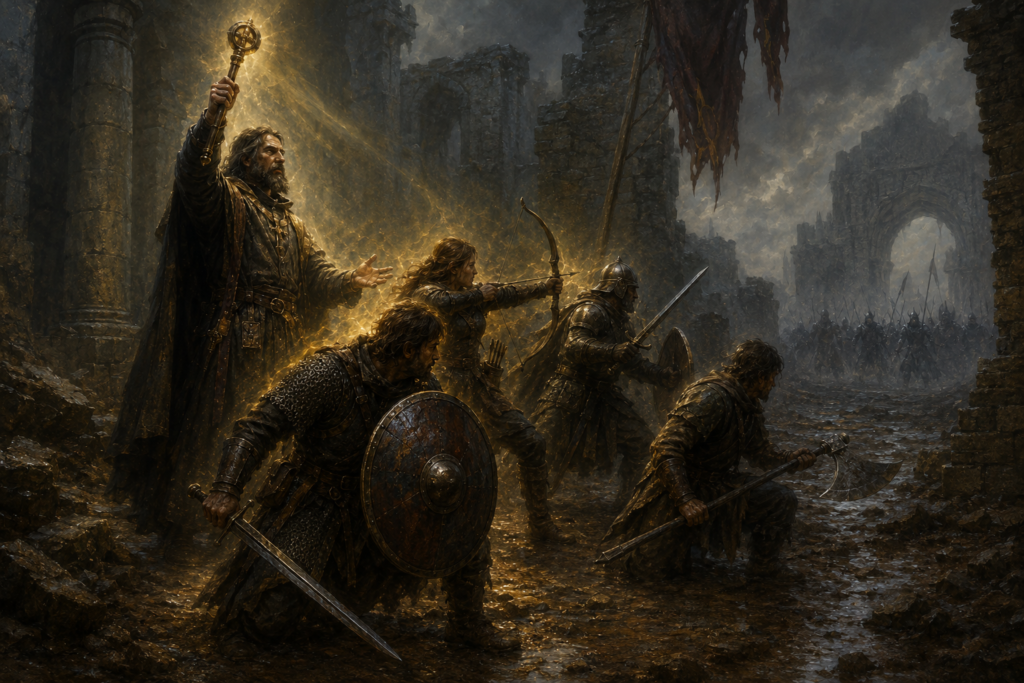
A war-priest’s command turns shared devotion into battle-fury, but the exact effect depends heavily on which 3.5e printing is being used.
Righteous Wrath of the Faithful is a legacy divine battle spell from D&D 3.0/3.5e. There is no direct official D&D 5e / 2014 or D&D 5.5e / 2024 version, and Pathfinder 1e does not have a native core version of the spell.
The 3.5e spell also changed between printings. Complete Divine uses a two-tier blessing: all allies receive lesser benefits, while allies who worship the same deity receive the full wrath and later fatigue. Spell Compendium revises the spell into a simpler combat buff for all affected allies, lowers it to Cleric 5, and removes the deity-specific two-tier structure.
Quick Rules Reference
- 5.5e / 2024: no direct official Righteous Wrath of the Faithful spell.
- 5e / 2014: no direct official version.
- Pathfinder 1e: no native core entry; a table can import a 3.5e printing only as an explicit legacy conversion.
- 3.5e Complete Divine: Cleric 7 / Purification 7; lesser blessing for all allies, stronger wrath for allies who worship the same deity, followed by 10 minutes of fatigue.
- 3.5e Spell Compendium: Cleric 5 / Purification 7; all affected allies gain an extra melee attack when making a full attack and +3 morale on melee attack and damage rolls.
- 3.0 Defenders of the Faith: uses the older deity-specific two-tier structure later carried into Complete Divine.
Rules
Righteous Wrath of the Faithful by Edition
5.5e / 2024 — No Direct Official Righteous Wrath
There is no official 2024 Righteous Wrath of the Faithful spell. The former 7th-level Emanation version on this page was a conversion, not published 2024 rules, and has been removed.
Use actual 2024 spells such as Bless or other edition-legal divine buffs when a modern rules answer is needed; do not import the legacy extra-attack, same-deity, or fatigue clauses unless the campaign explicitly adopts a conversion.
5e / 2014 — No Direct Official Righteous Wrath
The 2014 spell list has no direct Righteous Wrath of the Faithful. Its legacy mechanics should not be presented as core 5e rules.
The old spell’s identity—battlefield morale, extra melee pressure, and shared devotion—can be represented with real 5e buffs, but that is adaptation rather than a 2014 printing of this spell.
Pathfinder 1e — No Native Core Entry
Pathfinder 1e does not provide a native core Righteous Wrath of the Faithful entry. If a Pathfinder campaign imports 3.5e material, choose the specific 3.5e printing being imported rather than blending them together.
Recommended rule: label the imported version explicitly as either Complete Divine or Spell Compendium, because their level and effects differ.
Righteous Wrath of the Faithful — D&D 3.5e
Spell Compendium printing
| School | Enchantment (Compulsion) [Mind-Affecting] |
|---|---|
| Level | Cleric 5, Purification 7 |
| Components | V, S, DF |
| Casting Time | 1 standard action |
| Range | 30 ft. |
| Target | Allies within a 30-ft.-radius burst centred on you |
| Duration | 1 round/level |
| Saving Throw | None |
| Spell Resistance | Yes |
All affected allies gain one additional melee attack each round at their highest attack bonus when making a full attack. The extra attack does not stack with other effects that grant an extra attack, such as haste.
They also gain a +3 morale bonus on melee attack rolls and melee damage rolls. The attack-roll bonus can stack with the attack bonus from haste.
Complete Divine printing
| Level | Cleric 7, Purification 7 |
|---|---|
| Range | 30 ft. |
| Target | All allies in a 30-ft.-radius burst centred on you |
| Duration | 1 round/level |
| Saving Throw | None |
| Spell Resistance | Yes |
All allies fighting on your side gain +1 morale on attack rolls and saves against fear plus 1d8 temporary hit points.
Allies who worship the same deity as you instead receive the full wrath: one additional melee attack each round at their highest attack bonus, +2 morale on attack rolls, damage rolls and saving throws, another 1d8 temporary hit points for 2d8 total, and +3 morale on saves against mind-affecting effects.
When the spell ends, allies who received the full wrath are fatigued for 10 minutes.
What Changed?
- The previous 2024 conversion has been removed. There is no direct official 5.5e/2024 or 5e/2014 Righteous Wrath spell.
- Pathfinder 1e is no longer merged with 3.5e. It has no native core entry; imported 3.5e material should be labelled as such.
- Spell Compendium substantially revises the 3.5e spell: Cleric 5, no same-deity split, no temporary-hit-point package, and no fatigue aftermath.
- Complete Divine preserves the older two-tier devotion mechanic and the fatigue that follows the full wrath.
- The 3.0 version belongs to Defenders of the Faith and is retained below as legacy material.
Legacy 3.0 Righteous Wrath of the Faithful
Enchantment (Compulsion) [Mind-Affecting]
Level: Cleric 7
Components: V, S, DF
Casting Time: 1 action
Range: 30 ft.
Target: All allies within a 30-ft.-radius burst centred on you
Duration: 1 round/level
Saving Throw: None
Spell Resistance: Yes
The 3.0 printing gives all allies a lesser morale and temporary-hit-point benefit, then grants allies who worship the same deity the stronger extra-attack and morale package. The fully affected allies are fatigued for 10 minutes afterward.
Why This Spell Is Dangerous in the World
Righteous Wrath of the Faithful makes shared devotion tactically powerful. A mixed company receives courage and protection, but a temple guard, sacred host, oath-bound warband can become far more dangerous under the same spell.
That changes how priests and commanders organise war. A ruler may want soldiers bound to the same shrine. A temple may train elite companies around a single sacred oath. A war-priest may discover, in the middle of battle, who truly shares the cause and who merely marches beside it.
The aftermath keeps the spell from being cleanly heroic. The full wrath can win a battle line, but it may leave the faithful too spent to pursue a fleeing enemy, hold a second gate, carry the wounded, or survive a counterattack.
Best Uses
Use Righteous Wrath of the Faithful when the battle must be decided quickly. It is strongest in last stands, shrine defences, battlefield breakthroughs, desperate assaults, and fights against enemies that rely on fear or mental control.
The full effect is best on melee allies who can make real use of the extra attack and damage bonus. Paladins, battle clerics, fighters, barbarians, temple champions, oath-warriors, and sacred guards gain the most from it.
Tactics
In D&D 3.5e, the spell is a short-range burst cast at the decisive moment. Position the caster so the allies who matter are inside the 30-foot radius when the spell is released; the effect then lasts for its normal duration rather than following the caster as an aura.
In Pathfinder 1e, use this advice only if the campaign has explicitly imported one of the 3.5e printings. The key decision remains when and where to cast it: the burst should catch the battle line immediately before the decisive exchange.
Enemies who recognise the spell should not trade blows with the empowered faithful if they can avoid it. They should withdraw, scatter, delay, use terrain, attack from range, or wait for the fatigue that follows.
DM Notes
The same-deity test belongs to the Defenders of the Faith/Complete Divine printing. Under that version, full wrath applies only to allies who genuinely worship the same deity as the caster. The later Spell Compendium printing removes this distinction and grants its single combat package to all affected allies.
For the older two-tier printing, strong qualifying examples include members of the same temple guard, warriors sworn to the same god, initiates of the same mystery cult, or companions formally received into that deity’s warband.
Ordinary mercenaries, political allies, respectful outsiders, casual companions, and warriors merely fighting the same enemy receive only the lesser benefit in the older printing unless they truly share the deity.
This ruling gives the spell its identity. It is not just a combat buff. It tests belonging.
Good Combinations
- Bless: A useful lower-level morale and accuracy effect in editions where both spells are available; apply that edition’s normal bonus-stacking rules.
- Prayer: A strong older-edition pairing for a divine battle line, combining allied favour with pressure on enemies.
- Protection from Evil and Good: Excellent when the faithful are facing fiends, undead, possessed enemies, or creatures with fear and control effects.
- Freedom of Movement: Helps the main melee ally keep attacking instead of being restrained, pinned, grappled, or trapped.
- Death Ward: Protects the champion most likely to stand at the centre of the full wrath.
Using This Spell in Your Game
Righteous Wrath of the Faithful works best when the faith requirement matters in play.
Under the older Complete Divine printing, a mixed adventuring party can split between the lesser blessing and the full same-deity wrath. Under the later Spell Compendium printing, that distinction no longer exists: all affected allies use the same revised combat package.
Only the older two-tier printing can reveal or test shared devotion in that way. The later Spell Compendium version is a straightforward battlefield enchantment rather than a test of religious allegiance.
The aftermath should also matter. If the full wrath wins the fight, the next problem should not always wait politely. Fatigued warriors may struggle to chase a fleeing villain, defend a gate, drag the wounded clear, climb siege works, or escape before reinforcements arrive.
Adventure Hooks
The False Standard
A commander claims his army is united under one sacred oath, but Righteous Wrath of the Faithful grants full wrath to only a handful of soldiers. The failed blessing exposes divided loyalties, a forged relic, or a rival cult hidden inside the host.
The Second Gate
A temple guard uses the spell to repel the first assault on a sacred stronghold. They win, but the fully blessed defenders are now fatigued, and the enemy’s real attack begins at another gate.
The Priest Who Spent the Village
A desperate priest casts the spell night after night to drive villagers against a monster in the hills. The monster is real, but the priest’s holy fury is breaking the village faster than the creature is.
Historical and Mythic Context
Righteous Wrath of the Faithful belongs to older ideas of sworn warbands, divine patrons, battlefield vows and ritualised courage. Its strongest image is not simply rage, but a group of warriors whose shared devotion becomes a military force.
The Norse and Germanic berserker offers one useful comparison: a warrior whose battle-fury was remembered as part of a religious and martial identity. The spell should not simply turn every recipient into a berserker, but the parallel explains why supernatural courage and violent intensity can belong to the same ritual tradition.
Roman military culture offers another model through the sacramentum, the soldier’s oath of service and obedience. In a world where gods, divine patrons and sacred standards visibly matter, an oath can become more than law: it can mark who belongs to the warband, who shares its rites, and who receives the older version of the spell’s full blessing.
Temple guards, mystery cults, oath-bound households, sacred champions and divine warbands therefore fit the spell naturally. The older Complete Divine version makes shared worship mechanically important; the later Spell Compendium version shifts the emphasis toward collective battle-fury rather than testing religious belonging.
Keep this reference growing
If this page helped with your reading or game, you can support its upkeep or explore the curated books.
Explore the Bookshop — epics, classics and stories behind imagined worlds.