
Rain of Roses Spell: Sacred Rosefall, Wisdom Damage, and Divine Judgment
Rain of Roses Spell: Sacred Rosefall, Wisdom Damage, and Divine Judgment
A sacred storm of red roses falls from the sky, making beauty unbearable to the wicked.
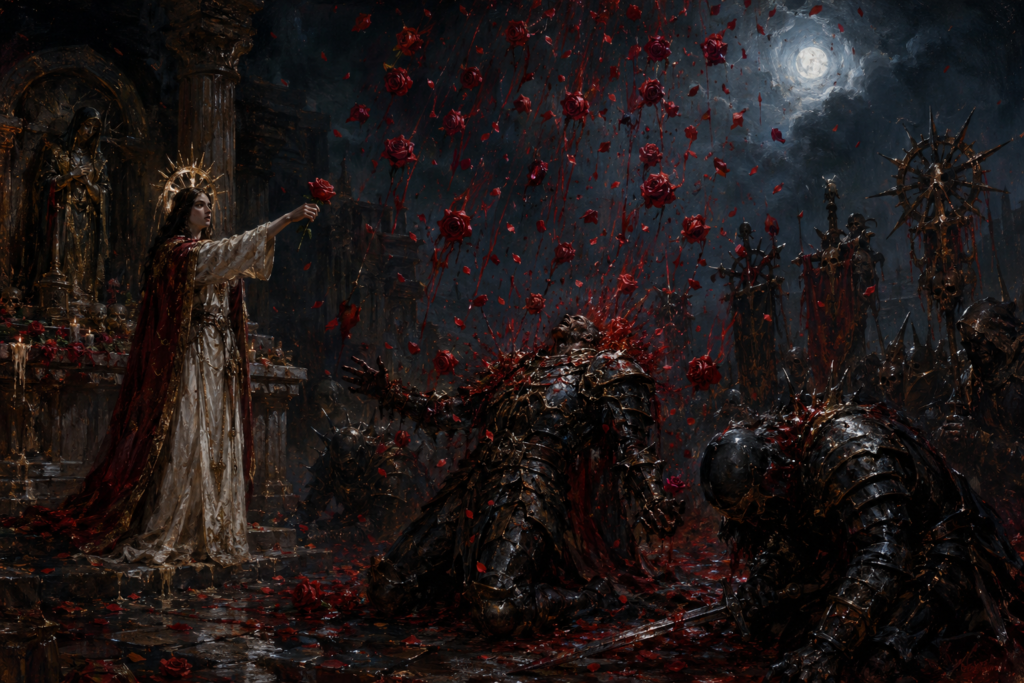
Rain of Roses is sacred judgment made visible. Red roses descend from an impossible sky, soft enough to silence a battlefield and sharp enough to find the guilty. The spell does not burn the wicked. It makes beauty unbearable to them.
Within the rosefall, evil creatures are cut by unseen thorns, sickened by fragrance and petal, and drawn toward nightmares as their spiritual defences fail. To the innocent, the rain may seem wondrous: crimson petals, a sweet scent, a hush in the air. To the corrupt, every falling rose is a wound, an accusation, and a dream waiting to devour the mind.
Quick Rules Reference
- Theme: Sacred evocation, falling roses, thorns, sickness, nightmare, and judgment.
- Best Role: Large-area anti-evil control and attrition.
- Targets: Evil creatures or creatures the DM defines as supernaturally evil.
- Primary Effect: Evil creatures suffer mental or spiritual harm from the roses’ thorns.
- Secondary Effect: Evil creatures may be weakened while they remain beneath the falling roses.
- Visual Identity: Red roses fall in a vast cylinder, beautiful to witnesses and terrible to the wicked.
Effect
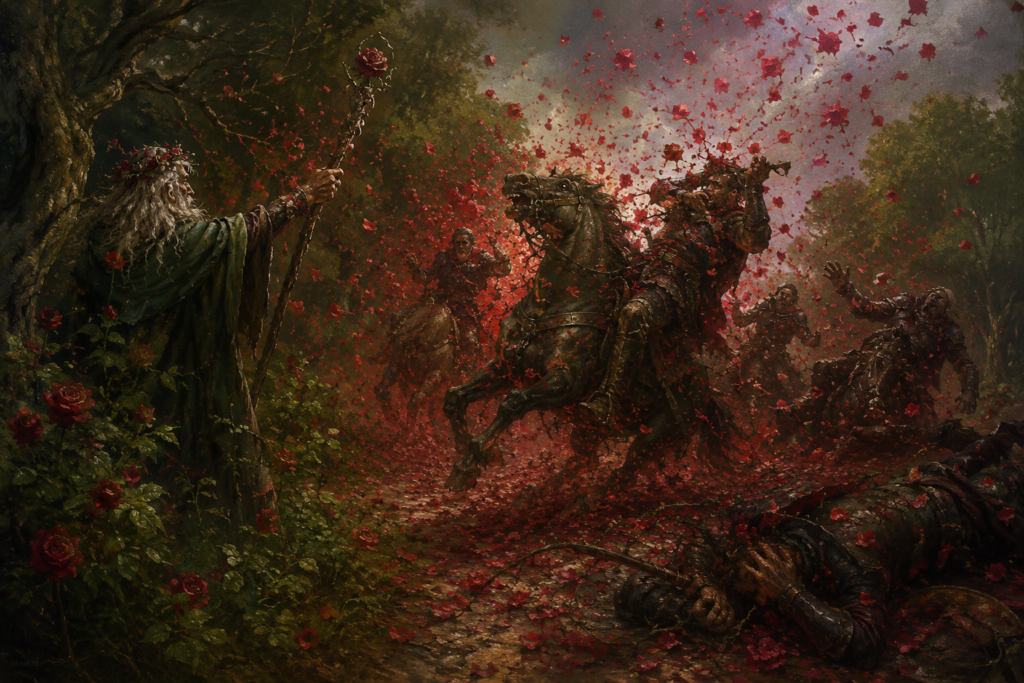
You call down a rain of red roses in a vast area. The flowers drift, whirl, and fall as if carried by a sacred wind. Their petals are soft, fragrant, and radiant, but their thorns cut evil creatures with supernatural precision.
The harm is not merely physical. The roses attack malice, corruption, cruelty, and spiritual self-possession. A creature brought down by the spell does not simply collapse from injury; it falls into sacred nightmare, trapped inside visions of judgment, guilt, terror, or divine accusation.
The petals also carry an overwhelming sweetness. Evil creatures touched by them may falter, retch, lose focus, or fight as though the world itself has turned against them. Resisting that sickening influence does not make the creature safe from the thorns.
Mechanics Tabs
The rules below are mechanics compatible for different game editions.
Rain of Roses 5.5e / 2024
Rain of Roses Pathfinder 1e / 3.5e
Rain of Roses 3.0e
Rain of Roses 5.5e / 2024-Compatible Version
7th-Level Evocation
Casting Time: Action
Range: 500 feet
Components: V, S, M (a red rose)
Duration: Concentration, up to 1 minute
School: Evocation
Spell Lists: Druid
Alternative Spell Name: Rosefall Judgment
You cause red roses to fall in an 80-foot-radius, 80-foot-high Cylinder centred on a point you can see within range. The area is Lightly Obscured by falling petals.
When a qualifying creature enters the area for the first time on a turn or starts its turn there, it must make a Wisdom saving throw. On a failed save, the creature takes 5d8 Psychic damage and has Disadvantage on attack rolls and ability checks until the start of its next turn. On a successful save, it takes half as much damage and suffers no additional effect.
A qualifying creature is an Evil creature, a Fiend, an Undead sustained by malice or evil magic, a creature consecrated to an evil power, or another creature the DM rules to be supernaturally evil. Ordinary enemies, selfish mortals, beasts, rivals, or morally flawed creatures are not automatically qualifying creatures unless the DM rules otherwise.
If a qualifying creature is reduced to 0 Hit Points by this spell, it falls unconscious rather than dying outright, unless the DM determines that its nature prevents unconsciousness. While unconscious in this way, the creature is trapped in sacred nightmares, visions of judgment, or memories of the harm it has done.
Creatures that are not qualifying creatures are not damaged or weakened by this spell, though they can see, smell, and move through the falling roses.
At Higher Levels: When you cast this spell using an 8th-level spell slot or higher, the Psychic damage increases by 1d8 for each slot level above 7th.
Rain of Roses Pathfinder 1e / 3.5e-Compatible Version
Evocation [Good]
Level: Druid 7
Components: V, S, M
Casting Time: 1 standard action
Range: Long (400 ft. + 40 ft./level)
Area: Cylinder, 80-ft. radius, 80 ft. high
Duration: 1 round/level (D)
Saving Throw: None for Wisdom damage; Fortitude negates sickened
Spell Resistance: Yes
Material Component: A red rose
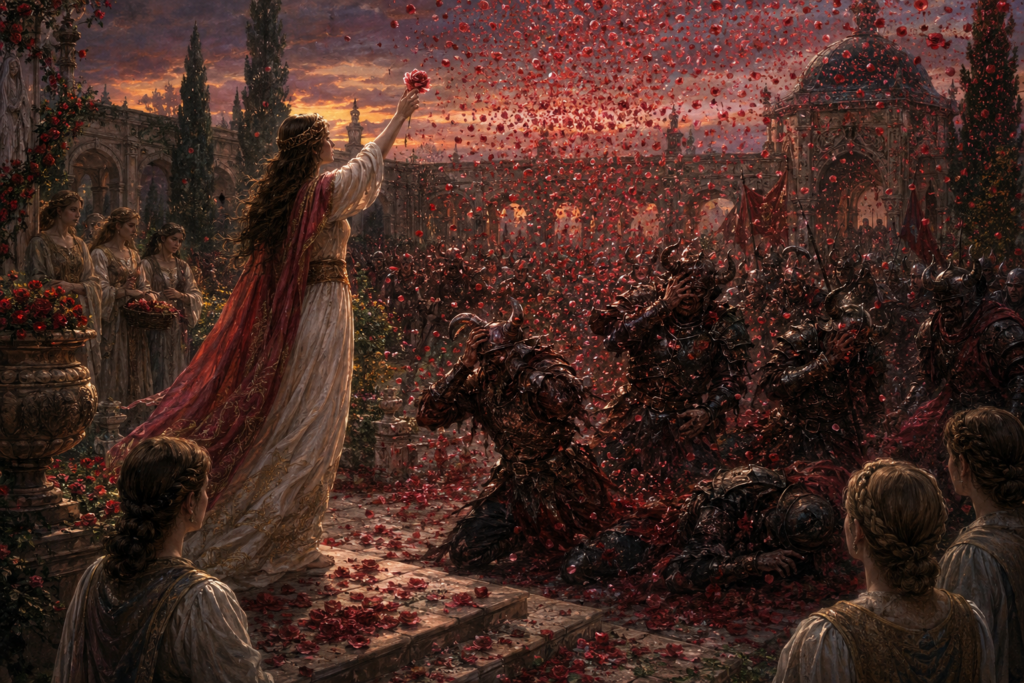
Red roses fall throughout the spell’s area. Evil creatures in the area are grazed by supernatural thorns, taking 1d4 points of temporary Wisdom damage each round they remain within the rain. A creature reduced to 0 Wisdom by this spell falls unconscious as its mind sinks into terrible nightmares.
In addition, evil creatures touched by the petals must attempt a Fortitude save. On a failed save, the creature is sickened while it remains in the spell’s area. A successful Fortitude save makes that creature immune to the sickened effect of this casting, but does not protect it from the Wisdom damage caused by the thorns.
Non-evil creatures are not harmed or sickened by the roses.
Rain of Roses 3.0e

Red roses fall from the sky.
(Book of Exalted Deeds)
Originally posted on D&D tools
Evocation [Good]
Level: Druid 7,
Components: V, S, M,
Casting Time: 1 standard action
Range: Long (400 ft. + 40 ft./level)
Area: Cylinder (80-ft. radius, 80 ft. high)
Duration: 1 round/level (D)
Saving Throw: None (ability damage) and Fortitude negates (sickening)
Spell Resistance: Yes
Their sharp thorns graze the flesh of evil creatures, dealing 1d4 points of temporary Wisdom damage per round. A creature reduced to 0 Wisdom falls unconscious as its mind succumbs to horrible nightmares.
In addition, the beautiful rose petals sicken evil creatures touched by them; those that fail a Fortitude save are sickened (-2 penalty on attack rolls, weapon damage rolls, saving throws, ability checks, and skill checks) until they leave the spell’s area.
A successful Fortitude save renders a creature immune to the sickening effect of the roses, but not the ability damage caused by their thorns.
Material Component: A red rose.
Why This Spell Is Dangerous in the World
Rain of Roses is dangerous because it can make hidden evil visible in public. A court, battlefield, temple garden, siege camp, or market square may look ordinary until the roses fall. The untouched stand in wonder. The wicked bleed, retch, stagger, or collapse into nightmare.
That makes the spell politically explosive. It can expose fiends, cursed nobles, corrupt champions, oathbreakers, and servants of evil powers. It can also turn a legal dispute, succession crisis, sacred accusation, or battlefield command into a public test of spiritual guilt.
Rules Clarifications and Edge Cases
- Rain of Rosesl is selective: The roses fall throughout the area, but the harmful magic affects only evil or qualifying creatures.
- Hostile is not the same as evil: In the 5.5e version, the DM decides whether a creature qualifies. Ordinary enemies are not automatically valid targets.
- The 3.5e/PF save is limited: The Fortitude save negates only the sickened effect. It does not prevent the Wisdom damage.
- Leaving the area matters: A creature affected by the sickening effect stops being sickened by the spell when it leaves the rosefall.
- Spell resistance applies: In the Pathfinder / 3.5e version, spell resistance can protect a creature from the spell’s magical effects.
- Unconsciousness is supernatural: A creature reduced to 0 Wisdom or 0 Hit Points by the spell is overwhelmed by nightmare, judgment, or spiritual collapse.
Good Combinations
- Wall of Thorns: Keeps evil creatures trapped near or inside the rosefall, making escape costly and slow.
- Entangle: Restricts movement through the area so affected creatures cannot simply walk out of the rain.
- Plant Growth: Turns open ground into punishing terrain, giving the roses more time to work.
- Hold Monster: Pins a dangerous evil creature beneath the falling roses long enough for the spell’s attrition to matter.
- Silence: Prevents enemy casters beneath the rosefall from answering sacred judgment with spells that require speech.
Adventure Hooks
The Garden That Judges: Once each year, Rain of Roses fall over a ruined sanctuary. The innocent gather beneath them for blessing. This year, several respected nobles collapse screaming.
The Siege of Red Petals: A druidic circle offers to break an evil warlord’s siege by calling down the spell over both armies. The defenders must decide whether they trust a magic that may reveal corruption on their own side.
The Rose That Would Not Wither: A single red rose used as the spell’s material component survives the casting and continues to bleed dew. Fiends want it destroyed. Druids, temple servants, and devils all claim it proves a different truth.
Historical and Mythic Context
Rain of Roses draws on the rose’s oldest and sharpest contradiction: beauty joined to wound. A rose is never only soft. It carries thorns. It blooms vividly and dies quickly. It can be offered in love, laid on graves, woven into victory, or stained by stories of divine grief. That makes it an ideal image for a spell where beauty becomes judgment.
In classical myth, the rose belongs naturally to the world of Aphrodite and Venus: beauty, desire, fertility, and dangerous attraction. Later mythic tradition links the red rose to the death of Adonis, the beautiful youth loved by Aphrodite. In one version, the rose is reddened by divine blood after Aphrodite is wounded by thorns while rushing to him. This gives the flower a sharper meaning than simple romance: beauty is pierced, love bleeds, and the flower becomes a sign of grief as much as desire.
The spell also echoes the Roman use of roses in memory of the dead. The Rosalia, or festival of roses, was associated with adorning graves, honouring the dead, and binding beauty to remembrance. In a fantasy world where magic makes symbols literal, that funerary rose becomes more than a memorial offering. It becomes a falling sign of judgment, memory, and the price of corrupted life.
For play, this makes Rain of Roses stronger than a decorative sacred storm. The roses are beautiful because the magic is not crude. They wound because the world itself has thorns. They sicken evil creatures because the wicked cannot endure what the innocent can stand beneath in wonder. A battlefield under this spell should feel less like an explosion and more like a verdict: red petals falling, guilty bodies failing, and nightmares opening where conscience should have been.