
Spell, Orpheus’s Song of Sanctuary, “Sanctuary of the Golden Lyre”
Orpheus’s Song of Sanctuary, “Sanctuary of the Golden Lyre”
The bard sings a forbidden measure of peace, and for a few heartbeats violence itself forgets how to reach the chosen.
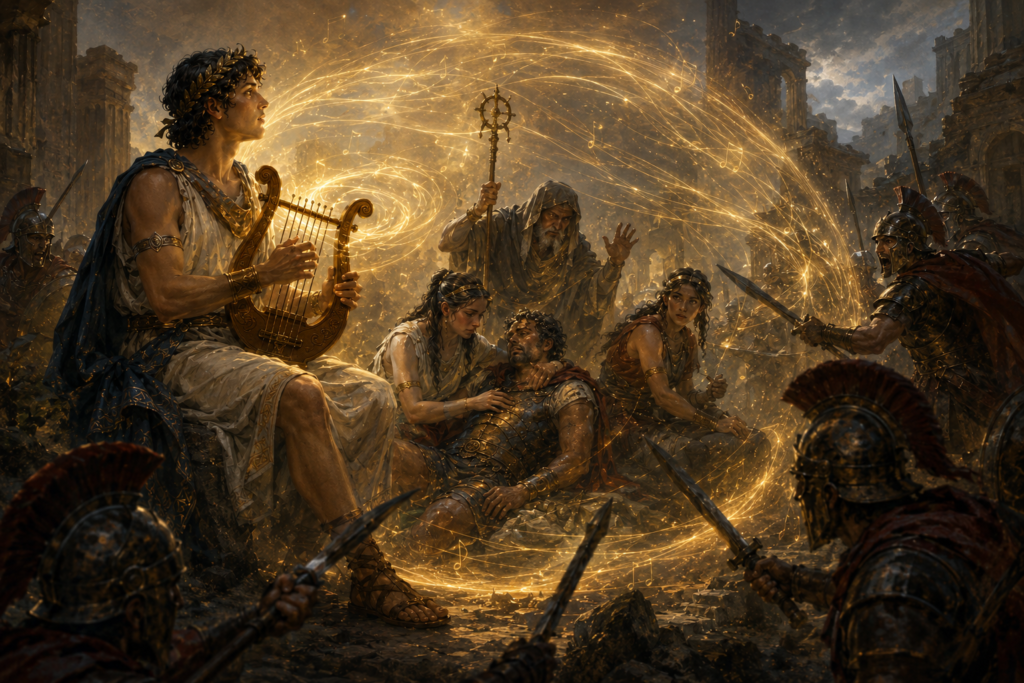
Orpheus’s Song of Sanctuary is a protective bard spell that shields allies from direct attack without making them invulnerable. It does not stop a battle, block area magic, or prevent enemies from acting. Instead, it places the chosen creatures beneath a supernatural musical ward that makes deliberate violence falter.
The spell is strongest when used to protect healers, envoys, wounded companions, ritual casters, prisoners, or allies trying to withdraw from a collapsing fight. Its limit is essential: a protected creature cannot use the sanctuary as cover for aggression. The moment a warded creature attacks, casts hostile magic, or directs violence against an enemy, the protection ends for that creature.
This is the spell of the raised hand, the carried body, the last word before execution, and the narrow road out of slaughter. It creates a temporary boundary in the battle: those beneath the song may move, heal, speak, defend, carry the wounded, maintain a ritual, or retreat, but they cannot safely fight from behind it.
Effect
You ward multiple creatures with a song of supernatural restraint. An enemy that tries to directly attack one of the warded creatures must first resist the spell. If the enemy fails, the attack falters and that part of its action is wasted. The enemy cannot directly attack the warded creatures for the rest of the spell’s duration.
The spell does not protect against area effects, battlefield hazards, traps, collapsing structures, environmental damage, existing ongoing effects, or attacks that are not aimed specifically at a warded creature.
Edition Tabs
Orpheus’s Song of Sanctuary 5.5e / 2024
Orpheus’s Song of Sanctuary, Pathfinder 1e / 3.5e
Orpheus’s Song of Sanctuary, 3.0e
Orpheus’s Song of Sanctuary 5.5e / 2024
5th-Level Abjuration
Casting Time: Action
Range: 60 feet
Components: V, S
Duration: Concentration, up to 1 minute
Available To: Bard
Saving Throw: Wisdom
Alternative Spell Name: Sanctuary of the Golden Lyre
Choose up to five willing creatures you can see within range. Each chosen creature is warded by a supernatural song.
The spell ends early on a warded creature if that creature makes an attack roll, casts a spell or uses an ability that deals damage to an enemy, forces an enemy to make a saving throw, or orders, magically compels, or otherwise directs another creature to make an attack or use a harmful effect.
Whenever a creature tries to directly attack a warded creature with a weapon attack, spell attack, targeted spell, or other harmful effect that specifically chooses that warded creature as a target, the attacker must make a Wisdom saving throw.
On a successful save, the attacker can attack that warded creature normally and is immune to this casting of Orpheus’s Song of Sanctuary for the rest of the spell’s duration.
On a failed save, the attacker cannot complete that attack against any creature warded by this casting. The attack, spell target, or hostile part of the action is wasted. Until the spell ends, that attacker cannot directly attack any creature warded by this casting.
This spell does not protect warded creatures from area effects, environmental damage, traps, falling objects, battlefield hazards, or effects that do not directly target them.
At Higher Levels: When you cast this spell using a spell slot of 6th level or higher, you may target one additional creature for each slot level above 5th.
Orpheus’s Song of Sanctuary, Pathfinder 1e / 3.5e
Abjuration
Level: Bard 5
Components: V, S
Casting Time: 1 standard action
Range: Close; 25 ft. + 5 ft./2 levels
Targets: One creature/level, no two of which can be more than 30 ft. apart
Duration: 1 round/level
Saving Throw: Will negates
Spell Resistance: No
Any opponent attempting to strike or otherwise directly attack one of the warded creatures, including with a targeted spell, must attempt a Will save.
If the save succeeds, the opponent can attack normally and is unaffected by this casting of the spell.
If the save fails, the opponent cannot follow through with the attack. That part of the opponent’s action is lost, and the opponent cannot directly attack any of the warded creatures for the duration of the spell.
Creatures that do not attempt to attack the spell’s subjects are unaffected. The spell does not prevent warded creatures from being caught in area effects.
A warded creature breaks the spell on itself if it attacks, casts an offensive spell, uses a hostile ability, or directs another creature to attack. The warded creature may still move, defend itself, heal, speak, perform, withdraw, carry objects or allies, maintain a ritual, or take other non-offensive actions.
Orpheus’s Song of Sanctuary, 3.0e
This spell wards allies from direct attack.
Relics & Rituals: Olympus
© 2004 White Wolf Publishing, Inc. Distributed for Sword and Sorcery Studios by White Wolf Publishing, Inc.
By W. Jason Peck, Aaron Rosenberg, Christina Stiles and Relics & Rituals: Olympus team
Abjuration
Level: Bard 5
Components: V, S
Casting Time: 1 standard action
Range: Close (25 ft. + 5 ft./2 levels)
Target: One creature/level, no two of which can be more than 30 ft. apart
Duration: 1 round/level
Saving Throw: Will negates
Spell Resistance: No
Any opponent attempting to strike or otherwise directly attack the warded creatures, even with a targeted spell, must attempt a Will save. If the save succeeds, the opponent can attack normally and is unaffected by that casting of the spell. If the save fails, the opponent can’t follow through with the attack, that part of his action is lost, and he can’t directly attack the warded creatures for the duration of the spell. Those not attempting to attack the subjects remain unaffected. This spell does not prevent the warded creature from being attacked or affected by area of effect spells. The subjects cannot attack without breaking the spell but may use non attack spells or otherwise act.
Why This Spell Is Dangerous in the World
Orpheus’s Song of Sanctuary is dangerous because it turns performance into protected space. A bard who knows the spell can halt an executioner’s blade, carry a wounded prince through a battlefield, protect witnesses during a trial, or force assassins to reveal themselves when their attacks fail.
The spell does not end violence. It redirects it. Enemies can still burn the hall, collapse a bridge, summon hazards, strike unwarded allies, or wait for the song to end. Intelligent foes quickly learn to attack the battlefield rather than the protected person.
That is what makes the spell feared. It does not save everyone. It saves just enough people, for just long enough, to ruin a murder, expose a tyrant, break an ambush, or let the dying speak before the blade falls again.
Best Uses
Protecting the wounded: The spell gives injured allies time to withdraw, receive healing, or survive long enough for help to reach them.
Guarding a ritual caster: A bard can shield companions maintaining a ritual, reading an inscription, opening a sealed gate, or negotiating with a spirit while the rest of the party holds the line.
Stopping assassins: The spell works well in courts, feast halls, sacred contests, theatres, and public ceremonies where the first visible act of violence matters.
Covering a retreat: Since warded creatures can move without breaking the spell, it gives the party a strong but limited way to escape without turning retreat into automatic safety.
Protecting noncombatants: Prisoners, envoys, witnesses, wounded nobles, sacred animals, children, and bearers of relics are all strong targets for the spell.
Tactics
Cast the spell before the enemy has already overwhelmed the party. It is strongest when the battlefield still has choices.
Place the ward on allies who need to act without attacking. Healers, scouts carrying a key, ritual casters, negotiators, and wounded front-line characters are better targets than damage dealers.
Enemies should adapt. A failed save should stop direct attack, but clever foes may switch to area spells, smoke, terrain destruction, intimidation, hostage-taking, or attacks against unwarded allies. This keeps the spell dramatic without making it a hard stop on the encounter.
The party should also understand the cost. A warded fighter who attacks loses the protection. That creates a real tactical decision: remain protected and reposition, or break the song and rejoin the fight.
DM Notes
Do not let this spell become protected artillery. If a warded creature attacks, casts an offensive spell, forces an enemy saving throw, or directs another creature to attack, the ward ends on that creature.
A failed saving throw wastes only the part of the action used to attack the warded creature. If the creature still has legal attacks, movement, reactions, bonus actions, or other options available, it may use them against unwarded targets or in non-direct ways.
Area effects still work. A dragon’s breath weapon, fireball, collapsing roof, rolling boulder, spreading poison gas, or burning oil can still affect warded creatures if the effect does not directly target them.
Use the spell to sharpen scenes, not flatten them. It should create a powerful pause in violence, a moment where the enemy must decide whether to change tactics, retreat, wait, or reveal how ruthless they are willing to be.
Good Combinations
- Healing Word: Lets the bard protect a fallen ally and bring them back into the scene without inviting immediate direct retaliation.
- Mass Cure Wounds: Works well when the spell buys the party one crucial round to recover in a broken formation.
- Calm Emotions: Reinforces the spell’s nonviolent pressure in riots, court scenes, negotiations, and faction standoffs.
- Wall of Force: Combines physical separation with magical restraint, creating a controlled space for evacuation, parley, or ritual completion.
- Dimension Door: Turns the spell into an extraction tool, letting the party protect a vulnerable ally long enough to remove them from the worst part of the fight.
Using This Spell in Your Game
Orpheus’s Song of Sanctuary works best where survival, restraint, and public consequence matter. Use it during executions, battlefield rescues, sacred performances, peace talks, hostage exchanges, funerals, trials, and desperate retreats.
The spell should not feel like a pause button. It should feel like a song holding back the hand of violence while everyone in the scene realizes the hand is still there.
Spellcasting Culture and Worldbuilding Hooks
Bards who learn Orpheus’s Song of Sanctuary are rarely treated as ordinary performers. In Hellenic courts, sacred theatres, mystery cults, and heroic households, the spell belongs to the old belief that song can command beasts, stones, spirits, and death itself.
Some rulers forbid the spell during trials and executions, fearing that it can shield the guilty from lawful punishment. Others preserve it as a sacred art used to protect suppliants, brides, envoys, poets, and funeral-bearers.
Among adventurers, the spell is respected because it asks a hard question: who can afford not to attack?
Adventure and Worldbuilding Hooks
The Interrupted Execution: A condemned prisoner survives the executioner’s first stroke when a hidden bard begins Orpheus’s Song of Sanctuary from the crowd. The party must decide whether the spell reveals innocence, conspiracy, or divine intervention.
The Theatre Under Siege: During a sacred performance, assassins enter the theatre to kill a foreign envoy. The only thing keeping the envoy alive is a chorus trained to sustain the song.
The Song That Fails: A famous bard’s sanctuary no longer protects anyone. The failure may come from a broken oath, a stolen lyre-string, a curse from the Underworld, or an enemy who has learned how to profane the melody.
Source and Literary Context
Orpheus’s Song of Sanctuary is adapted from Relics & Rituals: Olympus, published by Sword and Sorcery Studios / White Wolf Publishing in 2004. The spell draws on the mythic image of Orpheus as the supreme musician whose song could move animals, trees, stones, spirits, and even the powers of the Underworld.
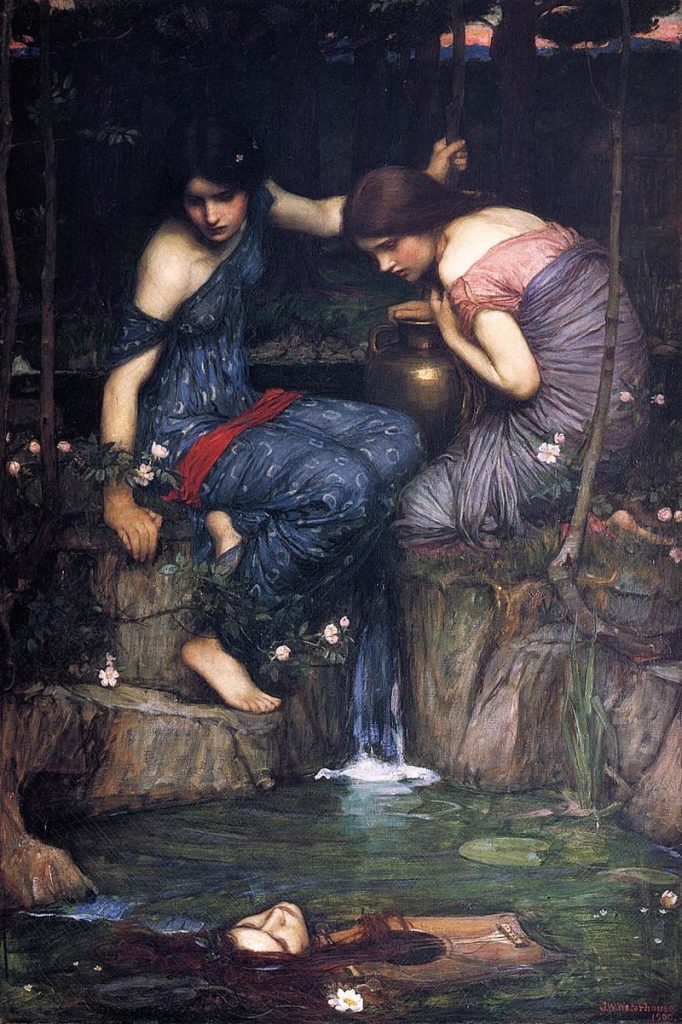
The public-domain painting associated with this spell entry is Orpheus by John William Waterhouse. The image is available through Wikimedia Commons here: John William Waterhouse, Orpheus, Wikimedia Commons.
For a concise reference on Orpheus as a Greek mythic musician, poet, and founder-figure of Orphic tradition, see Britannica’s Orpheus entry. In campaign terms, this spell treats music as a force that can restrain violence, cross thresholds, and briefly alter the order of a scene.
Keep this reference growing
If this page helped with your reading or game, you can support its upkeep or explore the curated books.
Explore the Bookshop — epics, classics and stories behind imagined worlds.