
Caustic Mire Spell: Sour Earth, Acid Sludge, and Burning Vapours
Caustic Mire Spell: Sour Earth, Acid Sludge, and Burning Vapours
A spell of sour earth, burning sludge, and flammable battlefield vapour.
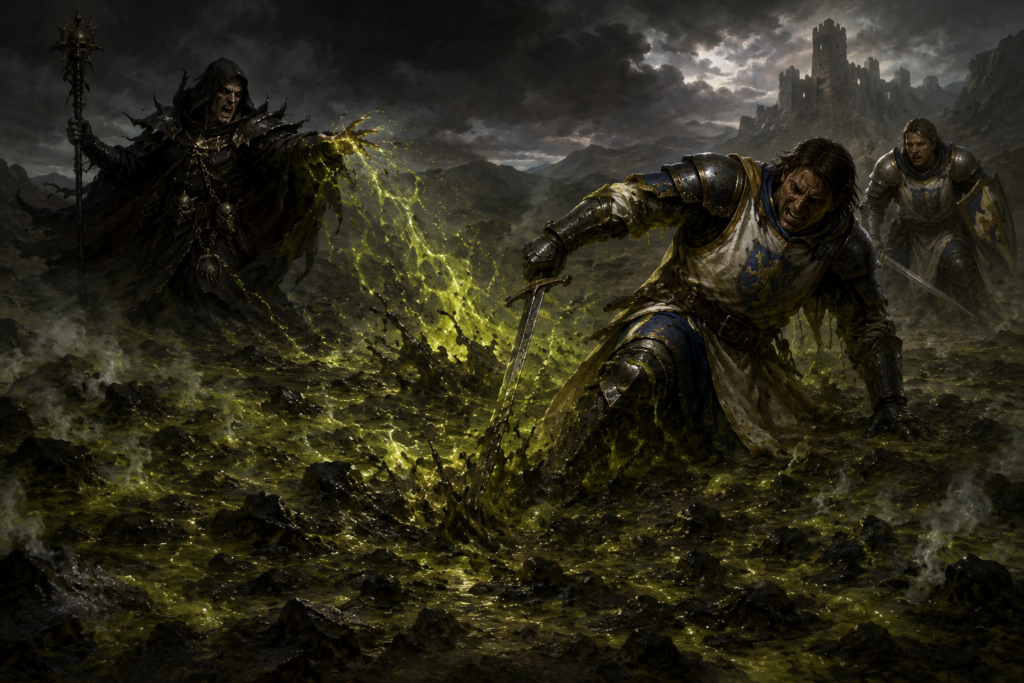
Caustic Mire makes the earth sweat poison. Sour sludge seeps through cracks, mud thickens into green-black acid, and safe footing becomes a clinging trap that burns whatever tries to cross it. Boots smoke. Hooves shy away. Shield lines break because no one wants to take the next step.
This is battlefield magic at its ugliest. It does not merely strike an enemy; it spoils a place. A road, gatehouse, ford, chapel floor, siege breach, or courtyard can become a shallow pit of corrosive filth in a single breath. Enemies caught inside must choose between standing still while the acid eats at them or forcing their way through sludge that punishes every movement.
The spell becomes still more dangerous when flame enters the area. The fumes rising from the sludge are flammable, and fire passing through them burns hotter. A disciplined caster uses Caustic Mire to break movement first, then punishes trapped enemies while they are still wading through the filth.
Quick Rules Reference
- Spell type: Conjuration spell that creates an acidic ground hazard.
- Main use: Area denial, movement control, chokepoint defence, and fire-damage support.
- Area: A 20-foot-radius spread of acidic sludge.
- Damage: Creatures are harmed by moving through the area or remaining in it.
- Movement: The sludge is thick and sticky, making affected ground costly to cross.
- Fire interaction: Fire damage dealt inside the area becomes more dangerous because of the flammable fumes.
- Best battlefield role: Divide enemies, punish melee attackers, and make safe footing scarce.
Effect
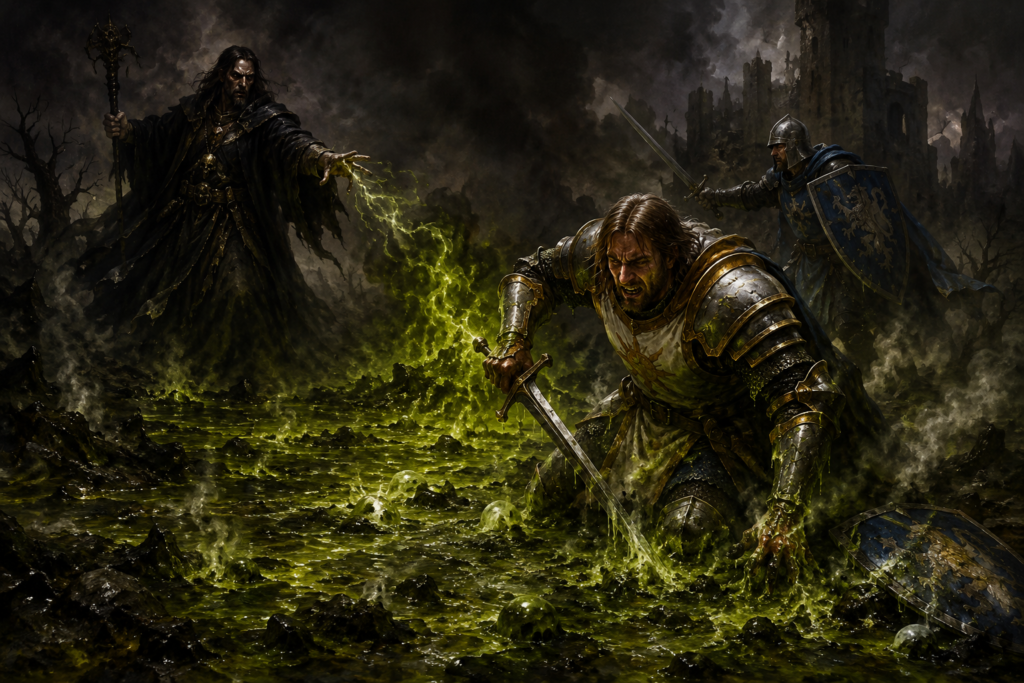
You cause foul acidic sludge to seep across the ground in a 20-foot-radius spread. The substance resembles thick, sticky mud mixed with alchemical waste: greenish-yellow acid, black bubbles, glistening scum, and low vapour that gathers close to the surface.
Creatures entering or moving through the affected area are slowed and burned as the sludge clings to boots, claws, hooves, wheels, and exposed flesh. A creature that stays in place inside the sludge is still harmed by the acid at the end of its turn.
The rising vapours are flammable. Fire effects that deal damage within the area burn hotter and more violently, adding extra damage based on the number of fire-damage dice rolled.
Mechanics Tabs
The rules below are mechanics tabs for different game editions.
Caustic Mire 5.5e / 2024
Caustic Mire Pathfinder 1e / 3.5e
Caustic Mire 3.0e
Caustic Mire 5.5e / 2024-Compatible Version
4th-Level Conjuration
Casting Time: Action
Range: 120 feet
Components: V, S
Duration: Concentration, up to 1 minute
Alternative Spell Name: Acid Mire
You choose a point on ground that you can see within range. Acidic sludge spreads from that point in a 20-foot-radius area. The spell requires a surface that can reasonably hold the sludge, such as soil, stone, packed earth, a floor, a road, a bridge, or similar ground. It does not normally form on unsupported air, vertical walls, or open water unless the DM rules that a suitable surface is present.
The area is Difficult Terrain for the duration. When a creature enters the area for the first time on a turn or starts its turn there, it takes 2d6 acid damage. A creature can take this damage only once per turn from the spell.
The fumes above the sludge are flammable. When a spell or other effect deals fire damage to one or more creatures in the area, each affected creature takes extra fire damage equal to the number of fire-damage dice rolled by that effect, with a minimum of 1 extra fire damage.
The sludge is a magical environmental hazard. It does not require a saving throw, but creatures can avoid most of its damage by not entering or remaining in the area.
At Higher Levels
When you cast this spell using a spell slot of level 5 or higher, the acid damage increases by 1d6 for each slot level above 4.
5.5e Notes
- Damage timing: The 5.5e version uses the cleaner modern timing of “enters the area for the first time on a turn or starts its turn there.” This prevents forced movement from multiplying damage too far.
- Forced movement: If a creature is pushed, pulled, or otherwise moved into the area, it takes the damage if it has not already taken this spell’s damage that turn.
- Flying creatures: A flying creature is affected only if it is moving through or standing in the sludge, not merely flying above the fumes.
- Fire bonus: The extra fire damage applies only to creatures inside the area that are already taking fire damage from the triggering effect.
- Objects and surfaces: The spell can stain, scar, and pit ordinary surfaces, but it is not intended to destroy fortifications or large objects unless the DM rules the material is especially vulnerable.
Caustic Mire Pathfinder 1e / 3.5e-Compatible Version
School: Conjuration (Creation)
Level: Sorcerer/Wizard 4
Components: V, S
Casting Time: 1 standard action
Range: Medium (100 ft. + 10 ft./level)
Area: 20-ft.-radius spread
Duration: 1 round/level (D)
Saving Throw: None
Spell Resistance: No
You create a 20-foot-radius spread of thick acidic slime across the ground. The area counts as difficult, sticky terrain. Entering an affected square costs 2 squares of movement, and each affected square a creature enters deals 1d6 acid damage.
A creature that remains in the acidic slime without moving from its space takes 1d6 acid damage at the end of its turn.
The fumes rising from the slime are flammable. Any effect that deals fire damage within the area deals +1 damage per die of fire damage, with a minimum of +1 damage.
Pathfinder / 3.5e Notes
- Square-by-square punishment: In the original-style version, moving through several affected squares can deal damage more than once because each entered square is hazardous.
- No saving throw: The spell is avoided through movement choices, flight, teleportation, resistance, or leaving the area rather than through a save.
- Spell resistance: Spell resistance does not apply because the spell creates a physical acidic substance rather than directly targeting a creature.
- Fire bonus: The extra fire damage improves fire effects inside the slime; it does not cause the whole area to explode unless the DM adds that as a special environmental consequence.
- Dismissible: The caster can end the spell early if the slime becomes a danger to allies or blocks a needed route.
Caustic Mire 3.0e
A foul sludge seeps out of the ground, coating the area before you.
(Complete Mage)
Conjuration (Creation)
Level: Sorcerer/Wizard 4,
Components: V, S,
Casting Time: 1 standard action
Range: Medium (100 ft. + 10 ft./level)
Area: 20-ft.-radius spread
Duration: 1 round/level (D)
Saving Throw: None
Spell Resistance: No
You cover the ground in an acidic slime, roughly the consistency of thick mud. The sludge is sticky; entering any square affected by caustic mire costs 2 squares of movement. In addition, each square entered deals 1d6 points of acid damage to the creature moving.
A creature who stands in the area without moving from its space takes 1d6 points of damage per round at the end of its turn.
The fumes rising out of caustic mire are flammable. Any effect that deals fire damage within an area of caustic mire deals an extra 1 point of damage per die (minimum +1 damage).
Why This Spell Is Dangerous in the World
Caustic Mire is dangerous because it turns footing into a weapon. A bridge, market square, temple floor, siege breach, mine passage, or castle gate can become unusable in seconds. It does not need to strike a named target, and it does not need the victim to fail a saving throw. It simply makes a place hostile while the magic lasts.
In battle, the spell is feared by soldiers because it punishes discipline. Shield walls, cavalry charges, baggage trains, and clustered infantry formations all suffer when the earth under them becomes glue and acid. A squad that might survive a direct blast can be broken apart by the slow panic of being trapped in burning mud.
Outside battle, its use is politically ugly. A caster who throws caustic sludge into a street, granary, ferry landing, stable yard, or temple precinct may be remembered less as a soldier and more as a defiler. The acid fades when the magic ends, but the fear of poisoned ground can linger far longer.
Rules Clarifications and Edge Cases
- Does the spell affect walls? Normally no. It coats the ground in the area, not vertical surfaces, unless the terrain is unusually sloped or the DM rules otherwise.
- Does jumping avoid the damage? A creature that completely clears the affected ground avoids the sludge. A failed or partial jump may still land in affected squares.
- Does levitation avoid it? Yes, if the creature is not touching the ground or sludge.
- Does acid resistance help? Yes. Acid resistance applies to the acid damage normally.
- Can fire burn the sludge away? Not by default. Fire makes the fumes more dangerous, but the spell’s duration still controls how long the sludge remains.
- Can allies cross safely? No. The spell does not distinguish friend from foe.
Good Combinations
- Wall of Fire: Forces enemies to choose between staying in acid, moving through acid, or entering intensified fire.
- Fireball: Punishes enemies trapped inside the sludge and benefits from the flammable vapours.
- Web: Holds creatures near or inside the affected area, creating a brutal control zone.
- Grease: Can make movement through the battlefield even more awkward if placed near the sludge’s edge.
- Slow: Makes escape from the hazardous area much harder.
Adventure Hooks
- The Burned Ford: Travellers report that a river crossing still smells of acid weeks after a wizard’s duel. Something beneath the ford has begun feeding on the magical residue.
- The Siege Chemist: A mercenary mage uses Caustic Mire to halt relief forces outside a starving town. The spell is tactically brilliant, but every use leaves civilians trapped between fire and acid.
- The Green Chapel Floor: A ruined shrine bubbles with old conjured mire whenever blood touches the stones. The spell should have faded years ago, but something sacred beneath the chapel is still reacting.
Historical and Mythic Context
Caustic Mire belongs to the old fear of bad ground: marsh, bog, poisoned mud, sulphurous pools, battlefield ditches, and roads that swallow the unwary. Natural marshes and bogs are not evil places, but in folklore and fantasy they often become thresholds into danger because they make ordinary travel uncertain. A firm road is law, settlement, and return. A mire is delay, exhaustion, hidden depth, and the loss of control.
The spell also touches the older imaginative territory of alchemy. Medieval and early modern alchemical language often joined transformation, mineral substances, vapours, corruption, and strange fires into a single symbolic world. Caustic Mire turns that imagery into battlefield magic: the ground becomes an alchemical vessel, and the enemy must cross the experiment while it is still reacting.
The acid element gives the spell its cruel physical identity. In ordinary chemistry, an acid is associated with sourness, reaction, corrosion, and chemical change. In fantasy terms, that becomes immediate and visible: leather blackens, iron spits, flesh burns, and each step through the sludge feels like the land itself has learned to bite.
As a conjuration spell, Caustic Mire does not merely suggest filth or frighten enemies with an illusion of poisoned earth. It creates a real, temporary substance. That makes the spell feel less like a flash of battle magic and more like a brief wound opened in the world: a place where earth, acid, rot, and fire-fume are forced into the same hateful shape.