
Creating Magic Items
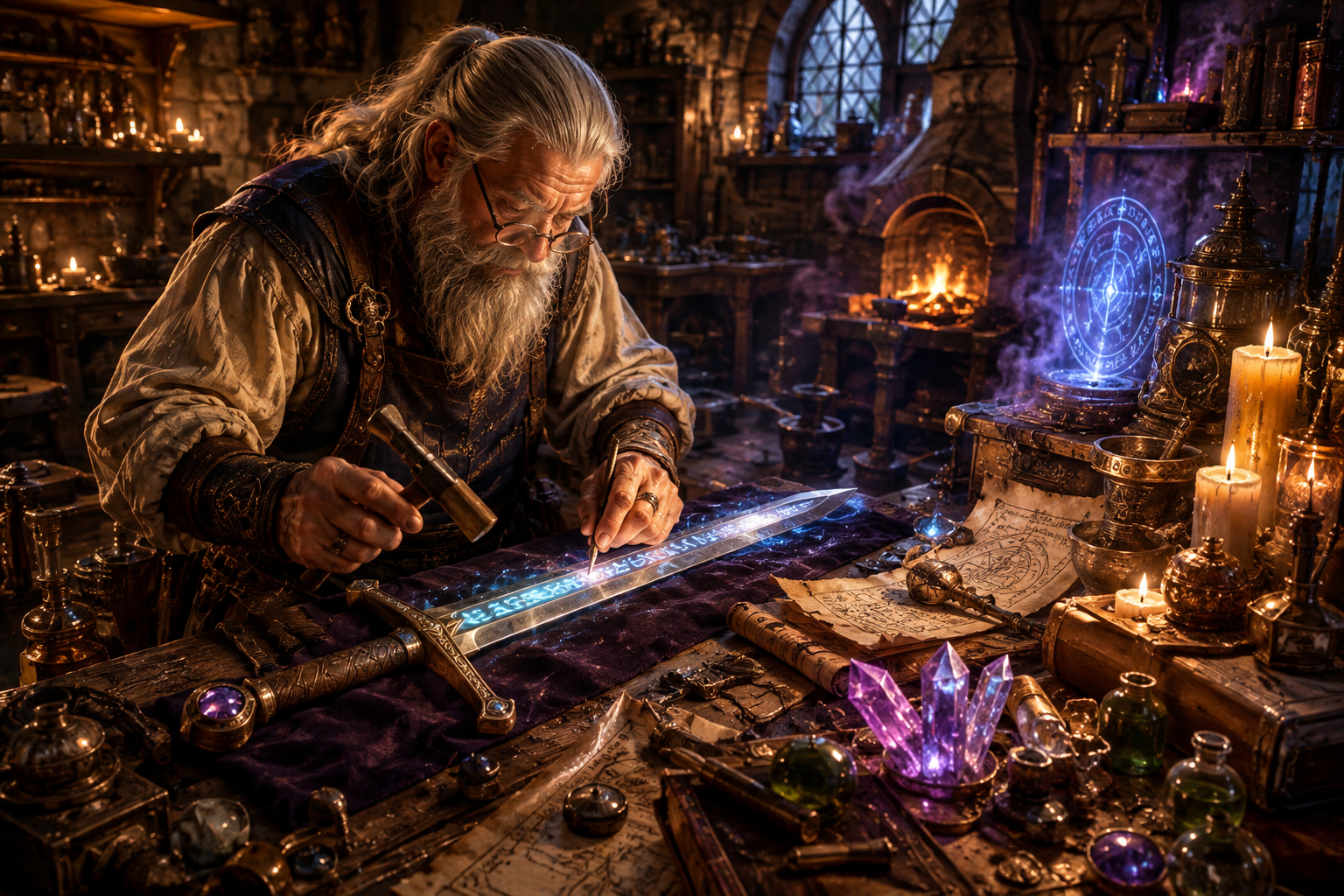
Creating magic items brings together skilled craft, magical knowledge, rare materials and time. Enchanted objects are forged, brewed, inscribed, carved, woven and assembled by specialist makers.
A sword must first be forged, a ring shaped, a scroll prepared and a potion compounded before magic can become part of the finished work. Powerful items demand greater skill, rarer materials and longer periods of uninterrupted creation.
Creating Magic Items — Rules
5.5e Magic-Item Crafting
Choose the item, gather the required materials, use the appropriate tools and spend the required crafting time. Rarity determines the basic cost and length of the project.
Quick Procedure
- Choose the item. Determine the item and its rarity.
- Have Arcana proficiency.
- Have proficiency with the required tool.
- Prepare any required spells. If the item allows its user to cast spells, those spells must be prepared on each crafting day.
- Provide the materials and base object.
- Spend the required crafting time. Each crafting day represents 8 hours of work.
Required Tools
| Magic Item | Required Tool |
|---|---|
| Armour | Leatherworker’s Tools, Smith’s Tools or Weaver’s Tools, depending on the armour |
| Potion | Alchemist’s Supplies or Herbalism Kit |
| Ring | Jeweller’s Tools |
| Rod | Woodcarver’s Tools |
| Scroll | Calligrapher’s Supplies |
| Staff | Woodcarver’s Tools |
| Wand | Woodcarver’s Tools |
| Weapon | Leatherworker’s Tools, Smith’s Tools or Woodcarver’s Tools, depending on the weapon |
| Wondrous Item | Tinker’s Tools or the tool used to make the ordinary object |
The crafter must be proficient in both Arcana and the required tool. Assistants must meet the same requirements.
Crafting Time and Raw-Material Cost
| Rarity | Crafting Time | Magical Raw Materials |
|---|---|---|
| Common | 5 days | 50 gp |
| Uncommon | 10 days | 200 gp |
| Rare | 50 days | 2,000 gp |
| Very Rare | 125 days | 20,000 gp |
| Legendary | 250 days | 100,000 gp |
Crafting days need not be consecutive.
The Physical Item Costs Extra
The table covers magical materials. A weapon, suit of armour or other valuable physical object must also be supplied.
Enchanting plate armour therefore requires both the magical materials and the plate armour itself.
Assistants
Qualified characters can work together. Divide the required crafting time by the number of participating characters. Normally one assistant can help, although larger projects may support a larger team.
Required Spells
If the finished item allows its user to cast a spell, the crafter must have that spell prepared on every day spent crafting the item.
Finding Raw Materials
Suitable magical materials are available 75% of the time in a city and 25% of the time in another settlement. If none are available, wait at least seven days before checking again.
The materials can take whatever form suits the item: purified metals, gemstones, rare pigments, alchemical reagents, unusual timber or substances taken from magical creatures.
Consumable Magic Items
For a consumable magic item other than a Spell Scroll, halve the normal crafting time and material cost.
Spell Scrolls: use their own scribing rules. The scribe can qualify through Arcana or Calligrapher’s Supplies and must have the spell prepared while working.
Potions of Healing
The standard Potion of Healing uses its dedicated Herbalism Kit crafting procedure.
Completion
Ordinary magic-item crafting does not require a universal final skill check. Once the requirements, materials and crafting time are satisfied, the item is complete.
Sentient Items
Sentient items possess personalities, mental ability scores and goals. Ordinary crafting does not provide a universal cost for adding sentience; it comes from a particular item’s rules or from the campaign.
Potions and scrolls are never sentient.
Artefacts
Artefacts lie beyond ordinary rarity-based crafting. Their creation requires exceptional circumstances determined by the campaign.
Common Rulings
- Ordinary magic-item crafting requires both Arcana proficiency and the required tool proficiency.
- Assistants must also meet those requirements.
- The mundane base object is paid for separately.
- Ordinary consumables halve time and cost.
- Spell Scrolls use their dedicated scribing rules.
- Every spell granted by the item must be prepared during each crafting day.
- Artefacts are outside ordinary crafting.
Pathfinder 1e Magic-Item Creation
Magic-item creation uses an item-creation feat, construction prerequisites, materials, crafting time and a final creation check.
Quick Procedure
- Choose the item and required creation feat.
- Record its caster level and prerequisites.
- Pay for materials. Magical supplies normally cost half the item’s base price.
- Spend the required crafting time.
- Make the final creation check.
- Resolve success or failure.
Materials and Base Price
Magical supplies normally cost half the item’s base price. A weapon, suit of armour or other valuable mundane component is supplied separately.
Expensive components consumed by an item’s function can increase the creation cost.
Crafting Time
Creating a magic item normally requires 8 hours of work for every 1,000 gp of base price or fraction thereof, with a minimum of 8 hours for most items.
Accelerated Crafting
A crafter can work at twice the normal rate by increasing the final creation DC by +5.
Crafting While Adventuring
Four hours spent crafting during an adventuring day normally produces only 2 hours of progress. Work in distracting or dangerous conditions is likewise reduced.
Cheap Potions and Scrolls
A potion or scroll with a base price of 250 gp or less can be completed in as little as 2 hours.
A caster can create no more than one magic item per day, regardless of how little time the item requires.
The Final Creation Check
At the end of the work, make one creation check. Spellcraft is standard, although some item categories permit an appropriate Craft or Profession skill.
Success completes the item. Failure wastes the work and materials. Failure by 5 or more creates a cursed item.
Missing Prerequisites
An eligible missing prerequisite increases the creation DC by +5.
The required item-creation feat cannot be bypassed.
Potions, spell-trigger items and spell-completion items must satisfy their relevant spell prerequisites.
Common Item-Creation Feats
| Item | Typical Item-Creation Feat | Common Creation Skill |
|---|---|---|
| Magic Armour & Shields | Craft Magic Arms and Armor | Spellcraft or Craft (armour) |
| Magic Weapons | Craft Magic Arms and Armor | Spellcraft or Craft (weapons) |
| Potions | Brew Potion | Spellcraft or Craft (alchemy) |
| Rings | Forge Ring | Spellcraft or Craft (jewellery) |
| Rods | Craft Rod | Spellcraft or appropriate Craft skill |
| Scrolls | Scribe Scroll | Spellcraft |
| Staffs | Craft Staff | Spellcraft |
| Wands | Craft Wand | Spellcraft |
| Wondrous Items | Craft Wondrous Item | Spellcraft or an applicable Craft or Profession skill |
Magic Armour and Weapons
A weapon, suit of armour or shield must be masterwork before receiving magical enhancement. The masterwork object’s cost is separate from the magical price.
For a straightforward enhancement bonus, the creator’s caster level must normally be at least three times the enhancement bonus.
Estimating a New Item’s Price
Start with an existing item that produces a comparable benefit. Use the formulas below when no close comparison exists.
| Effect | Guideline Base Price |
|---|---|
| Enhancement bonus to ability score | Bonus² × 1,000 gp |
| Enhancement bonus to armour | Bonus² × 1,000 gp |
| Bonus spell | Spell level² × 1,000 gp |
| Deflection bonus to AC | Bonus² × 2,000 gp |
| Other AC bonus | Bonus² × 2,500 gp |
| Enhancement to natural armour | Bonus² × 2,000 gp |
| Resistance bonus to saves | Bonus² × 1,000 gp |
| Other save bonus | Bonus² × 2,000 gp |
| Competence bonus to a skill | Bonus² × 100 gp |
| Spell resistance | 10,000 gp per point above SR 12; minimum SR 13 |
| Weapon enhancement bonus | Bonus² × 2,000 gp |
Spell-Effect Price Guidelines
| Effect | Guideline Base Price |
|---|---|
| Single use, spell completion | Spell level × caster level × 25 gp |
| Single use, use activated | Spell level × caster level × 50 gp |
| 50 charges, spell trigger | Spell level × caster level × 750 gp |
| Command word | Spell level × caster level × 1,800 gp |
| Use activated or continuous | Spell level × caster level × 2,000 gp before other adjustments |
Continuous effects, slotless items and combinations of several abilities can alter the final price substantially.
Multiple Abilities
For several similar abilities in a slotless item, value the most expensive at full price, the next at 75%, and further abilities at 50% each.
Different abilities are normally added together. An unrelated power added to a slotted item can cost 50% more.
Adding a Power to an Existing Item
Subtract the existing item’s value from the completed item’s value. The crafter pays and works toward the difference while meeting the new power’s prerequisites.
Intelligent Items
Intelligent magic items have an alignment, Intelligence, Wisdom and Charisma scores, languages, senses and at least one special ability.
Making an item intelligent adds 500 gp to its base price before the additional costs for improved mental abilities, communication, senses and powers.
A basic intelligent item begins with mental ability scores of 10, sight and hearing to 30 feet, and empathic communication with its owner.
Artefacts
Artefacts stand outside ordinary item-creation feats and pricing formulas.
Common Rulings
- No XP expenditure is required for ordinary creation.
- The final check is normally DC 5 + caster level.
- Each eligible unmet prerequisite adds +5 DC.
- The required item-creation feat cannot be bypassed.
- Accelerated crafting adds +5 DC.
- Failure wastes the materials and work.
- Failure by 5 or more creates a cursed item.
- A caster can create only one magic item per day.
D&D 3.5e Magic-Item Creation
Magic-item creation uses item-creation feats, gold, time, spells and experience points. Most projects cost half the base price in materials and 1/25 of the base price in XP.
Quick Procedure
- Choose the appropriate item-creation feat.
- Meet the caster-level, spell and other prerequisites.
- Determine the item’s base price.
- Pay half the base price in magical supplies.
- Spend XP equal to 1/25 of the base price.
- Spend one day for every 1,000 gp of base price.
Time and Workspace
The creator needs a quiet, comfortable and well-lit place suitable for sustained work. Each crafting day represents 8 hours.
Most items require one day per 1,000 gp of base price, with a minimum of one day.
A character can work on only one magic item at a time.
Summary by Item Type
| Item | Required Feat | Typical Base-Price Rule |
|---|---|---|
| Magic Armour & Shields | Craft Magic Arms and Armour | Enhancement and special-ability value; masterwork object paid separately |
| Magic Weapons | Craft Magic Arms and Armour | Enhancement and special-ability value; masterwork weapon paid separately |
| Potions | Brew Potion | Spell level × caster level × 50 gp |
| Rings | Forge Ring | Listed market price or general pricing guidelines |
| Rods | Craft Rod | Listed market price or general pricing guidelines |
| Scrolls | Scribe Scroll | Spell level × caster level × 25 gp |
| Staffs | Craft Staff | Derived from stored spells and charge costs |
| Wands | Craft Wand | Spell level × caster level × 750 gp |
| Wondrous Items | Craft Wondrous Item | Existing items and general pricing guidelines |
Costly Spell Components
An item that casts or reproduces a spell with an expensive material or XP component can add that expense to its creation cost.
Magic Armour and Shields
Armour and shields must be masterwork before magical enhancement is added. The physical item’s cost is separate from the magical price.
The creator’s caster level must normally be at least three times the enhancement bonus.
Magic Weapons
A weapon must be masterwork before receiving magical enhancement. Its physical and masterwork cost is paid separately.
The creator’s caster level must normally be at least three times the weapon’s enhancement bonus.
Potions
Creation costs half that base price in magical supplies plus XP equal to 1/25 of the base price. Relevant costly components are added separately.
Brewing a potion takes at least one day.
Rings
Use existing rings and the general pricing guidelines to determine value.
Creating a ring requires Forge Ring.
Rods
Rod prices vary widely, so existing rods provide the best guide.
Creating a rod requires Craft Rod.
Scrolls
The scribe must supply the spell and any required material component or focus.
Creating a scroll requires Scribe Scroll.
Staffs
A newly created staff begins with 50 charges. Its price is derived from its stored spells, caster level and charge costs.
Creating a staff requires Craft Staff.
Wands
A wand normally contains a spell of 4th level or lower and begins with 50 charges.
Creation costs half the base price in magical supplies plus XP equal to 1/25 of the base price.
Creating a wand requires Craft Wand.
Wondrous Items
Wondrous items vary too widely for one formula. Existing items are the best guide.
Creating one requires Craft Wondrous Item.
Estimating Magic-Item Gold-Piece Values
Compare a new design with an existing item first. Use the formulas below when no close comparison exists.
| Effect | Guideline Base Price |
|---|---|
| Enhancement bonus to ability score | Bonus² × 1,000 gp |
| Enhancement bonus to armour | Bonus² × 1,000 gp |
| Bonus spell | Spell level² × 1,000 gp |
| Deflection bonus to AC | Bonus² × 2,000 gp |
| Other AC bonus | Bonus² × 2,500 gp |
| Enhancement to natural armour | Bonus² × 2,000 gp |
| Resistance bonus to saves | Bonus² × 1,000 gp |
| Other save bonus | Bonus² × 2,000 gp |
| Competence bonus to a skill | Bonus² × 100 gp |
| Spell resistance | 10,000 gp per point above SR 12; minimum SR 13 |
| Weapon enhancement bonus | Bonus² × 2,000 gp |
Spell-Effect Pricing
| Spell Effect | Guideline Base Price |
|---|---|
| Single use, spell completion | Spell level × caster level × 25 gp |
| Single use, use activated | Spell level × caster level × 50 gp |
| 50 charges, spell trigger | Spell level × caster level × 750 gp |
| Command word | Spell level × caster level × 1,800 gp |
| Use activated or continuous | Spell level × caster level × 2,000 gp before duration adjustments |
Continuous Spell Duration Adjustments
- Rounds: ×4.
- 1 minute per level: ×2.
- 10 minutes per level: ×1.5.
- 24 hours or longer: may reduce the calculated price.
Charges and Uses per Day
Limited-use items reduce the value of an equivalent unlimited-use effect. An item with 50 total charges is normally worth half the corresponding unlimited-use estimate.
Multiple Similar Abilities
For several similar abilities in a slotless item, value the most expensive at full price, the next at 75%, and further abilities at 50% each.
Multiple Different Abilities
Different abilities are normally added together. An unrelated secondary power added to a slotted item usually costs 50% more.
Slotless Items
An item that functions without occupying a normal body slot normally costs twice as much as an equivalent slotted item.
Restrictions
Real restrictions can reduce an item’s estimated price. A required skill typically reduces price by about 10%; a restrictive class or alignment requirement by about 30%.
0-Level Spells
Treat a 0-level spell as one-half spell level when multiplying spell level in a pricing formula.
Adding New Abilities
To improve an existing item, pay the difference between its existing creation value and the completed item’s value while meeting the new power’s prerequisites.
Body-Slot Affinities
| Body Area | Common Magical Themes |
|---|---|
| Head / Headband | Mental improvement, knowledge, awareness |
| Eyes | Vision, perception and magical sight |
| Neck | Protection, discernment and defence |
| Shoulders | Protection, transformation and travel |
| Torso / Body | Physical enhancement and defence |
| Waist | Strength, endurance and physical enhancement |
| Wrists | Combat and defensive effects |
| Hands | Offensive power and manipulation |
| Rings | Broad persistent or activated effects |
| Feet | Movement, travel and mobility |
Intelligent Item Creation
A creator attempting to make an intelligent item must be caster level 15th or higher.
Mental abilities, communication, senses and special powers increase the item’s value and therefore its time, gold and XP costs.
An intelligent item has goals and preferences of its own and should be played as a character rather than passive equipment.
Artefacts
Artefacts cannot be produced through ordinary item-creation feats and pricing formulas.
Common Rulings
- Magical supplies normally cost half the base price.
- Ordinary creation costs XP equal to 1/25 of the base price.
- Masterwork weapons, armour and shields are supplied separately.
- Wands and staffs normally begin with 50 charges.
- Existing items are the best guide when pricing new designs.
- Slotless items and unrelated combined powers cost more.
- Artefacts are outside ordinary creation rules.
Video Guide: Crafting Magic Items
This practical walkthrough covers skills and tools, raw materials, assistants, crafting time, rarity and the process of turning a magical design into a finished item.
Designing and Creating Magic Items
Creating magic items begins with purpose. Decide what the object was made to accomplish before calculating its powers or price. A weapon built to kill giants should not feel like one made to defend a city gate, even if both are equally powerful.
Its form, materials and magic should support that purpose. Existing items provide the best guide to mechanical value; the item’s history gives it identity.
Give It a Purpose
Decide what problem the maker intended the item to solve. Its powers should follow from that purpose.
Give It a Maker
Someone forged, commissioned, inherited, stole, copied, buried or lost the object. That history belongs to the item.
Let the Form Matter
Materials, inscriptions, heraldry, workmanship and visible wear can reveal an item’s origin before its powers are fully known.
Give Power a Boundary
Charges, narrow targets, difficult activation conditions and costly components can make an item more distinctive than another permanent bonus.
Adding Powers to an Existing Item
Enchanted objects can change. A blade can be reforged, a ring given a second working, a staff rebuilt around a new purpose or an inherited object awakened to powers it did not possess before.
The practical obstacle is often finding someone capable of altering another master’s work.
A guild may demand proof of ownership before touching a valuable object. A dwarven artificer may recognise a lost method no human workshop can reproduce. A court enchanter may agree to the work only if the finished item legally belongs to the ruler financing it.
Sentient & Intelligent Magic Items
A thinking magic item is a character in its own right. It can remember, judge, bargain, deceive, refuse cooperation and pursue goals that conflict with those of its bearer.
Some are deliberately awakened. Others inherit memories from former owners, develop awareness after centuries of magical use or become vessels for something that was never intended to live inside an object.
An intelligent sword might love battle but despise pointless slaughter. A crown may consider itself the final judge of succession. A book may continually urge its bearer toward a place erased from every surviving map.
At the table: give a sentient item motives, loyalties and opinions. Its personality should matter as much as its powers.
Workshops, Materials & Commissioning
Creating magic items begins with ordinary craft. Smiths forge blades and armour. Jewellers cut stones and prepare settings. Calligraphers make pages and inks. Alchemists refine unstable substances. Leatherworkers, woodcarvers, weavers, glassworkers and metalworkers create the physical forms that hold magic.
The Workshop
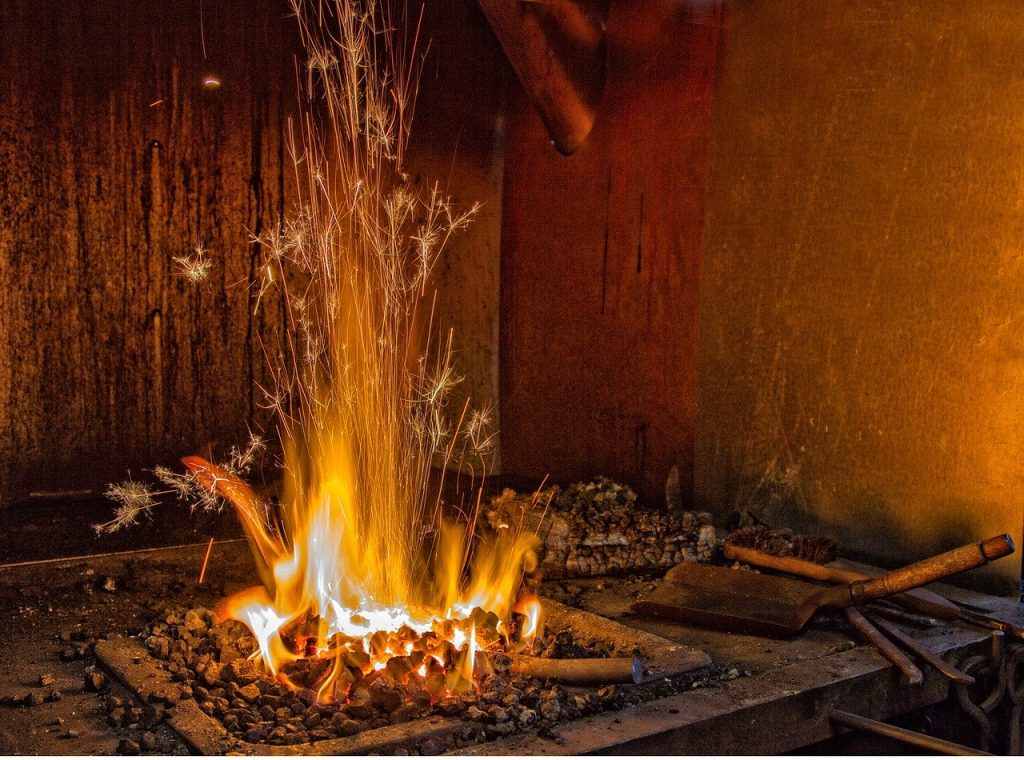
A magical workshop needs precision more than spectacle: controlled heat, accurate measures, dry storage, secure cabinets, dependable tools, prepared writing surfaces and uninterrupted working space.
Wealthier workshops add alchemical benches, specialised furnaces, gemstone tools, locked libraries, warded storage and secure rooms for dangerous commissions.
Rare Materials
Gold spent on a magic item often represents materials that cannot simply be taken from a shop shelf.
A commission may require unusually pure silver, flawless crystal, a rare pigment, unusual timber, a fragment of an older enchanted object or a substance taken from a dangerous creature.
When the material matters enough to become an adventure, treat it as something specific to the item rather than a universal monster-part currency.
Commissioning an Item
Finding a maker can be harder than finding the money.
A respected artificer may demand advance payment, proof of ownership, access to a restricted manuscript, help acquiring materials or a favour unrelated to the commission.
Powerful commissions also attract attention. Rivals may steal plans, patrons may conceal what they are buying and workshops may guard unfinished work as carefully as finished treasure.
Creating Magic Items in 1454
Creating magic items in 1454 happens where learned magic and skilled craft meet. Scholars can understand the principles of enchantment, but theory does not replace the hands of an experienced smith, jeweller, apothecary, calligrapher or other master artisan.
Universities preserve theory. Court scholars pursue expensive commissions. Guild workshops guard practical methods. Private masters train apprentices. Travelling specialists carry techniques between cities, courts and distant workshops.
Some methods survive only because generations of craftsmen continued to use them. The original explanation may be forgotten while the working technique remains sound.
Dwarven Craft
Dwarven communities remain important centres of metallurgy, stonework, mechanisms and runic craft. Some workshops preserve techniques that neighbouring human craftsmen cannot reproduce, particularly when repairing or extending very old enchanted objects.
This does not make dwarven craft universally superior. Different peoples excel in different materials and magical traditions, and an item made in one culture may look nothing like an object with the same function made elsewhere.
Guilds and Masters
Magic creates awkward questions for guild law. An enchanted sword may require a bladesmith, jeweller, alchemist and enchanter, each claiming authority over part of the commission.
Masters guard their reputations and methods fiercely. A failed commission can ruin a workshop. A stolen design can begin a feud. An apprentice who disappears with a master’s notebooks may be worth more than everything else missing from the strongbox.
Courts and Cities
Rulers compete for skilled artificers because enchanted objects turn rare expertise into portable power. Armour can protect a commander. A staff can preserve magical strength. A ring can become a diplomatic gift. Wards can secure gates, treasuries and archives.
Free cities compete for the same craftsmen. A celebrated workshop attracts wealthy patrons, apprentices and trade while strengthening the city’s military and political independence.
Magic Shops
Most magical trade is smaller than a warehouse filled with enchanted treasure. Potions, scrolls, charms and lesser objects circulate in wealthy centres; powerful permanent items are more often commissioned, inherited, privately traded, captured in war or recovered from older places.
A successful dealer may therefore be a broker rather than a maker: someone who knows which noble house is quietly selling a relic, which mercenary captain returned with unusual plunder and which workshop will accept a difficult commission.
Adventure Uses & Complications
The Missing Ingredient
The workshop can complete the item, but one irreplaceable material has disappeared from the market. The last known supply belongs to someone who refuses to sell.
The Stolen Pattern
A rival has acquired an unfinished copy of the artificer’s design. Recovering it matters more than catching the thief.
The Unfinished Masterwork
An enchanter dies halfway through a major commission. The object survives, but nobody knows what another hand will awaken by finishing it.
The Prince’s Commission
A ruler finances an item whose true purpose will alter the local balance of power.
The Guild Dispute
Several guilds claim legal control of the same workshop while an invaluable unfinished item remains locked inside.
The Item That Answers Back
A newly completed object begins speaking to its maker and knows something about its materials that nobody in the workshop could know.
Related Magic Item Rules
Rules Sources and Attribution
- SRD 5.2.1 Creative Commons attribution. This work includes material from the System Reference Document 5.2.1 (“SRD 5.2.1”) by Wizards of the Coast LLC, available at https://www.dndbeyond.com/srd. The SRD 5.2.1 is licensed under the Creative Commons Attribution 4.0 International License, available at https://creativecommons.org/licenses/by/4.0/legalcode.
- Pathfinder Roleplaying Game Core Rulebook — Magic Item Creation. Paizo Publishing.
- Revised D&D 3.5 System Reference Document — Creating Magic Items.
Open Game Content designation. The Pathfinder First Edition and Revised D&D 3.5 mechanical material on this page is designated Open Game Content only to the extent that it derives from material already released as Open Game Content under the Open Game License v1.0a.
Original SpiralWorlds setting material, 1454 campaign material, historical framing, adventure material, original explanatory prose, page design, artwork selection and editorial presentation are not designated Open Game Content.
Material derived from SRD 5.2.1 is used separately under Creative Commons Attribution 4.0 International.
Open Game License v1.0a & Section 15 Copyright Notices
OPEN GAME LICENSE Version 1.0a
The following text is the property of Wizards of the Coast, Inc. and is Copyright 2000 Wizards of the Coast, Inc (“Wizards”). All Rights Reserved.
1. Definitions: (a) “Contributors” means the copyright and/or trademark owners who have contributed Open Game Content; (b) “Derivative Material” means copyrighted material including derivative works and translations (including into other computer languages), potation, modification, correction, addition, extension, upgrade, improvement, compilation, abridgment or other form in which an existing work may be recast, transformed or adapted; (c) “Distribute” means to reproduce, license, rent, lease, sell, broadcast, publicly display, transmit or otherwise distribute; (d) “Open Game Content” means the game mechanic and includes the methods, procedures, processes and routines to the extent such content does not embody the Product Identity and is an enhancement over the prior art and any additional content clearly identified as Open Game Content by the Contributor, and means any work covered by this License, including translations and derivative works under copyright law, but specifically excludes Product Identity; (e) “Product Identity” means product and product line names, logos and identifying marks including trade dress; artifacts; creatures; characters; stories, storylines, plots, thematic elements, dialogue, incidents, language, artwork, symbols, designs, depictions, likenesses, formats, poses, concepts, themes and graphic, photographic and other visual or audio representations; names and descriptions of characters, spells, enchantments, personalities, teams, personas, likenesses and special abilities; places, locations, environments, creatures, equipment, magical or supernatural abilities or effects, logos, symbols, or graphic designs; and any other trademark or registered trademark clearly identified as Product Identity by the owner of the Product Identity, and which specifically excludes the Open Game Content; (f) “Trademark” means the logos, names, mark, sign, motto, designs that are used by a Contributor to identify itself or its products or the associated products contributed to the Open Game License; (g) “Use”, “Used” or “Using” means to use, Distribute, copy, edit, format, modify, translate and otherwise create Derivative Material of Open Game Content; (h) “You” or “Your” means the licensee in terms of this agreement.
2. The License: This License applies to any Open Game Content that contains a notice indicating that the Open Game Content may only be Used under and in terms of this License. You must affix such a notice to any Open Game Content that You Use. No terms may be added to or subtracted from this License except as described by the License itself. No other terms or conditions may be applied to any Open Game Content distributed using this License.
3. Offer and Acceptance: By Using the Open Game Content You indicate Your acceptance of the terms of this License.
4. Grant and Consideration: In consideration for agreeing to use this License, the Contributors grant You a perpetual, worldwide, royalty-free, non-exclusive license with the exact terms of this License to Use the Open Game Content.
5. Representation of Authority to Contribute: If You are contributing original material as Open Game Content, You represent that Your Contributions are Your original creation and/or You have sufficient rights to grant the rights conveyed by this License.
6. Notice of License Copyright: You must update the COPYRIGHT NOTICE portion of this License to include the exact text of the COPYRIGHT NOTICE of any Open Game Content You are copying, modifying or distributing, and You must add the title, the copyright date, and the copyright holder’s name to the COPYRIGHT NOTICE of any original Open Game Content You Distribute.
7. Use of Product Identity: You agree not to Use any Product Identity, including as an indication as to compatibility, except as expressly licensed in another, independent Agreement with the owner of each element of that Product Identity.
You agree not to indicate compatibility or co-adaptability with any Trademark or Registered Trademark in conjunction with a work containing Open Game Content except as expressly licensed in another, independent Agreement with the owner of such Trademark or Registered Trademark.
The owner of any Product Identity used in Open Game Content shall retain all rights, title and interest in and to that Product Identity.
8. Identification: If you distribute Open Game Content You must clearly indicate which portions of the work that you are distributing are Open Game Content.
9. Updating the License: Wizards or its designated Agents may publish updated versions of this License. You may use any authorized version of this License to copy, modify and distribute any Open Game Content originally distributed under any version of this License.
10. Copy of this License: You MUST include a copy of this License with every copy of the Open Game Content You Distribute.
11. Use of Contributor Credits: You may not market or advertise the Open Game Content using the name of any Contributor unless You have written permission from the Contributor to do so.
12. Inability to Comply: If it is impossible for You to comply with any of the terms of this License with respect to some or all of the Open Game Content due to statute, judicial order, or governmental regulation then You may not Use any Open Game Material so affected.
13. Termination: This License will terminate automatically if You fail to comply with all terms herein and fail to cure such breach within 30 days of becoming aware of the breach. All sublicenses shall survive the termination of this License.
14. Reformation: If any provision of this License is held to be unenforceable, such provision shall be reformed only to the extent necessary to make it enforceable.
15. COPYRIGHT NOTICE
Open Game License v 1.0a Copyright 2000, Wizards of the Coast, Inc.
System Reference Document Copyright 2000–2003, Wizards of the Coast, Inc.; Authors Jonathan Tweet, Monte Cook, Skip Williams, Rich Baker, Andy Collins, David Noonan, Rich Redman, Bruce R. Cordell, John D. Rateliff, Thomas Reid, James Wyatt, based on original material by E. Gary Gygax and Dave Arneson.
Pathfinder Roleplaying Game Core Rulebook © 2009, Paizo Publishing, LLC; Author: Jason Bulmahn, based on material by Jonathan Tweet, Monte Cook and Skip Williams.
Pathfinder Roleplaying Game Reference Document © 2011, Paizo Publishing, LLC.
Original Creating Magic Items setting material, 1454 campaign material, historical framing, adventure material and editorial content Copyright © 2026 SpiralWorlds. All rights reserved except material separately identified as Open Game Content or licensed under Creative Commons Attribution 4.0 International.