
Monaco — The Rock and Grimaldi Lordship
Western Mediterranean · Ligurian Coast · Grimaldi Lordship
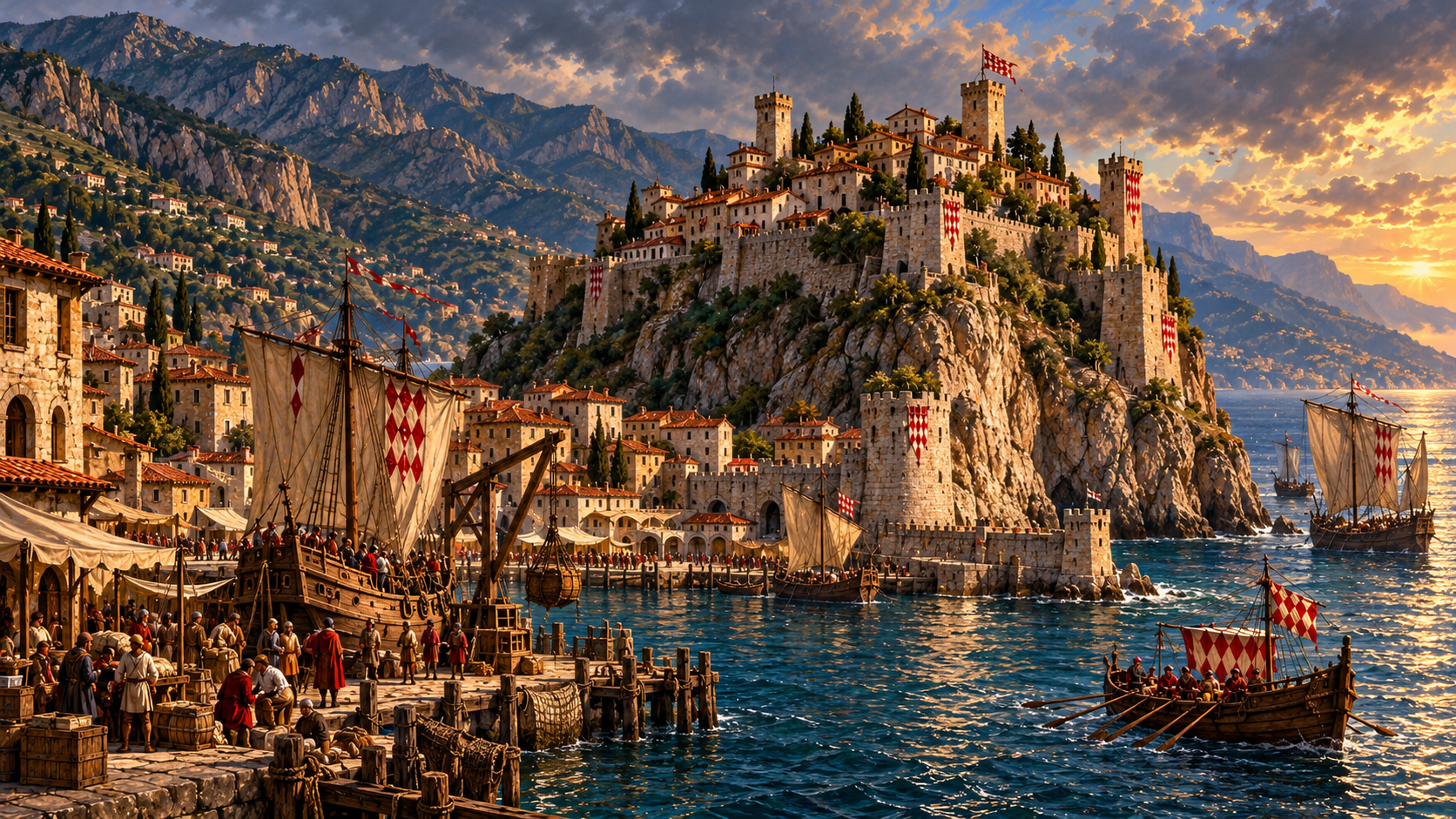
A fortress on a cliff, a harbour beneath it and a dynasty whose right to remain here is being tested from several directions at once.
At a Glance
- Political status
- Independent Grimaldi lordship centred on the fortress and harbour of Monaco, surrounded by stronger neighbouring powers and overlapping dynastic claims.
- Ruler
- Catalan Grimaldi, Lord of Monaco.
- Heir
- Claudine Grimaldi, Catalan’s young daughter.
- Government
- Seigneurial household government backed by the fortress garrison, harbour officers, retainers and negotiated local custom.
- Languages
- Ligurian speech dominates locally; Provençal varieties are common along the western approaches, with Latin used in formal records and correspondence.
- Strategic character
- Cliff fortress, coastal anchorage, customs point, intelligence post and maritime gate between Provence, Savoyard lands and Liguria.
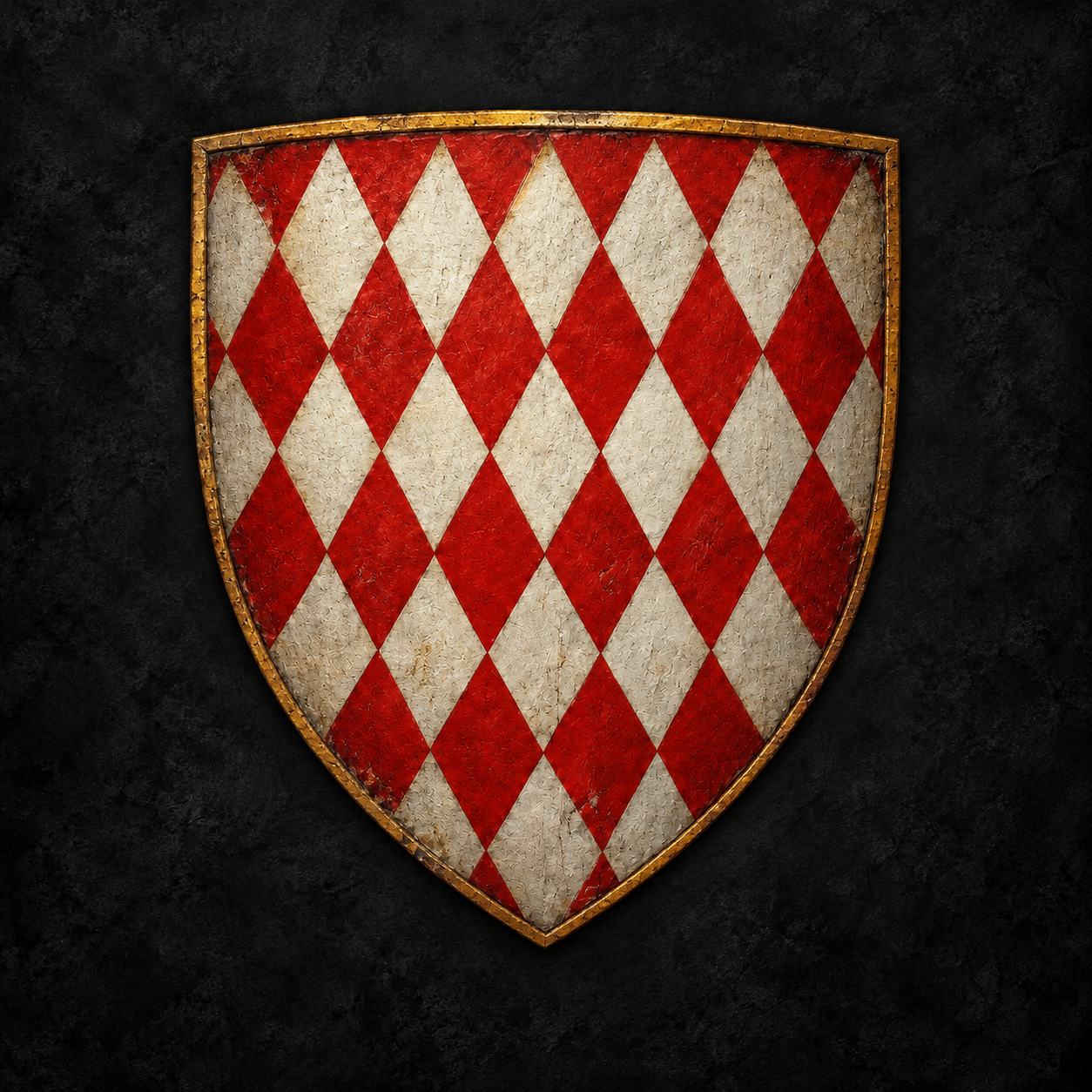
Monaco is small enough to cross quickly and important enough to start a war. The settlement clings to a steep coastal rock above a narrow harbour on the Ligurian Sea. Whoever holds the heights can watch ships moving between Provence and Genoa, shelter vessels beneath the fortress and control a valuable point on the coast without possessing a large inland territory.
The strength of Monaco is therefore not acreage. It is position. The Rock is difficult to seize cheaply, the harbour connects the lordship to the wider Mediterranean, and the Grimaldi possess family and commercial connections far beyond the walls. Every neighbouring power knows that a friendly Monaco is useful and a hostile Monaco is troublesome.
The new lord, Catalan Grimaldi, inherits all of this at once. His father Jean I is dead. The succession is legal, but legality does not make the transition safe. French, Savoyard and Genoese interests all have reasons to test the new ruler, while the Grimaldi household must ensure that the fortress, treasury, harbour and line of succession remain in friendly hands.
What Is Happening Right Now?
Catalan Has Inherited a Fortress, Not a Quiet Throne
Jean I Grimaldi has died and Catalan now holds Monaco. The garrison may accept the succession, but every letter, oath, appointment and harbour order issued during the change of ruler becomes politically significant. Men who were loyal to Jean must decide how quickly they will swear to Catalan. Neighbours will discover which officers can be bribed, frightened or persuaded before the new lord has fully secured his household.
The Dauphin’s Claim Has Not Simply Vanished
Jean I had agreed to sell the fortress to Louis, Dauphin of France, for twelve thousand gold écus. The payment was not completed. Catalan therefore has every reason to remove the Dauphin’s banner and act as an independent lord, while Louis has every reason to insist that the transaction still matters. A missing receipt, forged acknowledgement, intercepted letter or delayed chest of coin could change the apparent ownership of the Rock.
Savoy Watches the Eastern Approaches
Roquebrune and part of Menton are bound into a different feudal relationship with Savoy. That gives Savoyard officers, messengers and agents reasons to move close to Monaco without openly attacking it. A quarrel over a prisoner, cargo, boundary, toll or fugitive can become a test of which authority local people fear most.
Genoa Can Never Be Ignored
The Grimaldi are a Genoese dynasty even when Genoa is their rival. Family links, merchant interests and factional memories run along the Ligurian coast. Genoese captains know the waters, Genoese merchants know the harbour and Genoese politics can turn a distant family dispute into armed pressure at Monaco’s gate.
The Sea Is Another Border
The harbour brings food, messages, trade and reinforcements, but it also creates an approach that cannot be sealed with a mountain gate. Smugglers, spies and raiders can arrive under merchant colours. Beyond the ordinary shipping lanes, merfolk move through reefs, wreck-ground and deeper water. Their knowledge of drowned cargo and unseen coastal routes makes them useful allies, dangerous witnesses or enemies that land-bound rulers struggle to reach.
Run Monaco Tonight
The easiest way to run Monaco is to make every adventure about control of access. Somebody wants to enter, leave, land, climb, hide, inspect or carry something through the lordship. The Rock makes the question physical: who controls the gate, the harbour, the cliff path, the watchtower, the storehouse key and the boat waiting below?
The Core Pressure
Who owns Monaco if three powers can each produce a document saying it belongs to them?
Use Catalan’s succession, the unpaid French purchase and Savoyard interests around Menton and Roquebrune as simultaneous pressures. The characters do not need to decide the legal truth immediately. They need to decide whom they trust while people with soldiers are demanding an answer.
Three Things the GM Should Put on the Table
- A sealed document. A letter, contract, oath or receipt whose wording matters enough that somebody will steal or kill for it.
- A route. The harbour, a cliff path, an inland track or a boat that allows somebody to bypass normal authority.
- A witness. A guard, sailor, messenger, merchant or merfolk observer who knows what actually happened but has a reason not to speak freely.
The Rock and the Harbour
The Fortress of Monaco
The stronghold dominates the Rock. It is not an ornamental residence. Walls, towers, stores, sleeping quarters, armouries, cisterns and guarded entries exist because the Grimaldi have repeatedly had to hold this place against stronger enemies. Visitors approaching on official business are received as potential allies, petitioners or threats according to who sent them and how many armed companions wait outside.
Tour Sainte-Marie
The Sainte-Marie tower is one of the fortress’s politically charged points. The Dauphin’s banner has flown here beside the Grimaldi colours during the unresolved sale. Taking that banner down is not decoration; it is a declaration. Replacing it, stealing it or raising another standard can provoke armed response before anybody finishes arguing about law.
The Harbour
The harbour is Monaco’s working heart. Fishing boats, coasting vessels, messengers, traders and armed craft compete for limited safe space. Cargo is noticed because the settlement is small. A captain who unloads at night, refuses inspection or pays sailors to remain aboard creates immediate suspicion.
The Storehouses
Food, rope, sailcloth, weapons, lamp oil and imported goods must be kept somewhere secure. A locked warehouse can contain ordinary grain or evidence of treason. Burning one may hurt the lordship more effectively than attacking a tower.
The Cliff Paths
Narrow approaches around the Rock allow locals, scouts and smugglers to move where formed troops cannot. A path that seems worthless to an army can be priceless to four adventurers carrying a message, a hostage or a stolen seal.
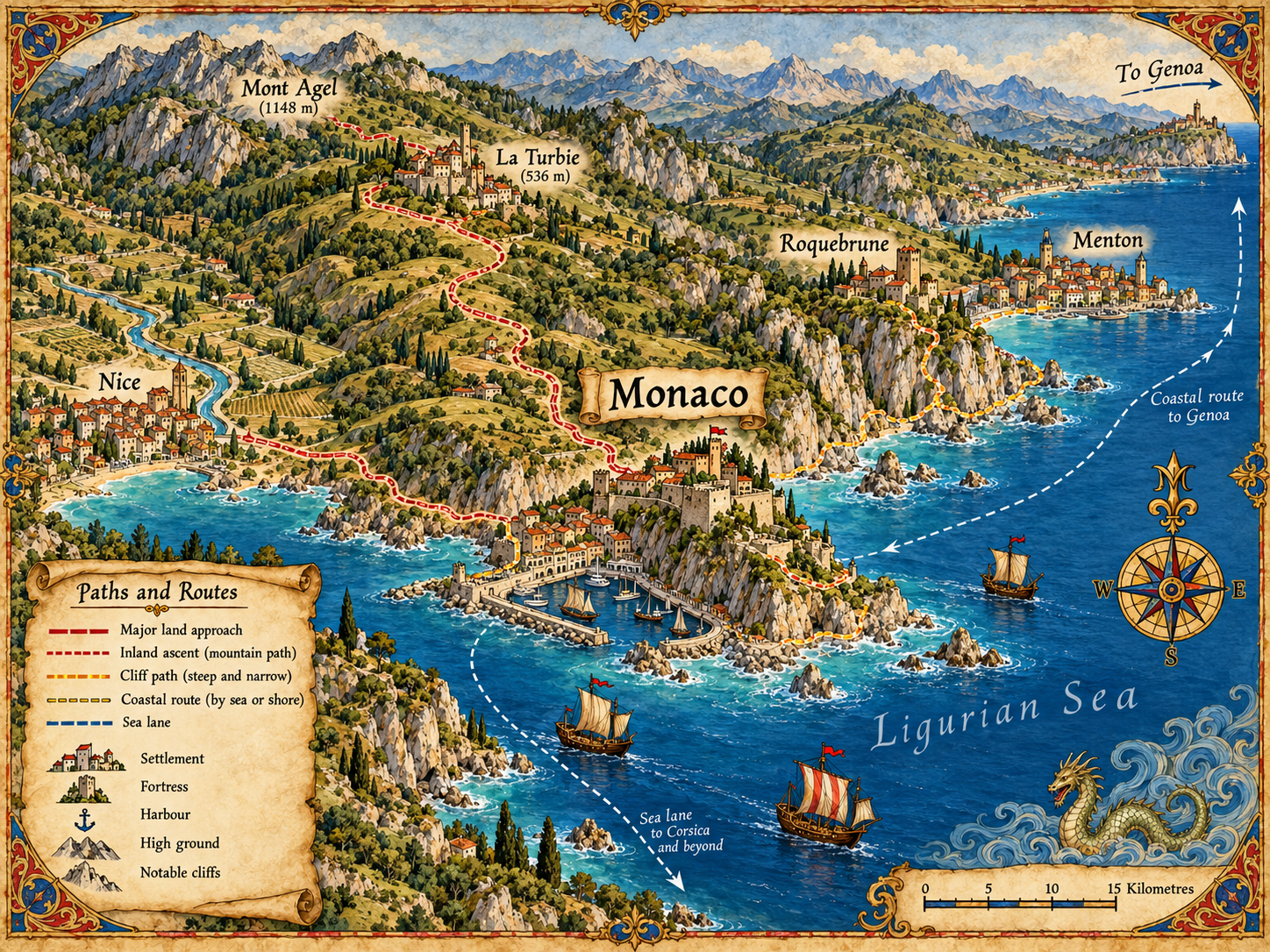
The Inland Road toward La Turbie
The ascent inland connects Monaco to high ground, regional roads and the politics of Savoy and Provence. Travellers lose sight of the harbour quickly as the terrain steepens. Ambushes, hidden messengers and small patrols are more useful here than large battles.
People and Powers
Catalan Grimaldi
The new Lord of Monaco must show that succession has changed the name of the ruler without weakening the fortress. He needs reliable officers, clear loyalties and proof that outside powers cannot buy Monaco more easily than they can conquer it.
Pomellina Fregoso
Catalan’s mother has already proved that she can hold Monaco under extreme pressure. When Jean and Catalan were prisoners years earlier, she refused to surrender the fortress despite threats against them. Nobody familiar with that episode mistakes her for a ceremonial widow. Her Genoese family connections also give her political reach beyond Monaco.
Blanche del Carretto
Catalan’s wife connects the ruling household to the del Carretto family of Finale. Her position matters because Monaco’s survival depends as much on marriages, kinship and negotiated support as on stone walls.
Claudine Grimaldi
Catalan’s young daughter is the dynastic future of Monaco. Jean I’s succession arrangements were deliberately written so that the lordship could remain in the Grimaldi name even through a female heir. Anyone planning beyond Catalan’s lifetime must therefore think about Claudine, her guardianship and the marriage alliances that may eventually surround her.
The Grimaldi Dynasty
The ruling house is not a single household confined to the Rock. Its kinship and political networks reach into Liguria and neighbouring lordships. That gives Monaco allies, rivals, creditors and cousins with competing ideas about what the family should do next.
Open the factions directory
for the wider Grimaldi dynastic network and other organisations active across the campaign world.
Law, Gates and Harbour Authority
Monaco’s law is personal, local and defensive. The lord’s officers care about conduct that threatens the fortress: concealed weapons, secret landings, forged seals, suspicious cargo, unauthorised signalling, harbour violence and strangers asking too many questions about gates or watches.
Ordinary travellers are not automatically treated as criminals, but an armed company attracts attention quickly. A respectable patron, letter of introduction or clear commercial purpose makes entry easier. Refusing to identify a ship’s owner, carrying contradictory travel papers or attempting to bypass inspection creates the opposite effect.
Magic is judged by consequence and intent rather than by one universal statute. Healing an injured sailor and magically opening a locked armoury are not treated as equivalent acts. Enchantment used on an officer, divination aimed at protected correspondence or magic used to conceal contraband will be treated as threats to the lordship.
Travel and Approaches
| Route | Why Travellers Use It | Likely Trouble |
|---|---|---|
| West toward Nice and Provence | Diplomacy, trade, messengers, onward travel into the French and Provençal sphere. | Competing political loyalties, customs disputes, patrols and intercepted correspondence. |
| East toward Roquebrune, Menton and Liguria | Local trade, Grimaldi family networks and routes toward Genoa. | Savoyard claims, Genoese agents, smugglers and family politics. |
| Inland toward La Turbie | High-road travel, messengers, scouts and routes avoiding the coast. | Steep terrain, ambush, weather, small patrols and disappearing couriers. |
| By sea | Fast movement of cargo, letters, troops and high-value passengers. | Storms, piracy, false colours, sabotage and supernatural encounters beneath the waterline. |
Dangers Beyond the Walls
Merfolk of the Coastal Waters
Merfolk know the sea in ways surface rulers do not. They can observe anchors, wrecks, hidden cargo and ships waiting beyond sight of the harbour watch. Their motives vary. Some trade warnings or salvage; others resent nets, armed ships and human claims over waters no human can occupy.
A merfolk encounter around Monaco works best when information matters more than combat. They may know where a missing boat sank, who approached the harbour underwater, what was thrown overboard at night or which vessel waited offshore while a spy climbed the Rock.
Use the Merfolk creature entry for rules and behaviour.
Smugglers and Political Agents
Monaco’s scale makes covert movement difficult but valuable. A smuggler who knows one safe landing place can become more important than a knight. Political agents use merchants, fishermen and hired guides because arriving under a foreign banner would reveal too much too soon.
Fire and Water
A fortress survives only while its stores and water supply do. Arson in the harbour, spoiled grain or damage to a cistern may force decisions that a direct assault could not. Sabotage is therefore a strategic weapon, not a minor nuisance.
Adventure Hooks
-
The Twelve Thousand Écus.
A courier claims to carry proof that the Dauphin’s payment for Monaco was finally made. Catalan wants the document examined before Louis’s agents can present it publicly. -
The Banner on the Tower.
The Dauphin’s standard disappears before it can be formally removed. If Catalan ordered the theft, it is theatre. If somebody else took it, they may be trying to provoke France. -
The Savoyard Prisoner.
Monaco’s guards seize a man near the eastern approach. Savoy demands his release, claiming he is an officer travelling lawfully. His baggage contains two sets of sealed instructions. -
The Heir’s Road.
A threat to the ruling household forces Claudine to be moved quietly between secure locations. The safest-looking route is already watched. -
The Wreck Below the Rock.
Merfolk report a newly sunken vessel carrying sealed chests and one survivor trapped in an air pocket. Three different factions insist the cargo belongs to them. -
Dry Cistern.
A fortress cistern begins losing water without visible damage. The leak is deliberate, and the saboteur expects the shortage to force Monaco to accept outside help.
Encounter Table
| d8 | Encounter |
|---|---|
| 1 | A harbour officer halts the party because a seal on their travel papers resembles one used on a forged French letter. |
| 2 | A fishing boat returns without its master. The crew insist he climbed willingly into the sea after speaking with someone below the surface. |
| 3 | A Savoyard messenger demands immediate passage through the gates while two Grimaldi retainers insist his satchel must be searched. |
| 4 | A warehouse keeper offers good money to move a locked chest before dawn and refuses to name its owner. |
| 5 | A Genoese merchant recognises one of the party and publicly claims they owe a favour to his family. |
| 6 | Someone on the cliff flashes a shuttered lantern toward a ship waiting beyond the harbour. |
| 7 | Merfolk surface beside the breakwater with a piece of wreckage bearing a noble seal. |
| 8 | A frightened guard reports that a key to a fortress store has been copied rather than stolen. |
A Short History of the Rock
The Grimaldi connection with Monaco reaches back to the late thirteenth century, when François Grimaldi and his companions seized the fortress. Control did not remain uninterrupted. Genoese power repeatedly returned, and the Rock changed hands more than once before Jean I and his brothers restored Grimaldi control in the early fifteenth century.
Jean’s long rule made survival depend on diplomacy as much as fortification. He fought, negotiated, accepted obligations and balanced stronger powers around Monaco. His imprisonment alongside Catalan demonstrated the danger clearly: enemies tried to force surrender by holding the ruling men while Pomellina Fregoso remained in command of the fortress. She refused.
Jean’s final years created the crisis Catalan now inherits. Roquebrune and part of Menton entered a feudal relationship with Savoy. Monaco itself was contracted for sale to Louis, Dauphin of France, but the promised payment was not completed. Jean also established succession provisions designed to prevent Monaco from passing out of the Grimaldi name if inheritance ever ran through a woman.
Those decisions are no longer abstract dynastic law. Jean is dead, Catalan rules, Claudine is the young heir, the French purchase remains disputed and every neighbouring power can see that Monaco is entering a vulnerable transition.
Using Monaco in a Campaign
Monaco works best as a compact political adventure location rather than a kingdom that requires weeks of travel. The party can arrive by boat in the morning, become trapped in a succession dispute by noon and discover by nightfall that the same missing document connects a foreign envoy, a harbour smuggler and somebody inside the fortress.
Keep the geography tight. When characters make enemies, they cannot simply disappear into another district. When they gain allies, those allies are close enough to matter quickly. A single locked gate, delayed boat or watched cliff path can change the whole session.
The strongest Monaco adventures mix three pressures: one political claim, one physical route and one person who knows more than they admit. Combat remains possible, but the location becomes distinctive when force has consequences. Killing a Savoyard officer, humiliating a Genoese captain or exposing a French agent may solve tonight’s danger while creating next month’s campaign problem.
Continue to Games Master Resources
for session preparation, factions, encounters and campaign consequences.
Sources and Historical Basis
The political framework is based on the Grimaldi succession, Jean I’s testament, the unresolved sale of Monaco to Louis the Dauphin, and Monaco’s relationships with Savoy, Menton and Roquebrune. Campaign material builds outward from that historical foundation while retaining the setting’s established supernatural world.