
Lordship of Groningen | Fortified Trade City of the Northern Low Countries
Lordship of Groningen | Fortified Trade City of the Northern Low Countries
A walled merchant city turns grain, tolls, seals, and dialect into rule over the older Frisian lands around it.

- Name: The Lordship of Groningen
- Alternative Name: Groningen and the Ommelanden
- Type: Fortified city-dominion, trade lordship, urban regional power
- Region: Northern Low Countries, northern Holy Roman borderlands
- Capital City: Groningen
- Other Settlements: Appingedam, Winsum, Bedum, Ten Boer, Garrelsweer, Aduard, Hunsingo villages, Fivelingo villages, Oldambt communities, Westerkwartier settlements
- Languages: Gronings / Low Saxon in and around the city; Frisian in older rural communities; Middle Dutch and Low German in trade, charters, and merchant dealings
- Religion(s): Civic churches, saints, monastic houses, rural holy wells, dike-oaths, ancestral customs, land-spirits, and older Frisian sacred survivals
- Government: Merchant oligarchy and fortified urban council rule
- Legislature: City council, guild influence, civic courts, merchant courts, negotiated assemblies, rural privileges, and Ommelanden resistance
- Current Ruler: The Council of Groningen, led by burgomasters, senior merchant families, and civic officers
- Other Notable Residents: Hanseatic merchants, dike-masters, Frisian oath-speakers, abbots, guild elders, shipmasters, salt and grain factors, foreign envoys, rural landholders, toll collectors, scribes, and hired city guards
- Coat of Arms: Groningen city arms
- Campaign Function: Trade hub, legal trap, northern power base, city-versus-countryside pressure cooker
Overview
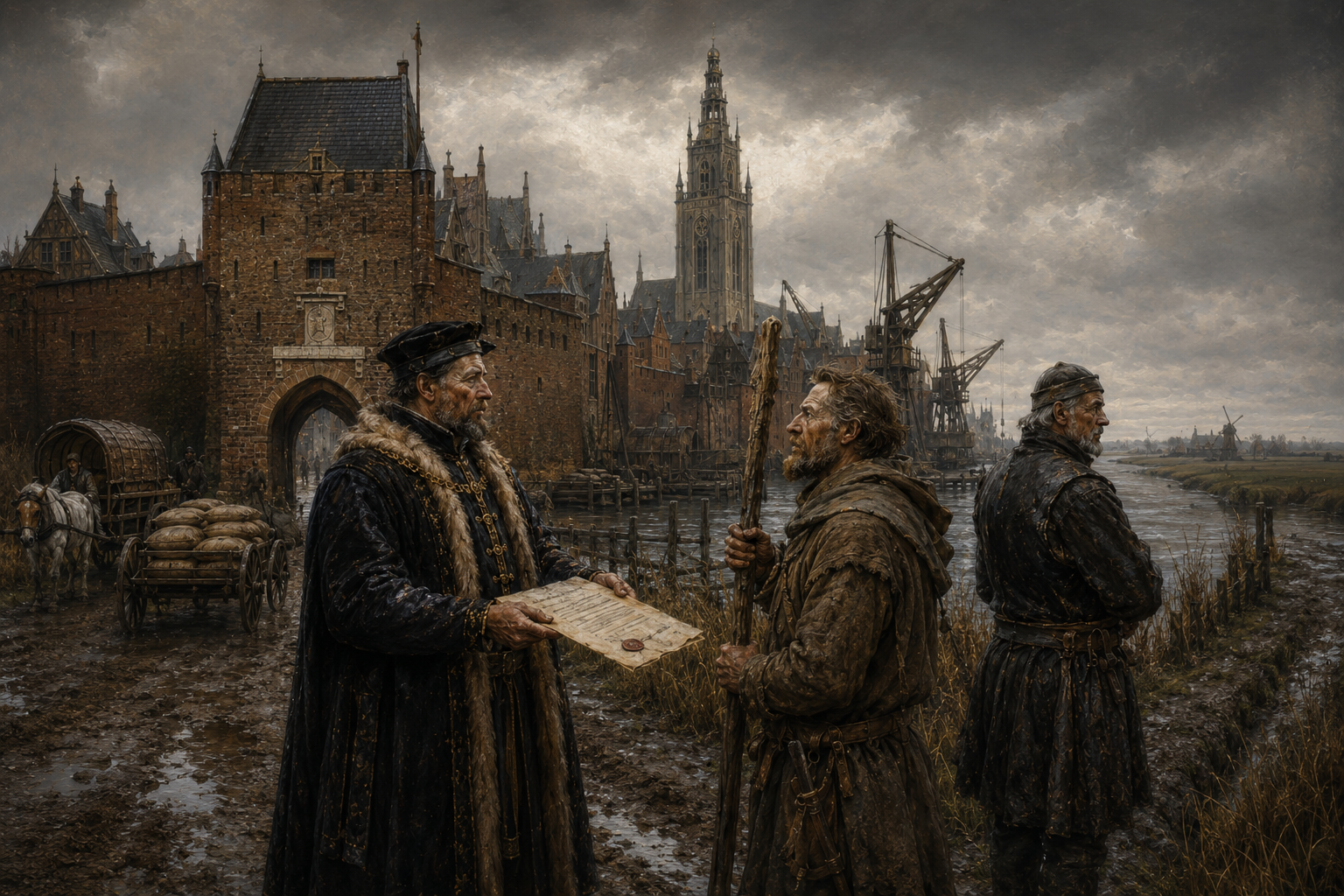
The Lordship of Groningen is a city turning necessity into rule.
Its power begins at the gate: grain waiting to be weighed, wax pressed beneath a seal, a toll demanded before dawn, a clerk deciding which charter counts, a warehouse door locked while villages wait outside the walls.
Groningen does not need to own every field if it controls the roads, markets, debts, storage, courts, ferries, dikes, and words by which those fields enter the wider world. The Ommelanden — the “lands around” — are older, wetter, more Frisian, and much less willing to become a possession of the city.
The title Lordship of Groningen works as a campaign-facing name for this practical dominance. The formal political label belongs to a later settlement, but the truth of the place already exists: Groningen behaves like a lordship before every neighbour agrees to call it one.
The city says trade, defence, written law, and stored grain give it the right to rule. The countryside answers with land-right, water-law, oath, ancestry, church memory, village privilege, and the stubborn fact that a dike does not hold because a burgomaster commands it.
This is the core of Groningen: city authority against rural freedom.
The City as Lord
Groningen’s rulers have no need of crowns. They have keys, gates, scribes, ledgers, warehouses, seals, guilds, creditors, ships, and guards.
A village may claim old liberty, but if its grain must be sold in Groningen, its debts recorded in Groningen, its disputes heard by Groningen-friendly courts, and its merchants forced through Groningen gates, liberty becomes negotiable. The city conquers by necessity as much as by force.
A toll can do what a raid cannot. A blocked market can punish more thoroughly than a hanging. A disputed seal can make an inheritance vanish. A delayed shipment can starve a village into reason.
Groningen is dangerous because it can be right. Its councillors may honestly believe they protect the north from disorder, piracy, flood, famine, predatory nobles, and rural feuds. They may also use those dangers to justify every new tax, seized privilege, and “temporary” emergency power that never quite expires.
The city’s sin is not crude tyranny. It is the conviction that order proves rightful rule.
The Ommelanden
The Ommelanden are the other power in the room.
These surrounding lands are made of farms, villages, dikes, wetlands, pastures, churchyards, terp settlements, local courts, monastic estates, noble holdings, marsh roads, and old Frisian communities. They preserve rural law, inherited grievance, practical independence, sacred custom, and a memory of freedom older than the city’s present strength.
They do not resist because they are backward. They resist because they understand what is happening. Market access becomes dependence. Dependence becomes jurisdiction. Jurisdiction becomes lordship. Lordship becomes history.
The countryside’s tragedy is that it often needs Groningen. The city has walls, storage, ships, scribes, money, armed men, and access to distant markets. The Ommelanden have land, food, water, memory, and legitimacy. Neither side can destroy the other without wounding itself.
That is why the conflict lasts.
Language, Law, and Sacred Pressure
Language is one of Groningen’s quiet weapons.
The city’s Low Saxon speech spreads through markets, contracts, toll stations, cart routes, guild dealings, and legal administration. Frisian remains strong in older rural communities, but anyone who wants to bargain, plead, borrow, appeal, sell, sue, or defend a claim inside Groningen must learn the city’s words.
The wrong word for a land-right, ferry due, dike obligation, or inherited privilege may reveal ignorance. A rural witness forced to answer in the city’s tongue may lose authority before the argument even begins.
Law is layered. City law governs gates, markets, tolls, guilds, contracts, debt, and civic privilege. Merchant law governs cargoes, weights, delivery, credit, ship loss, and foreign factors. Rural law governs land, dikes, water, inheritance, grazing, ferry rights, and local obligations. Sacred law governs oaths, burials, church protection, holy days, boundary markers, and offences against the dead or the land.
The best Groningen conflicts happen when two legal systems are both valid and mutually impossible. A city court may have the seal. A village may have the oath. A monastery may have the record. A dike-master may have the only practical authority before the flood arrives.
The region’s sacred pressure follows the same pattern. Groningen’s public religion is civic and institutional: churches, bells, guild altars, saints’ days, processions, burials, monasteries, and oath-taking. The countryside carries older obligations: dike offerings, boundary stones treated as witnesses, avoided marsh roads, dead kin invoked before land decisions, household powers, well customs, cattle charms, ancestral women, and local spirits.
Sacred power here should feel local, legal, wet, ancestral, and hard to dismiss.
Economy
Groningen’s economy is built on movement, storage, and delay.
The city profits from grain, cattle, hides, wool, fish, salt, peat, timber, cloth, metalwork, beer, warehousing, tolls, weighing rights, credit, contracts, and passage. Its merchants do not merely buy and sell. They create dependency.
A rural landholder who borrows against next year’s grain may discover that Groningen now has an opinion about his ferry rights, his daughter’s marriage, his dispute with a neighbour, and whether his village may sell outside the city market.
For adventurers, Groningen is useful but never neutral. It offers scribes, translators, shipmasters, moneychangers, appraisers, legal advocates, armour repair, winter stores, hired guards, foreign rumours, rare goods, and dangerous introductions. It also records names, cargoes, debts, witnesses, payments, and mistakes.
Groningen remembers who owed what.
What Makes Groningen Distinct
Groningen is not a generic northern trade city. Its identity is sharper.
It is a city trying to become a province.
It is a merchant republic in practice, even where law has not yet named it one.
It is a fortified market whose surrounding countryside does not accept that market power equals rightful rule.
It is a Low Saxon-speaking urban power pressing into older Frisian lands.
It is a legal battlefield where charters, tolls, dikes, dialect, and hunger matter as much as swords.
It is a place where violence is often less frightening than documentation.
Important Places
Groningen City
The capital and centre of power. Groningen is walled, busy, wet-streeted, sharp-tongued, and intensely aware of its own importance. Its churches, markets, council house, warehouses, gates, towers, canals, and harbour works are all political symbols.
Use the city for contracts, investigations, merchant intrigue, guild conflict, civic trials, forged charters, smuggling, hostage diplomacy, debt enforcement, and scenes where drawing steel solves the immediate problem while ruining everything else.
The City Gates and Walls
The walls are defence, theatre, and argument. The gates are legal instruments. Who enters, who waits, who pays, who is searched, who is recognised, and who is delayed can all become political acts.
In a mythic campaign, older stones may have been taken from rural boundary markers. A sealed gate may have been built over a drowned shrine. A tower bell may ring only when a false judgement is passed inside the city.
The Ommelander House
A meeting-place, embassy, hostel, or protected residence for representatives of the surrounding lands. This is where rural grievances enter the city in formal dress.
Use it for tense negotiations, forged charters, missing envoys, poisoned banquets, legal threats, public refusals to bow, and whispered arguments between rural factions that do not fully trust one another.
Aduard Abbey
A powerful monastic house and archive-centre. It preserves charters, genealogies, land grants, burial records, flood accounts, legal copies, and older sacred knowledge inconvenient to both city and countryside.
Aduard is dangerous because it remembers in writing.
The Dikes, Sluices, and Marsh Roads
The machinery of survival and movement. Whoever controls the dikes controls fields, roads, cattle, winter stores, and life itself. Raised tracks, muddy causeways, ferry paths, and wetland routes bind the city to the Ommelanden.
In Groningen, sabotage of a sluice is not vandalism. It is war by water.
Factions
The Council Families
Merchant houses, burgomasters, civic officers, and men who know that a sealed document can cut deeper than a knife. They want order, profit, obedience, and recognition of Groningen’s regional supremacy. They are not united: some want cautious influence, while others want direct control.
The Ommelanden Oath-Speakers
Rural representatives, elders, landholders, and legal memory-keepers. Their weakness is division. Their strength is legitimacy. A city can bribe one village, threaten another, and delay a third, but it cannot easily erase a dozen communities telling the same story.
Hanseatic Factors and Guilds
Foreign merchants, local guilds, shipmasters, craftsmen, and trade officials care about safe roads, reliable contracts, stored goods, delivery dates, skilled labour, and market stability. They can bring wealth, pressure, intelligence, retaliation, strikes, and public unrest.
They are useful allies until local instability threatens profit.
Monastic Houses and Dike-Masters
Abbeys preserve land records, sacred authority, and inconvenient truths. Dike-masters command practical obedience when water rises. A burgomaster may control the council chamber, but a dike-master may save or drown the countryside.
Together they represent two powers the city cannot fully buy: memory and survival.
Adventure and Worldbuilding Hooks
The Grain Lock
Groningen warehouses are full, but the council refuses to release grain until the Ommelanden accept a new tax. Hunger turns law into riot.
The question is not whether the city has food. The question is who has the right to open the doors.
The Dike That Refuses Repair
Workers repairing a storm-damaged dike fall ill, vanish, or begin confessing old crimes. The dike-master says the land is angry because a boundary oath was broken.
The city wants the work finished. The village wants the oath restored. The water is rising.
The Forged Charter
A newly “discovered” charter gives Groningen authority over three Ommelanden villages. The city says the seal is genuine. The villages say the witness list includes a man who died ten years before the charter was written.
The adventurers must determine whether the charter is false, copied from an older document, or altered from something more dangerous.
Using Groningen in Play
Use Groningen when you want intrigue with mud on its boots.
This is a place where food, debt, walls, water, language, and law decide who survives winter. Adventurers who arrive expecting simple trade work should quickly discover that every job has a legal side, every road has a claimant, and every village has a memory.
The best Groningen adventures do not ask, “Who is evil?” They ask, “Who has the right to decide?”
Give every major scene one practical pressure: a gate closing, cargo spoiling, a witness afraid to speak, a charter that must be read before sunset, a flood arriving before the council finishes arguing, a hungry crowd in the market, a merchant smiling because delay favours him, or a monk who knows the truth but fears what truth will do.
Violence should have consequences here. Killing a robber on a remote marsh road is one thing. Killing a rural envoy, city officer, toll witness, dike-master, monastic scribe, foreign merchant, or sworn translator may trigger law, debt, feud, sacred backlash, trade retaliation, or all of them at once.
Keep the tone wet, sharp, practical, proud, and tense. Let the supernatural appear through place, oath, water, law, memory, and consequence rather than spectacle.
Historical, Regional, and Mythic Context
Groningen’s medieval identity is rooted in the tension between the city and the surrounding districts known as the Ommelanden. The formal Lordship of Groningen belongs to a later political settlement, but for campaign use the title works as a clear shorthand for the city’s practical regional dominance: a fortified merchant city pressing its authority into the lands around it.
The Ommelanden had a strong Frisian background, while the city of Groningen exerted Saxon-speaking urban influence over trade, administration, and regional power. This makes language especially useful in play: speech can mark law, allegiance, market access, class, and whether someone belongs to city or countryside.
The historical background also supports a mythic treatment. A low northern landscape of dikes, marsh roads, church bells, old land-rights, monastic records, and disputed water is ideal for stories where law and landscape are bound together. In this region, a broken oath may flood a field, a moved boundary stone may trouble the dead, and a sealed charter may be treated almost like a weapon.
Useful starting references include Encyclopaedia Britannica’s overview of Groningen, the historical background to the Ommelanden, and the later political formation known as the Lordship of Groningen.
Keep this reference growing
If this page helped with your reading or game, you can support its upkeep or explore the curated books.
Explore the Bookshop — epics, classics and stories behind imagined worlds.