
Duchy of Bar — The Meuse and Seven Stones
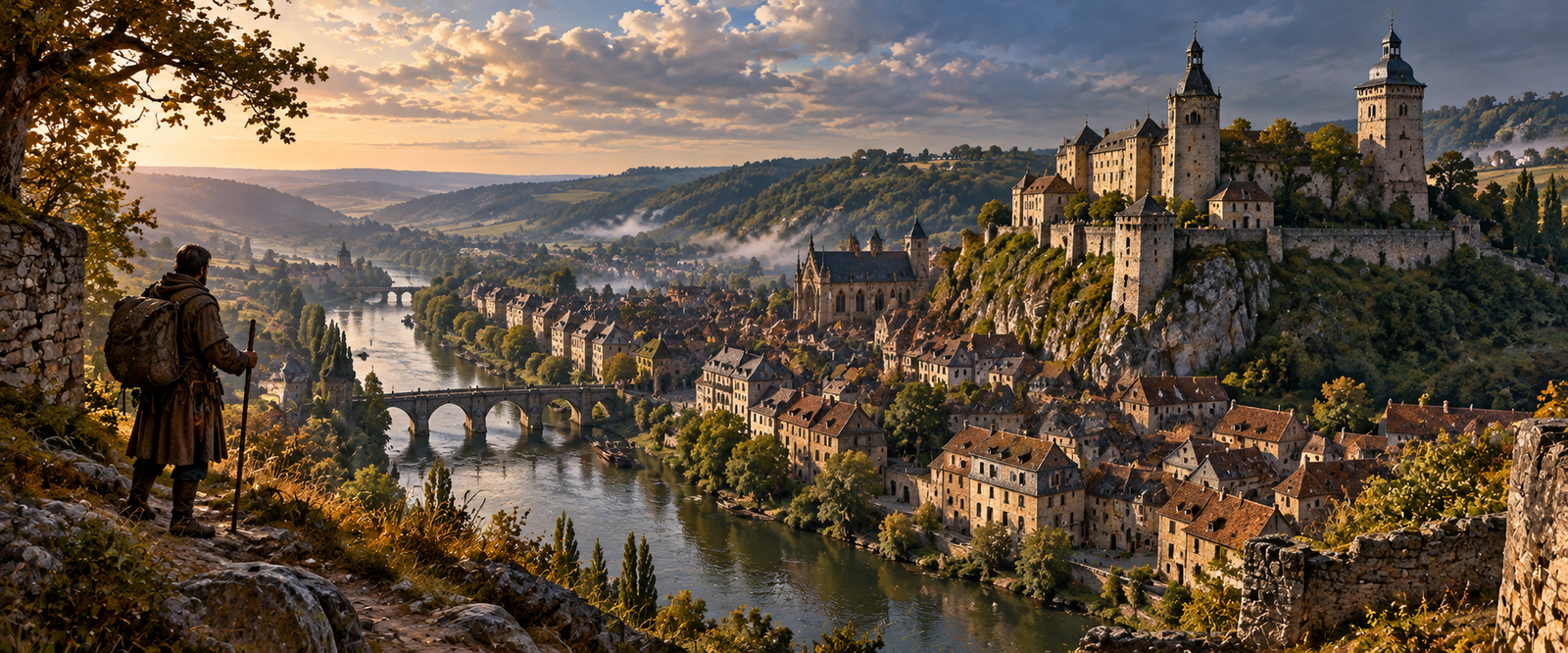
Barrois · Ornain valley · Meuse country · The seven faeries
At a Glance
| Ruler | René of Anjou, Duke of Bar |
|---|---|
| Main town | Bar-le-Duc, above the Ornain |
| Other places | Saint-Mihiel, Stenay and Commercy |
| Travel | Ornain valley west towards Saulx and Marne; roads east to Meuse towns |
| Folklore | Seven faeries and the great stones of the Meuse |
| Realm | Western Barrois owes fealty to France; eastern Barrois lies within the Empire. René rules both. |

Arms of Bar — two golden barbels on blue
Climb the steep streets of Bar-le-Duc and the duke’s castle rises above the Ornain valley. Below are mill wheels, dyers, carters and market stalls. Farther north the Meuse runs between wooded slopes and fortified towns, past old stones whose guardians have not forgotten the time the river nearly swallowed a village.
What Is Happening Right Now?
The Stone That Moved
A child saw one of the Ladies of the Meuse shift in the night. By morning there were scrape marks in the earth and the water had risen against a bank no one remembered flooding. Saint-Mihiel’s river-keepers need someone to find who moved the stone, strengthen the old protection or help families and livestock reach higher ground. One of the seven faeries has returned to finish the work.
No Grain in the Lower Market
Three grain carts are overdue on the road into Bar-le-Duc. Millers are running short, and Ysabeau at the Trout and Lantern fears one of the missing drivers is her brother. Follow the fresh wheel ruts into the woods, question the last innkeeper to see the carts, or trace flour sacks bearing a miller’s mark that have appeared for sale off the main road.
An Armed Message from Nancy
A wounded messenger from Lorraine warns that soldiers are assembling along the road from Nancy. Armed riders wearing a noble badge pursue him, and one knows the guard-captain at Bar-le-Duc by name. Meanwhile the soldiers have seized drovers’ pack animals. The party must decide whether to shelter the messenger, recover the animals or discover who gave the riders their orders before travellers are caught between the two forces.
Arriving in Bar
The Clock Tower above Bar-le-Duc has called out danger, market hours and the closing of gates since before René was born. Beneath it, the lower town runs along the Ornain: smiths work behind open doors, millers argue over broken gearing and carters unload sacks of grain for the markets. The upper town is quieter but not safer. There are soldiers at the castle and people seeking the duke’s favour, while the valley below has its own worries about the next shipment of grain.
Places and People
Bar-le-Duc — Castle and Lower Town
Visit the fortress on the high rock, then descend to the river markets where most visitors buy supplies. The Clock Tower’s fourteenth-century bell can summon both quarters at once. A traveller can see the lower market and the Ornain crossing from the upper fortification; loaded carts must use the gentler approach to reach the gates.
Saint-Mihiel — The Stones of the Seven Faeries
Beside the Meuse near Saint-Mihiel stand great rocks called the Ladies of the Meuse. Seven hostile faeries once carried boulders to choke the river and flood the settlement. The defenders of the old river shrines broke the flood spell and drove the faeries away, but the stones remained on the bank. People still watch the rocks during spring floods: so long as they remain where they were set, the village is safe. A stone has recently moved a hand’s breadth.
Stenay — The Arcaded Market
Stenay guards the northern Meuse road. Its broad medieval market square is lined with arcades that shelter traders from rain, while a street of smiths and goldworkers leads towards the lower Marais quarter. Bargemen and drovers exchange news under the covered walks. A ferryman has found grain sacks caught below a landing stage and wants someone to identify whose carts they came from.
Commercy — The Neighbouring Lordship
Commercy has its own lordship and fortified centre beside the Meuse; it is not simply an outlying ward of Bar-le-Duc. Pack-carriers use its markets, while ferrymen watch the level of the river before they take horses across. Travellers can buy provisions or find a guide here, though a swollen crossing may force them back along the ridge road.
Where to Stay and Find Help
- The Trout and Lantern, lower Bar-le-Duc: Ysabeau’s moderately priced riverside house serves stew and ale, with limited private rooms and a cramped but sound stable whose gate is bolted after dark. Carters come for news and a dry seat. Ask after the three missing grain wagons: Ysabeau knows one of their drivers.
- The Two Barbels, near the upper town gate: a respectable guesthouse with hot supper, clean rooms, locked storage and a small yard for visiting riders. Host Odo charges more than the lower-town alehouses but can introduce a smith and a messenger willing to ride to the duke’s court. A guest has just arrived without the horse he claims was stolen on the road.
- The Reed Cot, Saint-Mihiel’s riverward lanes: cheap bedding and fish stew for ferrymen and pack-carriers; its yard is too small for horses, so visitors must arrange stabling elsewhere. Keeper Basile knows how high the water rises at the Ladies of the Meuse. He has kept a lump of freshly broken stone hidden under the counter since the rocks began to move.
Bar-le-Duc’s market has rope, nails, lamp oil, horseshoes and wagon repairs; Saint-Mihiel’s carriers know the Meuse road. Buy provisions before setting out through woodland or across the river valley.
Travel and Onward Routes
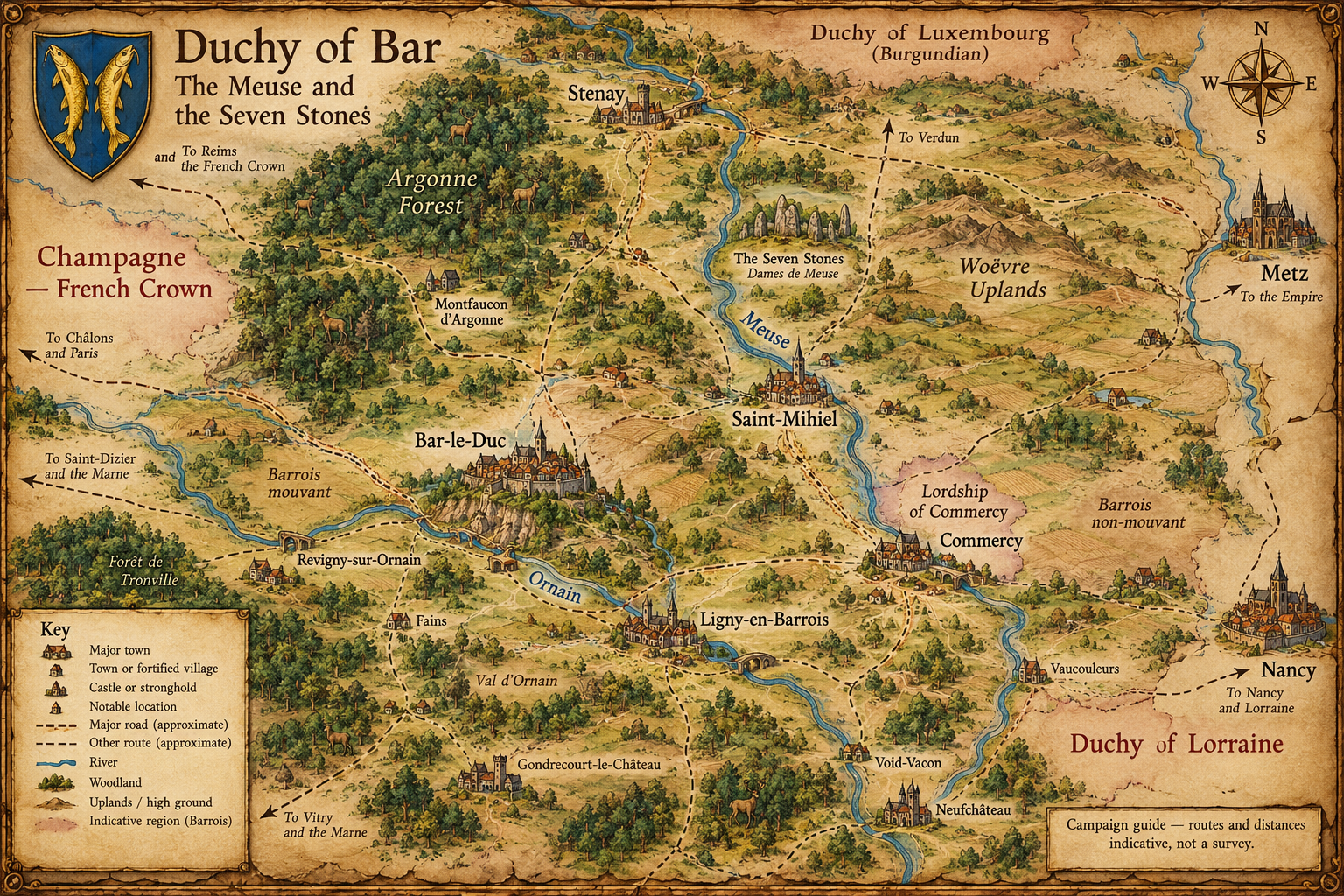
The Ornain flows west to the Saulx and Marne, not into the Meuse. Travellers bound for the Meuse use the overland routes between Bar-le-Duc, Lorraine and towns upstream and downstream. River transport is useful for heavy grain and timber; horses and pack animals are better for short country journeys when the water is high. Hire a guide when leaving the main roads, and look for shelter before entering unfamiliar woodland at dusk.
Bar is unusually divided in feudal allegiance: since the agreement of 1301, the western Barrois mouvant has owed homage to the French crown, while the eastern Barrois non-mouvant remains within the Empire. René rules both. This distinction matters when armies cross the Meuse or two crowns make demands on the same duke; ordinary visitors are far likelier to need a river pilot, safe lodging and dependable news.
Duchy of Bar — Painted Campaign Map
Historical Sources
Larousse — Comté, puis duché de Bar; Angers Patrimoine — Le roi René; Ville de Bar-le-Duc — Histoire et patrimoine; Sud Meuse tourism — medieval Clock Tower; Ville de Saint-Mihiel — seven faeries and the Ladies of the Meuse; Ville de Stenay — medieval arcaded market and streets; CNRS — records of the lordship of Commercy.
Keep this reference growing
If this page helped with your reading or game, you can support its upkeep or explore the curated books.
Explore the Bookshop — epics, classics and stories behind imagined worlds.