
Rietberg — The County in the Ems Marshes

- Status: Small Westphalian county; its independence is under increasing pressure.
- Seat: Rietberg, a walled market town in the marshy Ems lowlands; the count’s residence stands beyond its streets.
- Ruler: Count Konrad V of Rietberg (1428–1472), of the Arnsberg line.
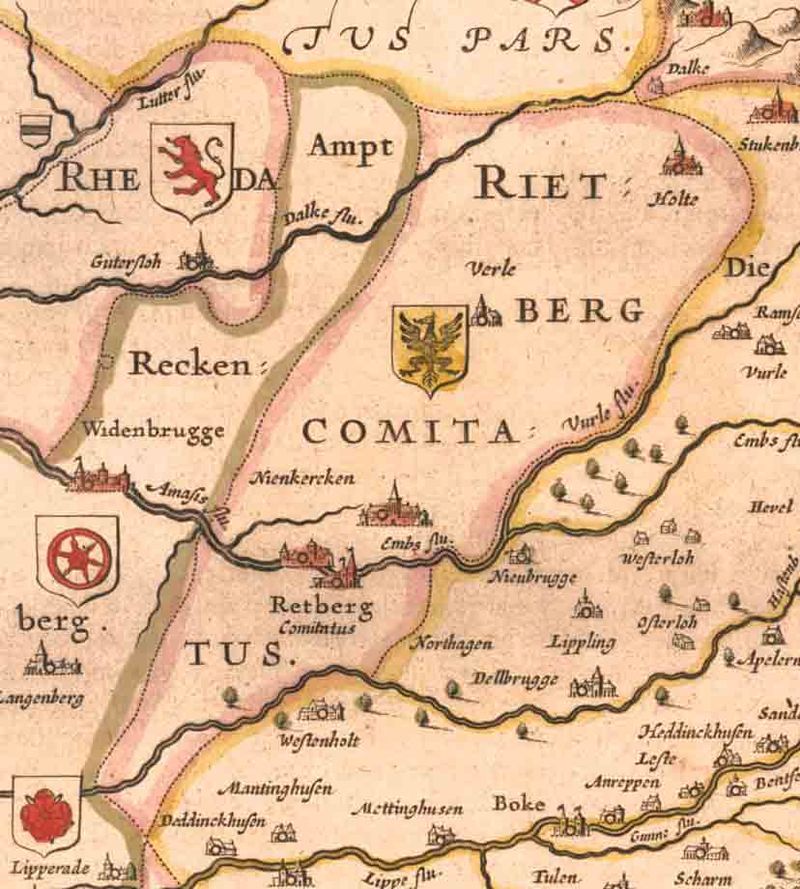
- Arms of the counts: A golden eagle on a red field. The older picture above shows Rietberg’s later municipal arms, not this early comital shield.
- Neighbours: Paderborn’s lordship to the east, Reckenberg and its Osnabrück overlords to the west, with roads toward Lippe and the towns of the Münsterland.
- Settlements and farms: Rietberg, Mastholte, Bokel, Neuenkirchen, Verl, Varensell and scattered farmsteads and hamlets.
- Speech: Low German in markets and households; written charters and foreign merchants use other tongues.
- Authority: The count’s household and officers control estate rights and tolls; Rietberg’s burgomasters and council defend their own civic privileges.
- Customs: Household and ancestral observances, local sacred precincts and seasonal rites coexist under the county’s law.
Rietberg is a small county built on ground that resists both roads and armies. The Ems divides into wet meadows, reed beds and drainage channels; the market town stands on slightly firmer land, while the count’s castle watches the approaches from the marsh. A traveller arriving from Paderborn or Reckenberg notices the timbered crossings, the guarded gates and the narrow strips of cultivation before seeing anything that resembles a noble court.
The Count, the Town and the Marsh
Count Konrad V’s family has held the territory since the Arnsberg inheritance divided in 1237. A charter from 1289 already names Rietberg’s judge, burgomasters and councillors. Those offices matter: the town’s merchants, craftsmen and landholders are subjects of the count, but they are not merely servants of his household. Rights over gate tolls, market days, mills and local courts are argued from old seals as fiercely as from armed possession.
The main street runs across the raised town ground between the northern Ems crossing and the southern roads. At the north gate, travellers from Münster and Bielefeld in Ravensberg share an approach; from the south the route divides toward Paderborn and Lippstadt. The wet ground protects the town from a casual assault, but it also makes a damaged bridge, a blocked drain or a disputed causeway a serious affair. The castle outside town is an older, practical stronghold on the Ems plain, not a great palace of marble halls.
Farms, Boundaries and Livelihoods
Most of the county lives beyond its walls. At Bokel, Mastholte, Neuenkirchen, Verl and Varensell, farmers contend with wet pasture, woodland boundaries, access to common ground and rents owed to several layers of authority. Craftspeople and traders work through the town’s market; the count’s officers need their payments, horses, timber and food. The Ems is part of daily work and defence, not a broad highway carrying endless fleets of barges.
Road travel matters as much as the river. A stranger moving goods between the county and its powerful neighbours may need the count’s safe-conduct, a local guide and proof that tolls have already been paid. The border with Reckenberg to the west and Paderborn’s lands to the east is close enough that a stolen horse or a detained wagon can become an argument between jurisdictions.
What Is Happening Right Now?
Envoys speak of placing Rietberg under the protection of the landgrave of Hesse. Money offered in return would strengthen the count’s position at once, but homage could make an independent county answerable to a distant lord. The town council wants to know which of its rights would survive such a bargain; the castle’s officers worry about how they will pay the garrison if the offer is rejected. Merchants who need predictable crossings may favour agreement, while households with disputed holdings fear that new officials will reopen old obligations.
A second danger can be seen from the town gate. Floodwater has torn out the timbers of the southern causeway, and a grain wagon is sinking beside the broken crossing. Its driver will not abandon the horses; a child sent to fetch help has vanished into the reed beds. Travellers can save the team with ropes, carry food across on foot, rebuild the approach with local carpenters or follow the child’s tracks before rising water erases them. The repair matters to everyone who needs tomorrow’s market, not merely to the count’s officers.
For Travellers
Ask which gate is usable before bringing carts through the wet ground, and secure a guide when leaving the raised roads. The market offers ordinary provisions, ferrymen’s advice, smiths and horse care, but not the facilities of a great imperial city. People here notice strangers because strangers can bring disputed writs, soldiers or trade. Those arriving under the count’s protection may find the town council less welcoming, and those carrying the council’s seal may find the castle less accommodating.
Historical Sources
Niedersächsische Akademie der Wissenschaften, Rietberg; Stadt Rietberg, Stadtgeschichte; Heimatverein Rietberg, local history.
Keep this reference growing
If this page helped with your reading or game, you can support its upkeep or explore the curated books.
Explore the Bookshop — epics, classics and stories behind imagined worlds.