
Hoya — Two Counties on the Weser
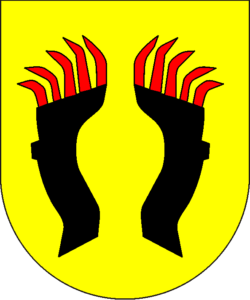
- Political status: divided County of Hoya, within the Empire
- Two seats: Hoya (northern county) and Nienburg (southern county)
- Ruling houses: the Hoya branch under Count Otto VII; the Nienburg branch under Count Johann V
- Family arms: two black upright bears’ paws, facing outward, on a gold field
- Important places: Hoya Castle, Nienburg, Bücken, Eystrup and the Weser crossings
- Language: Low German in everyday speech, Latin in some formal records
- Communities: boatmen, farmers, herders, millers, traders, craftspeople and local noble households; no reliable unified population count
- Sacred customs: household, ancestral and local divine traditions, with competing sacred estates and patronage
- Current tension: tolls and charters across the two counties, rival claims to religious patronage and obligations along the Weser
A County Divided
Hoya does not have a single court speaking for all its lands. The family partition of 1345 left a northern county centred on Hoya and a southern one governed from Nienburg. Both houses inherit rights along the Weser, but their stewards, retainers and merchants do not always agree on where those rights begin and end. The northern count’s seal may open a gate at Hoya yet carry little weight before a southern bailiff who demands a second toll.
Count Otto VII holds the northern branch while Johann V rules the Nienburg lands. Their kinsmen compete for influential sacred offices as well as secular patronage. One family member’s effort to command the sacred establishment of Münster has drawn the county into a struggle that neither boatmen nor villagers chose. Messengers now pass along the river with sealed commissions, and any host who gives lodging to the wrong emissary risks angering another lord.
The Weser and the Working County
The Weser carries grain, livestock, timber and cloth between settlements whose markets depend on the river. At a ferry, the master counts the animals before the boat is loaded. When the water is high, even a single lost barge can leave a town short of winter supplies. Hoya Castle guards the northern seat, and Nienburg’s market draws traders from farther south. Neither town controls the entire river, and an upstream dispute may be felt in every warehouse below.
Beyond the banks lie farm villages, hay meadows, wooded stretches and low wet country. The people who tend these lands know when a ford can be crossed and which bank gives way beneath a horse. They also know which households owe work on a bridge, which lord can call up mounted men and where a traveller can find a dry stable. These are matters of everyday survival; the county’s noble disputes make them harder.
Moors, Stories and Old Obligations
In wet years the moors hold water long after the river has fallen. A cart that leaves the raised causeway can sink to its axles before anyone reaches it. Guides tell of wandering lights that lure the careless away from the track and of riders heard on the dark bank when no horse has passed. Whether those lights are swamp-fire, a watchman’s lantern or something malicious, a village that has lost three travellers will pay handsomely for a trustworthy escort.
Older sacred precincts and burial grounds also carry obligations. A family may tend an ancestral mound, a ferry household maintain offerings at the river and a town patron demand service from a guild. The counts seek revenue and influence from these customs, but each community has its own reasons for refusing a new levy. The struggle is seldom between belief and disbelief: it is about who has the right to speak and collect in the name of a particular tradition.
What Is Happening Right Now?
A ferry near Hoya has been seized after two toll collectors arrived carrying rival seals. Boatmen refuse to load another wagon until one claim is recognised. In Nienburg, a chest of legal copies has gone missing from a travelling clerk’s room on the same night a messenger from Münster departed. A miller downstream is trying to keep flour moving to market despite both quarrels; his customers cannot afford to wait for a noble settlement.
A party can take work protecting river traffic, find the missing records, speak for villagers at either court or follow the lights into the wet country. A surviving witness may be more useful than a victory in battle. In Hoya, the safest road is often the one whose toll keeper already knows your name.
Historical Sources
Deutsche Biographie’s history of the House of Hoya documents the 1345 division into Hoya and Nienburg branches and its later reunification. The Göttingen Academy’s study of Hoya’s court records Johann V’s role in the Münster struggle. Historic heraldry shows two black bears’ paws on a gold field.
Keep this reference growing
If this page helped with your reading or game, you can support its upkeep or explore the curated books.
Explore the Bookshop — epics, classics and stories behind imagined worlds.